
Uncategorized
Best Energy Gels for Marathons: 2026 Fuelling Guide
Jul
Hitting the wall at kilometre 32 isn’t a rite of passage; it’s a sign your fuel strategy failed. You’ve spent months training your legs, but if your gut can’t process your nutrition, your fitness won’t save you. Finding the best energy gels for marathon performance means balancing high carbohydrate intake with digestive comfort. Whether you’re chasing a sub-3 hour finish or just aiming to cross the line standing up, the right gel is the difference between a personal best and a painful slog.
We know the struggle of sticky fingers, unpalatable flavours, and that sudden, sharp cramp that signals GI distress. Discover the top-rated endurance gels to power your 42.2km journey and avoid the dreaded bonk with science-backed nutrition. This guide provides a clear roadmap to 2026’s most effective fuelling options, from Maurten’s hydrogel technology to SIS’s isotonic range. We’ll compare the latest technical specifications, including sodium content and caffeine timing, to ensure you set a new PB with a stomach that stays settled from the starting gun to the finish line.
Key Takeaways
- Understand the physiology of the “bonk” and how to calculate the exact carbohydrate grams required to sustain your pace through the final 12 kilometres.
- Navigate the technical differences between hydrogel and isotonic options to find the best energy gels for marathon success that won’t cause GI distress.
- Evaluate top-performing 2026 products like Maurten Gel 100 and SIS GO Isotonic Gels for their carb-to-weight ratio and absorption speed.
- Create a foolproof race-day execution plan by setting a structured fuelling rhythm and coordinating intake with your hydration strategy.
- Learn how to build a personalised testing protocol using single gels to ensure your stomach is race-ready well before you reach the start line.
Fuelling Your 42.2km: Why Marathon Energy Gels are Non-Negotiable
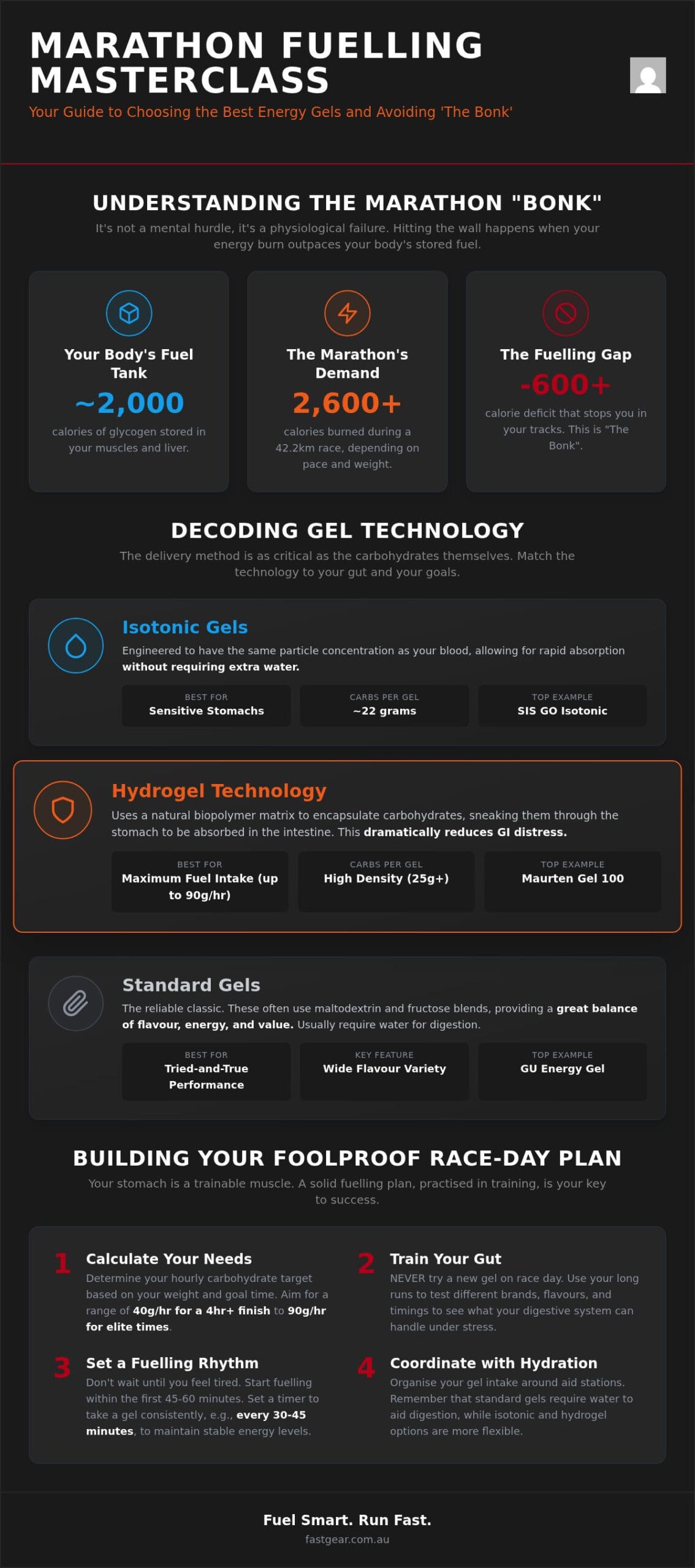
Every marathoner knows the 30-kilometre mark. It is where the “bonk” usually strikes, turning a promising run into a desperate struggle to reach the finish. This isn’t just a mental hurdle; it is a physiological failure. Your body stores roughly 2,000 calories of glycogen in the muscles and liver. A marathon burns closer to 2,600 or 3,000 calories depending on your intensity and weight. That 600-calorie deficit is what stops you in your tracks. Selecting the best energy gels for marathon success allows you to bridge this gap by providing exogenous fuel that enters the bloodstream while you move.
Modern formulations allow for 60 to 90 grams of carbohydrate intake per hour without overwhelming the digestive system. This consistent supply prevents the brain from entering a protective “survival mode” where it reduces power to the legs to preserve glucose for vital organs. Beyond physical output, regular fuelling provides a massive psychological edge. It keeps your mind sharp and your focus locked on your split times rather than your physical discomfort. When you maintain your blood sugar, you maintain your willpower.
The Role of Carbohydrates in Endurance
Not all carbohydrates are equal. Simple sugars like glucose provide an immediate spike but can lead to a subsequent crash if not managed. Most high-performance gels use maltodextrin, a complex carbohydrate that maintains blood glucose levels more effectively. Understanding what energy gels are and how they function is the first step in building your race-day strategy. During high-heart-rate efforts, blood is diverted away from the stomach to the working muscles. Solid food becomes incredibly difficult to digest, making liquid or gel fuel superior for rapid absorption. Glycogen depletion is the primary cause of marathon fatigue.
Identifying Your Personal Fuelling Needs
Your hourly carbohydrate target depends on several variables including body weight, running intensity, and metabolic efficiency. A lighter runner targeting a 4-hour finish might thrive on 40 to 50g per hour, while an athlete pushing for a sub-3 hour PB may require up to 90g. You cannot simply decide this on race morning. The “Train the Gut” philosophy is essential; you must teach your digestive system to process high loads of carbohydrates under physical stress. Testing the best energy gels for marathon training during your long runs ensures your stomach is as fit as your legs. Fastgear Australia provides single gels for this exact purpose, allowing you to experiment with different brands like Maurten or SIS before committing to a full box for race day.
Isotonic, Hydrogel, or Standard? Decoding Gel Technology
Understanding the mechanics behind your fuel is just as vital as your interval sessions. While the importance of carbohydrates for endurance is well documented, the delivery method determines whether those carbs reach your muscles or cause a mid-race disaster. In 2026, the market is split into four distinct categories: isotonic, hydrogel, standard, and slow-release. Each technology serves a specific physiological purpose. Finding the best energy gels for marathon day requires matching these technical specifications to your specific digestive profile.
Isotonic Gels for Sensitive Stomachs
SIS GO Isotonic Gels are engineered to have the same osmotic pressure as your blood. This specific concentration allows the gel to be absorbed immediately without the need for additional water from the gut. They are the ideal choice for high-intensity sections of the race or when water stations are congested. While they offer a slightly lower carbohydrate density per sachet, typically around 22g, the trade-off is a significantly lower risk of bloating. If you’ve struggled with a “sloshy stomach” in the past, an isotonic approach is your safest bet for digestive safety.
Maurten and the Hydrogel Revolution
Maurten Gel 100 represents the pinnacle of current sports science. Using a biopolymer matrix, it encapsulates high concentrations of carbohydrates, allowing them to pass through the acidic environment of the stomach and into the small intestine before being released. This prevents the stomach from being overwhelmed by sugar, reducing the risk of GI distress even at high doses of 90g per hour. Elite marathoners prefer this neutral-flavoured option because it eliminates the “flavour fatigue” that often occurs in the final 10km. It is a no-nonsense, high-efficiency tool for those chasing a serious PB.
Standard energy gels, such as the GU Energy Gel, remain a reliable and flavour-forward staple for many runners. These gels are often packed with branched-chain amino acids (BCAAs) to help reduce muscle fibre damage during the later stages of the race. If you want to understand the full science behind osmolality, dual-source carbohydrates, and strategic caffeine timing for this popular option, our GU energy gel guide for Aussie endurance athletes covers the complete technical framework. For athletes seeking a steadier energy curve, UCAN gels utilise a unique superstarch to provide a long-burn fuel source without the insulin spikes associated with traditional sugars. You can test these different technologies by picking up single sachets at Fastgear Australia to see which one your gut prefers during your next long training run.
The Best Energy Gels for Marathon Performance in 2026
Adhering to the scientific principles of marathon fueling means choosing products that maintain muscle glycogen without causing gastric distress. In 2026, the market has stabilised around a few high-performance leaders. Selecting the best energy gels for marathon success depends on your target finish time and your stomach’s tolerance. Fastgear Australia curates the most effective options based on professional athlete feedback and technical specifications. These selections represent the gold standard for endurance nutrition.
- Maurten Gel 100: The top pick for high-carb density. It delivers 25g of carbohydrates via hydrogel technology. It is flavourless, vegan-friendly, and has a firm, jelly-like consistency.
- SIS GO Isotonic Energy Gel: The best for easy digestion. This gel provides 22g of carbohydrates in a liquid-like format. It requires no additional water, making it perfect for intense race segments.
- GU Energy Gel: Best for value and flavour variety. With 21g of carbs and a wide array of tastes, it prevents palate fatigue. It contains BCAAs to support muscle recovery mid-run.
- UCAN Edge: The best natural alternative. It uses a unique superstarch to provide a steady insulin response. This is ideal for runners who prefer a long-burn energy source over a quick sugar hit.
Comparison of Top 2026 Marathon Gels
| Product | Carbs (g) | Sodium (mg) | Technology | Dietary Info |
|---|---|---|---|---|
| Maurten Gel 100 | 25g | 20mg | Hydrogel | Vegan / GF |
| SIS GO Isotonic | 22g | 20mg | Isotonic | Vegan / GF |
| GU Energy Gel | 21g | 60mg | Standard | Gluten-Free |
| Maurten CAF 100 | 25g | 20mg | Hydrogel | Vegan / GF |
When to Use Caffeine Gels
Strategic caffeine use can be the difference between a strong finish and a late-race fade. Most athletes benefit from a dose at the 30km mark to blunt perceived exertion. The Maurten Gel 100 CAF 100 provides a potent 100mg of caffeine, which is significantly higher than the 35mg found in a standard caffeinated GU. This high dose is designed to sharpen focus when mental fatigue peaks. Be cautious with total intake. Over-consumption can lead to jitters, an elevated heart rate, and increased GI issues. Always test your caffeine tolerance during your peak training weeks to ensure your heart and gut can handle the stimulation under load.
Organising Your Race-Day Strategy: Frequency and Hydration
A cupboard full of the best energy gels for marathon performance won’t help you if they’re still in your pocket at the 35km mark. Execution is everything. You need a systematic approach that removes decision-making when your brain is foggy from physical exertion. High-performance racing requires a protocol that treats fuelling as a series of non-negotiable checkpoints rather than a suggestion based on how you feel. Selecting the best energy gels for marathon success is only half the battle; the other half is the logistics of delivery.
- Step 1: Calculate your total requirement. If your target is 60g of carbs per hour for a 4-hour marathon, you need 240g total. Break this down by the specific carbohydrate count of your chosen brand.
- Step 2: Automate your intake. Set a repeating alarm on your watch for every 30 or 45 minutes. When it beeps, you fuel. Do not wait for hunger signals.
- Step 3: Sync with the course. Coordinate your gel intake with upcoming water stations. Standard gels require water to assist absorption and prevent a sticky palate.
- Step 4: Master the “rip and sip”. Practice tearing the sachet with your teeth and consuming the contents while maintaining your running stride.
- Step 5: Pack a contingency. Always carry a “Plan B” gel. You might drop one, or the final 5km might take longer than your best-case scenario.
The 42.2km Fuelling Timeline
A standard schedule for a mid-pack runner involves taking a gel at 0km, 7km, 14km, 21km, 28km, and 35km. This ensures a steady stream of glucose enters the bloodstream before your internal stores are depleted. As intensity increases, your body’s reliance on glycogen spikes, meaning you may need to tighten your intervals to every 30 minutes in the final hour. You should alternate standard gels with caffeinated versions every second or third intake to maintain a steady stimulant level without overstimulating the gut. This strategic rotation keeps your focus sharp without the crash associated with a single massive caffeine hit.
Carrying Your Fuel: Performance Gear
How you carry your fuel is just as critical as what you’re carrying. The Compressport Free Belt Pro is a favourite among Australian marathoners for its bounce-free, 360-degree storage capacity. Correct pocket placement ensures your centre of gravity remains stable, preventing the distraction of a swinging belt or bulging pockets that can ruin your running form. You can read more in our guide on How to Choose the Best Running Belt for Long Distance. Efficient storage allows you to focus entirely on your cadence and breathing. Secure your race-day nutrition kit today and start practicing your logistics during your final taper runs.
Secure Your Race-Day Fuel with Fastgear Australia
Fastgear Australia isn’t just another online shop; we’re your dedicated performance partner. We curate only the highest-performing endurance brands because we understand the technical demands of a 42.2km journey. Finding the best energy gels for marathon performance is about more than just sugar; it’s about technical efficiency and gastric reliability. Every product in our range, from Maurten to SIS, is selected for its ability to perform under extreme physical load. We don’t stock fluff. We stock results that have been proven on the world’s fastest courses by elite and age-group athletes alike.
Testing is the foundation of any successful race-day strategy. We offer single gels so you can build a custom “marathon tester pack” without the financial commitment of a full box of 24. This allows you to trial different textures and flavours during your long training runs to see what your gut tolerates at race pace. Finding the best energy gels for marathon success shouldn’t involve guesswork on race morning. By testing singles during your peak weeks, you eliminate variables and build absolute confidence in your nutrition plan before you reach the start line.
Logistics matter when you’re in the middle of a heavy training block. We provide fast national shipping across Australia to ensure your fuel arrives in time for your critical taper runs. Our team consists of active endurance athletes who use these products in the field every weekend. We understand the rigours of the marathon because we’ve chased those same finish lines and experienced the same challenges. When you shop with us, you’re getting expert support from a team that knows exactly what it takes to fuel a PB and avoid the dreaded bonk.
Build Your Custom Marathon Bundle
Many athletes find success by mixing brands to suit different phases of their plan. You might choose to use Maurten Gel 100 for its high-carb density on race day while relying on SIS GO Isotonic Gels for your lower-intensity training sessions. For the 48 hours leading up to the event, Tailwind powders are an excellent choice for efficient pre-race carb loading without the bulk of solid food. Having a varied kit ensures you are prepared for any condition the course throws at you. Browse the full Fastgear Nutrition Range to start building your personalised strategy.
Performance Beyond Nutrition
Your fuelling strategy is only as good as your ability to execute it under stress. Technical apparel, like the Compressport range, provides the functional storage and thermal regulation needed to carry your gels without distraction or discomfort. As you approach the upcoming race season, remember that meticulous preparation is the only antidote to the wall. Stay disciplined with your training, stay consistent with your nutrition, and trust the gear that the pros use. Shop Maurten Gel 100 Australia and secure the fuel you need to dominate your next 42.2km.
Secure Your 42.2km Strategy
Success at the 30km mark is built on the technical decisions you make during your peak training weeks. By decoding the science of hydrogels and isotonic delivery, you’ve moved beyond guesswork to a precision-engineered nutrition plan. Integrating the best energy gels for marathon success into a structured 30 or 45-minute rhythm ensures your glycogen stores remain topped up and your focus stays sharp through the final kilometres. Remember, the goal is to train your gut as hard as your legs to ensure seamless absorption under stress.
Fastgear Australia is your dedicated partner in this pursuit of peak efficiency. As an authorised Maurten and SIS stockist, we provide the expert technical advice and fast national shipping you need to dial in your race-day essentials before the taper begins. Don’t leave your performance to chance or unproven products that could compromise your digestive comfort. Optimise your marathon fueling at Fastgear Australia today and step onto the start line with absolute confidence in your gear. Your new personal best is within reach. Go and claim it.
Frequently Asked Questions
How many gels should I take during a marathon?
Aim to consume between 60 and 90 grams of carbohydrates per hour of racing. If your chosen sachet contains 20 to 25 grams of carbs, you will need to ingest one every 20 to 45 minutes. For a four-hour finish time, this typically equates to 6 to 10 gels total. Always calculate your requirements based on the specific carbohydrate count on the packaging rather than a generic number.
Can I use energy gels without water?
Only SIS GO Isotonic Gels are specifically formulated for consumption without additional water. Standard gels have a high osmotic concentration that requires approximately 150ml of fluids to assist absorption. If you take a non-isotonic gel without water, it can draw fluid from your blood into the gut, leading to dehydration, stomach cramps, and a delayed energy delivery that hampers your pace.
What is the best energy gel for a sensitive stomach?
Maurten Gel 100 is widely regarded as the best energy gels for marathon runners who suffer from GI distress. Its hydrogel technology encapsulates the carbohydrates in a biopolymer matrix, allowing them to bypass the stomach and release in the small intestine. This prevents the high sugar concentrations from sitting in the stomach, which is the primary cause of mid-race nausea and cramping.
When should I take my first gel during the race?
Take your first gel roughly 15 minutes before the start or within the first 30 minutes of running. Starting your fuelling rhythm early ensures your blood glucose levels are topped up before your muscle glycogen stores begin their significant decline. It is far easier to maintain your energy levels from the start than it is to recover from a nutritional deficit at the 25-kilometre mark.
Do caffeine gels actually help during a marathon?
Caffeine gels are highly effective for blunting perceived exertion and sharpening mental focus when fatigue peaks. Most athletes see the greatest benefit by taking a caffeinated option, such as Maurten CAF 100, at the 30km mark. This provides a physiological and psychological boost for the final 12 kilometres. Limit your intake to one or two caffeinated sachets to avoid jitters or an excessively high heart rate.
What is the difference between Maurten 100 and SIS GO gels?
The primary difference is the delivery mechanism and carbohydrate concentration. Maurten uses hydrogel technology to carry high doses of carbs through the stomach with a neutral flavour profile. SIS GO Isotonic Gels use a thinner, water-based formula that is already at the correct concentration for immediate absorption. While Maurten offers higher carb density, SIS provides a more liquid-like experience that doesn’t require water stations.
How do I avoid getting sick of the sweet taste of gels?
Utilise neutral-flavoured gels or those with higher sodium levels to combat flavour fatigue. Many runners find the best energy gels for marathon success are those that avoid artificial sweeteners, such as the Maurten range. Alternating between a flavoured sachet and a flavourless one can keep your palate from becoming overwhelmed, ensuring you can still stomach your nutrition during the final hour of the race.
Is it better to use gels or energy chews for a marathon?
Gels are the superior choice for race day because they require zero chewing and provide faster absorption at high intensities. Energy chews, like Clif BLOKS, are useful during training runs or the early, lower-intensity kilometres of a race. However, when your heart rate is elevated and breathing is heavy, the simplicity of a gel is far more efficient for maintaining your target marathon splits. For a deeper dive into how to combine electrolyte timing, dual-source carbohydrates, and hydration protocols with your gel strategy, the complete GU energy gel guide for peak race-day fuelling is an essential resource for any serious Aussie endurance athlete.
