
Uncategorized
Open Water Swimming Accessories Australia: The 2026 Performance Kit Guide
Sep
The Australian ocean doesn’t negotiate with your comfort. It demands absolute technical precision or it will punish your performance. Selecting the right open water swimming accessories Australia provides is the difference between a streamlined personal best and a painful DNF. You already understand that the surf is a relentless environment where minor equipment flaws quickly become major obstacles to your progress.
Saltwater neck chafing from your wetsuit and goggle fogging in humid coastal conditions are more than just minor irritations; they’re technical failures that compromise your focus and speed. We promise to help you master these harsh elements with a curated breakdown of the 2026 performance kit. You’ll learn exactly how to achieve zero chafing, maintain crystal clear visibility in the heavy swell, and manage efficient fueling during your longest marathon sets. We’re previewing the essential gear, from specialised neck protectors to high-octane nutrition, that’s purpose-built for the serious endurance athlete looking to dominate the open ocean.
Key Takeaways
- Identify the technical limitations of pool goggles and why wide-angle peripheral vision is non-negotiable for effective ocean sighting and navigation.
- Stop saltwater friction before it starts by utilising the Mugiro neck protector to shield high-friction zones from abrasive wetsuit rubber.
- Optimise your safety and presence in high-traffic coastal zones with technical open water swimming accessories Australia designed for maximum visibility.
- Execute precise fueling protocols in the surf using isotonic gels and specialised hydro-powders that ensure efficient energy delivery without the need for traditional storage.
- Build a cohesive performance kit that moves beyond basic gear to provide a disciplined, results-driven advantage in harsh Australian ocean conditions.
Essential Hardware: Goggles and Caps for the Australian Coast
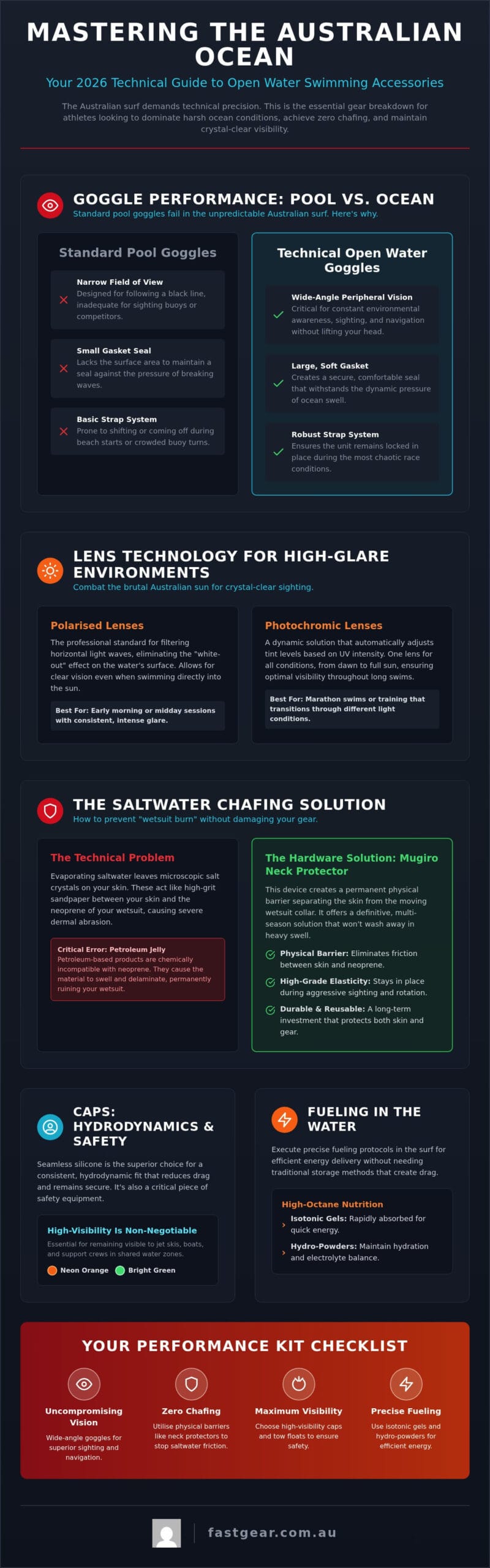
Standard pool goggles are engineered for controlled, chlorinated environments with fixed lane lines. They almost always fail when transitioned to the choppy Australian surf. The primary reason for this failure is the gasket design; small pool gaskets lack the surface area to maintain a seal against the unpredictable pressure of breaking waves. When you are navigating high-energy coastal zones, equipment failure isn’t just an inconvenience. It’s a performance killer. Choosing high-performance open water swimming accessories Australia offers means prioritising gear that handles the specific variables of our coastline, including heavy swell and intense salt concentration.
Peripheral vision is your most critical tool for sighting and navigation. Unlike pool sets where you follow a black line, Open water swimming requires constant environmental awareness to track buoys, monitor competitors, and identify shore landmarks. Lenses with a wide-angle field of view allow you to sight without lifting your head excessively, which preserves your body position and maintains momentum. Technical goggles also feature more robust strap systems to ensure the unit remains secure during a beach start or a crowded buoy turn.
Lens Technology for High-Glare Environments
The Australian sun creates a brutal level of surface glare that can effectively blind a swimmer during early morning or midday sessions. Polarised lenses are the professional standard here; they filtered out horizontal light waves to eliminate the “white-out” effect on the water’s surface. This allows for clear sighting even when swimming directly into the sun. For athletes undertaking marathon swims that transition from dawn to full sun, photochromic lenses provide a dynamic solution by automatically adjusting their tint based on UV intensity. These advanced optics are paired with high-grade anti-fog coatings designed to withstand the unique combination of high humidity and salt spray common in our coastal climate.
Hydrodynamic Caps and Fit
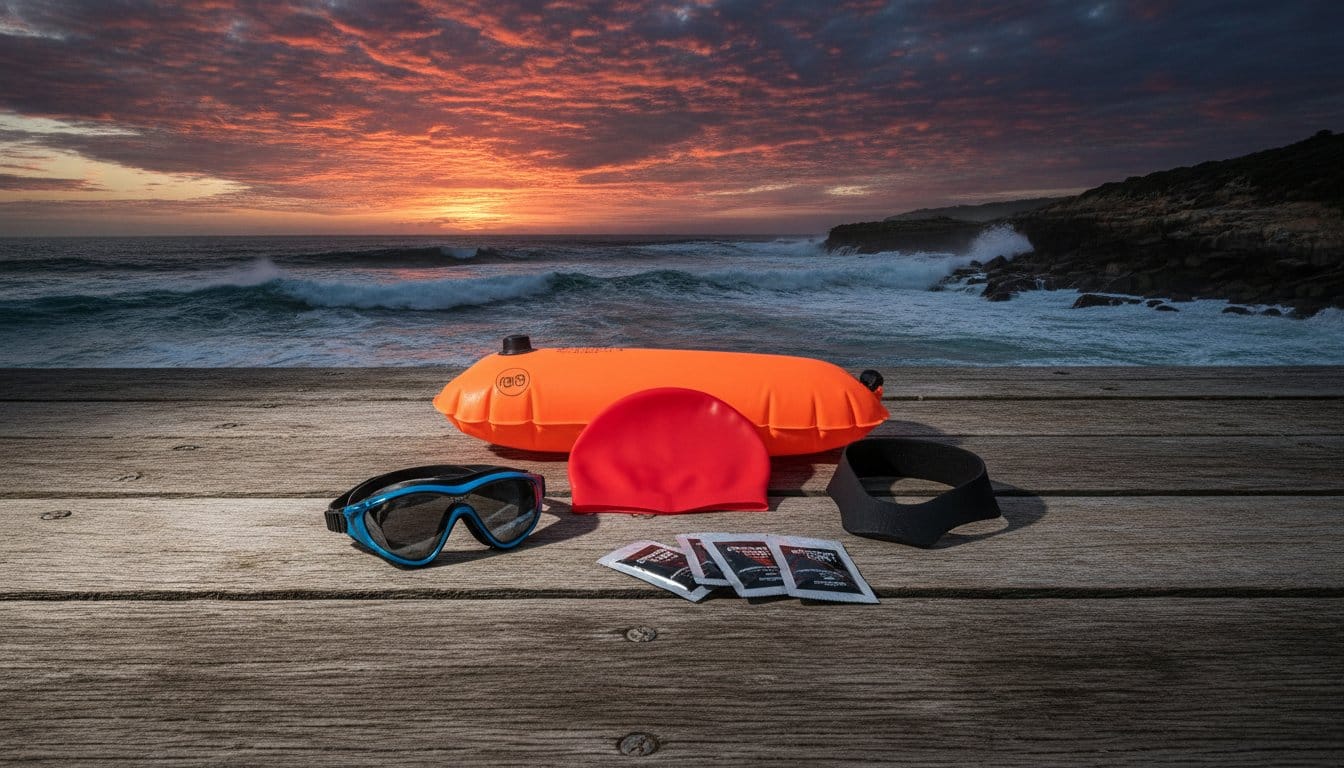
Heat management is a significant factor in warmer Australian waters. While latex caps are lightweight, they lack durability and often pull on the hair, causing distraction. Seamless silicone designs are the superior choice for serious competitors. These caps provide a consistent, hydrodynamic fit that reduces drag and remains secure throughout the duration of a race. Hydrodynamic efficiency is the measure of how effectively a swimmer’s profile and equipment minimise fluid resistance to maximise forward velocity through the water. Brands like Ocean Motion Wear focus on these technical requirements, offering performance swimwear and accessories inspired by the ocean environment. Beyond speed, your cap is a vital safety tool. High-visibility colours like neon orange or bright green are essential for remaining visible to jet skis, boats, and support crews in shared water zones.
The Chafing Solution: Protecting Your Skin from Salt and Rubber
Saltwater chafing is a different beast compared to pool-based friction. In the ocean, as water evaporates from your skin, it leaves behind microscopic salt crystals. These crystals act as a high-grit abrasive between your epidermis and the moving neoprene of your wetsuit. High-friction zones like the neck, underarms, and leg openings are particularly vulnerable during high-cadence sets. Without intervention, these areas suffer significant dermal abrasion within the first thirty minutes of a swim. When selecting open water swimming accessories Australia athletes trust, addressing this mechanical friction is priority one.
Many swimmers mistakenly reach for traditional petroleum jellies. This is a critical error for your high performance triathlon equipment. Petroleum-based products are chemically incompatible with neoprene and the adhesives used in wetsuit construction. They cause the material to swell and eventually delaminate, ruining a significant investment. You require technical lubricants or physical barriers that preserve the integrity of your gear while providing absolute skin protection. Effective management of these friction points ensures you maintain focus on your stroke mechanics rather than rising discomfort.
The Mugiro Neck Protector Advantage
The Mugiro Neck Protector is the permanent hardware solution for the most common injury in the surf: the “wetsuit burn.” This device creates a physical barrier that separates the skin from the moving collar of the suit. It’s engineered with high-grade elasticity to ensure it stays in place during aggressive sighting and neck rotation. Unlike balms that can wash away in heavy swell, this protector offers multi-season durability and consistent performance. It’s a non-negotiable component for any serious marathon swimmer looking to eliminate the distraction of salt-induced neck burns.
Synergy with Anti-Chafe Balms
For areas like underarms and leg openings where a hardware protector isn’t feasible, specialised anti-chafe balms are essential. These lubricants must be silicone-based or vegetable-based to remain wetsuit-safe. Apply these generously before entering the water, particularly during long-distance events where salt accumulation is highest. While focusing on skin protection, always maintain an awareness of broader protocols found in the Victorian Government water safety guide to ensure your session remains secure and productive. For those seeking the ultimate edge, adding a Mugiro Neck Protector to your kit is the most effective way to eliminate friction-related performance drops.
Visibility and Safety: Essential Gear for the Open Ocean
The Australian coastline is a crowded arena. Sharing the water with jet skis, recreational boaties, and surf lifesavers requires proactive visibility. High-performance open water swimming accessories Australia athletes utilise are designed to mitigate these environmental risks without compromising speed. A safety buoy is not a crutch for weak swimmers; it is a technical signalling device that ensures you are seen from a distance. In a high-energy surf environment, being visible is the first step in avoiding catastrophic collisions. Investing in these open water swimming accessories Australia experts recommend is a commitment to both safety and uninterrupted performance.
Organised marathon events frequently mandate specific safety hardware to ensure athlete security across long distances. You should ensure your kit includes the following technical components:
- Emergency Whistles: These are often a compulsory requirement for signalling surf lifesavers in distress situations when voice projection is neutralized by wind and swell.
- GPS Tracking: For the data-driven athlete, placing a tracker inside a tow float allows for precise analysis of sighting efficiency and pace without the signal interference that occurs when a watch is submerged.
- Tethered Buoys: These provide a temporary rest point if needed and serve as a high-visibility marker for support boats and kayakers.
Tow Floats and Dry Bags
Performance buoys must be streamlined to avoid unnecessary drag. A poorly designed buoy acts like a sea anchor, disrupting your stroke cadence and increasing metabolic cost. Modern technical floats feature narrow profiles and adjustable tethers that should be set to sit just above the back of the knee. This positioning ensures the buoy remains clear of your kick cycle. These units often double as dry bags, providing secure storage for car keys and essential electrolytes. Managing your intake during long-distance sets is a critical skill, and the Sports Dietitians Australia nutrition guide provides the evidence-based framework required to execute this effectively in a marine environment.
High-Visibility Standards
Neon green and orange remain the gold standards for Australian conditions. These colours provide the highest contrast against the deep blue of the ocean and the white foam of breaking waves. While we addressed cap colours in earlier sections, the integration of reflective detailing on all hardware is vital for low-light dawn sessions. For serious winter training, integrated LED lights are now a standard accessory. These waterproof units attach to the buoy or cap, providing a consistent light source that cuts through sea mist and spray, ensuring you remain visible to anyone else sharing the water.
Fueling in the Water: Open Water Nutrition Strategies
Endurance swimming is a metabolic game of attrition. Unlike the cycling leg of a triathlon, you don’t have the luxury of a frame-mounted bottle or a rear hydration system. Mastering your intake while moving through high-energy surf requires a tactical approach to your open water swimming accessories Australia setup. You must manage salt intake and hydration simultaneously to avoid the rapid onset of gastrointestinal distress common in marine environments. Inadvertent ingestion of salt water increases thirst and complicates the absorption of simple sugars, making technical fuel selection a performance requirement.
Hydrogel technology has revolutionised this discipline. Traditional gels often require significant freshwater intake to process, which is difficult to manage mid-ocean. Products like Maurten gel Australia athletes prefer use a biopolymer matrix to encapsulate carbohydrates. This allows for higher concentrations of energy to pass through the stomach into the small intestine for immediate absorption without causing stomach upset. For a 5km set, pre-session loading is usually sufficient. For 10km and marathon distances, a scheduled intake every 45 to 60 minutes is the professional standard to prevent glycogen depletion and maintain power output.
Storing Gels in Your Wetsuit or Buoy
Tactical storage is essential for maintaining momentum during long sets. Many elite swimmers tuck gels into the wrist or ankle cuffs of their wetsuits for immediate access without breaking their stroke rhythm. If you’re using a tow float, treat it as a mobile nutrition station. Minimise the time spent treading water by practising “blind retrieval” of your gels before race day. Every second spent stationary is a second lost to the coastal current. Efficient fuelling is a skill that must be drilled as consistently as your sighting or catch mechanics.
Post-Swim Recovery and Hydration
The session doesn’t end at the shoreline. Your first priority is flushing the residual salt from your system with immediate freshwater hydration to protect your kidneys and mucous membranes. Cold-water thermoregulation places an immense metabolic demand on the body, often burning significantly more calories than a pool-based equivalent. Integrating endurance sports nutrition Australia offers into your post-race routine is vital for rapid glycogen replenishment and muscle repair. Proper recovery ensures you are ready for the next high-intensity session without lingering fatigue.
Optimise your endurance performance by securing your high-performance nutrition kit from the experts at Fastgear Australia.
Curating Your Performance Kit with Fastgear Australia
Elite results in the surf are never accidental. They’re the product of a unified system where every piece of equipment works in synergy. A curated kit outperforms a collection of random accessories because it addresses the specific physiological and mechanical challenges of the Australian coast. When you source open water swimming accessories Australia from a technical specialist, you ensure that your goggles, skin protection, and nutrition protocols are designed to withstand the same extreme variables. Consistency is the foundation of confidence. Building a system that transitions seamlessly from high-intensity training to race day eliminates variables that cause performance anxiety and mechanical failure.
Testing your gear in actual Australian ocean conditions is a non-negotiable requirement. A kit that feels secure in the flat water of a 50-metre pool can fail spectacularly when subjected to a three-foot swell or high-velocity shore break. You must validate your setup under the same salt and glare conditions you expect on race day. This disciplined approach to equipment selection ensures that when you hit the water, your focus remains entirely on your output and navigation. Investing in the right open water swimming accessories Australia provides is about more than just comfort; it’s about securing your performance against the elements.
The Fastgear Professional Advantage
Fastgear Australia functions as more than a retailer; we’re a technical partner for the dedicated competitor. Our selection is rigorously vetted, featuring world-leading brands like Mugiro for friction management and Maurten for hydrogel-based energy delivery. We prioritise durability and marginal gains, understanding that for the serious athlete, equipment failure isn’t an option. With national shipping across Australia, we ensure your performance tools arrive in time for your next critical session. We focus on the hardware and nutrition that move the needle, allowing you to train with the same professional-grade gear used by elite marathon swimmers.
Final Race-Day Checklist
Execution on race day depends on a methodical preparation routine. Use this checklist to ensure your performance system is complete:
- Primary Hardware: Technical goggles with polarised lenses and a high-visibility silicone cap.
- Mechanical Protection: Mugiro neck protector and wetsuit-safe anti-chafe balms for high-friction zones.
- Nutrition Protocol: A structured plan using hydrogel gels, pre-stowed for rapid access.
- Safety and Data: A streamlined tow float for visibility and secure storage of emergency signalling tools.
Don’t leave your performance to chance. Organise your open water kit at Fastgear Australia today and secure the technical advantage required to dominate the surf.
Secure Your Technical Advantage in the Surf
Mastery of the Australian ocean requires more than just physical endurance; it demands a disciplined approach to your equipment selection. You’ve now learned that wide-angle optics are essential for sighting in heavy swell and that physical barriers like the Mugiro neck protector provide the only permanent solution to saltwater friction. Success in long-distance sets depends on executing a precise nutrition plan using hydrogel technology to maintain power output while avoiding gastrointestinal failure. Integrating these technical open water swimming accessories Australia provides into a cohesive system is the definitive path to peak performance.
Fastgear Australia is your reliable partner for serious endurance racing. We offer an authoritative range of Mugiro neck protectors and are an official stockist of Maurten hydrogel nutrition, providing performance-tested gear specifically for Australian athletes. Upgrade your performance kit at Fastgear Australia today. Train with focus, trust your equipment, and dominate your next session in the surf.
Frequently Asked Questions
What are the most important open water swimming accessories for beginners in Australia?
Beginners should prioritise wide-angle goggles, a high-visibility silicone cap, and a safety buoy for visibility. These open water swimming accessories Australia athletes rely on ensure safety in shared water zones. Don’t overlook the Mugiro neck protector to prevent painful wetsuit burns during initial sessions. A basic kit focuses on sighting, visibility, and skin protection to build confidence in the surf before moving toward advanced performance hardware.
How do I stop my goggles from fogging during a long ocean swim?
To prevent fogging, you must maintain the integrity of the factory anti-fog coating. Never touch the inside of the lens with your fingers as oils degrade the treatment. Rinse your goggles in fresh water after every session and store them in a protective case. If fogging persists during marathon swims, ensure your goggles are applied to a dry face before entering the water to create a stable thermal seal.
Is a wetsuit neck protector really necessary for triathlon training?
A neck protector is a non-negotiable tool for any athlete training in a wetsuit. Saltwater acts as an abrasive that turns neoprene edges into a saw against your skin. The Mugiro neck protector creates a physical barrier that eliminates friction and prevents the standard “wetsuit burn.” This hardware solution is far more effective than balms alone, particularly during high-cadence triathlon training blocks where skin recovery time is minimal.
What is the best way to carry energy gels while swimming?
The most efficient way to carry nutrition is by utilising your wetsuit cuffs or a tow float. You can tuck open water swimming accessories Australia like Maurten or SIS gels into the wrist or ankle seals for immediate access. For longer sets, a safety buoy with an integrated dry bag serves as a mobile nutrition station. This allows you to refuel without the need for support boats or land-based assistance during marathon distances.
How do I choose the right lens colour for Australian ocean conditions?
Select your lens colour based on the time of your session. Polarised or smoke-tinted lenses are essential for midday glare and sunny conditions to prevent eye fatigue and white-out. For dawn sessions or low-light winter training, clear or amber lenses provide the contrast needed for effective sighting. Photochromic lenses are the premium choice for marathon swims where light conditions transition from sunrise to full sun over several hours.
Can I use regular pool goggles for open water swimming?
Regular pool goggles are generally inadequate for the surf environment. They lack the wide-angle peripheral vision required for sighting landmarks and navigating around other swimmers in a pack. Additionally, pool goggle gaskets are often too small to withstand the pressure of breaking waves, leading to frequent leaks. Technical ocean goggles feature more robust seals and larger frames designed specifically for the unpredictable dynamics of the open ocean.
Do I need a safety buoy for ocean swimming in Australia?
A safety buoy is essential for any swimmer training in Australian coastal waters. It serves as a high-visibility marker for jet skis, boats, and surf lifesavers who may otherwise struggle to see a head in the swell. Beyond visibility, the buoy provides a temporary rest point and a secure dry bag for car keys or emergency signalling tools like whistles. These are often mandatory in organised events for athlete security.
How do I maintain my swimming accessories to ensure they last in saltwater?
Longevity in a marine environment requires immediate post-swim maintenance. Always rinse your goggles, caps, and neck protectors in fresh water to remove corrosive salt crystals. Dry your gear in a well-ventilated area away from direct sunlight, as UV exposure degrades silicone and neoprene over time. Store your goggles in a dedicated pouch to prevent lens scratches that compromise your visibility during critical sighting phases in the water.
