
Uncategorized
How to Use Energy Gels for Running: 2026 Performance Guide
Aug
Hitting the wall at kilometre 30 isn’t a rite of passage; it’s a sign of a failed fuelling strategy. You’ve likely felt that sudden, heavy-legged exhaustion where your pace drops and your mental focus shatters. It’s a common frustration for endurance athletes who put in the kilometres but struggle to manage their mid-race nutrition. Learning exactly how to use energy gels running is the difference between a podium finish and a painful walk to the finish line.
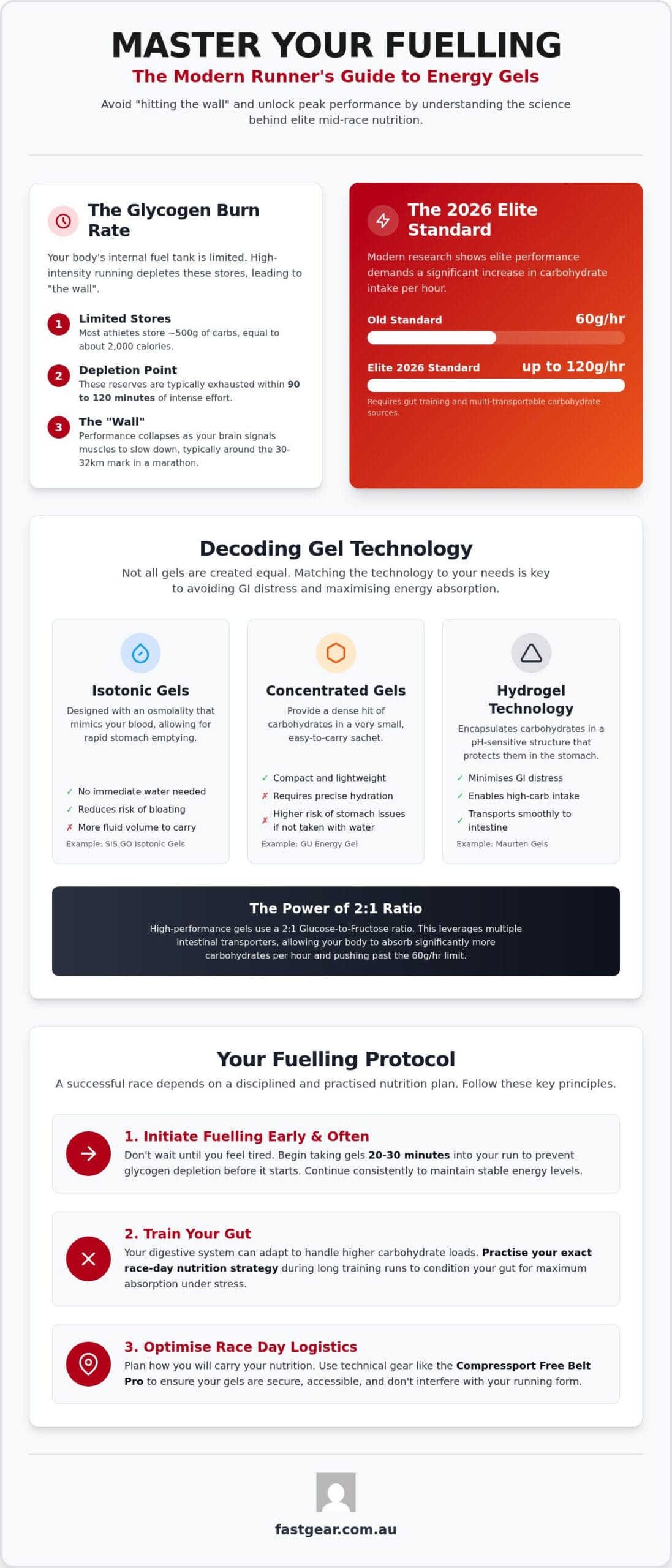
We understand the hesitation. Between the risk of stomach cramps and the overwhelming variety of brands, many runners settle for suboptimal intake. However, current 2026 research confirms that elite performance requires a shift from the old 60g per hour standard to upwards of 120g of carbohydrates per hour. This guide provides a technical roadmap to master your fuelling. We’ll break down the science of glucose-fructose ratios, explain how to train your gut for high-carb absorption, and detail a precise timing plan that keeps your energy levels consistent from the starting gun to the final sprint.
Key Takeaways
- Master the “Early and Often” rule by initiating your fuelling 20-30 minutes into your session to prevent glycogen depletion before it occurs.
- Discover how to use energy gels running to meet elite 2026 standards of 60-120g of carbohydrates per hour through multi-transportable glucose-fructose blends.
- Eliminate GI distress by selecting advanced technologies like Maurten’s hydrogel or SIS GO Isotonic gels that facilitate rapid absorption without requiring excess water.
- Optimise your race day logistics with technical gear like the Compressport Free Belt Pro to carry your high-performance nutrition securely and accessibly.
- Practise your specific nutritional protocol during long training runs to condition your gut for maximum carbohydrate uptake under high-intensity loads.
The Science of Fuelling: Why Energy Gels are Critical for Endurance
Endurance performance is a game of energy management. Your body relies on glycogen as the primary fuel source for high-intensity running. These internal stores are finite. Most athletes carry roughly 500 grams of carbohydrates, which equates to about 2,000 calories. During a marathon or high-intensity trail session, you’ll deplete these reserves within 90 to 120 minutes. Without exogenous fuel, your pace will inevitably crater. This physiological shutdown is what runners call “the bonk” or hitting the wall. It’s a failure of fuelling, not just fitness. Reviewing Energy Gels Explained shows how these concentrated supplements provide a steady stream of glucose to the blood, preserving your internal stores for the final kilometres.
Understanding Glycogen Depletion and “The Wall”
Your body prioritises carbohydrate metabolism at higher heart rate zones. It’s the most efficient fuel for speed. For most marathoners, the “danger zone” hits between kilometre 30 and 32. This is where your glycogen stores run dry. Your brain then signals the muscles to slow down to protect your system. Learning exactly how to use energy gels running ensures you never reach this critical depletion point. By starting your intake early, you keep the engine running on external fuel while saving your internal reserves for the finish line.
Glycogen is the primary fuel source for high-intensity running. When it’s gone, your performance collapses. Precision fuelling prevents this decline by maintaining a constant supply of energy to your working muscles. This isn’t about a temporary “sugar high”; it’s about maintaining physiological homeostasis under extreme stress.
The Role of Exogenous Carbs in Performance
Gels are designed for speed. They bypass the need for complex digestion, moving from the stomach to the small intestine almost immediately. This provides a rapid energy surge without the gastric load of solid food. Maintaining steady blood sugar also has a profound psychological effect. It keeps your mental focus sharp, allowing you to execute your pacing strategy under pressure. Mastering how to use energy gels running requires more than just carrying them; it requires a disciplined schedule.
You must “train the gut” during your long runs to handle higher carbohydrate loads. Modern research suggests athletes can absorb up to 120 grams of carbohydrates per hour with the right training and multi-transportable blends. Consistent practice prevents mid-race distress and ensures your digestive system is as race-ready as your legs. For a comprehensive look at macronutrient optimisation, consult our Ultimate Guide to Endurance Sports Nutrition Australia 2026.
Decoding Gel Types: Isotonic, Hydrogel, and Glucose-Fructose Ratios
Traditional energy gels often rely on maltodextrin as their sole carbohydrate source. While effective for shorter sessions, these products are limited by the body’s ability to process glucose via a single intestinal transporter. Modern, high-performance formulas utilise a 2:1 glucose-to-fructose ratio. This dual-source approach leverages multiple transporters, allowing for significantly higher absorption rates without the gastric bottleneck. If you want to master how to use energy gels running, you must match the gel’s chemistry to your gut’s specific tolerance and your race intensity.
Isotonic Gels vs. Concentrated Gels
Isotonic gels, such as SIS – GO Isotonic Gels, are engineered with a specific osmolality that mimics human blood. This technical design allows the gel to empty from the stomach rapidly. You can consume them without an immediate water “chase”, which is a massive advantage during high-intensity intervals or crowded race sections. Concentrated options like the GU Energy Gel – Single provide a dense hit of energy in a smaller sachet but require precise hydration to avoid osmotic distress. Choosing between them often comes down to your carrying capacity and whether you prefer the bulk of isotonic fluids or the compactness of concentrates. Understanding these differences is the foundation of learning how to use energy gels running for maximum efficiency.
The Hydrogel Revolution (Maurten Technology)
Maurten redefined endurance nutrition by introducing hydrogel technology. By using natural alginate and pectin, the carbohydrates are encapsulated within a pH-sensitive structure. Once this liquid hits the stomach acid, it transforms into a hydrogel, effectively “hiding” the high concentration of sugar from the stomach lining. This allows the fuel to pass directly into the small intestine where it is absorbed. It’s the gold standard for athletes aiming for 90 to 100 grams of carbohydrates per hour. For a deeper technical breakdown of this innovation, see our Maurten Gel Australia Guide.
Caffeine, Electrolytes, and Superstarch
Performance variants frequently include caffeine to combat late-race mental fatigue and lower perceived exertion. Sodium is equally critical, particularly for Australian athletes competing in humid conditions, as it aids fluid retention and prevents cramping. Conversely, UCAN gels offer a “slow-release” superstarch. This provides a stable energy curve rather than the rapid spikes and subsequent crashes associated with simple sugars. Following ACSM fueling guidelines ensures your intake matches the physiological demands of your specific event. Refine your race kit by selecting the right technology from our curated collection of SIS – GO Isotonic Gels.
Developing Your Strategy: Timing and Frequency for Different Distances
Precision timing separates podium contenders from those struggling to finish. The “Early and Often” rule is your baseline: you must initiate your fuelling protocol before physiological fatigue sets in. Waiting until you feel “flat” means you’ve already depleted your glycogen stores. In the Australian heat, where sweat rates are high, your gut’s ability to process fuel is under constant pressure. Mastering how to use energy gels running requires a disciplined schedule that adapts to your intensity and race distance.
Fuelling the Half-Marathon vs. Full Marathon
A 21.1km race requires a focused but lighter approach. Aim for 30-60g of carbohydrates per hour, which typically equates to one gel at the 45-minute mark and potentially another at 75 minutes. For the full 42.2km distance, the strategy becomes far more aggressive. You should aim for a gel every 25 to 30 minutes to stay within the 60-90g per hour range. A 60g-per-hour carbohydrate target is the absolute standard for serious marathoners seeking consistent pacing. This high frequency prevents the mid-race energy trough that often leads to a late-stage collapse.
The “Early and Often” Protocol
Start your engine early. Consuming your first gel 15 to 20 minutes after the starting gun ensures you aren’t playing catch-up later. It’s easy to forget to fuel when you’re in a “flow” state or navigating a technical trail section. Set a repeating alert on your sports watch to trigger every 30 minutes. This removes the mental load of calculation during high-intensity efforts. When you take a concentrated gel like GU, you must chase it with 150-200ml of water. This aids gastric emptying and prevents the gel from sitting heavily in your stomach. Without water, the high sugar concentration can pull fluid into your gut, causing bloating and cramps.
As you approach the final 10km, your strategy should shift. This is the time to deploy caffeine-enriched variants, such as the maurten gel 100 caffein. Caffeine lowers your perceived exertion and provides the cognitive boost needed to maintain form when your legs are screaming. Practise this specific transition during your long training runs. Learning how to use energy gels running at race intensity is the only way to ensure your gut is “trained” to handle the load under stress. If your heart rate is consistently in Zone 4 or 5, your blood flow is diverted from the gut to the muscles, making timing even more critical to avoid GI distress.
Practical Execution: How to Consume Gels and Carry Your Nutrition
Execution is where your strategy meets the road. Tearing a gel while maintaining a sub-4:00 pace is a technical skill that requires focus and coordination. You need to do it without breaking your stride or compromising your breathing pattern. Mastering how to use energy gels running involves more than just swallowing sugar; it’s about the logistics of the race environment. Efficient consumption ensures your muscles get the fuel they need without forcing your heart rate to spike from the effort of opening a packet.
The Mechanics of Mid-Run Consumption
Use the “sip and run” technique to maintain your rhythm. Tear the top of the sachet with your teeth, but keep the tab attached to the packet to avoid micro-littering. Squeeze the contents into the side of your mouth rather than directly down your throat. This prevents the “choking” sensation that occurs when you try to swallow while breathing heavily. In the Australian heat, sticky residue on your hands and face can become a distraction. Carry a small piece of damp sponge or use the water from the next aid station to clean up quickly. The “golden rule” of endurance racing is absolute: never try a new brand on race day. Your gut needs to be familiar with the specific osmolality and flavour profile of your fuel to avoid mid-race distress.
Every concentrated gel must be chased with roughly 150-200ml of water. This is non-negotiable for avoiding osmotic gut issues. Without water, the high sugar concentration in your stomach pulls fluid from your bloodstream into the intestine. This leads to dehydration and the dreaded “sloshing” stomach. Isotonic gels are the exception, but for everything else, time your intake to coincide with aid stations or your own hydration supply.
Organising Your Kit: The Compressport Free Belt Pro
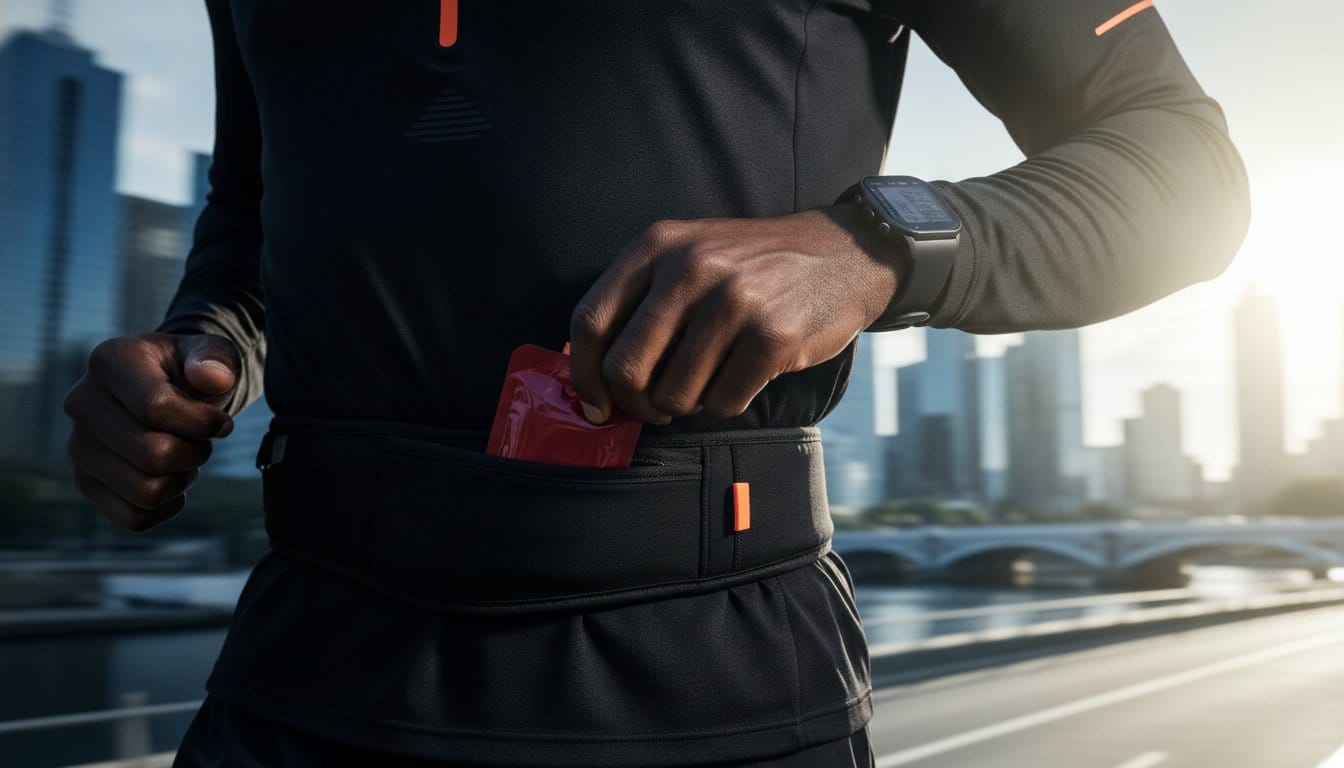
Carrying six to eight gels for a marathon is a logistical challenge. Stuffed pockets are inefficient. They cause uneven weight distribution and a constant, annoying bounce that wastes energy. The Compressport Free Belt Pro is the elite solution for bounce-free storage. Its 360-degree, wrap-around compartment holds your nutrition, phone, and even a small flask securely against your centre of gravity. It’s a high-performance alternative to bulky vests that can cause chafing during long kilometres in high humidity.
Organise your belt methodically. Place your standard gels on one side and your caffeine-enriched variants on the other. This allows you to grab the right fuel by feel without looking down or breaking your mental focus. When you’ve finished a gel, tuck the empty sachet back into the belt. Australian race organisers are increasingly strict on littering; keeping the course clean is a sign of a disciplined, professional athlete. Refine your race day setup by browsing our technical gear at Fastgear Australia.
Optimising Your Race Day: The Fastgear Protocol for Peak Performance
Success on race day is the result of meticulous preparation. The Fastgear Protocol is our expert-led strategy designed to eliminate variables and ensure peak output. It focuses on the critical synergy between world-leading nutrition, like Maurten and SIS, and technical apparel designed for elite mobility. Serious athletes view nutrition not as an afterthought but as the “fourth discipline” of endurance racing. Mastering how to use energy gels running requires you to align your biological needs with your physical kit for a seamless execution under pressure.
The Final Gear and Nutrition Checklist
Your race morning should be a routine, not a scramble. Confirm your hourly carbohydrate calculations one last time to ensure you have sufficient fuel for your projected finish time. Stage your gels in your Compressport Free Belt Pro according to your deployment plan. Regular gels should be easily accessible, while caffeine-enriched variants like maurten gel 100 caffein are positioned for the final push. If you’re tackling extreme distances or high temperatures, consult our Ultramarathon Fueling for Hot Weather guide to adjust your electrolyte and fluid intake accordingly.
- Double-check your total gel count against your hourly targets.
- Ensure your belt is positioned correctly to prevent movement or bounce.
- Verify your hydration plan matches the location of race aid stations.
Training Your Gut for Success
A high-performance engine needs to be tested under load. You must use your exact race-day nutrition protocol in at least three long training runs. This “gut training” process increases the density of carbohydrate transporters in your intestine, allowing for higher absorption rates without nausea. It’s the only way to troubleshoot minor stomach issues before they jeopardise your event. If a specific gel texture causes distress at pace, now’s the time to pivot to an alternative like SIS – GO Isotonic Gels or ucan gels.
Consistency is the hallmark of the elite competitor. By integrating advanced hydrogel technology with high-efficiency carrying solutions, you remove the friction between you and your personal best. Don’t leave your fuelling to chance or generic advice. Invest in the tools that the world’s fastest athletes rely on to maintain intensity from start to finish. Ready to execute? Shop our curated range of elite endurance nutrition and technical gear at Fastgear Australia and secure your next milestone.
Secure Your Next Personal Best
Mastering how to use energy gels running transforms your performance from a struggle against fatigue into a disciplined execution of speed. You’ve seen that the 2026 gold standard requires more than just random sugar intake. It demands an understanding of hydrogel technology, precise timing, and the right carrying solutions to maintain intensity. By adopting the Fastgear Protocol, you bypass the physiological limits that often lead to a late-race collapse. Consistency in training your gut is just as vital as your weekly mileage; don’t leave your race-day comfort to chance.
Fastgear Australia is your reliable performance partner and an authorised retailer of Maurten, SIS, and GU. We provide the expert-vetted endurance gear required for elite output, supported by fast national shipping across Australia. Your potential is limited only by your preparation and the tools you choose to deploy. Optimise your race-day fuelling with Fastgear Australia’s elite nutrition range and take control of your next milestone. The road is waiting; ensure you’re ready to dominate every kilometre.
Frequently Asked Questions
Do I really need to take energy gels with water?
Yes, you must consume concentrated gels with roughly 150-200ml of water to ensure proper absorption. Concentrated formulas have a high osmolality, meaning they pull fluid from your bloodstream into your gut if not diluted. This leads to dehydration and the dreaded “sloshing” sensation. The only exception is an isotonic gel, which is pre-diluted to match your blood concentration. Always time your intake with aid stations to maintain gastric comfort.
How many energy gels should I take during a marathon?
Most serious marathoners should target 60 to 90 grams of carbohydrates per hour, which typically requires six to ten gels depending on the brand’s specific carb count. A common error is under-fuelling, which leads to late-race depletion. If you’re using a 2:1 glucose-fructose blend like Maurten, you can aim for the higher end of this range. Practising how to use energy gels running during your long training blocks is the only way to confirm your specific hourly requirement.
Can energy gels cause stomach upset or diarrhea?
Gastrointestinal distress often occurs when the gut is overwhelmed by high sugar concentrations or restricted blood flow during high-intensity efforts. Taking concentrated gels without sufficient water is a primary cause of osmotic diarrhea. To prevent this, you must “train your gut” by using your race-day nutrition during at least three long training runs. This process increases your body’s ability to transport and absorb carbohydrates under physical stress without causing an adverse reaction.
What is the difference between isotonic gels and regular gels?
Isotonic gels are engineered with a specific concentration of salts and sugars that matches human blood, allowing them to be consumed without additional water. Regular gels are highly concentrated and require water to aid gastric emptying. While isotonic options like SIS – GO Isotonic Gels are bulkier and heavier to carry, they offer superior convenience during high-intensity race sections where drinking from a cup is difficult. Your choice should depend on your hydration strategy and carrying capacity.
When should I take my first energy gel during a race?
You should consume your first energy gel approximately 20 to 30 minutes into your race. The goal is to supplement your glycogen stores before they begin to deplete significantly. Waiting until you feel hungry or tired is a common mistake that leads to a performance deficit you cannot recover from later. Starting your fuelling protocol early ensures a steady supply of exogenous carbohydrates to your working muscles from the outset, maintaining your blood glucose levels.
Are caffeine energy gels better than regular ones?
Caffeine gels aren’t inherently better, but they serve a specific strategic purpose for endurance athletes. Caffeine reduces perceived exertion and improves mental focus, making it ideal for the final 10km of a marathon or technical trail sections. However, over-reliance can lead to jitters or a late-race crash. Most elite athletes use regular gels for the first two-thirds of a race and switch to caffeinated variants like maurten gel 100 caffein for the finishing push.
How do I carry 6-8 gels during a long-distance run?
Carrying a full marathon fuelling kit requires a technical solution like the Compressport Free Belt Pro. Stashing multiple gels in standard shorts pockets causes excessive bounce and chafing, which wastes energy and breaks your rhythm. A dedicated performance belt distributes the weight 360 degrees around your waist, keeping your nutrition secure and accessible. Learning how to use energy gels running efficiently includes mastering the logistics of carrying them without compromising your biomechanics or slowing your pace.
