
Uncategorized
Energy Chews for Marathon Runners: 2026 Australian Guide

Oct
More carbohydrate per packet doesn’t automatically make a chew the right race-day choice. When comparing energy chews for marathon runners australia, look beyond the headline number: check how servings are defined, whether the format is practical to eat on the move, and how it fits your fuelling and hydration plan.
Chews differ in format, serving information and ingredients. Your pace, preferences and personal tolerance also affect what feels manageable during a marathon. The best choice is one you can use consistently, not simply the one with the biggest number on the packet.
This guide explains what to compare, including label details, portion format and ease of use, and how to consider chews alongside gels and drink mixes. It also covers Fastgear Australia’s Clif – BLOKS Energy Chews and offers a practical way to test your preferred routine during training, so race day isn’t the first time you try it.
Key Takeaways
- Compare carbohydrate information per labelled serving, not by the chew’s appearance or packet size alone.
- Assess portion format, portability and taste to find energy chews for marathon runners australia that fit your race-day routine.
- Chews, gels and drink mixes can work in one fuelling plan, but account for each product to avoid accidental duplication.
- Test your chosen chews during training, record how the routine feels and adjust one fuelling variable at a time.
- Use the decision framework to compare Fastgear Australia’s Clif – BLOKS Energy Chews with your wider endurance fuelling options.
Why marathon runners in Australia consider energy chews for race-day fuelling
A marathon asks you to keep moving for hours while following a fuelling plan, managing effort and responding to changing race conditions. Choosing a fuel is only part of the task. You also need a format you can carry, open and consume without disrupting your rhythm. Energy chews may suit that routine, but they’re one option in a broader plan, not a guaranteed performance fix.
Energy chews are chewable sports-fuelling products designed to provide a measured way to take in fuel during endurance activity. They differ from everyday lollies in their intended use and product labelling, which can describe carbohydrate content, serving information and directions. Carbohydrate plays a key role in endurance fuelling; this overview of the role of carbohydrates in endurance sports provides helpful background. Check each product’s label rather than assuming all chews contain the same ingredients or provide the same amount per serve.
What makes energy chews different from other running fuel?
Chews provide fuel in a solid, chewable format. You bite and chew them, rather than swallowing a gel or sipping a drink mix. The experience can feel more deliberate, and the amount you take at a time may depend on how the product is portioned. Texture, ingredients, serving size and directions vary, so a packet’s appearance won’t tell you its carbohydrate content. Read the label and compare the stated values per serving.
When might a marathon runner choose chews?
Chews may appeal if you prefer taking fuel in chewable portions or want variety during a long event. They can also fit a plan that combines different fuel formats. Ease of use is personal, though. Your pace, breathing, ability to handle packaging and race conditions all affect whether chewing feels practical at a particular point. You may prefer another format at certain stages, or find that chews don’t suit you.
A search for energy chews for marathon runners australia should lead to a comparison based on your own fuelling needs, not a promise that one format works for everyone. Treat a chew as one part of your plan: account for its labelled serving alongside gels or drink mix, and consider how it fits with your hydration routine. Practise using it in training before relying on it during a race.
How to compare energy chews for marathon running
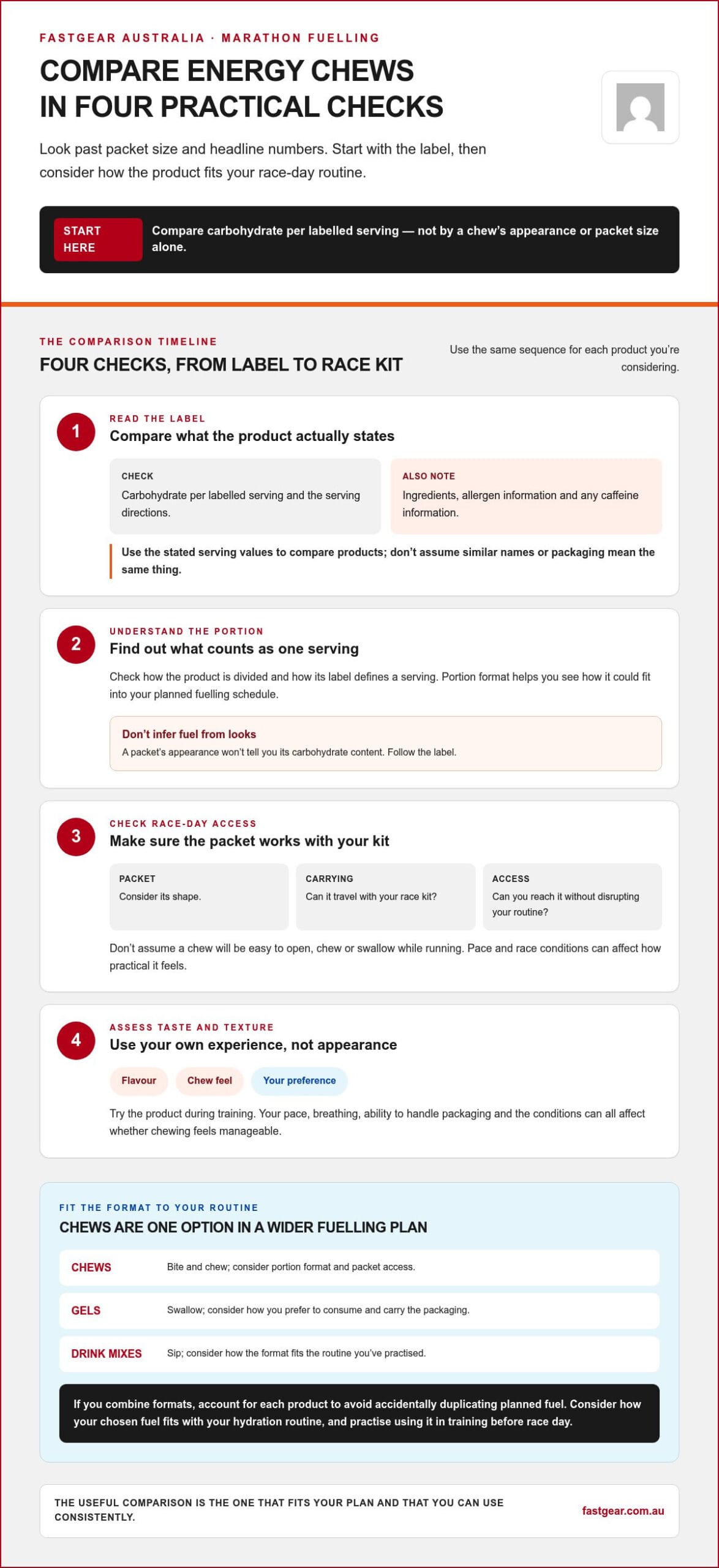
Start with the product label, then compare the details that affect use during a race. Don’t judge carbohydrate content by a chew’s size or appearance. Note the stated amount per labelled serving and the serving directions. Then consider whether the format fits your fuelling plan and how you’ll carry it. This gives you a consistent basis for comparing options, even when the packet sizes look different.
| What to compare | What to check | Why it matters |
|---|---|---|
| Label information | Carbohydrate per labelled serving, serving guidance, ingredients, allergens and any caffeine information | Lets you compare products using the information provided, rather than assumptions. |
| Portion format | How the product is divided and what the label defines as a serving | Helps you understand how it could fit into your planned fuelling schedule. |
| Portability | Packet shape and whether you can carry and access it with your race kit | A product needs to be practical for your chosen carrying method. |
| Taste and texture | Flavour and chew feel, assessed through your own experience | Preference can influence whether you want to use the product during a long event. |
Which label details should you check before buying?
Serving-level comparisons are more useful than product names alone because they show what the manufacturer states you get in a defined portion. Write down the carbohydrate amount and serving directions as shown. Don’t assume two products with similar names or packaging provide the same amount. Check the ingredient list, allergen information and any caffeine content, too. Use those details to compare products, not to set a universal marathon target. Individual fuelling plans vary.
How do texture, portioning and packaging affect race-day use?
Texture and portion size come down to personal preference, so assess them in training rather than relying on appearance or another runner’s experience. Check where the packet will sit in your kit and whether you can reach it without interrupting your routine. Ease of use can change with pace and conditions. Don’t assume a particular chew will be easy to open, chew or swallow while running; trial it yourself.
Apply the same checks to Fastgear Australia’s Clif – BLOKS Energy Chews, using the information on the product label. For a focused look at endurance fuelling products, explore Fastgear Australia’s endurance nutrition range and compare each option against your plan.
Energy chews, gels and drink mixes: choose the format that fits your plan
There’s no single format that suits every marathon runner. Compare chews, gels and drink mixes against three practical factors: what you prefer to consume, how you’ll carry it, and how it fits the fuelling routine you’ve practised. A combination can work, too. Keep track of what each product contributes so you don’t accidentally double up on planned fuel.
| Format | Consider | Planning question |
|---|---|---|
| Chews | Chewable portions and packet access | Do you like the format, and can you manage it while running? |
| Gels | How you prefer to consume a concentrated product and carry its packaging | Does it fit your routine and the product’s label directions? |
| Drink mixes | Preparation, bottle space and the product’s labelled serving | Are you already carrying a bottle, and how does the mix fit your plan? |
When could chews suit a runner better than gels?
A chewable format may appeal if you prefer taking fuel in portions rather than consuming a gel. You might also choose chews to add variety to a long race plan. Preference is only one part of the decision, however. Your pace, access to fuel and personal tolerance can change what feels practical at different points in the event. Don’t assume chews digest more easily or provide energy faster; trial your chosen option during training and follow its label.
For a closer look at the format distinction, read Energy Gels vs Chews: Which Fuel is Faster? Treat the title as a comparison prompt, not a reason to assume one format is faster for every runner.
When might a drink mix be easier to manage?
If carrying a bottle is already part of your race plan, a drink mix may be convenient to include. Check its directions and serving information, then account for the fuel it contributes alongside any chews or gels. Fluid and fuel needs are related, but they aren’t interchangeable: drinking to your plan doesn’t automatically account for all the fuel you intend to take in. For broader context, see Ultimate Guide to Endurance Sports Nutrition Australia 2026.
For runners comparing energy chews for marathon runners australia, the best fit is the format that works with their existing routine and can be carried and consumed as planned. Test combinations in training, keep track of what each product contributes, and adjust deliberately rather than changing several parts of the plan at once.
How to test energy chews before marathon race day
A chew that looks suitable on paper still needs to work in your race routine. Test it during training, not for the first time on marathon day. Practise with the same product and carrying setup you intend to use on race day.
Keep the trial controlled. Change one fuelling variable at a time, such as the chew or when you take it, while keeping the rest of your routine as consistent as practical. This makes your observations easier to interpret. Use the product label and your existing fuelling plan as your guide rather than adopting a schedule that hasn’t been tailored to you.
What should a training-run chew trial include?
Start by checking the label for serving guidance, carbohydrate information, ingredients, allergens and any caffeine details. Then try the product on a training run where you can focus on how it fits your routine. After the run, note:
- When you took it and whether that matched your plan.
- How the taste and texture felt during the run.
- Whether the packaging was easy to carry, access and manage while moving.
- Any unwanted symptoms or changes in how you felt, without assuming their cause.
Repeat the trial before refining your plan. One experience may not show how the same product will feel in different conditions or at a different pace. If you change the product, timing or carrying method, adjust one variable at a time and record what changed.
How can you plan chew access during a marathon?
Mark your intended fuelling points on your race plan, then check that the product’s serving directions fit your approach. Decide where you’ll carry the chews, such as in a pocket or running belt, and practise taking them out without disrupting your rhythm. The practical question is not just whether you like the chew, but whether you can access and use it as planned.
Keep your overall plan in view. If you’ll also use gels or a drink mix, account for their labelled servings so you don’t accidentally duplicate planned fuel. For broader planning context, consult a personalised endurance fuelling strategy and adapt it to your own needs.
Use the same trial process to assess energy chews for marathon runners australia options, including Clif – BLOKS Energy Chews. Explore energy chews at Fastgear Australia and choose an option to test in training before race day.
Choose marathon energy chews from Fastgear Australia
Choosing a chew is a practical decision, not a search for a universal winner. Compare the product label and serving format, then consider portability, taste and texture. Finally, test your shortlist during training. This process helps you judge whether an option fits your fuelling plan and feels manageable on the move.
Fastgear Australia is a national online retailer focused on endurance nutrition and performance gear. Its range includes Clif – BLOKS Energy Chews, giving marathon runners a chew option to assess against their race-day needs. Product details can vary, so use the label on the specific product for serving information, ingredients and other relevant details.
Is Clif – BLOKS Energy Chews a match for your shortlist?
Assess it with the same criteria you’d use for any candidate: read the label, understand the stated serving, and consider whether its format and packaging suit your carrying setup. Taste and texture are personal, so don’t rely on the product name or another runner’s preference to predict your experience. Trial it in training and compare what you observe with your existing plan.
Keep the assessment grounded in what you can verify. Check the product label for carbohydrate information, serving directions, ingredients and allergen details. Don’t infer flavour, portion size or other specifications from the name alone, and avoid performance claims that the label doesn’t establish.
What to do before your next marathon long run
Choose one candidate and inspect its label before adding it to your planned fuelling routine. During a suitable training session, practise carrying and consuming it as you intend to on race day. Note whether the packaging is accessible, how the chew feels to eat, and any unwanted symptoms. Change one variable at a time so you can make sense of your response.
- Check: Review serving directions and product information.
- Practise: Use the chew with your intended pockets or running belt.
- Record: Note timing, taste, texture, access and how the routine felt.
- Refine: Adjust your plan based on the trial, not assumptions.
Build confidence through repetition, not a last-minute race-day experiment. If you’re ready to shortlist a chew for your next training block, explore energy chews for your next training block at Fastgear Australia.
Make your race-day fuelling plan practical
The right chew is the one that fits your plan and feels manageable while you run. Compare carbohydrate information and serving guidance on the label, then weigh up portion format, portability, taste and texture. Chews, gels and drink mixes can work together, but account for each one to avoid unintentionally doubling up.
For energy chews for marathon runners australia, test your shortlist before race day. Practise carrying and consuming your chosen option during training, note how it suits your routine, then refine your plan. Don’t leave a new product or setup until the start line.
Fastgear Australia specialises in endurance sports nutrition and performance gear, including Clif – BLOKS Energy Chews. Explore the range and assess each option against the label and your training experience: Explore energy chews at Fastgear Australia.
Build your routine one tested decision at a time. You’ll be better prepared to start your marathon with a fuelling plan you’ve practised and trust.
Frequently Asked Questions
Are energy chews suitable for marathon runners?
Energy chews can suit marathon runners who prefer a chewable fuel and can fit it into a tested fuelling plan. Check the product label for carbohydrate per serving, serving directions and ingredients, then consider how you’ll carry and consume it while running. They’re not the right choice for everyone or every race stage. Practise with a candidate during training before relying on it in a marathon.
How many energy chews should I take during a marathon?
There’s no universal number of chews to take during a marathon. Products can differ in carbohydrate per labelled serving and recommended use, so check the specific label and use those details to plan your intake. Account for fuel from gels or drink mixes as well, to avoid accidental duplication. Your overall fuelling needs and tolerance are individual; test your plan in training rather than improvising on race day.
Can I use energy chews without drinking water?
Don’t assume every chew can be used without water. Follow the product’s label directions and keep hydration in your plan separate from your fuel calculations. The practical choice may depend on the product, your preference and race conditions. If you’re unsure how a chew feels to consume during a run, trial it during training alongside your usual hydration routine before deciding how it fits race day.
Are energy chews better than gels for a marathon?
Neither format is universally better. Chews offer a chewable option, while gels provide a different consumption experience. Preference, packaging, pace and personal tolerance can all affect what feels practical. Compare carbohydrate per labelled serving and follow product directions rather than judging by appearance or format alone. Some runners use different products in one plan, but count each serving carefully and test the combination in training.
Can energy chews contain caffeine?
Yes, some energy chews may contain caffeine, but don’t assume a product does or doesn’t based on its name or category. Check the specific product label for caffeine information and serving guidance, and include any stated caffeine in your overall plan. If you’re sensitive to caffeine or unsure whether it suits you, consider your individual needs and seek advice from a qualified health professional before use.
Should I try energy chews before race day?
Yes. Test your chosen chews during training rather than introducing them on race day. Read the label first, then practise using the product with your intended fuelling and hydration routine. Record timing, taste, texture, ease of access and any unwanted symptoms. Change one variable at a time so your observations are easier to interpret. This gives you a practical basis for deciding whether it belongs in your race plan.
How should I carry energy chews during a marathon?
Carry chews in a pocket or running belt that you’ve tested during training. Check that the packaging fits securely and that you can access it as planned without disrupting your run. Practise carrying, retrieving and consuming the product at a realistic training pace. The best setup depends on your kit and preference, so test the exact arrangement you intend to use rather than leaving it until race morning.
