
Uncategorized
Cycling Carb Fuel Powder Australia: The 2026 High-Performance Buyer’s Guide
Sep
Your glycogen stores are a ticking time bomb that inevitably detonates at the ninety-minute mark unless you’ve mastered the precision of liquid intake. For the dedicated endurance athlete, hitting the wall isn’t just a setback; it’s a failure of systems management. Finding the right cycling carb fuel powder australia is the difference between a podium finish and a miserable crawl back to the car. You’ve likely felt that familiar heavy-legged fatigue or the frustrating bloat of a high-sugar drink that simply won’t settle in your gut.
We agree that nothing ruins a high-intensity effort faster than gastrointestinal distress or an empty tank. This 2026 buyer’s guide promises to master your endurance fuelling by providing a technical breakdown of the best carbohydrate powders available in the Australian market. You’ll learn how to eliminate the bonk and maximise power output through science-backed strategies. We’ll preview the shift toward 1:0.8 maltodextrin-to-fructose ratios, the mechanics of biopolymer hydrogels, and the essential bottle logic needed to survive long rides in the Australian summer heat. It’s time to stop guessing and start fuelling for peak physical output.
Key Takeaways
- Master the physiological shift from solid food to high-density liquid fuel to prevent glycogen depletion during sustained, high-intensity efforts.
- Identify the technical superiority of the 1:0.8 maltodextrin-to-fructose ratio for maximising carbohydrate oxidation while minimising gut distress.
- Compare the performance benefits of biopolymer hydrogels against traditional isotonic solutions to ensure rapid gastric emptying and efficient energy delivery.
- Optimise your race-day strategy with the premier cycling carb fuel powder australia to safely achieve absorption rates of up to 120g per hour.
- Implement a structured gut training protocol to build tolerance for high-concentration fuel mixes before your next major competition.
Beyond the Bonk: Why Cycling Carb Fuel Powders are Essential for Endurance
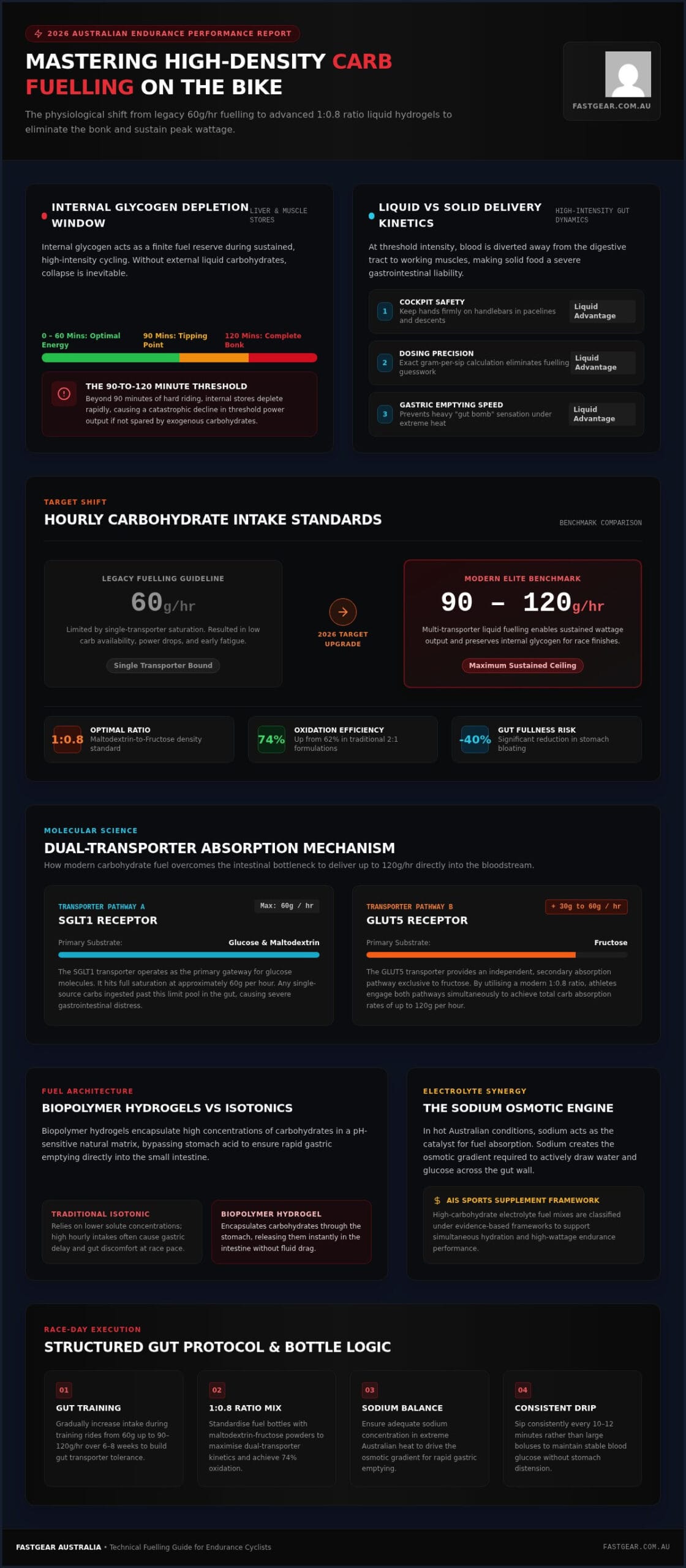
High-intensity cycling demands a relentless fuel supply that your internal systems can’t sustain alone. Your body burns through finite glycogen stores in the liver and muscles, typically providing enough energy for roughly 90 to 120 minutes of hard riding. Beyond this window, you face the physiological collapse known as hitting the wall or bonking. To avoid this catastrophic drop in power, you need a precise delivery system. Advanced cycling carb fuel powder australia has evolved far beyond simple salt tablets. The goal is now total blood glucose maintenance without the gastric emptying delays that plague traditional sports drinks.
The Science of Glycogen Sparing
Exogenous carbohydrates act as a shield for your internal stores. By providing a steady stream of glucose and fructose, you preserve muscle glycogen for the final sprint or the steepest climb. While the old guard recommended 60g of carbs per hour, 2026 performance standards have shifted. Elite athletes now target 90g to 120g per hour. This increase in intake correlates directly with sustained wattage output. It’s not just about finishing; it’s about maintaining a high-performance ceiling for the duration of your ride. Using a high-quality cycling carb fuel powder australia allows you to hit these aggressive targets without the digestive distress associated with older formulations.
Liquid vs. Solid Fueling on the Bike
Solid food is a liability at high heart rates. When you’re pushing threshold, blood is diverted from the gut to the working muscles. Processing a bar or a sandwich requires significant metabolic energy and time, often leading to a “gut bomb” effect. Liquid fuelling eliminates these hurdles. It provides a consistent drip-feed of energy that’s easy to absorb. Drinking your calories offers several tactical advantages:
- Safety: Keep both hands on the bars during high-speed descents or tight pacelines where reaching for a wrapper is dangerous.
- Precision: You know exactly how many grams of carbs you’re ingesting per sip, allowing for meticulous energy management.
- Consistency: Liquids pass through the stomach faster than solids, ensuring energy reaches your bloodstream without sitting heavy in your gut.
For Australian riders facing extreme heat, the efficiency of a liquid-based strategy is non-negotiable. It ensures you stay fuelled while managing hydration, keeping your core temperature and power output stable when the mercury rises. By choosing the right powder, you turn your hydration into a high-octane delivery system.
Decoding the Label: Key Metrics for Choosing Your Carb Powder
Selecting the right cycling carb fuel powder australia requires looking past the branding and into the molecular ratios. Performance isn’t found in artificial sweeteners or heavy flavouring; it’s found in the transport kinetics of your gut. To push past the traditional 60g per hour ceiling, your fuel must utilise multiple absorption pathways simultaneously. Every gram that sits unabsorbed in your stomach is a liability that causes bloating rather than providing wattage.
Multiple Transportable Carbohydrates
Your small intestine uses specific “doors” called transporters to move fuel into the blood. The SGLT1 transporter handles glucose and maltodextrin but saturates at approximately 60g per hour. To exceed this limit, you must engage the GLUT5 transporter with fructose. Modern elite standards have shifted from the classic 2:1 ratio to a more fructose-dense 1:0.8 ratio. This specific blend increases carbohydrate oxidation efficiency from 62% to 74% while significantly reducing the sensation of stomach fullness. Single-source carb powders are a relic of the past. They create a bottleneck in your gut that leads to gastrointestinal distress and power loss during high-intensity efforts.
Electrolyte Balance in High-Carb Mixes
Sodium is the engine that drives absorption. It works in synergy with glucose, creating an osmotic gradient that pulls water and energy into your system. For riders in the humid Australian summer, sodium replacement is critical for both hydration and fuel delivery. The AIS Sports Supplement Framework classifies these high-carb electrolyte drinks as Group A supplements, meaning they have the strongest evidence for performance enhancement. If your mix lacks sufficient sodium, you risk fluid sloshing in the stomach. You can learn more about balancing these minerals in our Electrolytes for Athletes guide.
Osmolality dictates how fast fluid leaves your stomach. High-concentration drinks that are hypertonic can cause gastric distress unless they use specific technologies like hydrogels to mask the carb density. You should avoid powders loaded with artificial fillers or unnecessary complex flavours. These additives increase the osmotic load without providing energy, often resulting in “gut rot” during long efforts. Stick to clean, science-backed formulas that prioritise rapid gastric emptying. If you’re ready to upgrade your bottle logic, you can explore our curated endurance range for the latest in high-performance fuelling.
Hydrogels vs. Isotonics: Comparing the Best Fuelling Technologies in Australia
Selecting a cycling carb fuel powder australia requires matching the delivery technology to your specific race duration and gut sensitivity. Most riders are familiar with standard maltodextrin mixes, but modern endurance science has introduced high-efficiency alternatives. Cluster Dextrin, or highly branched cyclic dextrin, is a standout for those who struggle with “sloshing.” It has an ultra-high molecular weight that results in low osmotic pressure. This allows the solution to bypass the stomach rapidly, even when mixed at high concentrations. If you prefer a slow-burn approach, Superstarch (found in UCAN) offers steady-state energy by providing a complex structure that avoids the sharp insulin spikes seen with simple sugars.
The Maurten Hydrogel Revolution
Maurten’s hydrogel technology represents a paradigm shift in how we handle high-density fuel. It uses pH-sensitive biopolymers, specifically alginate and pectin, that react instantly with stomach acid (pH below 2). The liquid solution solidifies into a protective gel, effectively “hiding” the massive carbohydrate load from the stomach’s sensors. This enables the transport of up to 80g of carbs per serving in Maurten 320 without triggering the nausea typically associated with hypertonic drinks. Elite professionals choose this system for 100-mile races and Grand Tour stages where calorie density is the primary objective. You can find a deeper dive into these mechanics in our Maurten Gel Australia: The High-Performance Guide.
Traditional Isotonics and Hypotonics
Traditional isotonics like SIS GO are formulated to match the body’s fluid concentration, typically between 250 and 340 mOsm/L. These solutions follow established guidelines on carbohydrate-electrolyte drinks for endurance exercise to ensure simultaneous hydration and energy delivery. While they offer rapid absorption, there’s a ceiling on how many calories you can pack into a bottle before the mix becomes hypertonic and slows gastric emptying. Tailwind Nutrition takes a different approach, focusing on “all-day” fuelling with a mild flavour profile. It’s designed to prevent palate fatigue during six-hour efforts in the Australian heat. If your sweat rate is exceptionally high, a hypotonic mix like Skratch (utilising Cluster Dextrin) is often superior, as it prioritises fluid replacement without sacrificing energy throughput. Choosing between these technologies depends on whether you value maximum calorie density or rapid fluid turnover.
Strategy and Execution: How to Optimise Your Liquid Fuelling on the Bike
Success on the bike isn’t just about what’s in your bottle; it’s about how you deploy it. High-intensity efforts require a calculated approach to cycling carb fuel powder australia. Your intensity dictates your burn rate. If you’re riding at threshold, your reliance on exogenous carbohydrates increases exponentially. Failing to match your intake to your output leads to the inevitable power fade. A disciplined execution strategy ensures that your energy delivery remains as consistent as your cadence.
The 5-Step Fuelling Plan
A systematic approach eliminates race-day guesswork. Follow this protocol to dial in your performance:
- Step 1: Determine your sweat rate. Australian summer conditions can push fluid loss above 1.5 litres per hour. Use a pre and post-ride weigh-in to calculate your specific needs.
- Step 2: Choose your carb target. Aim for 80g to 120g per hour depending on your gut tolerance and the duration of your event.
- Step 3: Mix your bottles the night before. This ensures full dissolution. It prevents powder clumps from blocking your bite valve during critical race moments.
- Step 4: Set a fuel timer. Program your head unit to alert you every 10 to 15 minutes. Small, frequent sips maintain steady blood glucose better than large, infrequent gulps.
- Step 5: Review your response. Document any bloating or energy dips post-ride. Use this data to refine your concentration for the next session.
Training Your Gut for Race Day
Absorption is a trainable skill. You wouldn’t attempt a 200km ride without training, and you shouldn’t attempt a 90g carbohydrate hour without physiological preparation. Start with a baseline of 40g and increase the concentration by 10g each week. This progressive load upregulates the transporter proteins required for high-volume absorption. You must practice this in training to ensure your digestive system can handle the osmotic load under stress. For a comprehensive breakdown of metabolic timing, see our Cycling Nutrition Australia: The 2026 Guide.
Managing the Australian heat requires tactical bottle logic. High-carbohydrate mixes are often hypertonic. They can pull water out of your cells if not balanced with adequate fluid. Use a dual-bottle setup: one bottle with a concentrated cycling carb fuel powder australia and a second bottle with plain water or a low-calorie electrolyte mix. This allows you to increase fluid intake during hot intervals without accidentally overdosing on carbohydrates. If you’re ready to test your limits, shop our elite endurance nutrition range to find your perfect match.
The Fastgear Selection: Elite Carb Powders for Australian Cyclists
Selecting the right cycling carb fuel powder australia is the final step in your performance architecture. Fastgear Australia curates only world-tour level brands that meet the rigorous demands of elite multisport racing. Whether you require the extreme density of a hydrogel or the simplicity of an all-in-one electrolyte mix, our selection prioritises physiological efficiency and gut comfort. Every product in our range is selected for its impact on physical performance, ensuring you have the tools to maintain your power ceiling from the first kilometre to the last.
Maurten 320: The Heavy Hitter
Maurten 320 powder is the gold standard for maximum carbohydrate intake. It delivers 80g of carbohydrates in a single 500ml bottle, providing double the energy of traditional sports drinks. This makes it the preferred choice for Ironman events and long-distance Gran Fondos where calorie density is paramount. The 160 variant offers a lighter 40g dose for shorter sessions or high-intensity intervals. To ensure the hydrogel functions correctly, you must mix the powder with water containing low calcium levels, ideally below 40mg/L. Australian riders in hard-water regions should use filtered water to prevent the biopolymers from gelling prematurely in the bottle.
Fastgear Australia Endurance Blend: The Reliable Workhorse
Fastgear Australia offers a versatile solution for endurance efforts where simplicity is key. This formulation combines a clean carbohydrate profile with a full electrolyte spectrum, eliminating the need for separate salt tablets. The light, non-acidic flavours are specifically designed to prevent “flavour boredom” during ultra-endurance events or multi-day bikepacking trips across the outback. It dissolves instantly and remains stable in your bottle, making it the endurance workhorse for riders who demand a reliable, all-day fuel source. It is particularly effective for athletes who prefer a “drip-feed” approach to their hourly carbohydrate targets.
SIS GO Isotonic: Reliable Energy
SIS GO Isotonic Gels provide a science-backed alternative for high-intensity bursts where you need immediate energy without the need for extra water. These gels are formulated to empty from the stomach quickly, providing 22g of carbohydrates per sachet. They are a staple for criterium racing and short-course triathlons where ease of consumption is critical. By integrating these with your liquid fuelling strategy, you can micro-manage your energy levels during the most demanding phases of a race.
Buying from Fastgear Australia ensures you receive fresh stock with the longest possible shelf life and access to expert support from seasoned endurance athletes. Our team understands the mechanical and physiological demands of Australian racing. We provide national delivery across the country, ensuring you are race-ready regardless of your location. You aren’t just buying fuel; you’re securing a performance partnership dedicated to your next milestone.
Fuel Your Next Milestone
Precision fuelling is no longer a luxury reserved for the pro peloton; it’s a requirement for any rider seeking to push their physiological limits. You now understand the mechanics of the 1:0.8 ratio and the protective power of biopolymer hydrogels. Mastering your cycling carb fuel powder australia strategy means moving beyond guesswork to a system of disciplined, data-driven intake. Every gram of fuel must serve a specific purpose in your performance architecture.
Fastgear Australia is your performance partner. As an authorised retailer of elite brands like Maurten and Tailwind, we provide the specialised endurance nutrition that serious athletes demand. We ensure your stock is fresh and your delivery is prompt with fast national shipping across Australia. Don’t let your next major effort be derailed by a preventable bonk or gastric distress. Success requires more than just fitness; it requires the right tools for the job.
Optimise your performance with our curated Cycling Carb Powders and take control of your metabolic destiny. The road ahead is long. Fuel it with precision.
Frequently Asked Questions
How many grams of carbs should I consume per hour while cycling?
Most endurance cyclists should target 60g to 90g of carbohydrates per hour. Highly trained athletes can push this to 120g by utilising a 1:0.8 maltodextrin-to-fructose ratio. This dual-source approach engages multiple intestinal transporters to maximise absorption. You must dial in these numbers during training to ensure your gut can handle the load. Finding the right cycling carb fuel powder australia allows you to maintain these high intake rates without the risk of energy depletion.
Will high-carb powders cause stomach issues or bloating?
Gastrointestinal distress usually occurs when carbohydrates sit unabsorbed in the stomach due to high osmotic pressure. You can prevent this by choosing powders with hydrogel technology or highly branched cyclic dextrin. These formulations bypass the stomach quickly, moving into the small intestine where they are absorbed efficiently. Gut training over six to eight weeks is also essential. This progressive adaptation upregulates your transporter proteins, effectively eliminating the bloat associated with high-sugar drinks.
Do I still need to take salt tablets if I use a carb powder?
Salt tablets are only necessary if your chosen powder lacks a complete electrolyte profile. Tailwind powder includes a full spectrum of minerals, making it an all-in-one solution for many riders. However, Maurten 320 focuses purely on carbohydrate density. If you use a carb-only mix during an Australian summer, you’ll need to supplement with sodium to match your sweat rate. This prevents hyponatremia and ensures the osmotic gradient remains optimal for energy transport.
Can I mix different brands of carb fuel in the same bottle?
You should avoid mixing different brands of fuel in a single bottle. Each manufacturer uses specific ratios of maltodextrin and fructose to optimise absorption and maintain a desired osmolality. Combining products can disrupt these precise ratios, potentially leading to gastric emptying delays. If you want to use multiple brands, keep them in separate bottles or use a gel-and-water strategy. This allows you to manage your intake without compromising the technical integrity of the fuel.
What is the difference between Maurten 160 and Maurten 320?
The primary difference is the carbohydrate concentration per serving. Maurten 160 provides 40g of carbohydrates, while Maurten 320 delivers a massive 80g of carbohydrates in the same 500ml of water. Both utilise the same biopolymer hydrogel technology to protect the stomach. You should choose the 320 for high-intensity racing or long-distance efforts where calorie density is critical. The 160 is ideal for shorter sessions or when you’re combining liquid fuel with solid food.
Is it better to get carbs from powder or gels?
Powders provide a consistent, drip-feed of energy through your hydration, while gels are best for tactical surges. A gel like the SIS GO Isotonic provides a quick 22g hit of carbs without requiring extra water. For long rides, a base of cycling carb fuel powder australia ensures a steady blood glucose level. Supplementing with gels during steep climbs or final sprints provides the extra energy needed for high-wattage efforts. A hybrid approach often yields the best results.
How do I stop my carb drink from tasting too sweet on hot days?
Flavour fatigue is common in high temperatures. You can mitigate this by running a dual-bottle setup, keeping one bottle filled with plain water to cleanse your palate. Alternatively, choose powders with neutral flavour profiles like Maurten or mild options from Tailwind. These are formulated to be non-acidic and subtly sweet, making them easier to tolerate over several hours. Keeping your bottles insulated or using ice can also help maintain a refreshing temperature in the Australian heat.
Are these carb powders suitable for vegan or gluten-free athletes?
Most elite carbohydrate powders are suitable for vegan and gluten-free diets. Brands like Maurten, Tailwind, and SIS use plant-based ingredients and are formulated without gluten-containing grains. However, you should always check the specific packaging for the “Gluten-Free” or “Vegan” seal if you have strict dietary requirements or coeliac disease. These clean labels ensure that every athlete can access high-performance fuelling without compromising their dietary principles or health needs.
