
Uncategorized
Cycling Nutrition Australia: The 2026 High-Performance Fueling Guide
Jul
You don’t hit the wall at the three-hour mark because your legs failed; you hit it because your fuelling strategy did. Most riders accept the “bonk” or mid-ride stomach cramps as an unavoidable tax on endurance cycling. It’s a frustrating reality when your gut rejects a standard sugar gel just as the intensity ramps up during a humid 100km session.
Mastering cycling nutrition Australia requires a technical approach that balances high-carb intake with the specific demands of the local climate. This 2026 guide provides a repeatable system for elite performance, focusing on science-backed absorption and efficient gear integration. We’ll show you how to eliminate GI distress using hydrogel technology, manage electrolyte loss in high humidity, and organise your technical kit for remote missions. Expect a direct breakdown of the protocols needed to maintain peak power, optimise your power-to-weight ratio, and accelerate your recovery times through precision fuelling.
Key Takeaways
- Stop the “bonk” before it starts by mastering glycogen management and the core principles of cycling nutrition Australia.
- Learn how hydrogel technology in Maurten Gel 100 eliminates gut distress by delivering fuel directly to the intestine.
- Discover why technical gear like the Wove M8 saddle is vital for maintaining an aero position without hindering your digestion.
- Build a personalised hydration plan based on your sweat rate and sodium loss to handle high-intensity sessions in the heat.
- Optimise your power-to-weight ratio with high-performance nutrition that supports efficient absorption and faster recovery.
The Fundamentals of Cycling Nutrition in the Australian Climate
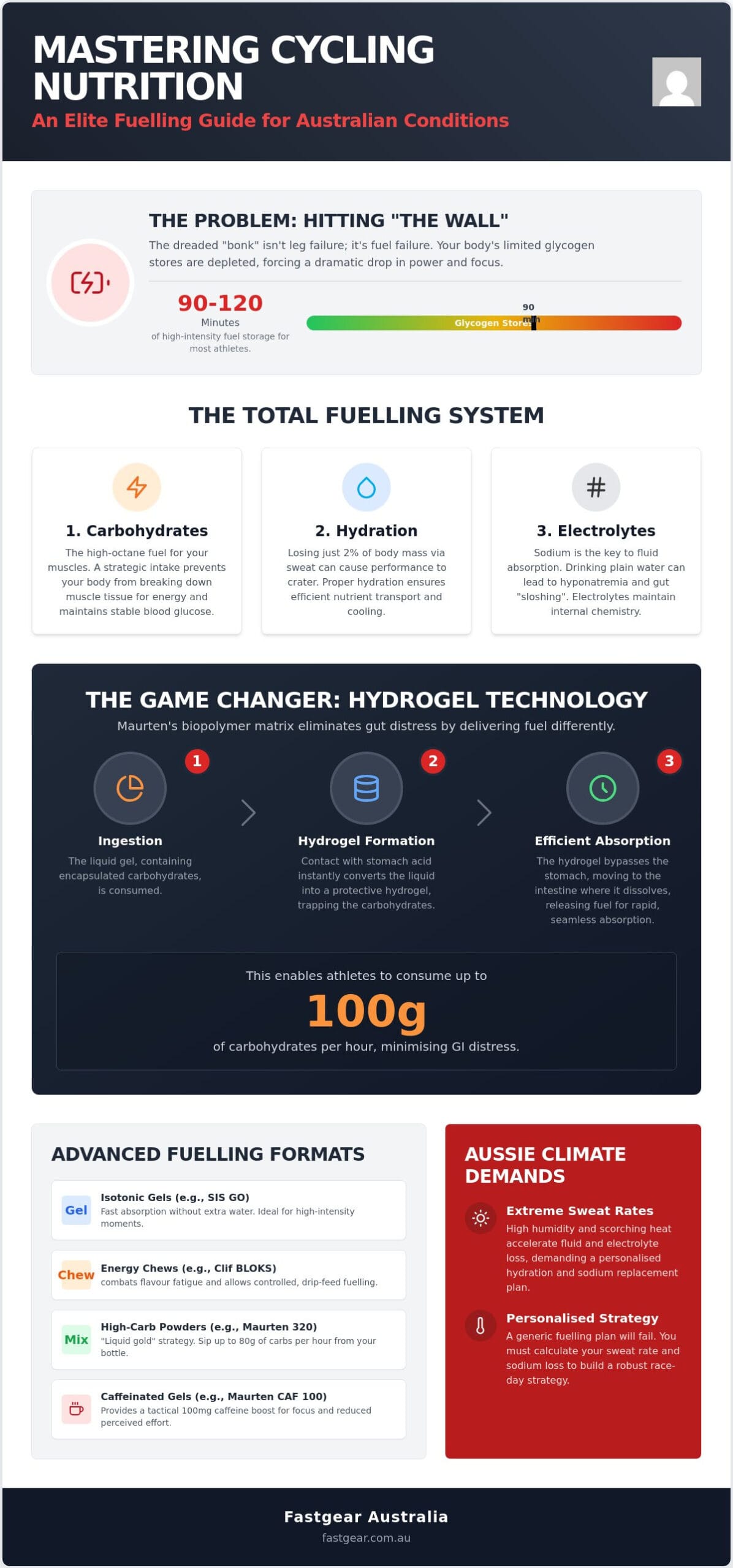
Elite performance is built on more than just high-wattage intervals and aerodynamic frames. True endurance success depends on a strategic “Total Fueling System” that integrates nutrition, hardware, and execution. At its core, cycling nutrition Australia is the calculated intake of carbohydrates, electrolytes, and fluids designed to sustain power output and prevent physiological failure. Without a precise plan, you’re simply waiting for the “bonk” to happen. This occurs when your body’s limited glycogen stores are exhausted, forcing your brain to dial back power to protect vital organs. You feel heavy, your focus slips, and your power numbers plummet.
The Australian climate adds a layer of complexity that standard global guides often ignore. High humidity in Queensland or the scorching dry heat of a Victorian summer drives sweat rates to extreme levels. This isn’t just about thirst; it’s about maintaining the internal chemistry required for muscle contraction. When you lose more than 2% of your body mass through sweat, your performance doesn’t just dip, it craters. Effective fuelling requires a proactive approach that starts before you even clip in.
Carbohydrates: The High-Octane Fuel for Your Legs
Your body is an inefficient storage vessel for high-intensity energy. Most athletes can only store enough glycogen for roughly 90 to 120 minutes of hard riding. Once those stores vanish, your system begins breaking down muscle tissue to find fuel. This is where the Fundamentals of sports nutrition become critical. You need a mix of simple carbohydrates for immediate glucose spikes and complex structures to provide a steady stream of energy. Effective fuelling during long rides across the Nullarbor or through the Snowy Mountains keeps blood glucose stable and protects your lean muscle mass from catabolism.
The Hydration Equation: More Than Just Water
Drinking plain water during a five-hour epic in the Aussie sun is a recipe for disaster. This often leads to hyponatremia, a dangerous dilution of sodium levels in the blood. Sodium is the master key that unlocks fluid absorption. Without it, water simply sits in your gut, creating that heavy, “sloshy” stomach feeling that makes high-intensity efforts impossible. Dehydration also slows down gastric emptying, meaning the gels you consume stay in your stomach rather than moving to your small intestine for absorption. For the endurance cyclist, the ideal electrolyte balance involves a high-sodium concentration that mirrors your specific sweat rate to ensure rapid fluid transport and zero gut distress.
Advanced Fueling Formats: Gels, Powders, and Hydrogel Technology
The evolution of cycling nutrition Australia has moved far beyond basic glucose syrups. To maintain elite power over 100km or more, you need formats that match your physiological limits. Modern endurance fueling leverages specific delivery mechanisms to maximise carbohydrate oxidation while minimising gastrointestinal (GI) distress. Whether you prefer the convenience of a gel, the high-density delivery of a powder, or the texture of a chew, your choice should be based on absorption speed and gut tolerance. High-performance athletes often utilise a mix of these formats to follow the Australian Institute of Sport nutrition guidelines for elite competition.
Isotonic options like SIS GO Isotonic Gels remain a staple for high-intensity efforts. Their specific concentration allows for rapid gastric emptying without the need for additional water, making them ideal for technical descents or bunch sprints. For those struggling with “flavour fatigue” during six-hour epics, Clif BLOKS Energy Chews provide a necessary change in texture and a controlled way to drip-feed carbohydrates. However, the most significant shift in the pro peloton involves “liquid gold” strategies using Maurten 320 or Tailwind powders. These high-density solutions allow you to sip 80g of carbs per hour through your bidon, simplifying your fueling logistics on remote Aussie roads.
The Hydrogel Revolution: Why Maurten is Different
Maurten Gel 100 represents a fundamental shift in sports science. Traditional gels can cause “sloshing” and cramps because high concentrations of sugar often sit in the stomach too long. Maurten uses a biopolymer matrix that creates a protective hydrogel upon contact with stomach acid. This encapsulates the carbohydrates, allowing them to bypass the stomach and move straight to the small intestine for absorption. This technology enables riders to safely push toward 90-100g of carbohydrates per hour. When the pace intensifies or focus wavers, opting for Maurten Gel 100 CAF 100 provides a tactical 100mg caffeine boost alongside the hydrogel delivery. You can explore the full Maurten range to see how this technology fits your racing kit.
Steady Energy with UCAN Gels
While hydrogels focus on high-volume delivery, UCAN Gels offer a different physiological advantage through “Superstarch.” This complex carbohydrate provides a slow, steady release of glucose into the bloodstream. It’s an ideal choice for athletes prone to insulin spikes and subsequent crashes. UCAN is particularly effective during long-distance training blocks where metabolic efficiency and stable blood sugar are the priority. Integrating these into your strategy helps maintain a consistent energy floor, preventing the erratic highs and lows associated with lower-quality sugar sources.
The Hardware Connection: How Gear Impacts Your Digestion
Peak performance isn’t just about what you eat. It’s about how your body processes that fuel while under extreme physical load. An aggressive aero position is essential for speed, but it often creates significant internal pressure. This physical compression can hinder gastric emptying and lead to reflux or bloating during high-intensity sessions. Achieving the best results in cycling nutrition Australia requires hardware that supports your anatomy rather than fighting against it. Your bike fit and gear choices directly dictate your gut’s ability to absorb the carbohydrates you consume.
Saddle Design and Gastric Comfort
The Wove M8 Road / Tri Saddle is a critical tool for the serious endurance athlete. Traditional saddles often force riders into a rounded lower back to avoid soft-tissue pressure. This posture collapses the midsection and squeezes the stomach. The Wove M8 features a unique ergonomic profile that allows for a deeper pelvic tilt without compromising blood flow. By rotating the pelvis forward on a supportive, stable platform, you open up the torso. This creates the necessary space for the diaphragm and digestive organs to function effectively. Consistent fuelling is only possible when you aren’t fighting your bike for every breath. Carbon-railed performance saddles like those from Wove also damp road buzz. This reduces the systemic fatigue that often leads to a “shut down” of the digestive system. As noted by Sports Dietitians Australia, maintaining comfort and a functional position is essential for a successful race-day plan.
Smart Storage for Long-Distance Autonomy
Accessibility is the second half of the hardware equation. If your gels are buried in a sagging jersey pocket, you’ll likely delay your intake. This leads to the glycogen depletion and “bonking” mentioned in previous sections. The Compressport Free Belt Pro solves this by providing 360-degree, bounce-free storage around the waist. It allows you to carry extra flasks of Maurten or Tailwind without the weight pulling on your shoulders or causing “jersey sag.” It’s a game-changer for autonomous rides through remote areas where service stations are few and far between. Technical storage ensures your fuel is always within reach, allowing for the precise, frequent intake required for 100km+ rides.
Managing core temperature is also vital for gastric health. When you overheat, your body diverts blood away from the stomach to the skin for cooling. This effectively halts digestion and causes the “sloshy” stomach feeling. Using technical apparel like the Compressport Trail Racing SS Tshirt aids this process through targeted ventilation and moisture-wicking properties. Keeping your core cool ensures that the blood stays where it’s needed: processing your high-performance fuel for maximum power output.
Strategic Execution: Personalising Your Race-Day Plan
Strategic execution turns scientific theory into a podium finish. Even the most advanced hydrogels fail if your intake timing is off or your sodium levels crash. Personalising your plan for cycling nutrition Australia requires a methodical approach to your physiological data and environmental conditions. Follow these five steps to build a bulletproof strategy.
- Step 1: Calculate your sweat rate and sodium loss. Weigh yourself before and after a one-hour threshold ride in typical Aussie conditions to determine fluid loss. If you finish with white salt streaks on your kit, you’re a “salty sweater” and need higher sodium concentrations to prevent hyponatremia.
- Step 2: Determine your carbohydrate target. Aim for 30 to 60g of carbs per hour for moderate sessions. Scale up to 90g or more for elite efforts where power output is consistently high.
- Step 3: Test during “bricks” or long weekend rides. Use your training sessions to simulate race-day intensity. This ensures your gut can handle the volume of fuel while your heart rate is elevated.
- Step 4: Enforce the “Nothing New on Race Day” rule. Consistency is paramount. Never experiment with a new gel flavour or powder brand during a target event.
- Step 5: Plan your pre-ride meal and recovery protocol. Focus on low-fibre, high-carb options like white sourdough or porridge two to three hours before the start to top up glycogen without adding bulk to the digestive tract.
Training the Gut for High Carbohydrate Intake
Your digestive system is a trainable organ. If you usually consume 30g of carbs per hour, jumping to 90g on race day will cause immediate GI distress. Gradually increase your intake by 10 to 15g per hour each week during your long training rides. Practice the technical skill of opening and consuming your GU Energy Gel or SIS Isotonic Gel while at threshold pace to ensure you can fuel under pressure. You should begin a structured gut-training protocol at least six to eight weeks before your primary event to maximise carbohydrate absorption capacity.
Recovery: The Often-Forgotten Pillar
The race doesn’t end at the finish line; it ends when your glycogen stores are replenished. The 30-minute post-ride window is critical for initiating muscle repair and glycogen resynthesis. Aim for a 3:1 carbohydrate-to-protein ratio immediately after dismounting to kickstart the recovery process. Circulation is the other half of the recovery equation. Using technical gear like Compressport calf sleeves helps flush metabolic waste and reduces muscle soreness. Precision rehydration involves drinking 1.5 litres of fluid for every kilogram of body weight lost during the ride. To secure the gear needed for your next training block, shop our professional endurance range.
Optimising Your Performance with Fastgear Australia
Your body is the engine that drives your bike. Serious riders spend thousands of dollars on electronic groupsets and lightweight carbon wheels, yet many still rely on generic supermarket snacks to fuel their efforts. Achieving elite results in cycling nutrition Australia requires treating your intake with the same precision you apply to your mechanical setup. Fastgear Australia bridges the gap between sports science and the road, providing the technical tools required to maintain peak power in the harshest environments.
We don’t stock every brand on the market. We only provide a curated selection of “best-in-class” technical endurance products that have been proven at the highest levels of competition. By focusing on brands like Maurten, SIS, and UCAN, we remove the guesswork from your preparation. Whether you’re training for a local criterium or a multi-day epic across the Nullarbor, our national shipping ensures your essential supplies arrive at your door anywhere in the country. We understand that on race day, there is no room for compromise.
The Fastgear Performance Partner Approach
We view ourselves as your dedicated performance partner. Choosing the right hardware is just as important as selecting the right gel. Our expertise extends to technical gear like the Wove M8 Road / Tri Saddle, which we provide to solve the ergonomic issues that often hinder digestion. You can bundle your entire season’s requirements, from GU Energy Gels to Maurten 320 powder, ensuring you have a consistent supply for every training block. We prioritise technical specifications and functional reliability over generic marketing fluff. This direct approach allows you to focus on your cadence while we handle the logistics of your “Total Fueling System.”
Ready to Conquer Your Next Century?
Preparation is the difference between a personal best and a long walk home. Before you clip in for your next century or target event, ensure your kit is fully optimised. A final high-performance checklist includes:
- Technical storage: A Compressport Free Belt Pro for bounce-free access to your fuel.
- Precision hydration: Your bidons filled with Tailwind or Maurten 160 powder.
- Texture variety: Clif BLOKS or energy chews to prevent flavour fatigue.
- Recovery kit: Compressport gear ready to aid circulation the moment you finish.
There is a significant psychological boost that comes from knowing your fueling is dialled in. When you trust your gut and your gear, you can push deeper into the red zone without fear of the “bonk.” It’s time to stop guessing and start performing. Optimise your performance at Fastgear Australia.
Secure Your Competitive Edge
Mastering your fueling isn’t just about avoiding the “bonk”; it’s about unlocking your full physiological potential. By integrating advanced hydrogel technology to prevent gut distress and utilising ergonomic hardware like the Wove M8 saddle to open up your digestion, you remove the physical barriers that hold most riders back. Success in cycling nutrition Australia requires this dual focus on high-performance fuel and technical gear. Training your gut and testing your strategy during long weekend sessions ensures that when race day arrives, your system is as efficient as your groupset.
Fastgear Australia acts as your dedicated performance partner in this pursuit. As the official Australian stockist for Maurten and the exclusive provider of Wove aerodynamic saddles, we provide a curated selection that replaces generic supermarket options with professional-grade solutions. Our team focuses on technical specifications that solve real-world athlete pain points like dehydration and GI distress. With fast national shipping on all race-day essentials, you can dial in your season strategy with total confidence. Shop the ultimate range of high-performance cycling nutrition and gear at Fastgear Australia and prepare to dominate your next century. Your peak performance is within reach.
Frequently Asked Questions
What is the best cycling nutrition for long rides in Australia?
The best strategy for long rides in the Australian climate combines high-density carbohydrates with advanced electrolyte replacement. Utilising hydrogel technology like Maurten Gel 100 ensures you can absorb 90g of carbs per hour without the gastric distress common in high-humidity conditions. Supplementing these with Tailwind or SIS powders in your bidons provides the necessary sodium to manage extreme sweat rates during summer sessions.
How many grams of carbohydrates do I need per hour while cycling?
Endurance athletes typically require between 30g and 90g of carbohydrates per hour depending on the intensity and duration of the ride. While 30-60g is sufficient for moderate training, elite performance in competitive events often demands up to 100g per hour. It’s essential to train your gut during long weekend rides to handle these higher volumes before attempting them on race day.
Why does Maurten hydrogel prevent stomach upset?
Maurten hydrogel prevents stomach upset by encapsulating high concentrations of carbohydrates in a biopolymer matrix. This matrix protects the fuel from stomach acid, allowing it to bypass the stomach and move directly into the small intestine. Because the carbohydrates aren’t sitting in the gut, you avoid the bloating, sloshing, and cramping often caused by traditional sugar-heavy gels and drinks.
Can I just use water and electrolytes for a 3-hour ride?
Water and electrolytes are insufficient for a three-hour ride if you intend to maintain high power output. Your body only stores enough glycogen for roughly 90 to 120 minutes of intense effort. Beyond this point, you’ll experience a significant performance drop or “bonk” unless you consume exogenous carbohydrates like GU Energy Gels or SIS GO Isotonic Gels to fuel your muscles.
How do I carry enough nutrition for a 100km ride?
Carrying enough fuel for 100km requires a mix of liquid nutrition and technical storage solutions. Use high-carb powders like Maurten 320 in your bidons to maximise your intake per sip. For gels and chews, the Compressport Free Belt Pro offers 360-degree, bounce-free storage around your waist. This setup allows you to carry several hours of fuel without the discomfort of overloaded jersey pockets.
Is the Wove M8 saddle worth it for long-distance cycling?
The Wove M8 saddle is a vital investment for serious athletes who experience digestive issues or numbness in an aero position. Its unique ergonomic profile allows for a deeper pelvic tilt, which opens up the torso and reduces pressure on the stomach. By improving your posture on the bike, you facilitate better gastric emptying and maintain consistent power during long-distance cycling nutrition Australia protocols.
What should I eat immediately after a hard cycling session?
You should consume a combination of high-quality protein and carbohydrates within 30 minutes of dismounting. This recovery window is critical for muscle tissue repair and replenishing depleted glycogen stores. A 3:1 carbohydrate-to-protein ratio is the gold standard for endurance recovery. Following this with precision rehydration ensures your body is ready for the next day’s training block without lingering fatigue.
How do I prevent “the bonk” during a cycling event?
Preventing “the bonk” requires a proactive fuelling plan that starts the moment you clip in. You must consume carbohydrates at regular 20-minute intervals to stay ahead of your body’s energy expenditure. By maintaining a steady stream of glucose through gels, powders, or chews, you prevent your glycogen stores from hitting zero. Consistency and early intake are the only ways to ensure your power doesn’t crater.
