
Uncategorized
Best Marathon Energy Gels: 2026 Australian Fuelling Guide
Aug
Hitting the wall at the 30km mark isn’t an inevitable rite of passage for endurance athletes; it’s a clear signal that your fuelling strategy has failed your physiology. You’ve spent months clocking kilometres and refining your stride, yet the persistent fear of gastrointestinal distress or late-race nausea often remains the biggest hurdle to a personal best. It’s a common frustration to see disciplined training undone by a stomach that simply refuses to cooperate during high-intensity efforts.
This guide identifies the best energy gel for marathon success in 2026, focusing on scientifically-backed options that prioritise gut stability and efficient absorption. We’ll show you how to maintain a precise carbohydrate intake to prevent the bonk while keeping your digestive system calm over the full 42.2 kilometres. You’ll gain the confidence to execute a sub-4 or sub-3 hour strategy with tools that offer genuine marginal gains. We’ll break down the latest hydrogel innovations, isotonic formulas, and the impact of new FSANZ caffeine regulations to ensure your race day nutrition is as performance-tuned as your fitness.
Key Takeaways
- Understand the physiological limits of glycogen storage and how precise carbohydrate timing prevents the metabolic crisis known as “the bonk”.
- Identify the best energy gel for marathon success by comparing hydrogel technology for maximum absorption against isotonic formulas for easier digestion.
- Discover tailored nutrition recommendations for specific performance goals, including elite-level density for sub-3 hour targets and stable options for sensitive guts.
- Learn the 6-8 week gut training protocol designed to increase transporter activity and ensure your digestive system remains stable under race-intensity efforts.
- Optimise your gear setup with technical solutions like the Compressport Free Belt Pro to carry your full fuelling strategy without bounce or distraction.
The Science of Marathon Fuelling: Why Energy Gels are Non-Negotiable
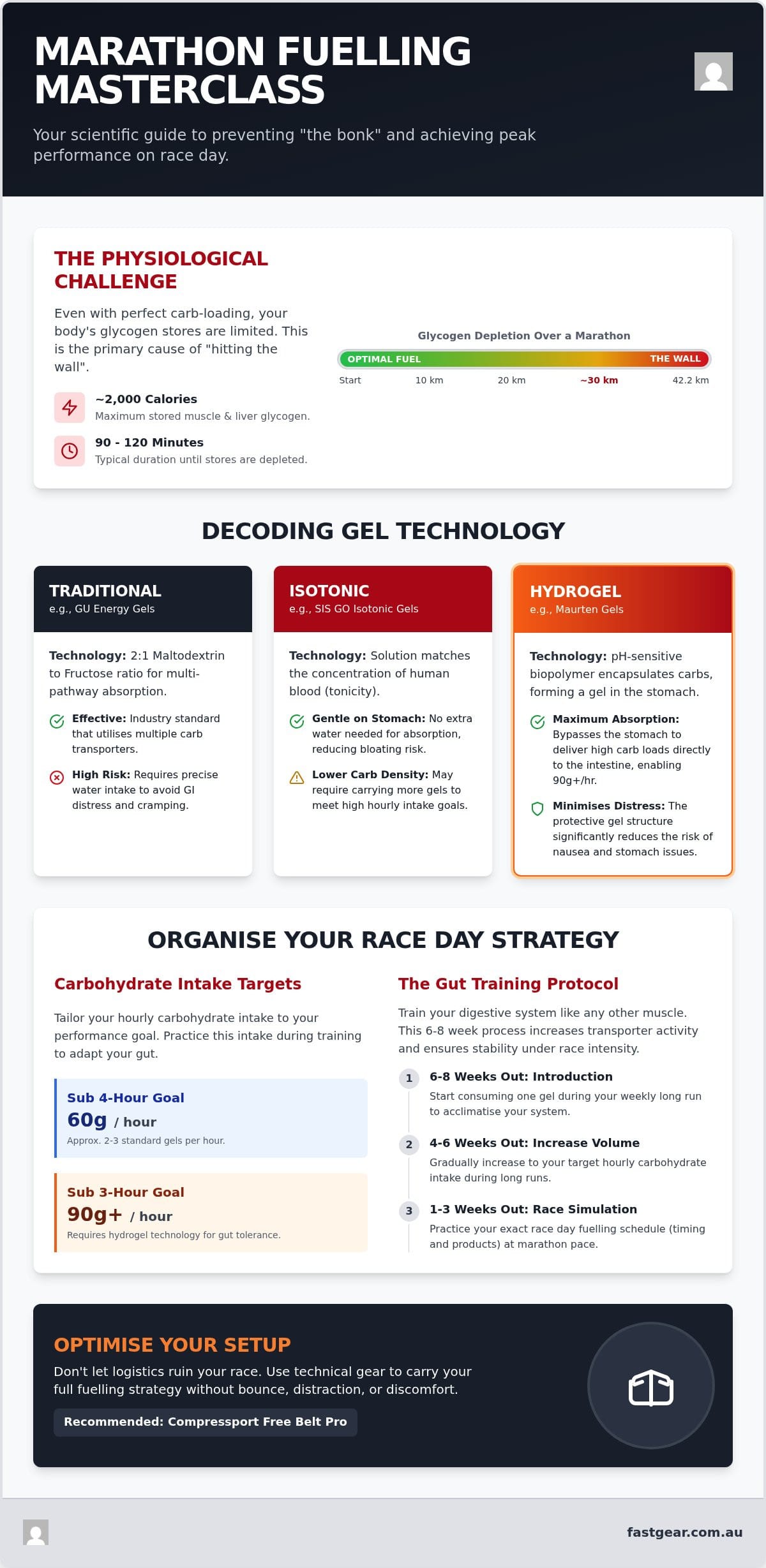
Marathon running is a physiological war of attrition. Your body relies on two primary fuel tanks: muscle glycogen and liver glycogen. Even with a perfect taper and strategic carb-load, these stores are capped at approximately 2,000 calories. For most athletes, this energy lasts roughly 90 to 120 minutes of sustained effort. Beyond this point, your body faces a metabolic crisis that can’t be ignored.
Energy gels are designed to bridge the gap between your internal limits and the finish line. Liquid or gel-based carbohydrates are superior to solid food during high-intensity efforts because they bypass the need for heavy mechanical digestion. When you’re running at 85% of your max heart rate, blood is diverted away from the gut to the working muscles. Solid food sits heavy, often causing nausea; Energy Gels provide a streamlined solution that enters the bloodstream rapidly without the gastrointestinal cost.
Understanding Glycogen Depletion and “The Wall”
As your intensity and duration increase, your body prioritises carbohydrate oxidation over fat metabolism. The 30km mark is the traditional point of failure because it’s where internal stores typically reach critical levels. Without intervention, your pace will plummet as your muscles struggle to maintain power output. Glycogen depletion is the primary cause of hitting the wall.
The Role of Exogenous Carbs in Performance
Consuming exogenous carbohydrates provides a steady glucose stream to both your muscles and your brain. This isn’t just about physical power; it’s about cognitive focus and grit. When blood sugar drops, your central nervous system increases the perception of fatigue to protect vital organs. By selecting the best energy gel for marathon performance, you maintain the blood glucose levels necessary to stay mentally sharp during the punishing final 10km.
A structured approach is essential for any serious athlete. Integrating these tools into a comprehensive endurance sports nutrition Australia strategy ensures you aren’t just guessing on race day. Finding the best energy gel for marathon success is the difference between a strong finish and a walk to the line. Consistency in your fuelling protocol allows you to hold your target pace when the “bonk” threatens to derail your results.
Decoding Gel Technology: Hydrogel vs. Isotonic vs. Traditional
Selecting the best energy gel for marathon performance requires moving beyond flavour preferences to technical delivery systems. The market is no longer dominated by simple sugar syrups. Modern endurance athletes must choose between hydrogels, isotonic formulas, and traditional carbohydrate ratios based on their specific gastric tolerance and intensity goals. Efficiency in fuel delivery is the only metric that matters when your glycogen stores are depleting.
Traditional gels like GU rely on a 2:1 ratio of maltodextrin to fructose. This configuration is an industry standard because it utilises multiple intestinal transporters to move energy into the bloodstream faster than glucose alone. While effective, these concentrated gels require precise water intake to avoid drawing fluid from the blood into the gut. Failure to time your water intake with these gels can lead to osmotic pressure imbalances and subsequent cramping.
Hydrogel Technology: The Maurten Revolution
Maurten has redefined the gold standard for high-performance fuelling. Their hydrogel technology uses a pH-sensitive biopolymer that encapsulates high concentrations of carbohydrates. Once this gel hits the acidic environment of the stomach, it transforms into a protective structure that bypasses the stomach entirely. This allows the fuel to be absorbed directly in the small intestine. For athletes aiming for 90g of carbs per hour, this technology is essential for preventing gastrointestinal distress. You can find a deeper breakdown of these technical specs in our Maurten Gel Australia guide.
Isotonic Gels: Fuelling Without Extra Water
Tonicity refers to the concentration of salts and sugars in a solution relative to human blood. SIS GO Isotonic gels are engineered to match this concentration perfectly. Because they are already at the correct osmotic pressure, they don’t require additional water for absorption. This makes them the best energy gel for marathon runners who struggle with the timing of water stations or have highly sensitive stomachs. They provide a thinner, easier-to-swallow consistency that reduces the risk of mid-race nausea during high-intensity efforts.
For those seeking a different metabolic profile, UCAN offers a superstarch alternative. Unlike traditional simple sugars, this complex carbohydrate provides a slow, steady release of energy without the insulin spike. This makes it a reliable choice for fat-adapted athletes or those prone to reactive hypoglycaemia. To build your custom race kit, explore the full range of high-performance nutrition at Fastgear Australia.
The Best Energy Gels for Marathon Performance in 2026
Selecting the best energy gel for marathon success requires matching your fuelling strategy to your specific race goals. Rather than overwhelming you with dozens of mediocre options, we’ve categorised the top-performing fuel sources based on your experience level and target pace. Whether you’re chasing a sub-3 hour finish or simply aiming to cross the line without a stomach upset, these selections represent the pinnacle of sports nutrition in Australia.
- Sub-3 Hour Performance: Maurten Gel 100. High-density fuel for athletes pushing the limits of carbohydrate absorption.
- First-Timer Strategy: SIS GO Isotonic. The most reliable “safe” bet for those still learning their gut’s limits.
- Sensitive Gut: UCAN Edge. Provides steady-state endurance and supports fat-adaptation without the insulin spike.
- Flavour and Focus: GU Energy Gels. Ideal for runners who prefer diverse flavour profiles and a strategic hit of caffeine.
Fastgear Australia curates these world-leading brands because they offer the most efficient delivery systems currently available. Choosing the right product is about more than just taste; it’s about ensuring your body can process the energy while running at threshold pace.
Premium Performance: Maurten Gel 100 and 100 CAF
Maurten Gel 100 stands as the premium choice for elite-level density. Its neutral, slightly sweet flavour profile is a deliberate design choice to prevent “flavour fatigue” in the final hour of racing. When your palate rejects overly sweet or syrupy textures at the 35km mark, Maurten remains palatable. Each sachet delivers exactly 25g of carbohydrates, providing a clear building block for calculating your hourly intake. For the critical 32km “kick”, the Maurten 100 CAF version integrates 100mg of caffeine to sharpen cognitive focus and reduce perceived exertion when the physical wall looms. This strategic use of caffeine helps maintain pacing discipline when mental fatigue begins to set in.
Reliability and Texture: SIS and GU
The texture of your fuel can be as important as its chemical makeup. SIS GO Isotonic gels offer a thin, watery consistency that’s easy to ingest at high heart rates. They don’t require the thick, sticky swallow often associated with traditional gels. In contrast, GU Energy Gels provide a thicker, more traditional texture that many runners find satisfying. GU’s primary advantage lies in its inclusion of electrolytes, which help maintain fluid balance during hot Australian race conditions. If you find the “liquid” sensation of gels off-putting, Clif Bloks serve as a high-performance textured alternative, offering a chewable format that delivers a similar carbohydrate hit. These options ensure you can maintain your fuel schedule regardless of your texture preference or stomach sensitivity.
Training Your Gut: How to Organise Your Race-Day Strategy
Your digestive system is as trainable as your cardiovascular system. Successful marathon fuelling isn’t just about finding the best energy gel for marathon day; it’s about upregulating the SGLT1 and GLUT5 transporters responsible for moving glucose and fructose into the bloodstream. This physiological adaptation requires a methodical 6 to 8 week protocol. If you skip this phase, even the most advanced hydrogel technology won’t save you from mid-race distress when your body is under peak metabolic stress.
The goal of gut training is to decrease the transit time of nutrients and increase the rate of gastric emptying. By consistently exposing your system to carbohydrates during exercise, you reduce the risk of gastrointestinal symptoms. This process ensures that when you reach the 30km mark, your gut is still efficiently processing fuel rather than shutting down. Identifying the best energy gel for marathon performance is the first step, but conditioning your body to accept it at race pace is what secures the result.
The 6-Week Gut Training Protocol
A structured approach to gut training prevents the “nothing new on race day” disaster. During weeks one and two, start with 30g of carbohydrates per hour on your easy recovery runs. This allows you to test basic palatability and volume tolerance without the pressure of high intensity. In weeks three and four, progress to 60g per hour during your specific marathon-pace blocks. This is critical because your stomach behaves differently when blood is shunted away to working muscles. By week five, you must finalise your specific brand and flavour choices. Use your peak long runs to simulate your exact race-day fuelling intervals to ensure total confidence in your strategy.
Fuelling for the Australian Heat
The Australian climate adds a layer of complexity to carbohydrate absorption. High ambient temperatures cause the body to divert more blood to the skin for cooling, which significantly slows the rate of gastric emptying. Dehydration exacerbates this issue, leading to the dreaded “sloshing” sensation and increased nausea. To maintain high absorption rates in the heat, you must combine your gels with high-quality electrolytes. This maintains plasma volume and keeps the digestive process moving. For those racing in extreme conditions, our ultramarathon fueling for hot weather guide offers deeper technical strategies for thermal management. Consistency is key to avoiding a late-race collapse. Don’t leave your gastrointestinal stability to chance; you can shop the full range of race-tested nutrition at Fastgear Australia to start your training protocol today.
Optimising Your Setup: Carrying and Consuming Fuel on Course
Even the best energy gel for marathon performance is useless if it’s bouncing in a pocket or left at a water station. Efficient portage is the final pillar of a successful fuelling strategy. You need a system that allows for rapid access without breaking your running form or increasing your cognitive load during the final kilometres. Traditional pockets often lead to chafing or excessive movement, while hand-held bottles can cause muscular imbalances over 42.2 kilometres. For the competitive runner, a technical waist belt is the superior solution.
When using traditional, concentrated gels, employ the “squeeze and chase” technique. Consume the gel approximately 50 to 100 metres before reaching a water station. This timing allows you to swallow the gel and immediately wash it down with water. This ensures optimal osmotic balance and prevents the sticky mouthfeel that can distract you from your pace. If you’ve selected an isotonic option, this coordination is less critical, but maintaining a consistent rhythm remains paramount.
The Compressport Advantage for Marathoners
The Compressport Free Belt Pro is the ultimate solution for carrying a full marathon fuelling kit. It provides enough capacity for 6-8 gels, a phone, and even small soft flasks without any vertical bounce. The ergonomic design ensures the weight is distributed evenly around your centre of gravity, which preserves your running economy. Pairing this with a Compressport trail shirt Australia provides a lightweight, highly breathable setup that manages moisture effectively in humid conditions. Proper gear reduces the mental energy required to manage your nutrition, allowing you to stay focused when you enter the “hurt locker” phase of the race.
Race-Day Execution: Timing and Logistics
Execution begins before the clock starts. Consume your first gel 15 minutes before the gun goes off to top up blood glucose levels. Once the race is underway, maintain a strict interval of 30 to 45 minutes for each subsequent gel. Never wait until you feel hungry or tired to start your fuelling cycle; by the time those signals reach your brain, your glycogen stores are already dangerously low. Identifying the best energy gel for marathon success is only half the battle; the rest is discipline. We suggest carrying a final “emergency” caffeinated gel for the 38km mark. This provides a critical neural boost to sharpen your focus and sustain your power output through the finishing straight.
Execute Your Perfect Race Day Strategy
A successful marathon finish is the result of disciplined training and a precision-tuned nutrition plan. You’ve learned that preventing the metabolic crisis of “the bonk” requires more than just raw sugar; it demands a structured gut training protocol and the right delivery technology. Whether you prioritise the high-density hydrogel of Maurten or the gut-friendly isotonic consistency of SIS, identifying the best energy gel for marathon success is about matching your fuel to your specific intensity and gastric profile. Don’t let months of physical preparation be undone by poor portage or a lack of electrolyte balance in the Australian heat.
Fastgear Australia provides the authoritative range of Maurten and SIS products needed to sustain your output over 42.2 kilometres. By pairing world-leading nutrition with technical gear like the Compressport Free Belt Pro, you reduce cognitive load and ensure every gram of carbohydrate is absorbed efficiently. Our expert-led advice is designed to give Australian endurance athletes the marginal gains required for a new personal best. Optimise your marathon fuelling with Fastgear’s curated nutrition range and step onto the start line with total confidence. You’ve done the work; now finish strong.
Frequently Asked Questions
How many gels should I take during a marathon?
Take between six and eight gels during a standard marathon, depending on your target finish time and carbohydrate absorption rate. Most athletes aim for 30 to 60 grams of carbohydrates per hour, which translates to one gel every 30 to 45 minutes. Consuming the best energy gel for marathon success requires consistency; don’t wait for hunger to strike. Start your fuelling cycle early to maintain glycogen levels and prevent a late-race metabolic collapse.
Can I take energy gels with sports drinks or just water?
Consume traditional concentrated gels with water only to ensure efficient gastric emptying. Mixing high-carbohydrate gels with sports drinks increases the solution’s tonicity, which often leads to “sloshing” and gastrointestinal distress. Isotonic gels like SIS are an exception as they are pre-mixed to the correct concentration. For most runners, using water from course stations is the safest way to maintain a stable gut while processing exogenous fuel at race intensity.
What is the best energy gel for a sensitive stomach?
Maurten Gel 100 is widely considered the best energy gel for marathon runners with sensitive stomachs due to its unique hydrogel technology. By encapsulating carbohydrates in a pH-sensitive biopolymer, it bypasses the stomach for absorption in the small intestine. Alternatively, SIS GO Isotonic gels provide a thinner consistency that requires no extra water, reducing the risk of nausea. UCAN Edge is also a reliable option for those seeking a slow-release fuel source.
How long does it take for an energy gel to kick in?
Expect to feel the effects of an energy gel within 10 to 15 minutes of ingestion. While the brain receives a near-instant signal that fuel is coming, it takes slightly longer for glucose to enter the bloodstream and reach working muscles. This lag is why proactive fuelling is essential. Taking a gel every 40 minutes ensures a steady supply of energy, preventing the sharp blood sugar drops that cause physical and mental fatigue.
Should I use caffeine gels for the whole marathon?
Limit caffeine gels to strategic points rather than using them for the entire race. Current FSANZ regulations suggest a maximum of 200mg of caffeine from sports foods daily. Most runners benefit from one caffeinated gel 15 minutes before the start and another at the 32km mark to sharpen cognitive focus. Using caffeine too frequently can lead to jitters, increased heart rate, and potential gastrointestinal issues during the high-intensity phases of the race.
Is it better to use energy gels or energy chews?
Gels are typically superior for high-intensity marathon racing because they require no chewing and are absorbed rapidly. Energy chews, such as Clif Bloks, provide a welcome change in texture but can be difficult to manage when your heart rate is elevated and your breathing is heavy. Many athletes use gels as their primary fuel source and reserve chews for the early kilometres where mechanical digestion is slightly easier to handle at a controlled pace.
What happens if I don’t take any gels during a marathon?
Skipping gels leads to glycogen depletion, commonly known as “hitting the wall.” Since internal stores only last about 90 to 120 minutes, your body will be forced to rely on fat metabolism, which is a slower energy conversion process. This results in a significant pace drop, muscle cramping, and a loss of mental focus. Without exogenous carbohydrates, maintaining target marathon intensity becomes physiologically impossible for most runners once their internal fuel is exhausted.
Can energy gels cause diarrhoea during a race?
Energy gels can cause runner’s diarrhoea if they create high osmotic pressure in the gut. This happens when you consume concentrated sugar without enough water, causing the body to pull fluid into the intestine. To prevent this, always practice your strategy during training to upregulate your gut transporters. Using hydrogel or isotonic options significantly reduces this risk by ensuring the fuel moves through the digestive system without causing a fluid imbalance. For more tips on maintaining digestive comfort, check out Healthy Gut.
