
Uncategorized
Triathlon Fuelling Strategy: The 2026 High-Performance Guide
Sep
If you’re still aiming for a modest 60 grams of carbohydrates per hour during a full-distance race, you’re leaving minutes on the course. In 2026, the science of the triathlon fueling strategy has shifted from mere survival to aggressive, high-density intake. We understand the frustration of training for months only to have your podium ambitions derailed by debilitating cramps or a sudden “gut bomb” during the run leg. Performance shouldn’t be limited by your digestive tract.
This guide promises to eliminate the guesswork and provide a calibrated blueprint to optimise your energy levels for a faster finish. You’ll learn how to master the 1:0.8 glucose-to-fructose ratio and leverage Maurten hydrogel technology to push your absorption limits toward 120 grams per hour. We’ll detail the exact sodium requirements for the Australian climate and the technical logistics of carrying your fuel using tools like the Compressport Free Belt Pro. Whether you’re targeting Olympic distance or Ironman epics, this is your roadmap to maintaining consistent power and finishing with a full tank.
Key Takeaways
- Target elite-level carbohydrate intakes of up to 120g per hour by implementing a scientifically backed triathlon fueling strategy tailored to your specific physiological limits.
- Calibrate your sodium and fluid intake to maintain blood volume and prevent performance-limiting dehydration during high-intensity efforts in Australian conditions.
- Minimise mid-race gut distress by utilising advanced hydrogel technology and isotonic gels designed for rapid gastric emptying and efficient energy absorption.
- Optimise your race-day logistics with technical gear like the Wove M8 saddle to reduce abdominal pressure and improve digestive efficiency on the bike leg.
- Transition from high-intensity liquid fuelling in Sprints to structured, multi-transportable carbohydrate plans for 70.3 and full-distance Ironman events.
Mastering Your Triathlon Fuelling Strategy: The Fourth Discipline
Triathlon is not merely a three-sport event. Success requires mastering the fourth discipline: the strategic management of glycogen stores and electrolyte balance. You can possess the highest VO2 max in your age group, but if your triathlon fueling strategy is flawed, your engine will stall long before the finish line. High-level fitness is useless if you cannot access the energy required to power it. A poor nutritional plan will dismantle months of disciplined training in a single race-day hour.
Foundational success rests on the “Three Pillars of Fuelling”: carbohydrates, hydration, and electrolytes. Understanding the basics of sports nutrition is critical for any athlete seeking marginal gains. Carbohydrates provide the high-octane fuel for threshold efforts. Hydration acts as the delivery vehicle for those nutrients while managing thermoregulation. Electrolytes, specifically sodium, maintain the osmotic pressure required for fluid absorption. Without all three working in synergy, performance collapses.
Gut training is the most overlooked component of race preparation. You don’t just train your legs; you must train your digestive system to handle high-density carbohydrate loads under physical stress. By gradually increasing your intake during long bike and run sessions, you upregulate the transporters in your small intestine. This preparation ensures your body is ready to absorb the fuel you provide on race day without rebellion.
Why Traditional Fuelling Plans Often Fail
Most plans fail because they ignore the physiological limit of carbohydrate absorption in the small intestine. Standard glucose transporters can become saturated, leading to sugar sitting in the gut rather than reaching the muscles. Dehydration exacerbates this by slowing gastric emptying, which causes the uncomfortable “sloshing” sensation many athletes experience. When you add race-day nerves and high-intensity efforts, your digestive capacity shrinks, making precision-engineered nutrition essential.
The Goal: Sustained Power and Cognitive Focus
The objective is to maintain blood glucose levels to prevent central nervous system fatigue. When blood sugar drops, your brain signals your muscles to slow down as a protective mechanism. A robust triathlon fueling strategy prevents the dreaded “bonk” or “hitting the wall” by providing a steady stream of exogenous energy. Glycogen depletion is the physiological state where intramuscular fuel stores are exhausted, forcing the body to rely on slower fat oxidation and causing a mandatory, drastic reduction in pace. By fueling correctly, you keep your cognitive focus sharp and your power output consistent until the final kilometre.
The Physiology of Performance: Carbs, Sodium, and Gut Training
Beyond race-day nutrition, managing systemic inflammation is crucial for sustaining a high-volume training load; to support your recovery, check out Pureffect for advanced molecular hydrogen technology.
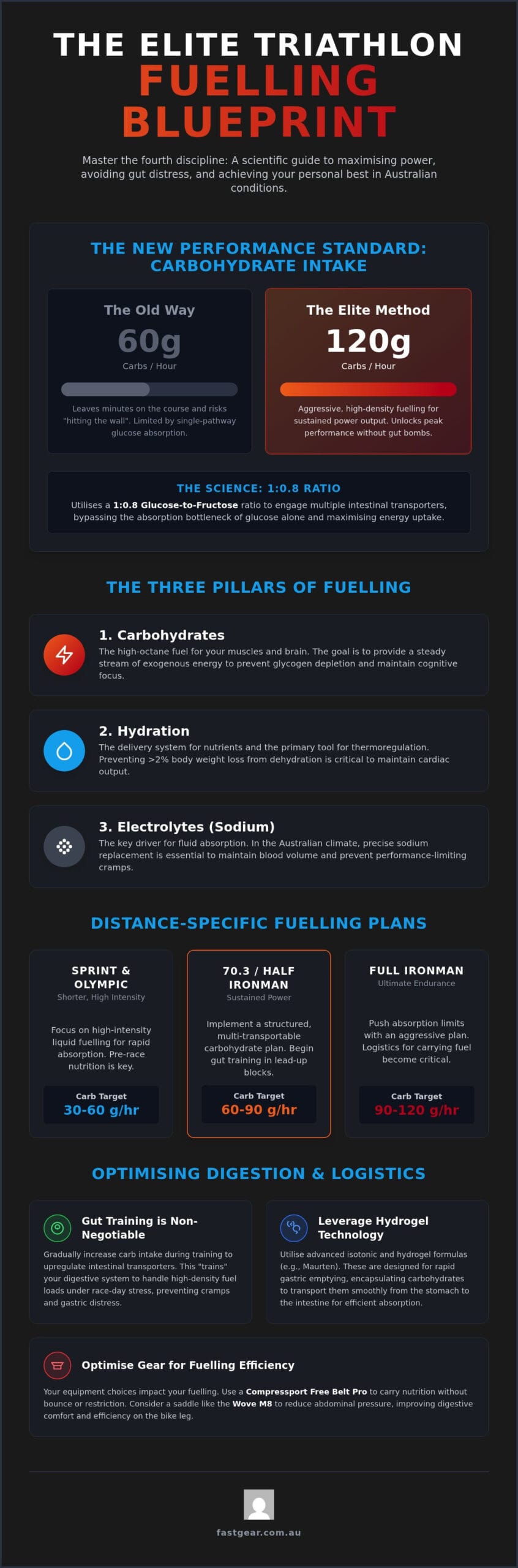
Modern sports science has redefined the upper limits of human endurance. While the traditional 60g carbohydrate-per-hour benchmark remains a safe baseline for many, elite performance in 2026 now targets 90g to 120g per hour. This leap is made possible by the 1:0.8 glucose-to-fructose ratio. By utilising multiple intestinal transporters, you bypass the saturation point of glucose alone, allowing for higher energy throughput without gastric distress. A successful triathlon fueling strategy relies on this precision math to sustain threshold power over hours of racing.
Sodium is the primary driver of this system. It isn’t just about preventing cramps; it’s about maintaining blood volume and facilitating fluid absorption in the small intestine. In the harsh Australian climate, losing more than 2% of body weight to dehydration triggers a sharp decline in cardiac output and aerobic capacity. You must replace what you lose to keep the delivery system functional. Precision is the difference between a podium finish and a DNF.
Calculating Your Carbohydrate Requirements
Your burn rate is a product of intensity and duration. A 70.3 bike leg typically requires 60 to 90g per hour, while full-distance Ironman efforts demand the upper limit of 120g to survive the run. Liquid fuels and gels are prioritised over solids to minimise the metabolic cost of digestion. Use a structured approach to endurance sports nutrition Australia to establish your baseline during training blocks. Start at 60g and increment by 10g every fortnight to find your ceiling.
The Sodium Equation: Beyond Simple Salt
Generic electrolyte drinks often fail because they lack sufficient sodium concentration for heavy sweaters. Australian conditions often require 500mg to 1000mg of sodium per hour. Without this, you risk hyponatremia, a dangerous dilution of blood sodium levels often confused with simple dehydration. Precision is required. Measure your sweat rate by weighing yourself before and after a one-hour threshold session to determine your specific fluid and salt needs.
Training Your Gut for Race Intensity
Gut training is a non-negotiable physiological adaptation. You must teach your stomach to process high carbohydrate volumes while blood flow is diverted to working muscles. Replicate race-day intensity during your long sessions to test these limits. It’s critical to finalise your cycling nutrition Australia setup months before the event. If you don’t train your gut, race-day failure is a statistical certainty. Explore our range of high-performance fuel to start your adaptation phase today.
Gels, Powders, or Chews: Choosing Your Race-Day Fuel
Selecting the right delivery mechanism is the cornerstone of a successful triathlon fueling strategy. It isn’t just about the total volume of carbohydrates; it’s about how those nutrients interact with your physiology under high-intensity loads. The market has evolved beyond simple sugar water. Today, we categorise fuel by its delivery technology, ranging from hydrogel matrices to isotonic solutions, each serving a specific role in your race-day logistics. Precision here prevents the metabolic bottleneck that leads to performance decline.
Hydrogel technology has set a new standard for high-performance racing. Products like Maurten gel Australia utilise a biopolymer matrix that encapsulates carbohydrates, allowing them to bypass the stomach and release directly in the small intestine. This reduces the risk of gastrointestinal distress even at high concentrations. For those who prefer a simpler approach, SIS GO Isotonic Gels offer the benefit of fuelling without the immediate need for extra water, making them ideal for the run leg where water-to-gel ratios are difficult to manage. Meanwhile, Clif Bloks energy chews provide necessary textural variety, offering a psychological break from liquids and gels during long-haul bike segments.
The Hydrogel Advantage for Sensitive Stomachs
The biopolymer matrix in Maurten 100 gels creates a protective barrier around the glucose and fructose. This allows for a 1:0.8 ratio that moves quickly into the gut for absorption. It’s the gold standard for athletes who typically suffer from “sloshing” or acidity. Use the standard Maurten Gel 100 for your base hourly intake, and switch to the Maurten Gel 100 Caffeine approximately 45 minutes before the finish for a final cognitive and physical surge.
Liquid Fuelling vs. Concentrated Gels
Liquid fuelling with products like Tailwind or Maurten 320 powder allows you to consolidate your triathlon fueling strategy into your aero bottles. This “all-in-one” approach simplifies logistics on the bike but requires careful management of flavour fatigue. If you’re out there for five hours or more, the sweetness can become overwhelming. Integrating UCAN gels can help; their unique starch structure provides a steady-state energy release without the sharp insulin spikes associated with traditional simple sugars. This keeps your energy levels consistent while your aero bottles handle the bulk of your hydration and electrolyte needs. Balancing these formats ensures you remain fuelled, focused, and free from digestive rebellion.
Distance-Specific Fuelling: From Sprints to the IRONMAN
A successful triathlon fueling strategy must adapt to the specific metabolic demands of your chosen distance. Sprint and Olympic events are high-intensity efforts where speed is the priority. Because these races typically conclude within 150 minutes, your primary focus is on saturating glycogen stores before the klaxon. In contrast, the 70.3 and full Ironman distances require a transition to aggressive, hourly intake. Without a structured plan to replace the 600 to 1000 calories burned every hour, physical and cognitive performance will inevitably decline during the final kilometres of the race.
The “Australian Heat Factor” is a non-negotiable variable for athletes competing across the national racing circuit. High humidity and extreme temperatures accelerate glycogen depletion and increase the metabolic cost of thermoregulation. When core temperatures rise, blood is diverted away from the stomach to the skin for cooling, which drastically reduces your gut’s ability to process fuel. You must prioritise electrolyte concentration and fluid volume to keep the delivery system functional. Failing to account for local climate conditions is the most common cause of mid-race gastrointestinal failure during the marathon leg.
The 70.3 and IRONMAN Fuelling Blueprint
The bike leg represents your “Buffet” phase. It is your best opportunity to consume high-density carbohydrates because your heart rate is lower and more stable than during the run. Aim to front-load your intake here, targeting the upper limits of your gut’s absorption capacity to provide a buffer for the run. Once you reach the pavement, you enter the “Survival” phase. Digestive capacity drops, making it essential to shift toward easily absorbed gels and on-course hydration. Managing the ultramarathon fuelling for hot weather transition is vital for maintaining pace during the final 21 to 42km of the day.
The Pre-Race and T1 Strategy
Your 24-hour carbohydrate load is the foundation of race-day success. Target 8 to 10g of carbohydrate per kilogram of body mass in the day preceding the event to ensure muscle glycogen levels are fully saturated. On race morning, consume a low-fibre, high-carb meal 2.5 to 4 hours before the swim to allow insulin levels to stabilise. A final “Top-off” gel taken 15 minutes before the start ensures blood glucose is elevated as you enter the water. This comprehensive triathlon fueling strategy ensures you start with a full tank and the confidence to execute. Secure your high-performance nutrition to ensure your race-day logistics are as prepared as your physiology.
Executing the Plan: Gear and Logistics for Efficient Delivery
A sophisticated triathlon fueling strategy is only as effective as your ability to execute it under race conditions. If your nutrition is inaccessible or creates physical discomfort, your caloric intake will suffer. High-performance racing requires a seamless integration between your technical gear and your nutritional requirements. You must organise your equipment to facilitate rapid delivery while maintaining an aerodynamic profile. Precision in logistics ensures that your focus remains on power output rather than struggling with a sticky gel packet at 40km/h.
Logistical failure often stems from a lack of “delivery drills” during training. Opening a gel with your teeth while navigating a technical descent or crosswinds requires practice. You should aim to minimise “chafe and waste” by pre-opening certain items or using streamlined storage solutions. Every second spent fumbling for fuel is a second of lost momentum. Your gear should act as an extension of your body, providing the marginal gains necessary to sustain your pace through the final leg.
The Bike Setup: Maximum Fuel, Minimum Drag
Your bike cockpit must balance aerodynamics with accessibility. Utilise Between the Arms (BTA) hydration systems for your primary fluid intake, as this allows you to drink without leaving the aero tuck. For high-density carbohydrate delivery, many athletes now use “super-bottles” on the frame, containing a concentrated mix of Maurten 320 or Tailwind. This reduces the number of bottle swaps required at aid stations. The Wove M8 saddle Australia plays a critical role here. By reducing abdominal pressure in a deep aero position, it facilitates better gastric emptying and comfort, allowing you to stay in your most efficient position for longer while your gut processes the necessary fuel.
The Run Setup: Staying Light and Efficient
Transitioning your triathlon fueling strategy to the run leg presents the challenge of vertical oscillation. Traditional gel belts often bounce and chafe, leading to distractions and skin irritation during a marathon. The Compressport Free Belt Pro is a game-changer for serious competitors. It provides a stable, wrap-around storage solution that distributes the weight of your Maurten gels and SIS packets evenly across your centre of mass. This prevents the “pendulum effect” of heavy pockets and keeps your fuel within easy reach. Incorporating these triathlon race day essentials Australia into your transition plan ensures you exit T2 with everything required for a fast, well-fuelled finish. Speed in transition is useless if you leave your energy behind.
Master the Science of Your Next Milestone
Success in multisport isn’t accidental; it’s engineered. By integrating a high-density triathlon fueling strategy with rigorous gut training and technical gear optimisation, you eliminate the variables that cause race-day failure. You’ve learned that hitting the 120g carbohydrate-per-hour limit is possible with hydrogel technology, and that sodium precision is mandatory for the Australian climate. The final piece is execution. Your bike setup and run logistics must serve your nutritional needs, ensuring every calorie is absorbed and every watt is sustained.
As an authorised Maurten and SIS stockist, Fastgear Australia provides the precision-engineered fuel and expert technical gear selection required by high-performance Australian athletes. We don’t just sell products; we curate the marginal gains that define podium finishes. From the aerodynamic comfort of the Wove M8 saddle to the stability of the Compressport Free Belt Pro, we provide the tools to support your disciplined mindset.
Optimise your race-day fuelling with Fastgear’s curated endurance range and secure your fastest finish yet. The course is waiting. It’s time to execute.
Frequently Asked Questions
How many grams of carbs per hour should I aim for in a 70.3?
Target a range of 60 to 90 grams of carbohydrates per hour during the bike and run legs of a 70.3. This benchmark ensures you maintain the intensity required for middle-distance racing without exhausting glycogen stores. Heavier athletes or those producing higher power outputs should aim for the upper limit. Training your gut with high-performance products like Maurten 320 powder or SIS GO Isotonic Gels ensures you can absorb these volumes efficiently.
Can I use only liquid nutrition for a full IRONMAN?
Yes, a liquid-only approach is a highly effective triathlon fueling strategy for the full distance. Utilising high-density powders like Maurten 320 or Tailwind allows you to consolidate your caloric and electrolyte needs into your aero bottles. This simplifies logistics and reduces the metabolic energy cost of digestion. You must practice this during long training rides to ensure you can manage flavour fatigue over a 10 to 17-hour race window.
What is the best way to prevent stomach cramps during the run?
Preventing run-leg cramping requires a combination of gut training and the use of hydrogel technology. Products like Maurten Gel 100 encapsulate carbohydrates in a biopolymer matrix, allowing them to bypass the stomach and reduce gastrointestinal distress. Ensure your sodium intake is calibrated to your sweat rate to maintain fluid balance. Additionally, using a stable carrier like the Compressport Free Belt Pro prevents the bouncing that often triggers digestive issues during a marathon.
How do I adjust my fuelling for a particularly hot Australian race day?
Increase your sodium and fluid intake to compensate for the extreme sweat rates typical of the Australian climate. Aim for 500mg to 1000mg of sodium per hour and 500ml to 800ml of fluid during the bike leg. Heat slows gastric emptying, so shifting toward liquid-based fuels or hydrogels is essential to maintain absorption. This adjustment protects your blood volume and aerobic capacity, ensuring your core temperature does not reach performance-limiting levels.
Is it better to use caffeinated gels at the start or end of the race?
Save caffeinated gels for the final 45 to 60 minutes of your race to maximise their ergogenic benefits. Consuming a Maurten Gel 100 Caffeine during the latter stages of the run provides a critical surge in cognitive focus and physical power when fatigue is most acute. While a small dose before the swim can assist some athletes, the most significant performance gains occur when caffeine blunts the perception of effort during the closing kilometres. If you prefer a natural caffeine kick as part of your training or pre-race ritual, you can visit Caffeine Lab to explore specialty coffee roasts that offer a clean energy boost.
Never rely on aid station nutrition as your primary fuel source because the provided brands may not align with your training. Consistency is the foundation of a successful triathlon fueling strategy. Carry your own curated selection of Maurten gels or GU Energy Gels to ensure your gut processes familiar ingredients. Use aid stations primarily for water to wash down your concentrates and for additional cooling, rather than as a gamble for your energy needs.
How much sodium do I need if I am a “salty sweater”?
Salty sweaters should target the upper end of the spectrum, typically between 800mg and 1000mg of sodium per hour. If you notice white salt streaks on your kit after training, your sodium loss is likely high. Precision is required to maintain osmotic pressure and fluid absorption in the small intestine. Using high-sodium powders like Tailwind or specialised electrolyte supplements ensures you replace what is lost, preventing the dangerous performance decline associated with hyponatremia.
What should I eat the night before a triathlon to avoid GI issues?
Consume a high-carbohydrate, low-fibre meal that is easy for your system to process. Focus on simple starches like white rice or plain pasta while avoiding heavy fats, spicy sauces, and fibrous vegetables. This ensures your glycogen stores are saturated without leaving excess bulk in your digestive tract on race morning. Complete this primary loading phase approximately 12 to 15 hours before the klaxon to allow for full absorption and a clear gut.
