
Uncategorized
Isotonic Gel vs Regular Gel: Which Fuel Prevents the Dreaded Gut Rot?
Jul
That concentrated energy gel you’re relying on for your next PB might be the very thing forcing you into a mid-race portaloo stop. Most endurance athletes have felt that heavy, sloshing sensation or the sharp bite of stomach cramps when fuel sits like lead in the gut. It’s a common frustration that ruins months of training. When evaluating isotonic gel vs regular gel, the choice determines whether your body absorbs energy or fights against it.
You need a fueling strategy that supports your pace rather than sabotaging your digestion. We’ll cut through the confusion of osmotic pressure and tonicity to provide a clear and direct approach to race-day nutrition. You’ll learn how to balance carb counts from brands like SIS and Maurten with your specific hydration needs. We’ll also preview the latest 2026 research on glucose stability to ensure you stay fueled without the gastrointestinal friction. It’s time to optimise your performance and leave the gut rot behind.
Key Takeaways
- Master the science of tonicity to understand why regular gels require precise water timing while isotonic options offer a direct shortcut to energy absorption.
- Resolve the isotonic gel vs regular gel dilemma by matching your fuel choice to your race-day hydration capacity and gut sensitivity.
- Identify how specific textures and carbohydrate densities, from SIS GO Isotonic to Maurten Gel 100, can eliminate the risk of mid-race stomach cramps.
- Learn to coordinate your fuel intake with technical carrying solutions like the Compressport Free Belt Pro for seamless energy delivery during high-intensity efforts.
- Develop a strategic nutrition plan that balances high-performance output with gastric comfort to ensure you never have to compromise your pace for a portaloo stop.
Understanding Energy Gels: Why Your Choice Matters for Performance
Energy gels are the gold standard for endurance fuel. They deliver a concentrated hit of carbohydrates to keep you moving when your internal stores begin to fail. However, the debate between isotonic gel vs regular gel isn’t just about flavour or brand preference. It’s about how your body processes that fuel under extreme physical stress. A poor choice often leads to ‘gut rot’, which is the uncomfortable bloating, cramping, or nausea caused by undigested sugars sitting in your digestive tract. To solve this, you must understand the physiological cost of your nutrition strategy.
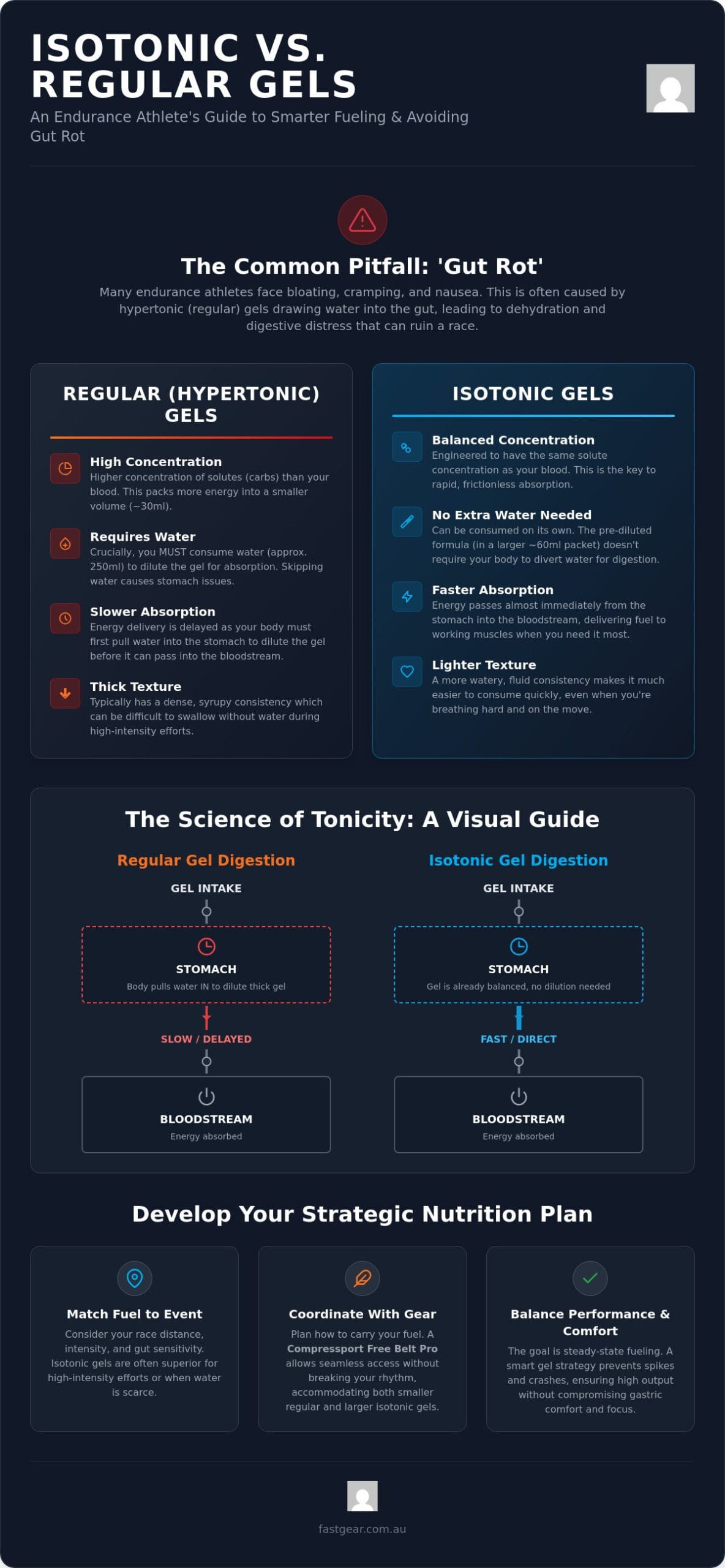
An isotonic gel is defined as a solution with the same concentration as human blood. This specific balance allows the gel to pass through the stomach wall and into the bloodstream almost immediately. Unlike traditional options, it doesn’t require the body to divert water for digestion. This makes it a high-performance tool for athletes who need speed and comfort simultaneously, especially when water stations are far apart.
The Role of Carbohydrates in Endurance Sports
Your body relies on glycogen stored in the muscles and liver. These stores are finite. After 60 to 90 minutes of high-intensity effort, you face the ‘bonk’. This is the point where your brain and muscles run out of glucose, leading to a total physical shutdown. Gels provide a portable, mess-free alternative to solid food. They fit easily into technical gear like the Compressport Free Belt Pro, ensuring you have access to fuel without the bulk or chewing required by solid bars. Key benefits include:
- Rapid delivery of simple sugars like maltodextrin.
- Compact packaging for easy storage during marathons.
- Pre-measured doses to track your hourly carb intake.
Common Pitfalls: Why Your Stomach Revolts
Many athletes experience mid-race distress because they don’t account for the ‘osmotic pull’ effect. Regular gels are hypertonic, meaning they have a higher concentration of solutes than your blood. When you swallow a thick gel without enough water, your body draws water out of your bloodstream and into your stomach to dilute it. This causes dehydration and a sloshing sensation that ruins your rhythm. Understanding The Science of Tonicity is vital for avoiding these disasters. Nausea isn’t just a physical hurdle; it’s a psychological drain that can sap your motivation and destroy your finishing time. Steady-state fueling with the right products prevents the spikes and crashes that lead to a DNF.
The Science of Tonicity: Isotonic vs Regular Gels Explained
Tonicity is the technical measure of dissolved particles within a liquid, specifically sugars and electrolytes, compared to your blood. In the context of isotonic gel vs regular gel, this concentration determines how quickly the fuel exits your stomach. Regular gels are hypertonic. They possess a much higher concentration of solutes than your internal fluids. Isotonic gels are engineered to mirror the concentration of your cell fluid, allowing for near-instant transit without metabolic friction. Hypertonic gels require external water for gastric emptying.
How Hypertonic (Regular) Gels Work
Standard energy gels like those from GU or Clif pack a high carbohydrate density into a small, 30ml serve. This is efficient for storage but creates a physiological bottleneck. Because the solution is so concentrated, your body cannot absorb it directly. Research has shown an Extreme variation in energy gels regarding their osmolality, which explains why some brands cause more distress than others. To process a hypertonic gel, you must drink approximately 250ml of water. If you skip the water, your body draws fluid from your blood into the gut to dilute the “sludge.” This leads to delayed absorption and the dreaded sloshing sensation. It’s a common mistake that turns a high-performance fuel into a digestive anchor.
The Isotonic Advantage: SIS GO and Beyond
Isotonic gels, such as SIS GO Isotonic Gels, use specific maltodextrin ratios to achieve the correct osmotic balance. They don’t need extra water to move through the stomach wall. This rapid gastric emptying ensures that glucose reaches your working muscles faster during high-intensity efforts. You might notice these gels are often larger, typically 60ml compared to the 30ml regular version. This increased volume is necessary to keep the carbohydrate concentration low enough to remain isotonic. It’s a technical trade-off. You carry slightly more volume, but you gain a more reliable fueling system that doesn’t rely on the timing of the next water station. A February 2026 study in Frontiers in Physiology highlighted that while these formulations don’t always cut finishing times, they significantly enhance blood glucose stability for advanced runners. For athletes targeting pace stability, this consistency is vital. You can browse our range of performance gels to find the right balance for your next race. Using a dedicated storage solution like the Compressport Free Belt Pro makes carrying these larger serves effortless.
Practical Differences: Texture, Water Intake, and Carb Density
The tactile experience of fueling often determines whether an athlete sticks to their nutrition plan or abandons it by the second hour. Texture is a primary deal-breaker. Regular gels are notoriously thick and syrupy, often requiring significant effort to swallow when your heart rate is redlining. In contrast, isotonic gels offer a thinner, more liquid consistency. This “drinkable” quality makes them far easier to consume while breathless. When comparing isotonic gel vs regular gel, you must also consider carbohydrate density. Regular gels pack more punch per gram of weight carried, often delivering 20 to 25 grams of carbs in a compact 32g sachet. Isotonic versions require more volume to achieve the same energy output because they are pre-diluted.
A sophisticated alternative is the hydrogel technology found in Maurten Gel 100. This formulation uses a pH-sensitive biopolymer to encapsulate carbohydrates, allowing the fuel to bypass the stomach and move directly into the small intestine. This mechanism drastically improves the rate of gastric emptying, providing 25g of carbohydrates without the typical digestive load. It offers a middle ground for those who need high density without the “sludge” effect of traditional hypertonic options.
The ‘Sludge’ vs ‘Watery’ Debate
Preference often comes down to palatability under stress. Some runners prefer the instant “hit” of a thick, sweet gel, while others find the syrupy texture repulsive during high-intensity efforts. This is especially true in the Australian heat. At 30 degrees Celsius, a thick, sticky gel can feel like a chore to swallow. Isotonic options are generally easier to stomach when you are dehydrated or suffering from flavour fatigue. Brands manage sweetness levels differently, with isotonic gels often tasting less cloying because of their higher water content.
Logistics: Carrying Your Fuel
Choosing your fuel involves a literal weight penalty. Carrying six 60ml SIS GO Isotonic Gels means managing 360ml of liquid, whereas six 32g regular gels weigh significantly less. This extra bulk requires technical storage solutions. The Compressport Free Belt Pro is designed specifically for this purpose, providing a bounce-free way to carry larger isotonic serves or multiple Maurten Gel 100 sachets. Strategic placement is vital. In a triathlon, you might tape regular gels to your bike frame for easy access but switch to isotonic fuel during the run when your gut is more sensitive. Balancing the weight of your gear with the efficiency of your gut is the key to a successful race day.
Strategic Fueling: Matching Your Gel to Your Event and Gut
Selecting between an isotonic gel vs regular gel requires a tactical assessment of your race environment. It isn’t just about what tastes better. You must account for your access to water and how well you have trained your digestive system to handle high carbohydrate loads. Short, high-intensity efforts like a 10km or half-marathon favour isotonic gels. When you are redlining, you don’t want to wait for the next water station to dilute a thick syrup. You need immediate transit. Understanding the tactical application of isotonic gel vs regular gel ensures you don’t waste energy on digestion when you should be focusing on pace.
Longer efforts like an Ironman or a 100km ultra demand a different approach. Here, the sheer volume of fuel required makes carbohydrate density a priority. You should aim for a ‘Gut Training’ protocol during your lead-up. This involves gradually increasing your intake during long runs to teach your body to process 60 to 90 grams of carbs per hour. This prevents the gastric shutdown that often occurs when athletes try to ‘force-feed’ on race day.
Scenario A: The Self-Sustained Trail Run
Trail runners often carry their own hydration in a bladder or soft flasks. This setup makes regular gels like GU Energy Gel or Clif – BLOKS Energy Chews a space-efficient choice. Since you have water on your back, you can manage the dilution requirements of hypertonic fuel easily. You must still monitor your electrolyte balance to avoid sodium imbalances. Some athletes prefer tailwind powder as a ‘liquid gel’ alternative. It mixes directly into your flasks, providing a steady stream of energy and salts without the need for individual gel packets. For cyclists facing similar challenges on long rides, pairing gels with a quality hydration powder for cycling can provide a more complete and precisely calibrated fuelling system.
Scenario B: The Flat-Out Road Marathon
In a road marathon, water stations are often chaotic. SIS – GO Isotonic Gels are the gold standard because they remove the guesswork. You can fuel whenever you feel the need without syncing it to a specific cup of water. This prevents ‘sticky hands’ and the dry, sticky throat sensation that accompanies hypertonic gels. For those chasing a PB with a high-carb strategy, maurten gel 100 provides 25g of carbs in a low-volume serve. It uses hydrogel technology to bypass the stomach, offering density without the hypertonic risk.
You can build your race-day nutrition plan with our curated range of elite endurance fuel.
Optimising Your Race Day: Why Fastgear Curates the World’s Best Gels
Fastgear Australia is more than a retailer. We are a dedicated performance partner for athletes who refuse to settle for mediocre results. Choosing between an isotonic gel vs regular gel is a critical decision that impacts your finishing time and physical comfort. We curate only the world’s most reliable fuel to ensure you have the right tools for the job. Our range features SIS – GO Isotonic Gels for rapid transit, maurten gel 100 for high-carb hydrogel efficiency, and GU Energy Gel – Single serves for classic density. Every product in our inventory undergoes rigorous selection based on technical specifications and proven results.
Carrying your nutrition shouldn’t be an afterthought. High-volume isotonic serves require stable carriage to avoid bouncing and discomfort. We recommend pairing your fuel with the Compressport Free Belt Pro. This technical solution provides a secure fit for multiple gels and accessories. We test our gear in harsh Australian conditions. When the mercury rises above 30 degrees Celsius, you need equipment and fuel that won’t fail. From the Wove M8 Road / Tri Saddle for long-distance comfort to Mugiro – Neck Protectors for anti-chafe security, we provide a complete ecosystem for athletic optimisation.
The Fastgear Australia Advantage
Only brands that pass our strict ‘gut-test’ earn a spot on our shelves. We understand the rigours of high-level competition and prioritise utility over marketing fluff. Our team offers fast national shipping across Australia. This ensures your race-week essentials arrive well before you hit the start line. Whether you need Clif – BLOKS Energy Chews for a technical trail run or ucan gels for steady-state energy, we have the stock ready for dispatch to your door.
Next Steps for Your Personal Best
Success on race day starts in training. Use your long runs to trial different brands and formats. You must determine which isotonic gel vs regular gel ratio works for your specific metabolism and intensity levels. Never introduce new nutrition on the morning of a major event. You can build a customised selection from our individual gel range to find your perfect match. Our team is available to provide professional advice for your next Ironman, marathon, or local fun run. Reach out to refine your strategy and lock in your performance gains.
Master Your Race-Day Nutrition Strategy
Eliminating gut rot requires a technical understanding of how your body processes fuel under physical stress. The decision between an isotonic gel vs regular gel dictates your hydration strategy and your gastric comfort. Use isotonic options for rapid transit when water timing is uncertain or when you are redlining. Rely on the density of regular gels or hydrogels when you have a reliable water source or need to pack maximum energy into a compact space. Fastgear Australia is your expert partner for elite endurance fuel. We are stockists of SIS, Maurten, and GU, ensuring you have access to the latest sports science technology. Our national shipping provides Australian endurance athletes with their race-week essentials exactly when they need them. Pair your nutrition with technical gear like the Compressport Free Belt Pro to execute your plan with total precision. It’s time to leave the portaloo stops behind and focus on your performance.
Shop the full range of Isotonic and High-Performance Gels at Fastgear Australia
Stay focused, stay fuelled, and crush your next personal best with confidence.
Frequently Asked Questions
Do I need to drink water with an isotonic gel?
No, you don’t need to consume additional water with an isotonic gel for it to be absorbed. These formulations are pre-diluted to match the concentration of your body’s fluids, allowing for rapid gastric emptying. While you still need to maintain your overall hydration levels throughout a race, the gel itself won’t draw water from your bloodstream to aid digestion.
Can I mix isotonic and regular gels in the same race?
Yes, you can strategically mix both types to suit different segments of your event. Many athletes use regular gels on the bike leg of a triathlon where water is easily accessible in bottles. They then switch to an isotonic gel vs regular gel approach on the run to avoid the need for precise water station timing while their gut is under higher stress.
Why do regular gels give me stomach cramps?
Regular gels are hypertonic, meaning they have a higher concentration of sugars and electrolytes than your blood. If you don’t drink enough water with them, your body pulls fluid into the stomach to dilute the solution. This process causes dehydration in the gut wall, leading to the bloating and sharp cramps often described as ‘gut rot’.
How many energy gels should I take per hour?
Most athletes should aim for two to three gels per hour to reach a target of 60 to 90 grams of carbohydrates. Your specific intake depends on your weight, intensity, and gut training level. It’s vital to test this frequency during long training sessions to ensure your digestive system can handle the carbohydrate load without distress.
What is the difference between a hydrogel and an isotonic gel?
Isotonic gels rely on specific solute concentrations for absorption, while hydrogels like Maurten Gel 100 use a pH-sensitive biopolymer. The hydrogel encapsulates the carbohydrates, allowing them to pass through the stomach and into the small intestine before being released. This technology provides a high carbohydrate hit with a significantly lower risk of gastrointestinal friction.
Are isotonic gels better for triathletes than runners?
Isotonic gels are exceptionally beneficial for runners who have limited capacity to carry water between aid stations. Triathletes often have more flexibility on the bike to use various fuel types. However, for the final run leg of any triathlon, the ease of swallowing an isotonic gel while breathless makes it a superior choice for most competitors.
Can I use energy gels for cycling sessions?
Yes, energy gels are highly effective for cycling, especially during high-intensity intervals or climbs where chewing solid food is difficult. Regular gels are popular with cyclists because they can be easily chased with water from a frame-mounted bottle. For long Aussie summer rides, gels provide the rapid glucose hit needed to maintain power output. Complementing your gel strategy with a well-formulated hydration powder for cycling ensures your electrolyte and fluid balance supports sustained performance across the full duration of your ride.
How do I carry large isotonic gels during a marathon?
The most efficient way to carry 60ml isotonic sachets is with a technical waist belt like the Compressport Free Belt Pro. These belts distribute the weight evenly around your centre of gravity, preventing the bouncing sensation that occurs with standard pockets. Proper gear selection ensures your isotonic gel vs regular gel strategy remains comfortable from the start line to the finish.
