
Uncategorized
Cycling Hydration Powder: Aussie Performance Guide 2026
Aug
What if your mid-ride leg cramps aren’t a lack of fitness, but a failure of precision? It’s a common frustration for Aussie cyclists; grinding up a humid climb only to feel your power evaporate as the “bonk” sets in. You’ve likely tried generic sports drinks, only to end up with gastrointestinal distress and a bloated stomach that slows you down. Selecting the right hydration powder for cycling is about more than just replacing lost fluids. It’s about technical optimisation and ensuring your body can actually absorb what you’re drinking.
We understand that serious performance requires a simplified fuelling strategy that works under high-intensity pressure. This guide will show you how to master your electrolyte balance and eliminate glycogen depletion for good. We’ll explore the science of bioavailability, decode FSANZ standards for isotonic formulations, and compare high-performance options like Maurten and Tailwind. You’ll learn how to maintain consistent power output and achieve rapid recovery without the gut issues that hold you back. Let’s dial in your nutrition for the 2026 season.
Key Takeaways
- Combat the “Triple Threat” of fluid loss, salt depletion, and glycogen exhaustion with precision-engineered formulations.
- Identify the optimal 2:1 glucose to fructose ratio on labels to ensure maximum absorption and zero gut issues during high-intensity efforts.
- Select the correct hydration powder for cycling by understanding the technical differences between isotonic, hypotonic, and hypertonic solutions.
- Master a precision fuelling strategy by calculating your individual sweat rate and hourly carbohydrate requirements for any race distance.
- Leverage professional-grade brands like Maurten and Tailwind that are curated specifically for the unique rigours of Australian endurance conditions.
What is Hydration Powder for Cycling and Why Does it Matter?
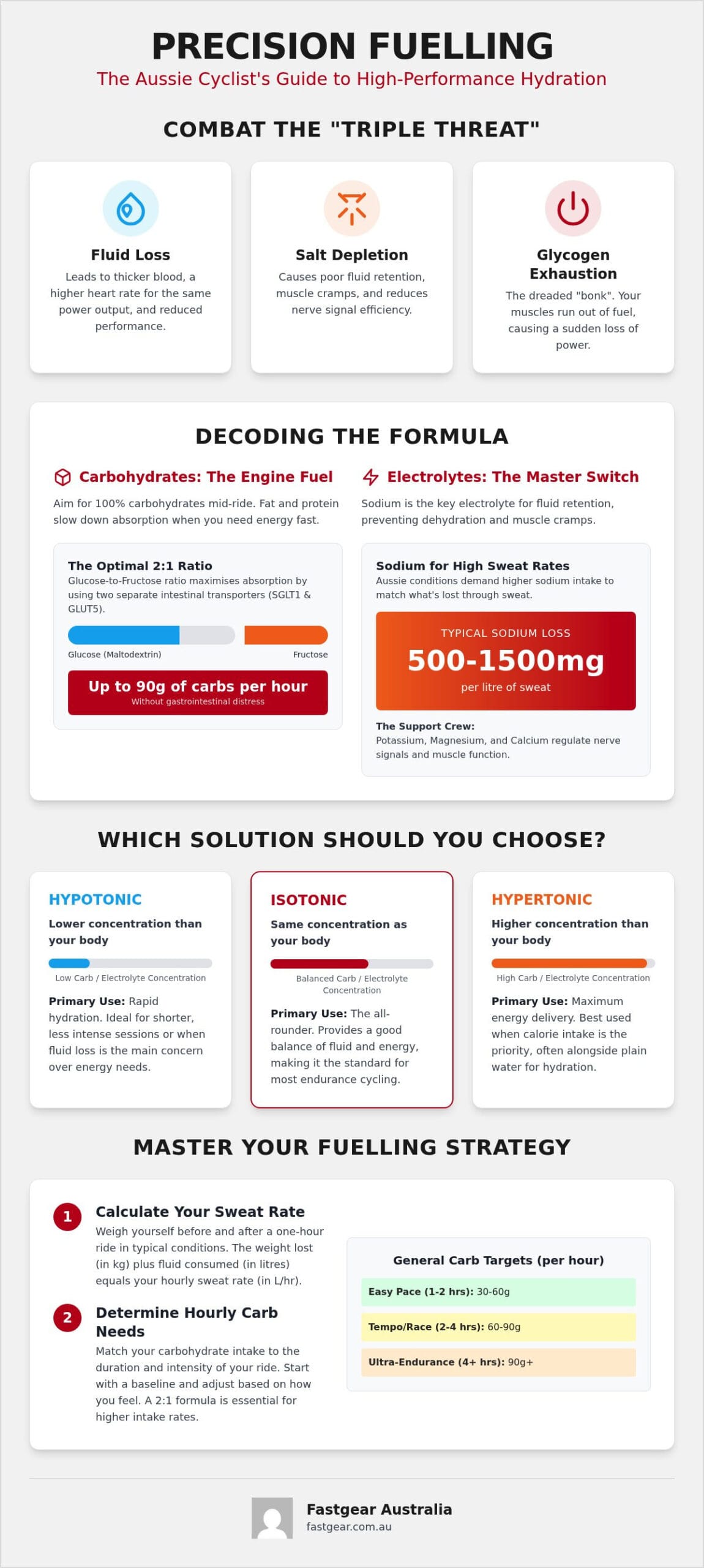
A high-performance hydration powder for cycling is a technical, concentrated blend of essential electrolytes and fast-acting carbohydrates. It’s designed to solve the “Triple Threat” every Aussie cyclist faces during endurance efforts: fluid loss, salt depletion, and glycogen exhaustion. While chugging plain water might stop your mouth from feeling dry, it often fails to address the underlying physiological crisis. Sports drinks, also known as electrolyte drinks, are engineered to facilitate rapid absorption through the gut wall. This is the core of bioavailability. On a 100km ride through the heat of the Adelaide Hills or the humidity of Queensland, your body needs more than just wetness. It needs a solution that moves from your bottle to your bloodstream with maximum efficiency to maintain plasma volume and cellular function.
The Role of Sodium and Electrolytes
Sodium is the master switch for fluid retention in the bloodstream. Without it, the water you drink simply sits in your stomach or passes through the kidneys, leading to frequent nature breaks rather than better performance. Electrolytes are minerals that carry an electric charge essential for muscle contractions. By maintaining specific sodium levels, you create the osmotic pressure required to pull water into your cells. Potassium, magnesium, and calcium act as the support crew for this process. They regulate nerve signals and muscle relaxation, serving as your primary defence against mid-climb leg spasms. Precision in your electrolyte mix ensures your muscles fire correctly under the heavy load of a long-distance ride.
The “Bonk” vs. Dehydration
It’s vital to distinguish between running out of fuel and running out of fluid. The “bonk” occurs when you hit glycogen depletion; your muscles have literally run out of sugar to burn. Dehydration is a volume issue where your blood thickens, making it harder for your heart to deliver oxygen to working muscles. Modern hydration powder for cycling bridges this gap by providing dual-purpose fuelling. These powders deliver the glucose needed for power while simultaneously managing fluid balance. Watch for red flags on your head unit. If your heart rate is 10 beats higher than usual for the same power output, you’re likely dehydrated. If your legs feel like lead but your heart rate won’t rise, you’ve likely bonked. Using an engineered mix allows you to fight both battles at once, keeping your power output consistent from start to finish.
Decoding the Label: Essential Ingredients in Quality Powders
Picking a hydration powder for cycling requires more than a glance at the flavour. You need to scrutinise the technical specifications. For mid-ride performance; the ideal ratio is almost always 100% carbohydrates. Fat and protein slow down gastric emptying, which is the last thing you want when pushing 300 watts. High-performance brands like Maurten and Tailwind focus on clean ingredient panels. They strip away the artificial colours and fillers that cause gastrointestinal distress in the heat of an Aussie summer. Following the ACSM fluid replacement guidelines ensures your intake matches your output, but the source of those calories matters just as much as the volume.
Carbohydrate Sources: Maltodextrin, Fructose, and Cluster Dextrin
Your gut has limits on how much sugar it can process per hour. Using a 2:1 ratio of glucose (often as maltodextrin) to fructose allows you to bypass single-channel bottlenecks. Glucose uses the SGLT1 transporter while fructose uses GLUT5. By hitting both channels; you can absorb up to 90g of carbs per hour without the dreaded ‘sloshing’ stomach. Maurten takes this further with hydrogel technology. It encapsulates the carbohydrates in a pH-sensitive structure that bypasses the stomach entirely, releasing fuel only once it hits the small intestine. This tech is why serious athletes prioritise these premium hydration powders for race day. For high-intensity training windows where gut comfort is paramount, Maurten 160 powder applies this same hydrogel science in a lower-carbohydrate formulation specifically suited to interval sessions and shorter efforts.
Electrolyte Concentrations for High Sweat Rates
Sodium is the heavy lifter here. While many commercial drinks under-dose; a technical hydration powder for cycling should provide significant sodium to match Aussie sweat rates. Many athletes lose between 500mg and 1500mg of sodium per litre of sweat. Don’t fall for the myth that magnesium is the sole cure for leg cramps. While magnesium supports muscle function; sodium is what maintains the blood volume that prevents the cramp in the first place. Technical options like Fastgear Elyte provide 1000mg of sodium per serving to meet these extreme demands. Balance is key. Too much salt makes the drink unpalatable; too little leads to hyponatremia. Aim for a mix that remains drinkable even after four hours in the saddle.
Isotonic vs. Hypotonic vs. Hypertonic: Which Should You Choose?
Your gut’s ability to process fuel is dictated by osmolality. This is a technical measure of the concentration of particles, such as carbohydrates and electrolytes, compared to your blood plasma. Getting this balance right determines whether your hydration powder for cycling actually enters your bloodstream or simply sloshes around in your stomach. Most Aussie riders default to whatever tastes good; however, high-performance athletes select their mix based on the intensity and duration of the effort. There are three primary categories to consider:
- Hypotonic: These have a lower concentration of particles than blood. They are absorbed faster than plain water and are ideal for rapid rehydration on extremely hot days when fluid loss is high but calorie needs are low.
- Isotonic: These match the concentration of your blood. According to the Australian Food Standards Code, an isotonic drink must have an average osmolality of 250 to 340 mOsm/L. They provide a balanced delivery of fluid and energy.
- Hypertonic: These have a higher concentration than blood. While they are absorbed more slowly, they deliver a massive dose of fuel. These are the go-to for ultra-endurance events where calorie replacement is the priority.
When to Use Isotonic Mixes
Isotonic solutions are the workhorses of the cycling world. They are perfect for high-intensity efforts like criterium racing or interval sessions where you need quick energy without the risk of a heavy stomach. Because the concentration matches your body, gastric emptying is rapid and efficient. If you’re using products like SIS – GO Isotonic Gels or tailwind powder, you’re targeting that balanced delivery. These mixes ensure you stay hydrated while keeping your glycogen stores topped up during those punchy, hour-long efforts where there’s no time for solid food. They eliminate the guesswork for mid-distance rides.
The Case for High-Carb Hypertonic Drinks
Liquid fuelling is revolutionising how Aussie cyclists tackle 100km+ rides and Ironman events. Hypertonic drinks, like maurten 320 powder, allow you to consume a massive amount of energy without the spiking effect of simple sugars. By transitioning from gels to high-carb powders, you achieve a steadier state of energy delivery. This strategy simplifies your race-day plan; you simply drink your calories and focus on the road ahead. However, this requires gut training. You can’t just jump into a race with 80g to 100g of carbs per hour. Start with smaller doses during training to teach your digestive system to handle the load. This methodical approach ensures zero gut issues when it matters most.
How to Optimise Your Hydration Strategy: A Step-by-Step Guide
Thirst is a lagging indicator. If you wait until you’re parched to drink your hydration powder for cycling, you’ve already lost the performance battle. Precision requires a proactive protocol that moves beyond guesswork. Follow this five-step strategy to dial in your intake for your next big ride.
- Step 1: Calculate your hourly sweat rate. Weigh yourself naked before and after a one-hour threshold ride. Every 1kg of weight lost equals one litre of fluid deficit. Use this data to determine your baseline replacement volume.
- Step 2: Determine your carbohydrate needs. Match your intake to ride intensity. Low-intensity base miles require roughly 30g per hour. For race-pace efforts or long climbs, push toward 90g using high-carb mixes like Maurten 320.
- Step 3: Mix your bottles the night before. This ensures the powder is fully dissolved. It prevents gritty textures and ensures a consistent osmotic profile from the first sip to the last.
- Step 4: Set a “sip timer” on your bike computer. Discipline beats intuition. Aim for a small intake every 10 to 15 minutes. This maintains a steady flow of nutrients and prevents the “sloshing” caused by bolus drinking.
- Step 5: Adjust for temperature. In extreme heat, your sweat rate increases but your gut’s ability to process carbs often drops. Dilute your mix slightly to prioritise fluid absorption while maintaining electrolyte levels.
Mixing for the Aussie Summer
Flavour fatigue is a genuine threat during a four-hour ride in 35-degree heat. Overly sweet drinks often become unpalatable as the day wears on. Use the “Ice-Sock” trick; slide a wet, frozen sock over your bottle to keep the contents cool through evaporation. For high-humidity days, consider a separate salt-only bottle using high-performance hydration powders alongside your primary carb mix. This allows you to manage extreme sodium needs independently of your energy intake, ensuring you don’t over-consume sugar just to stay hydrated.
Pre-Loading and Recovery
Hyper-hydration before a big event involves increasing your fluid and sodium intake 12 to 24 hours prior. This expands your plasma volume; it provides a vital buffer against the inevitable losses during the ride. Post-ride, your hydration powder for cycling should kickstart the glycogen replenishment process by delivering fast-acting sugars to depleted muscles. Recovery hydration should include sodium to ensure fluid is retained rather than excreted. This methodical approach ensures you bounce back faster for tomorrow’s session.
Fueling Your Performance with Fastgear Australia
Fastgear Australia functions as more than a retail outlet; we are your technical performance partner. We specifically curate our range to withstand the unique environmental pressures of the Australian continent. From the dry heat of the Nullarbor to the tropical humidity of North Queensland; our selection of hydration powder for cycling is chosen for its proven bioavailability and gut-friendly profiles. Choosing a specialist means you benefit from a deep understanding of endurance sports science. We don’t just sell products. We provide the technical tools you need to eliminate the bonk and maintain peak power output.
A complete fuelling strategy often requires more than just a single bottle. You can easily bundle your preferred powder with SIS – GO Isotonic Gels or Clif – BLOKS Energy Chews to create a layered energy approach. This ensures you have both liquid and solid options to manage hunger and energy fluctuations over long durations. Our collection is organised to help you find exactly what you need for your specific race distance and intensity. You can access our full range with fast national shipping to ensure your kit is ready before the next event.
Our Top Picks for Long-Distance Cyclists
We stock the world’s leading endurance brands because they deliver results when the pressure is on. tailwind powder is our premier all-in-one solution. It’s designed for riders who prefer to get all their calories and electrolytes from their bottles; eliminating the need for separate gels. For those targeting pro-peloton levels of intake; maurten 320 powder is the gold standard. Its hydrogel technology allows for an exceptionally high carbohydrate count without the typical sugar crash or stomach upset. For your daily training sessions; SIS – GO Isotonic Gels provide reliable; cost-effective hydration that keeps your sessions productive and your recovery on track.
Expert Advice and National Support
The team at Fastgear Australia understands the rigours of high-level training and competition. We support the local cycling community by providing technical expertise that goes beyond the label. Whether you’re preparing for your first century or a world-class triathlon; we help you dial in the specifics of your hydration powder for cycling. We prioritise efficiency; which is why we offer fast national delivery across Australia. You can order with confidence; knowing your race-day fuel will arrive in time for your final taper. Our goal is to simplify your logistics so you can focus entirely on the road ahead.
Shop the full range of cycling hydration powders at Fastgear Australia
Dominate Your Next Ride
Precision is the difference between a podium finish and a mid-ride collapse. By mastering osmolality and matching your carbohydrate intake to intensity, you eliminate the physiological guesswork that leads to the bonk. You now have the tools to calculate your specific sweat rate and select a technical hydration powder for cycling that actually works in the Australian heat. Whether you need the high-carb efficiency of Maurten or the all-in-one simplicity of Tailwind, your choice should always be data-driven and technically sound.
Fastgear Australia is your dedicated performance partner and an authorised retailer of global leaders like Maurten and Tailwind. We combine specialised endurance sports expertise with fast Australia-wide shipping to ensure you’re never without your race-day fuel. It’s time to stop guessing and start executing with precision. Optimise your ride with our curated hydration range at Fastgear Australia. Your best performance of the 2026 season starts with the right bottle mix. See you on the road.
Frequently Asked Questions
Is hydration powder better than electrolyte tablets for cycling?
Powders are generally superior for performance because they offer customisable carbohydrate delivery alongside essential electrolytes. Tablets usually focus on hydration alone with minimal calories. For endurance efforts, a hydration powder for cycling provides the dual-purpose fuelling needed to maintain power, whereas tablets are better suited for short recovery spins or low-intensity commutes where energy replacement isn’t the priority.
How many grams of carbohydrates should I aim for per hour of cycling?
Aim for 30g to 90g of carbohydrates per hour depending on your ride intensity and duration. For sessions under two hours, 30g to 60g is sufficient for most Aussie riders. Ultra-endurance events or high-intensity racing may require up to 90g per hour to prevent glycogen depletion. Always test these higher limits during training to ensure your gut can handle the load before race day.
Can I mix different brands of hydration powder in one bottle?
You can mix brands, but it’s technically risky because it alters the intended osmolality of the solution. Each brand is engineered with specific ratios of glucose to fructose and sodium to ensure rapid absorption. Combining them might lead to a hypertonic mix that slows gastric emptying and causes stomach issues. It’s better to use one brand per bottle to maintain a predictable and efficient absorption rate.
Why does my stomach hurt when I use certain hydration powders?
GI distress is often caused by high concentrations of simple sugars or artificial fillers like sorbitol. If the drink is too concentrated, it pulls water from your blood into your gut, causing bloating and cramps. Switching to a clean hydration powder for cycling that uses maltodextrin or hydrogel technology can often resolve these issues by bypassing the stomach and speeding up the absorption process.
Do I need a hydration powder for rides shorter than 60 minutes?
Not usually, unless the temperature is extreme or the intensity is exceptionally high. For a standard one-hour recovery ride, plain water or a light electrolyte tablet is often enough. However, if you’re doing a 60-minute criterium or high-intensity intervals in the Aussie sun, using a powder ensures you don’t start your recovery in a deficit. It’s about maintaining a baseline for your next session.
What is the best way to clean my bottles after using sticky hydration powders?
Rinse your bottles with warm, soapy water immediately after every ride to prevent mould growth and stubborn residues. For high-carb mixes, use a bottle brush and a mixture of bicarbonate of soda and water to neutralise odours. To find specialised tools for maintaining your gear, you can explore Online Retail Sales at Happy Home Shopping Guyana for niche kitchen gadgets that simplify the cleaning process. Let them air dry completely with the lids off. Replacing your bottles every six months is a good standard for hygiene if you use performance powders daily.
Should I use caffeinated hydration powder for every ride?
No, caffeine should be used strategically rather than habitually to maintain its effectiveness. While it lowers perceived exertion and improves focus, over-reliance can lead to jitteriness or an excessively high heart rate. Save caffeinated powders for the final third of a long race or for particularly brutal interval sessions. This ensures you get the maximum ergogenic benefit when you actually need it most.
How much sodium do I really need if I am a “salty sweater”?
Salty sweaters often require 1000mg to 1500mg of sodium per litre of fluid to maintain performance. If you see white streaks on your kit after a ride, you’re likely losing more salt than the average cyclist. Standard drinks often under-deliver on sodium. Look for high-strength electrolyte mixes specifically designed for high sweat rates to prevent hyponatremia and maintain the blood volume required for cooling.
