
Uncategorized
Compressport Free Belt Pro Review: The Ultimate High-Performance Storage for Aussie Trail Runners
Aug
Your heavy hydration vest might actually be the biggest obstacle between you and a personal best on the demanding trails across our sunburnt country. While packs are the standard choice for many, they often lead to unnecessary chafing, trapped heat, and gear bounce that disrupts your rhythm. You want to move fast and stay cool without sacrificing your access to essential nutrition and safety gear.
We understand that managing core temperature during a humid Aussie summer run is just as critical as your training volume. That’s why the Compressport free belt pro has become the tactical advantage for elite trail runners across the country. This review explores how this streamlined storage solution eliminates the bulk of a traditional pack while providing secure, accessible space for your Maurten gels and trekking poles.
Discover the performance benefits of the latest 2.0 version, featuring refined sizing and reinforced openings designed for the rigours of the country’s toughest ultra-marathons. We’ll break down the technical specifications, comfort levels, and why this belt is the ultimate tool for heat management and speed on the trail.
Key Takeaways
- Learn how the seamless microfibre construction of the Compressport free belt pro eliminates chafing and improves core temperature regulation.
- Master the 360-degree pocket system to organise your mandatory gear for bounce-free stability on technical descents.
- Understand the tactical advantages of waist-based storage for maintaining speed and accessibility during high-intensity races.
- Get a step-by-step packing guide to balance weight distribution and ensure easy access to soft flasks and Maurten gels.
- Discover why sourcing your gear from Australian endurance specialists ensures you’re ready for the unique demands of local trails.
What is the Compressport Free Belt Pro and Why Does it Matter?
The Compressport free belt pro isn’t just another waist pack. It’s a piece of technical equipment engineered for the sharp end of racing. Designed specifically for the demands of ultra-distance trail running and long-course triathlon, this belt provides a high-capacity storage solution that sits flush against your body. It replaces the traditional, restrictive running vest with a single piece of seamless microfibre. For athletes who value speed and efficiency, shedding the weight of a backpack is a genuine tactical advantage.
You can easily organise all your race-day essentials including:
- Large-format smartphones and keys
- Up to 1.5 litres of hydration in soft flasks
- Energy nutrition like Maurten gels or GU packets
- Emergency gear such as foil blankets and whistles
- Trekking poles via integrated silicone loops
This belt matters because it solves the fundamental problem of gear access. You don’t have to stop or reach behind your shoulders to grab a gel. Everything is accessible via a 360-degree opening. It’s about maintaining momentum. When you’re redlining on a climb, the last thing you need is a bouncing pack or a complicated zip. The Free Belt Pro keeps your essentials secure and your focus on the trail ahead.
The Evolution of Trail Storage in Australia
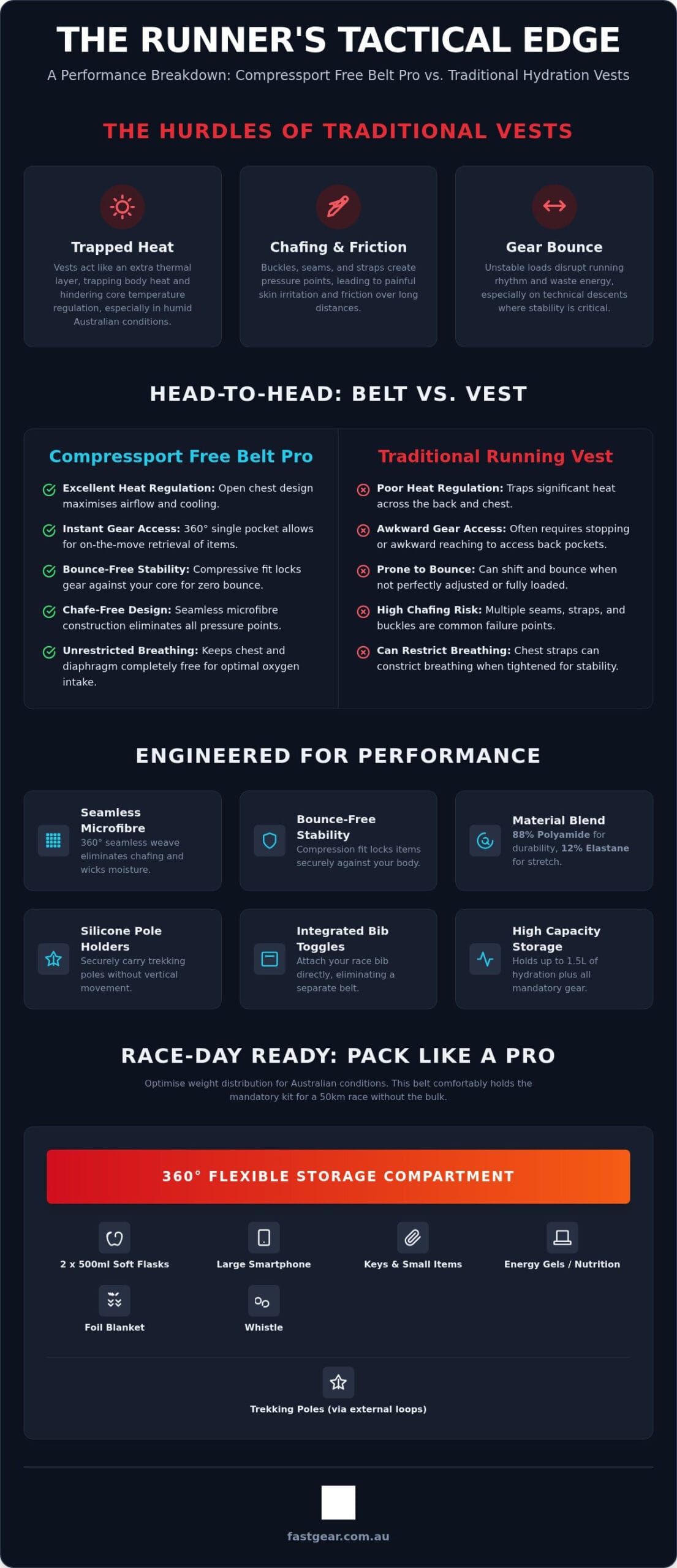
Aussie runners face unique environmental challenges. High humidity and intense heat make traditional vests feel like a thermal layer you simply can’t remove. We’ve seen a clear shift toward “minimalist-maximalist” gear in the local scene. This involves carrying the same mandatory kit list required for major events but with significantly less bulk. By the 2026 season, elite athletes are increasingly opting for waist-based systems to keep their chests open for better breathing and core temperature regulation. The Compressport free belt pro fits this performance gear landscape perfectly. It offers enough volume for a 50km race kit without the heat trap of a heavy pack.
Seamless Technology: The End of Chafing
Long hours on the move usually lead to friction. Traditional belts with buckles and seams often fail at the 30km mark, resulting in painful skin irritation. This belt uses a 360-degree seamless weave that eliminates pressure points entirely. The breathable microfibre material is highly hydrophobic. It won’t soak up sweat and become heavy during intense efforts. It wicks moisture away from your skin, keeping you dry even in the tropical conditions of a Queensland summer run. The “Stay-In-Place” technology is achieved through a precise blend of 12% elastane and 88% polyamide, ensuring the belt remains locked to your pelvic bone regardless of the terrain or the load you’re carrying.
Technical Breakdown: Bounce-Free Engineering for Elite Performance
Stability on technical trails requires more than just tight fabric. The Compressport free belt pro utilises a 360-degree single pocket system that wraps around your waist. This layout provides total flexibility. Unlike compartmentalised belts that limit where you place specific items, this open architecture lets you distribute weight based on your own centre of gravity. The compression properties are specifically tuned to lock gear against the small of your back, preventing the rhythmic thud of a bouncing smartphone or flask.
Integrated silicone pole holders are a game changer for technical ascents and descents. They eliminate vertical movement by gripping the poles firmly against the lower back. This prevents that annoying rhythmic shifting common with cheaper alternatives. You can deploy or stow your poles in seconds without breaking your stride. It’s a level of engineering that prioritises momentum over all else.
Race day efficiency is about reducing friction. The built-in bib toggles mean you can finally retire your separate elastic race belt. It’s one less piece of gear to manage at the start line. By integrating the bib attachment directly into the storage system, Compressport has created a truly streamlined solution for the competitive athlete.
Storage Capacity: What Can You Actually Fit?
You aren’t limited to just keys and a card. This belt comfortably holds two 500ml soft flasks and a large-format smartphone without sagging. Maintaining Hydration during a long effort is easier when your water is literally at your fingertips. Organise your space by placing heavier flasks on the hips and tucking your Maurten gels into the front for “no-dig” access. You can grab fuel without fumbling with zips or stopping to adjust your kit. Even with a full load, the elastic remains taut and secure.
Weight and Breathability vs. The Competition
Every gram counts when you’re climbing 1,000 metres of vertical gain. Traditional running vests often weigh between 150g and 300g before you even add water. The Compressport free belt pro is a fraction of that weight. Because it sits on the waist, it leaves your chest and back exposed. This ventilation factor is crucial for keeping your core temperature lower than a vest allows, especially in humid Australian conditions. The elastic fibres are built for the long haul. They maintain their tension and “snap” even after hundreds of kilometres of use and repeated wash cycles. If you’re looking to optimise your race-day kit, you can explore the full Compressport range to see how these technical pieces work together.
Comparison: Compressport Free Belt Pro vs. Traditional Running Vests
Choosing between a hydration vest and a high-performance belt often depends on your specific race goals and the environmental conditions. While traditional vests are excellent for carrying large water volumes, they inevitably trap heat against your back and chest. The Compressport free belt pro offers a cooler alternative by leaving your upper body completely unobstructed. This lack of coverage is a massive advantage for thermoregulation during intense efforts in the Australian sun. While many athletes rely on vests for every outing, expert running belt reviews highlight that a dedicated waist system often provides better stability for high-cadence efforts.
Accessibility also differs significantly between the two systems. Vests typically offer chest pockets for nutrition, but accessing gear in the rear compartment usually requires you to stop or perform an awkward reach over your shoulder. The 360-degree wrap-around pocket of the belt allows you to slide your hand around your waist to grab a phone or a Maurten gel without breaking your stride. Stability is another key factor. A vest can “swing” if the straps aren’t perfectly tensioned, whereas the belt provides a secure “wrap” that moves with your hips. This reduces the vertical oscillation of your gear, which is particularly noticeable when you’re descending technical stairs or rock hopping.
When to Choose the Belt Over the Vest
For short to medium trail races up to 50km, speed is usually the priority. If the mandatory kit list is minimal, a belt is the superior choice for staying light and agile. It’s also the go-to option for hot and humid Australian races where a vest would lead to rapid overheating. Triathletes also find the Compressport free belt pro invaluable during the run leg of a 70.3 or Ironman. It allows them to carry their own specialised nutrition and salt tabs without the bulk of a pack, ensuring they aren’t reliant solely on what’s available at aid stations.
The Hybrid Approach for Ultras
In 100km or 100-mile events, the mandatory gear requirements often exceed the capacity of a belt alone. This is where the hybrid approach excels. You can use the belt to supplement your vest, moving heavy items like soft flasks and smartphones from your chest to your waist. This redistribution of weight to the hips helps to reduce shoulder fatigue and neck strain over long hours. Positioning heavy items around the hips ensures an ergonomic advantage by aligning the load with your natural centre of gravity, which significantly reduces the energy cost of stabilisation on uneven ground. It’s a professional setup that offers the best of both worlds: high capacity and peak comfort.
Race-Day Strategy: Packing Your Belt for Australian Conditions
Packing the Compressport free belt pro is a precise exercise in weight distribution. A poorly loaded belt leads to unnecessary movement, while a strategically organised one feels like it isn’t even there. Stability is non-negotiable. Follow this five-step protocol to ensure your gear remains secure from the first kilometre to the finish line.
- Step 1: Secure mandatory gear. Place your foil blanket and whistle in the rear of the belt. These items are rarely used but provide a flat, stable base against your lower back.
- Step 2: Balance hydration on the hips. Position 500ml soft flasks directly over your iliac crest. This centres the heaviest part of your kit over your natural pivot point, reducing the “pendulum effect” during technical descents.
- Step 3: Front-load high-carb nutrition. Tuck your Maurten or GU gels into the front section. You need these accessible when your heart rate is high and fine motor skills are fading.
- Step 4: Attach poles under tension. Only slide your trekking poles into the rear silicone loops once the belt is on your body. The tension of the elastic is what locks the poles in place.
- Step 5: Final bib check. Use the integrated toggles to secure your race number. Ensure it sits flat against your thigh so it doesn’t flap or catch the wind.
Don’t wait until race morning to test your setup. You can buy the Compressport Free Belt Pro at Fastgear Australia and begin dialling in your specific gear configuration during your long training runs.
Nutrition Integration: Maurten and GU Packing
The high-stretch microfibre allows for impressive volume without the “sausage roll” effect. You can comfortably fit up to six maurten gel 100 units across the front and sides. If you prefer solid fuel, Clif BLOKS Energy Chews or GU packets should be placed on your dominant hand side for quick retrieval. For those using tailwind powder, keep spare sachets tucked into the small of your back. This keeps them dry and away from the sweat-heavy zones on your hips, ensuring the powder remains pourable at the next refill station. If you’re also a cyclist looking to sharpen your fuelling protocols, our comprehensive guide to cycling nutrition Australia covers science-backed strategies for managing high-carb intake and electrolyte loss in the local climate.
Managing the Australian Heat
Heat management is where this belt outperforms every vest on the market. In the humid conditions of an Australian summer race, a vest acts as an insulator. The Compressport free belt pro leaves your torso exposed, allowing for maximum sweat evaporation. To keep your hydration flasks slightly cooler, try sliding a small piece of insulating foam between the flask and your body. Because the microfibre is hydrophobic, it dries significantly faster than padded mesh. This prevents the belt from becoming a heavy, soggy anchor during the mid-day heat segments of your race.
Why Buy Your Compressport Gear from Fastgear Australia?
Ordering technical gear from international retailers often leads to frustrating customs delays and hidden import fees. Fastgear Australia provides a local, high-performance alternative with national shipping that ensures your kit arrives before your next weekend long run. We don’t just stock the Compressport free belt pro; we’ve tested it on the same technical trails where you train and race. This local expertise means we understand how the gear performs in 35-degree heat and high humidity, allowing us to provide advice that’s actually relevant to your environment.
Our support team consists of endurance athletes who understand the rigours of the sport. We aren’t just a warehouse; we’re a dedicated performance partner. When you buy from us, you’re accessing a wealth of knowledge on gear setup and race-day logistics. Whether you’re preparing for your first 50km trail event or aiming for a podium in a long-course triathlon, we help you dial in your equipment so nothing is left to chance on the start line.
The Fastgear Performance Ecosystem
We’ve built a curated ecosystem designed for peak efficiency. You can pair your Compressport free belt pro with a Compressport Trail Racing SS Tshirt to create a friction-free system that manages sweat and prevents chafing. Our range includes world-class nutrition like Maurten and technical hardware like Wove M8 Road / Tri Saddles. This allows you to source your entire race-day kit in one transaction. By choosing specific brands that work together, you ensure your fueling strategy and gear storage are perfectly aligned for maximum speed.
Ready to Race?
The Compressport free belt pro represents a significant storage upgrade for any runner looking to shed weight and improve core temperature regulation. It’s the elite choice for those who value agility and quick access to nutrition. Before you make your selection, follow this final checklist for a bounce-free fit:
- Measure your hips at the widest point rather than your natural waistline.
- If you’re between sizes, we recommend sizing down for a more secure, compressed fit during high-impact descents.
- Ensure the belt sits low on your hips, just above the glutes, to maintain a low centre of gravity.
- Test your full race-day load, including soft flasks and smartphones, during a shorter training session first.
Don’t let a bulky hydration vest slow you down or cause you to overheat during the height of summer. Upgrade your storage system today and experience the freedom of a minimalist, high-capacity setup. Shop the Compressport Free Belt Pro at Fastgear Australia and take the first step toward a faster, more comfortable race day.
Optimise Your Race-Day Setup
Success on the trail requires more than just fitness; it requires a kit that works with your body, not against it. Switching to the Compressport free belt pro allows you to ditch the bulk of a hydration vest while maintaining secure access to your mandatory gear and nutrition. You’ll benefit from improved thermoregulation and a lower centre of gravity, which are critical tactical advantages during technical descents in the Australian heat. It’s a streamlined solution that lets you focus entirely on your pace and the terrain ahead.
Fastgear Australia is your Authorised Compressport Australian Retailer and a team of specialised endurance nutrition experts. We provide fast national shipping across Australia to ensure you’re fully equipped for your next start line. Whether you’re racing a 50km ultra or a long-course triathlon, we have the technical gear and expertise to help you reach your peak. It’s time to experience the freedom of bounce-free, high-performance storage.
Upgrade your race-day storage with the Compressport Free Belt Pro at Fastgear
Take your performance to the next level and stay focused on the trails. We’ll see you out there.
Frequently Asked Questions
Does the Compressport Free Belt Pro bounce when fully loaded?
No, provided you’ve selected the correct size and distributed the weight evenly across your hips. The 360-degree compression keeps gear locked against your body to eliminate vertical movement. For the best result, place heavier items like soft flasks on your hip bones rather than the small of your back to align the load with your centre of gravity.
What size Compressport Free Belt Pro should I choose for a snug fit?
You should measure your hips at the widest point, not your waist, to find the most accurate fit. The Compressport free belt pro 2.0 version released in July 2026 now features four sizes for better precision. If you’re between sizes, choose the smaller option. A tighter fit ensures the compression remains effective when carrying a full load of nutrition.
Can I carry trekking poles on the Free Belt Pro during a race?
Yes, the belt features dedicated silicone loops on the rear specifically for trekking poles. These loops are designed to hold foldable poles securely without any rattling or shifting while you move. The silicone grip prevents the poles from sliding out during high-impact descents. You can easily stow or deploy them while running without having to stop.
Will a large smartphone like an iPhone Pro Max fit in the belt?
Yes, the high-stretch microfibre easily accommodates large-format smartphones including the iPhone Pro Max. The 360-degree wrap-around pocket expands to fit bulky items without compromising the belt’s overall stability. Because there are no restrictive internal dividers, you can position your phone wherever it feels most comfortable against your body, usually in the small of your back.
Is the Free Belt Pro 2.0 waterproof or sweat-resistant?
The material is highly breathable and hydrophobic, meaning it doesn’t absorb sweat or water during your run. While it isn’t strictly waterproof, it won’t become heavy or soggy during a humid Aussie summer. If you need to keep electronics completely dry during a heavy downpour, we recommend using a small dry bag or zip-lock pouch inside the belt.
How do I wash my Compressport belt to ensure it lasts?
We recommend hand washing or using a gentle machine cycle in a laundry bag at 30 degrees. Avoid using fabric softeners or bleach, as these can damage the technical elastic fibres and reduce the compression over time. Air dry the belt in the shade rather than using a tumble dryer. Proper care ensures the belt maintains its shape for hundreds of kilometres.
Can I use the Free Belt Pro for Ironman triathlon run legs?
Yes, many triathletes use the Compressport free belt pro to carry their own specialised nutrition and salt tablets during the run leg. It’s a popular choice for 70.3 and full Ironman distances because it’s lighter and cooler than a vest. The integrated bib toggles also mean you don’t need a separate race belt, simplifying your transition from bike to run.
Is the belt comfortable to wear directly against the skin?
The belt is constructed from a single piece of seamless microfibre, making it exceptionally comfortable against the skin. There are no buckles, zips, or seams to cause irritation or chafing over long distances. It’s designed to be soft yet durable, providing a “second skin” feel that allows for a full range of motion during high-intensity efforts.
