
Uncategorized
Best Swimming Goggles for Triathlon Australia: The 2026 Performance Guide
Aug
What if your 1.5km swim leg turned into a 1.8km slog simply because you couldn’t see the sighting buoy through a haze of fog and glare? In Australian open water, visibility isn’t just a convenience. It’s a critical performance metric. If you’re fighting a leaking seal or stinging saltwater mid-race, you’re wasting energy and losing time. We know that nothing ruins a personal best faster than gear failure in the surf. Finding the best swimming goggles for triathlon Australia requires balancing technical hydrodynamics with the harsh reality of our intense UV levels.
This 2026 performance guide helps you master the swim leg by selecting, fitting, and maintaining professional-grade eyewear. You’ll learn how to eliminate eye fatigue from sun glare and prevent painful saltwater chafing using technical solutions like the Mugiro neck protector. We’ll preview the latest smart goggle technology, custom 3D-printed fits, and essential anti-fog maintenance to ensure your vision remains crystal clear from the beach start to the T1 transition. Stop guessing and start seeing your path to the finish line with absolute precision.
Key Takeaways
- Understand how wide-angle vision and efficient sighting prevent energy-wasting navigation errors in open water.
- Identify why UV400 protection and polarised lenses are essential for managing the extreme glare of the Australian sun.
- Select the best swimming goggles for triathlon Australia by prioritising technical specs like high-grade silicone and hydrodynamic design.
- Implement the “Two-Pair” rule to ensure you always have a race-ready backup in your transition bag for unexpected gear failure.
- Master the “Dry Suction” test and pair your goggles with a Mugiro neck protector to guarantee a leak-free seal and zero saltwater chafing.
Visibility Equals Speed: Why Triathlon Goggles Matter
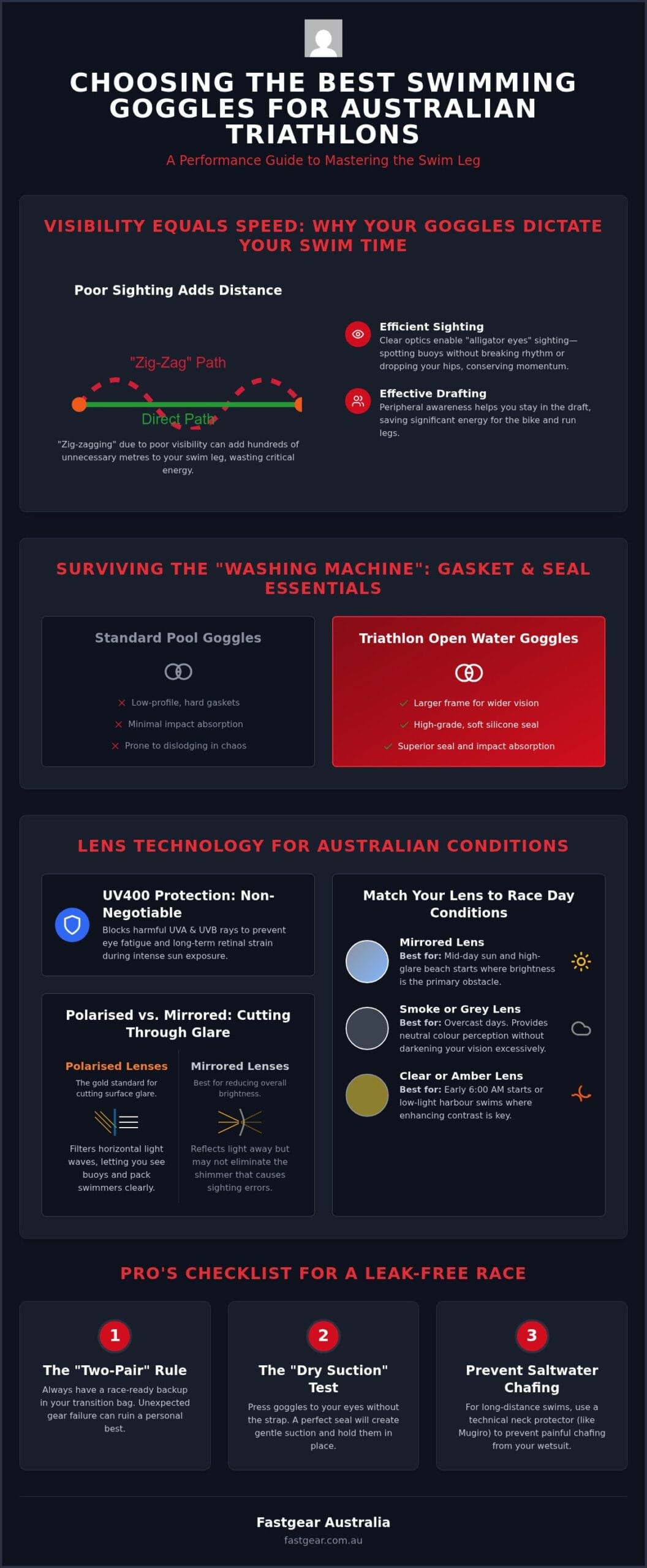
Speed in the water isn’t just about your stroke rate. It’s about the shortest distance between two points. In open water, poor visibility leads to “zig-zagging,” a common error that can add hundreds of metres to your race. Finding the best swimming goggles for triathlon Australia means choosing gear that prioritises sighting and peripheral awareness. While standard Swimming Goggles work for squad training, they often lack the technical features required for the ocean. Triathlon-specific models offer increased lens curvature and softer gaskets to handle the unique demands of a mass start.
Technical gear is a direct investment in your personal best. High-performance goggles reduce the cognitive load of navigation, allowing you to focus entirely on your power output. The difference lies in the details. Pool goggles are typically low-profile with hard gaskets for minimal drag in calm lanes. Open water goggles use larger frames and softer materials to provide a wider field of vision and better impact protection.
The Science of Sighting and Energy Conservation
Clear optics allow for efficient “alligator eyes” sighting. This technique involves lifting just your eyes above the waterline to spot a buoy without dropping your hips or breaking your rhythm. When you can see the pack clearly, you can draft more effectively. Research into endurance swimming shows that drafting can save significant energy for the bike leg. Comfort also plays a vital role in performance. A secure, comfortable fit helps maintain a relaxed heart rate during the chaotic first 400m, preventing the panic that occurs when water leaks into your lenses. The best swimming goggles for triathlon Australia must provide this mental and physical security.
Gaskets and Seals: Surviving the “Washing Machine”
The triathlon swim start is often called the “washing machine” for a reason. Accidental kicks and stray elbows are part of the sport. Larger silicone gaskets are essential here. They provide a wider surface area to distribute pressure and absorb impacts that would dislodge smaller pool goggles.
- High-grade silicone: Offers a superior seal that adapts to facial contours without excessive tension.
- Hydrodynamic profiles: Minimise drag during the entry and catch phase of your stroke.
- Pressure balance: A well-designed gasket provides suction without causing intense eye fatigue over long distances.
For long-distance events, gear compatibility is key. Using a technical neck protector alongside your goggles can prevent saltwater chafing, ensuring your focus remains on the finish line. You need a seal that holds firm under pressure but remains comfortable after 3.8km of salt-water immersion.
Essential Technical Specs for Australian Open Water
Australia’s coastline presents a brutal environment for endurance gear. With UV levels often reaching extreme categories, UV400 protection is a non-negotiable standard for the best swimming goggles for triathlon Australia. High-intensity radiation doesn’t just damage skin; it causes significant eye fatigue and long-term retinal strain during 90-minute ocean swims. Technical lenses must act as a barrier against both direct sunlight and the harsh reflection off the water. Choosing professional-grade materials ensures your vision remains sharp from the first buoy to the final sand sprint.
Polarisation vs. Mirrored Lenses
Choosing between Mirrored or Polarized Goggles depends on your specific race-day conditions. Polarised lenses are the gold standard for Australian triathletes. They use a technical filter to block horizontal light waves, effectively cutting through surface glare. This allows you to see the buoy clearly even when swimming directly into a rising sun. Mirrored coatings reflect light to reduce overall brightness but don’t always eliminate the shimmering glare that causes sighting errors in choppy swell.
Lens Tints for Aussie Conditions
Matching your lens tint to the morning forecast is a pro-level move that saves seconds on the course. Different lighting conditions require specific optical filters to maintain contrast.
- Mirrored: Essential for mid-day sun and high-glare beach starts where brightness is the primary obstacle.
- Smoke or Grey: Provides neutral colour perception on overcast days without darkening your vision too much.
- Clear or Amber: Best for 6:00 AM starts or low-light harbour swims where contrast is more important than shading.
Anti-Fog Technology and Maintenance
Saltwater is naturally corrosive. It degrades anti-fog coatings faster than standard pool chemicals. The best swimming goggles for triathlon Australia use high-grade silicone and scratch-resistant treatments to survive the coastline. Never rub the inside of the lens with your fingers; this destroys the delicate factory coating instantly. While the “lick and dip” method works in a pinch, professional anti-fog sprays are more reliable for long-course events. Always rinse your gear in freshwater immediately after every session to prevent salt crystals from perishing the straps or scratching the optics.
Optimising your setup for these conditions ensures you aren’t fighting your gear while fighting the tide. You can find a curated range of high-performance swimming goggles designed to meet these exact technical requirements.
Building Your Goggle Quiver: Training vs. Race Day
Building a “quiver” of eyewear is a standard practice for elite triathletes. You wouldn’t ride your carbon race wheels for every mid-week training session, and your optics deserve the same strategic approach. Using the best swimming goggles for triathlon Australia only on race day ensures the lenses remain pristine and the seals stay supple. Daily squad training in chlorinated pools is brutal on gear. Over time, chemicals degrade anti-fog coatings and cause silicone to lose its elasticity, leading to leaks when you can least afford them.
The Pool Trainer: Durability and Simplicity
Squad sessions require goggles that can handle high-intensity sets and frequent wall turns. Look for low-profile designs that reduce drag and stay secure during explosive push-offs. Durability is the priority here. Choose chlorine-resistant materials that won’t discolour or perish over a long season. Clear or light blue tints are ideal for indoor lanes or evening sets under stadium lights. These are your workhorses. Save the high-tech polarised coatings for the ocean where they are actually needed.
The Race Specialist: Maximum Field of Vision
Race-day optics are about situational awareness and comfort. You need wide-angle lenses, often offering 180-degree vision, to monitor the pack and spot distant landmarks without turning your head. These models feature premium gaskets designed for sustained comfort over 60 to 90 minutes of saltwater immersion. Hydrodynamic strap systems are also vital to ensure they stay locked under your swim cap during a chaotic beach start. To avoid race-day surprises, use your race goggles for at least three open-water sessions before the event. This confirms the seal holds under race-pace intensity and ensures you are familiar with the sighting clarity.
The “Two-Pair” Rule is essential insurance for every athlete. Always keep a backup pair in your transition bag. If a strap snaps or a seal fails five minutes before your wave starts, a second pair is your only way to stay in the race. Match these to the expected light conditions. An early morning start in lower light conditions might require clear lenses, while a bright, sunny midday race across many Australian courses demands the best swimming goggles for triathlon Australia with polarised protection. Pairing your race optics with technical accessories like the Mugiro – Neck Protector creates a complete performance system. This setup eliminates distractions, allowing you to focus purely on your navigation and stroke rate rather than gear failure.
Preventing Leaks and Chafing: The Professional Setup
Precision fitting is just as critical as high-end optics. Even the best swimming goggles for triathlon Australia will fail if the physical setup is flawed. Achieving a leak-free seal requires a methodical approach that accounts for facial anatomy and the movement of your stroke. Don’t wait until you’re at the water’s edge to test your fit. Follow this five-step professional setup to ensure your gear remains secure through the most chaotic beach starts.
- The Dry Suction Test: Press the goggle gaskets to your eyes without using the strap. A slight vacuum should hold them in place for a few seconds. If they fall immediately, the frame shape isn’t a match for your bone structure.
- Bridge Adjustment: If your model has interchangeable nose bridges, find the width that keeps the gaskets centred. A bridge that’s too narrow pulls the seal away from the outer corners of your eyes.
- Strap Tension: Over-tightening is a common rookie error. It distorts the silicone gasket and causes “goggle eye” headaches. The strap should be just tight enough to maintain the seal, not to crush the frame against your face.
- Cap Integration: Wear your goggle straps under your swim cap. This provides a hydrodynamic profile and prevents your goggles from being knocked off if you take a stray heel to the head in the pack.
- Anti-Chafe Application: Apply a technical barrier to your neck to manage the friction caused by the interaction between your skin, goggle straps, and wetsuit collar.
The Mugiro Solution: Beyond the Eyes
Saltwater acts as a powerful abrasive. During a long-distance swim, the constant rotation of your head creates a “sawing” effect where the goggle straps meet your neck. This often results in painful “wetsuit burn” that can ruin your run leg. The Mugiro – Neck Protector acts as a technical second skin. It creates a friction-free interface between your gear and your body, eliminating chafing for 70.3 and Ironman athletes. It’s a vital component of a complete performance system.
Troubleshooting Common Leak Points
If you’re still experiencing leaks, check for hair interference. Even a few strands of hair caught under the silicone gasket will break the surface tension and allow water to seep in. For male athletes, a clean shave on race morning is the most effective anti-leak strategy. Stubble prevents the silicone from creating a flush seal against the skin. If a leak occurs mid-swim, don’t stop and tread water. Roll onto your back, pull the bottom of the gasket slightly to drain the water, and press the frame back into place while maintaining forward momentum.
Ready to upgrade your race-day kit? Explore our curated range of high-performance swimming goggles and accessories to find your perfect fit.
Choosing Your Pair: The Fastgear Performance Selection
Fastgear Australia doesn’t just sell gear; we curate it. We understand that the best swimming goggles for triathlon Australia must withstand the high-salt, high-UV environment of our coastlines. Our selection process is rigorous. We prioritise technical specifications that serious athletes demand. Every pair in our range features UV400 protection and high-grade silicone gaskets. We focus on polarised optics to ensure you aren’t blinded by the morning sun reflecting off the Pacific or Indian Ocean. Technical reliability is our baseline. Performance optimisation is our goal.
Curated for the Australian Triathlete
Our selection criteria are simple. We only stock gear that survives the surf and the sun. Our team tests these models in local conditions to ensure they don’t perish under intense Australian UV exposure. Wide-vision lenses are a priority in our shop. In choppy water, being able to see 180 degrees allows you to track the pack and find the buoy faster without breaking your stroke. You get support from athletes who actually use this gear. We know the difference between a training lap at the local pool and a race start at Mooloolaba. We only recommend what we’ve proven on the course.
Complete Your Swim Kit
A performance system goes beyond eyewear. As established, the Mugiro – Neck Protector is essential for long-distance comfort. It prevents the friction that leads to race-ending chafing. But the swim leg also requires internal preparation. Pre-race fueling is vital for maintaining power through the swell. We recommend using a carbohydrate gels for endurance approximately 30 minutes before the klaxon. This provides the carbohydrate hit and mental focus needed for a high-intensity start. It’s the standard for athletes who refuse to compromise on race-day nutrition.
- Expert Selection: Only professional-grade endurance gear.
- Technical Focus: UV400, anti-corrosive coatings, and polarised lenses.
- Fast Logistics: National Australian shipping ensures your kit arrives before race weekend.
- Athletic Insight: Support from a team that understands the rigours of the sport.
Don’t leave your vision to chance. You can Browse the Fastgear Australia Swimming Goggle Range to find the exact pair for your next event. Whether you’re chasing a podium or a personal best, the right optics are your most important navigation tool. Get your gear sorted today and focus on the finish line.
Dominate the Open Water with Precision Optics
Mastering the swim leg requires more than just endurance. It demands absolute confidence in your equipment. By prioritising technical specifications like UV400 protection and polarised lenses, you can eliminate the sighting errors that add unnecessary distance to your race. Selecting the best swimming goggles for triathlon Australia means choosing gear that survives our extreme coastal conditions. Remember to maintain your goggle quiver and use a Mugiro neck protector to ensure your comfort lasts from the beach start to the final stroke.
Fastgear Australia provides specialised endurance gear curated by performance experts who understand the rigours of the Aussie coast. We focus on technical reliability and offer fast national shipping to get your race-day essentials to you when they matter most. Optimise your swim leg with Fastgear’s performance goggles and eliminate gear-related distractions on the course.
Your personal best is within reach. Trust your preparation, sight with absolute clarity, and let your hard work carry you through the surf. We’ll see you at the finish line.
Frequently Asked Questions
Are polarised goggles really worth it for triathlon?
Polarised lenses are essential for Australian triathletes because they filter horizontal light waves to eliminate surface glare. This allows you to sight buoys clearly even when swimming directly into a rising sun. While they require a higher initial investment than standard tints, the energy saved from better navigation makes them a superior choice for competitive race days.
How do I stop my swimming goggles from fogging up during a race?
Stop fogging by applying a professional anti-fog spray before your race and rinsing briefly in freshwater. Never touch the inside of the lens with your fingers as this destroys the factory coating instantly. If you’re using older gear, a light application of baby shampoo or a dedicated anti-fog solution provides a reliable barrier against condensation in cold water.
Should I wear my goggles under or over my swim cap?
Wear your goggles under your swim cap to ensure they remain secure during a chaotic mass start. This setup creates a hydrodynamic profile and prevents the straps from being knocked loose by other swimmers’ limbs. It also helps lock the seal against your face, significantly reducing the risk of leaks when you dive or hit choppy swell.
Can I use my pool goggles for an ocean triathlon?
You can use pool goggles, but they lack the wide-angle peripheral vision required for effective open water navigation. Pool models often have harder gaskets that don’t absorb impacts as well as the best swimming goggles for triathlon Australia. For ocean races, choose specialised eyewear with softer, larger silicone seals to protect against accidental kicks in the pack.
What is the best lens colour for a sunrise race start in Australia?
Clear or amber lenses are best for the low-light conditions of a 6:00 AM start. However, if the course turns back towards the rising sun, polarised lenses become necessary to manage the sudden intensity. Many athletes choose a light-tinted polarised lens as a versatile middle ground for the varying light conditions found on Australian coastlines.
How do I prevent my wetsuit and goggle strap from chafing my neck?
Prevent painful chafing by using a specialised Mugiro neck protector between your skin and your gear. Saltwater increases friction, leading to “wetsuit burn” during long-course events. Unlike petroleum jelly which can damage neoprene, a technical protector provides a physical barrier that stays in place for the entire duration of a 3.8km swim leg.
How often should I replace my triathlon goggles?
Replace your race goggles every four to six months if you use them for regular open water sessions. Chlorine and saltwater eventually perish the silicone seals and degrade the anti-fog treatments. If you notice a loss in optical clarity or the straps feel brittle, it’s time to upgrade. Always keep a fresh pair specifically for race day to ensure peak performance.
What should I do if my goggles get kicked off during the swim start?
Stay calm and roll onto your back to create space from the pack if your goggles are dislodged. Locate your eyewear immediately and clear any water before reseating them firmly. If you’ve followed the “under the cap” rule, they’ll likely still be hanging from your head, allowing for a quick fix without wasting energy treading water.
