
Uncategorized
Trail Running Accessories Australia: The 2026 Performance Gear Guide

Sep
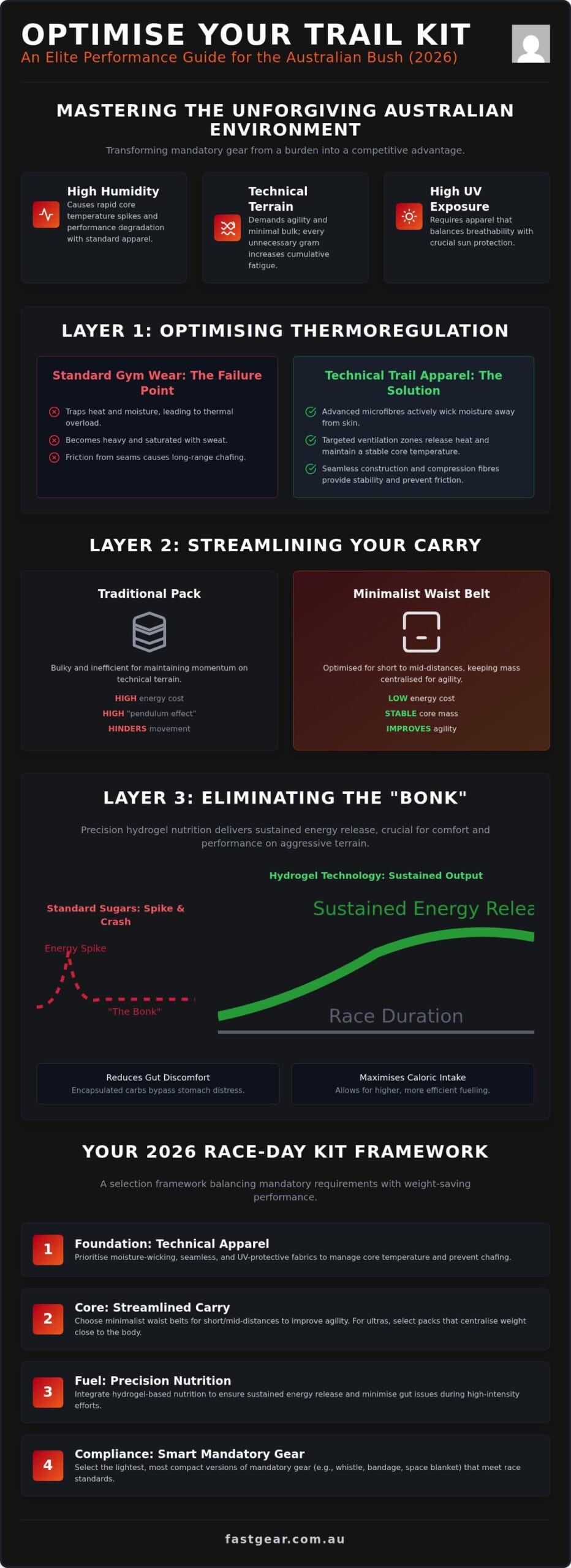
In the unforgiving Australian bush, technical gear isn’t just a requirement; it’s a performance multiplier that determines whether you crush your PB or succumb to the heat. You understand that high humidity and technical terrain demand more than just mental grit. To maintain peak output, your setup must be as disciplined as your training block. This guide shows you how to optimise every kilometre using the most advanced trail running accessories Australia has to offer for the 2026 season.
We agree that chafing and “bonking” are avoidable failures that shouldn’t dictate your race day. We promise to help you refine your kit for maximum efficiency, ensuring you remain comfortable in extreme conditions while meeting strict mandatory gear standards. We’ll preview the essential synergy between moisture-wicking apparel, precision hydrogel fuelling, and streamlined hydration belts designed for elite endurance athletes. Prepare to transform your approach to technical terrain and shave minutes off your next ultra-trail finish.
Key Takeaways
- Master thermoregulation by selecting technical apparel that manages core temperature in high Australian humidity.
- Streamline your race-day setup with high-performance trail running accessories Australia athletes use to reduce bulk and improve technical agility.
- Eliminate the “bonk” with precision hydrogel nutrition designed for gut comfort and sustained energy on aggressive terrain.
- Optimise storage efficiency by transitioning from bulky packs to minimalist waist belts for short and mid-distance events.
- Build a compliant race-day kit using a selection framework that balances 2026 mandatory requirements with weight-saving performance.
Mastering the Australian Bush: Why Technical Trail Accessories Matter
In the Australian bush, the margin between a podium finish and a DNF is often found in the technical details of your kit. Many runners view trail running accessories Australia as a simple safety checklist for race registration. This is a mistake. High-performance accessories are engineered to enhance speed, comfort, and efficiency; they transform gear from a burden into a competitive advantage. While mandatory gear lists provide a baseline for survival, a performance-optimised kit focuses on athletic output.
The 2026 standard for elite athletes is “light and fast.” On technical terrain, every unnecessary gram creates drag and increases cumulative fatigue. Transitioning from a survival-based mindset to a streamlined setup allows you to maintain momentum on steep ascents and technical descents where bulky gear hinders movement. Speed requires gear that disappears during the effort.
The Performance Mindset: Gear as a Tool
Choosing the right kit reduces cognitive load during high-intensity efforts. When your gear functions seamlessly, you stop thinking about discomfort and focus entirely on line choice and pace. Performance accessories are tools that minimise friction and maximise output. Proper weight distribution is also vital for running economy. By centralising mass close to the core, you reduce the pendulum effect that wastes energy during lateral movements on uneven Australian trails. Efficiency is the result of precision engineering.
Adapting to the Australian Environment
Australian trails present extreme variables like high UV exposure and punishing humidity. Standard gym wear often traps heat, leading to rapid core temperature spikes and performance degradation. Technical fabrics prioritising moisture-wicking properties are essential for maintaining thermoregulation in the bush. This systemic approach to gear includes your internal state. Integrating endurance sports nutrition Australia 2026 strategies as a core accessory ensures your physiology remains as tuned as your equipment. Without effective temperature management and fueling, even the lightest shoes won’t prevent the “bonk” when the mercury rises. Technical gear must solve the specific challenges of the environment to be effective.
Technical Apparel: Optimising Thermoregulation in Harsh Conditions
In the Australian heat, your choice of apparel is a physiological decision. Standard gym wear fails because it lacks the capillary action required to move moisture away from the skin in high humidity. When fabric becomes saturated, it loses its ability to cool the body, leading to rapid core temperature spikes. Technical trail running accessories Australia athletes rely on are engineered specifically to prevent this thermal overload. Performance is impossible when your body is fighting to stay cool, and incorporating active cooling tech like FrostWave into your pre-race or post-run routine can help maintain your physiological edge.
Balancing breathability with protection is essential for long-range efforts. While a shirt must allow maximum airflow, it also needs to protect against UV exposure and the abrasive nature of the bush. High-performance racing shirts utilise targeted ventilation zones in areas of high sweat production, ensuring heat escapes before it impacts your pace. This targeted cooling keeps your heart rate stable and your focus sharp throughout the effort.
Modern technical apparel uses specialised weaves to manage sweat in extreme humidity. These microfibres accelerate evaporation, keeping the garment light even during intense efforts. Seamless construction is another critical feature. It eliminates the friction points that cause long-range chafing, a common failure point in humid environments. For a detailed analysis of how these technologies work in the field, read our Compressport trail shirt Australia review. These shirts are essential for anyone serious about trail running accessories Australia wide.
Compression and Recovery on the Move
Integration of compression into racing apparel is about more than recovery; it’s about stability. Posture-support fibres woven into the fabric help keep shoulders aligned and the chest open, improving oxygen intake when fatigue sets in. By reducing muscle oscillation, these garments minimise the micro-tears that lead to DOMS and mid-race cramping. Technical apparel acts as a second skin for heat dissipation, allowing for efficient cooling while providing structural support to the torso.
Performance gear should work with your body, not against it. Investing in a technical racing shirt ensures your thermoregulation remains stable throughout the race. This allows you to focus on the technicality of the trail rather than the discomfort of your kit. It’s the difference between surviving the heat and using it to your advantage.
Streamlining Your Carry: Running Belts vs. Traditional Packs
Traditional hydration vests have long been the default for bush running, but elite athletes are pivoting toward minimalist storage solutions to maximise speed. In the Australian summer, a full vest acts as an insulator, trapping heat against the spine and driving up core temperature. This thermal penalty can lead to premature fatigue. High-performance trail running accessories Australia competitors use, such as technical waist belts, provide a streamlined alternative that solves the heat retention issue while maintaining essential storage.
Ergonomics play a vital role on technical terrain. A waist belt keeps your centre of gravity low and stable, which is critical during aggressive descents where a shifting pack can disrupt your balance. Accessibility is another major advantage. You can access fuel and gear without breaking your running stride or fumbling with zippers. This efficiency translates directly into faster splits and reduced cognitive load during the late stages of a race.
The Case for the Running Belt
Stability is the primary metric for a performance belt. Unlike traditional waist packs with bulky buckles and narrow straps, modern “free belt” designs utilise a continuous, elasticated tube that sits flat against the hips. This construction eliminates bounce and prevents the kit from migrating during high-cadence efforts. Capacity is surprisingly high; a technical belt can securely hold:
- A 500ml or 600ml soft flask
- Several high-carb gels or energy chews
- A large smartphone and emergency whistle
- Foldable trekking poles via rear silicone loops
Integration with Mandatory Gear
For races like the Ultra Trail Australia or Blackall 100, meeting mandatory gear requirements without adding unnecessary bulk is a tactical challenge. A technical belt allows you to distribute weight away from your shoulders, organising space for phones, emergency blankets, and nutrition. For ultramarathon efforts, using a belt in conjunction with a lightweight vest provides the perfect balance of hydration capacity and quick-access storage. You must organise your run belt for long distance to ensure your emergency kit remains separate from your active fueling. This methodical approach to gear organisation prevents fumbles at aid stations and keeps you moving toward the finish line.
Fueling the Long Haul: Precision Nutrition for Technical Trails
In the context of high-performance racing, nutrition is far more than sustenance; it’s the most critical technical accessory in your kit. While shoes and apparel manage your interaction with the environment, your fuelling strategy manages your internal physiology. On the technical trails of the Australian bush, glycogen depletion is a constant threat. Without a methodical approach to energy intake, even the most advanced trail running accessories Australia provides can’t save you from the “bonk.”
Precision nutrition requires understanding the difference between isotonic and concentrated gels. In extreme Australian heat, isotonic gels provide hydration and energy simultaneously without requiring extra water to digest. This is a massive advantage when your fluid intake is limited by the capacity of your waist belt. Concentrated gels offer a higher caloric density but demand precise water intake to avoid osmotic pressure issues in the gut. Managing this balance is essential for maintaining a high power-to-weight ratio over six, twelve, or twenty-four hours of effort.
The Hydrogel Advantage
Hydrogel technology represents a shift in how athletes handle high carbohydrate loads on bumpy terrain. By encapsulating carbohydrates in a pH-sensitive biopolymer, hydrogels bypass the stomach and release their payload directly in the small intestine. This process minimises the risk of “gut rot” often caused by high-fructose concentrations during intense physical exertion. You can maximise your absorption rates without the debilitating sugar crash associated with traditional simple sugars. For technical fuelling specs and race-day protocols, consult our Maurten gel Australia guide.
Tailoring Your Nutrition Strategy
Your hourly carbohydrate requirements depend on the intensity of the technical terrain and your personal sweat rate. Most elite runners target 80 to 100 grams of carbohydrates per hour to maintain peak output. In the final quarters of a race, caffeine gels play a vital role in maintaining mental focus and reducing perceived exertion when the central nervous system begins to fatigue. Don’t overlook electrolyte management. High-sweat efforts in national parks require a proactive approach to sodium, potassium, and magnesium. Use our guide on electrolytes to maintain fluid balance and prevent the cramping that halts momentum. Precise fuelling is the engine that drives your technical gear.
Ready to optimise your race-day performance? Explore our curated range of high-performance endurance nutrition to ensure your engine never runs dry.
Building Your Race-Day Kit: A Selection Framework
Success on race day is the result of methodical preparation and disciplined kit selection. A generic approach to gear fails because it ignores the specific variables of the Australian bush. By following a structured framework, you ensure your setup is optimised for the unique demands of your event. This process moves from broad environmental factors to the technical details of your individual kit.
Step 1: Assessing the duration and intensity of your run. A 20km sprint demands a minimalist storage profile focused on high-cadence agility. In contrast, an ultramarathon requires a capacity for sustained power and significant water carry. Your storage choice must reflect the time you expect to spend between aid stations and the total volume of mandatory gear required.
Step 2: Matching apparel to the expected humidity and UV index. High humidity requires maximum capillary action in your fabrics to ensure sweat evaporates quickly. If the UV index is forecast to be high, prioritise technical shirts with integrated posture support and neck protection to manage solar load. Thermal regulation is your primary defence against early-onset fatigue.
Step 3: Choosing storage based on mandatory gear requirements. Major 2026 race standards often mandate waterproof layers with taped seams and thermal tops. Use a technical belt to house heavy items like phones and precision nutrition, leaving your vest free for lightweight, bulky items. This distribution keeps your centre of gravity stable on technical descents.
Step 4: Layering your nutrition for steady energy delivery. Don’t rely on a single fuel source for long-range efforts. Combine hydrogel powders for baseline energy with gels and chews for tactical bursts during steep climbs. This multi-layered approach ensures your gut remains stable while your energy levels stay consistent throughout the effort.
The Fastgear Selection Process
We curate trail running accessories Australia athletes use to find marginal gains in harsh conditions. Our inventory focuses on brands like Compressport and Maurten because they provide the technical synergy required for elite output. For a broader range of functional lifestyle and outdoor products that complement your technical kit, iwdas0-dd.myshopify.com offers a diverse selection for active individuals. These tools are designed to work together, reducing the friction between your gear and your performance. Test every accessory in training before race day to ensure total familiarity with your kit’s functionality.
Maintain your equipment with the same discipline you apply to your training. Rinse technical fibres in cold water after every run to prevent salt crystals from degrading the fabric’s elasticity. Periodically check the expiration dates on your gels and hydration powders to ensure maximum efficacy during your race. If you are ready to refine your setup for the 2026 season, enquire about our high-performance triathlon and trail gear to secure your next competitive milestone.
Dominate the Technical Trail
Success in the Australian bush requires a kit that functions as a single, high-performance system. You’ve learned how technical apparel manages thermal load and why minimalist storage solutions provide the agility needed for aggressive terrain. Integrating precision hydrogel nutrition ensures your physiology matches your equipment’s capabilities. By selecting high-performance trail running accessories Australia competitors trust, you turn environmental challenges into a distinct competitive advantage. Efficiency is the result of disciplined gear selection and expert preparation.
Fastgear Australia provides an authoritative range of Maurten and Compressport gear specifically curated for the unique demands of local national parks. Our specialised endurance knowledge ensures you receive race-day essentials backed by sports science. With fast national shipping, your next performance milestone is within reach. Upgrade your trail kit with Fastgear Australia and step onto the start line with total confidence. The trails are waiting; ensure you’re equipped to lead the pack.
Frequently Asked Questions
What are the most essential trail running accessories for Australian conditions?
Technical apparel and precision hydration are the foundations of a successful kit. You need a moisture-wicking shirt to manage core temperature and a stable carry system like the Compressport Free Belt Pro. These are the primary trail running accessories Australia athletes use to maintain speed in high humidity. Don’t forget high-sodium electrolytes to replace what’s lost through sweat. A disciplined setup ensures you stay efficient throughout the effort.
How do I choose between a running belt and a hydration vest?
Base your choice on race duration and thermal load. A running belt offers superior heat dissipation and keeps your centre of gravity low, making it ideal for shorter, faster efforts. Transition to a hydration vest only when mandatory gear requirements exceed the capacity of a belt. For most Australian mid-distance trails, a technical belt provides enough storage for gels, flasks, and phones without the insulation penalty of a pack.
What is the best way to prevent chafing during long trail runs in humidity?
Eliminate friction by choosing seamless technical apparel and specialised anti-chafe tools. High humidity accelerates skin irritation, so avoiding cotton is non-negotiable. Use a Mugiro neck protector to prevent collar rub and apply high-quality lubricants to high-friction areas. Technical fabrics move moisture away from the skin rapidly, reducing the damp environment where chafing thrives. Consistent maintenance of your gear also prevents salt crystal buildup that can cause irritation.
How many energy gels should I carry for a 21km trail run?
Plan for 60 to 90 grams of carbohydrates per hour of effort. For a 21km trail run lasting two hours, carry four to five gels such as GU Energy Gels or SIS Isotonic Gels. Technical terrain often increases your duration compared to road running, so always pack one extra emergency gel. This strategy ensures your glycogen levels remain stable and prevents the late-race power drop often seen in under-fuelled athletes during technical efforts.
Is hydrogel nutrition better for trail running than standard gels?
Hydrogel technology is superior for athletes prone to gastrointestinal distress on technical terrain. Brands like Maurten use a biopolymer to encapsulate carbohydrates, allowing them to pass through the stomach for absorption in the small intestine. This reduces the gut rot common with standard high-sugar gels. While standard gels are effective, hydrogels allow for higher carbohydrate concentrations without the associated digestive risk, making them an essential part of modern trail running accessories Australia kits.
What should be in my mandatory gear kit for Australian trail races?
Mandatory gear lists vary by event but typically focus on safety and self-sufficiency. Expect to carry a waterproof jacket with fully taped seams, a long-sleeve thermal top, a mobile phone, and a whistle. Most Australian races also require an emergency space blanket and a minimum water capacity of 1.5 litres. Always check the specific 2026 regulations for your race, as organisers enforce these requirements strictly at registration and during the event.
How do I manage electrolytes when running in extreme Australian heat?
Proactive electrolyte replacement is critical in the heat. Don’t wait for thirst or cramps to signal dehydration. Use high-performance powders like Tailwind or Maurten 320 to maintain sodium and potassium levels throughout your run. These solutions ensure fluid absorption is optimised and your muscles function correctly under high thermal stress. Consistent intake of small amounts is more effective than large, sporadic doses that can upset your stomach during intense physical efforts.
Do I need a specific shirt for trail running or is a regular gym tee okay?
A regular gym tee lacks the technical engineering required for endurance trail running. Technical shirts like the Compressport Trail Racing SS Tshirt utilise targeted ventilation and posture-support fibres to improve oxygen intake and thermoregulation. Standard polyester shirts often trap heat and become heavy when saturated with sweat. Investing in specialised apparel ensures you stay cool and comfortable, allowing you to focus on the trail rather than your gear’s failure.
