
Uncategorized
Hydration Powder for Endurance: 2026 Performance Fuelling
Sep
You’re at the 32km mark, your legs feel like lead, and your stomach is doing somersaults while the Australian sun hammers down. It’s a familiar nightmare for many athletes, but hitting the wall isn’t an inevitable part of the race. Choosing the right hydration powder endurance formula is the difference between a podium finish and a painful DNF. Most competitors struggle with the ‘slosh’ in their gut because they haven’t dialled in their osmolality or carbohydrate ratios correctly.
We know you’ve put in the hard kilometres and the early mornings, so it’s frustrating when your fuel strategy fails you at the business end of the season. This guide promises to help you master the science of electrolyte and carbohydrate powders to eliminate cramping and finally hit your next PB. We’ll break down the latest 2026 performance standards, compare hydrogel technology against traditional mixes, and build a clear fuelling plan that keeps your energy levels consistent for four plus hours with zero gut issues.
Key Takeaways
- Learn why plain water fails during long-distance events and how to prevent hyponatremia by maintaining precise electrolyte balances.
- Categorise your fuel into hydration-first or fuel-first powders to select the optimal hydration powder endurance formula for your intensity and heat levels.
- Master the technical differences between isotonic, hypotonic, and hypertonic solutions to guarantee rapid absorption and zero gut distress.
- Optimise your race-day logistics with “bottle logic” strategies and learn why preparation the night before is critical for powder solubility.
- Discover how Maurten hydrogel technology and Tailwind’s all-in-one approach provide high-carbohydrate delivery without causing mid-race stomach cramps.
The Physiology of the Bonk: Why Water Alone Fails Endurance Athletes
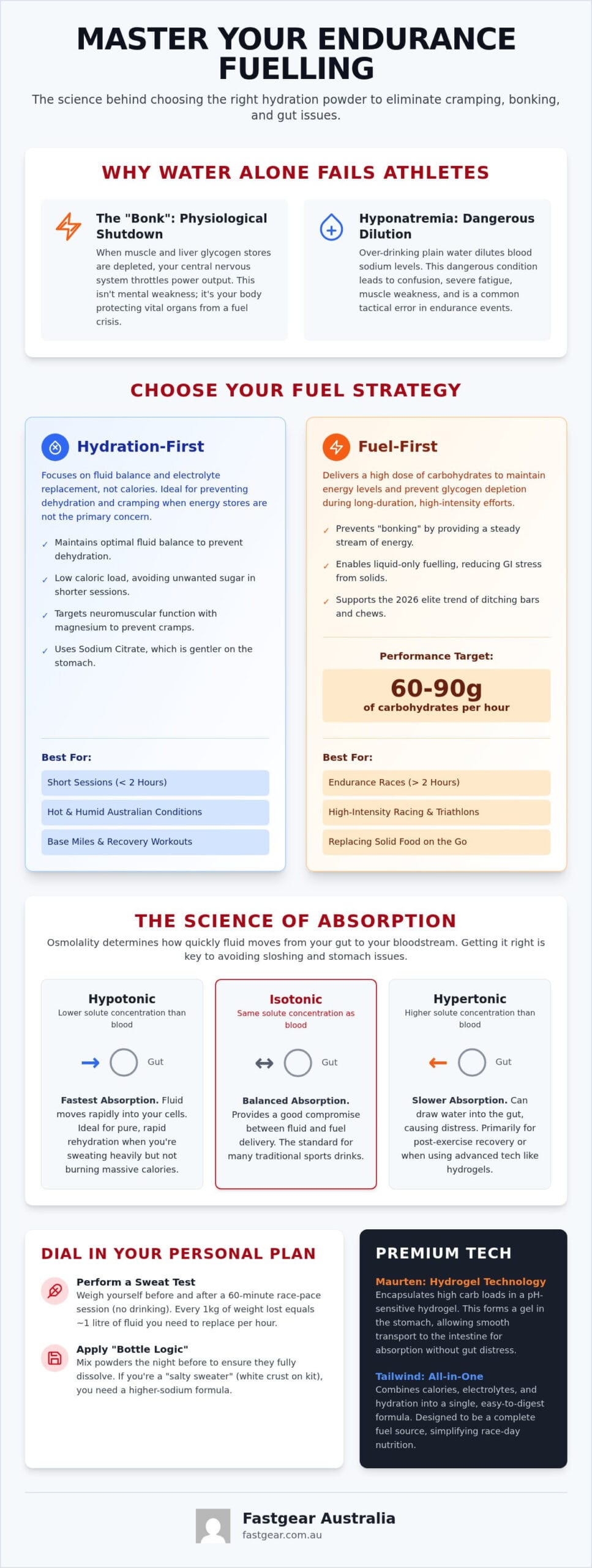
The “bonk” isn’t just a mental hurdle; it’s a total physiological shutdown. When your glycogen stores in the muscles and liver run dry, your central nervous system throttles your power output to protect vital organs. This state of depletion makes every kilometre feel like an uphill battle. Relying solely on water during these high-intensity efforts is a tactical error that often leads to hyponatremia. This occurs when you dilute your blood sodium levels by over-drinking plain fluids, resulting in confusion, fatigue, and severe muscle weakness. To maintain peak output, a technical hydration powder endurance strategy is required to replace what is lost through exertion.
Effective fuelling is built on the scientific foundation of Oral Rehydration Therapy. This principle proves that the body absorbs water most efficiently when it’s paired with specific ratios of sodium and glucose. Without these components, fluid sits in the stomach rather than entering the bloodstream where it’s needed to maintain blood volume and cooling. For the serious athlete, hydration is a matter of transport logistics, not just quenching thirst.
The Sodium-Glucose Connection
Sugar serves a dual purpose in your drink bottle. While it provides a steady stream of energy, its primary role in hydration is acting as a key for the SGLT1 transporter in the small intestine. This protein requires glucose to “unlock” the pathway for sodium and water to pass through the intestinal wall. Without this co-transport mechanism, your absorption rate drops significantly. Your mix must also replace the specific minerals lost in sweat, primarily sodium, followed by potassium, magnesium, and calcium. Osmolality is the measure of solute concentration in a solution, which dictates whether fluids move rapidly into your bloodstream or linger in the gut causing distress.
Sweat Rates and Individual Needs
Generic hydration plans fail because sweat rates are highly individual. A simple sweat test is the best way to dial in your requirements. Weigh yourself without clothes before a sixty-minute race-pace session. Do not drink during the effort. Weigh yourself again immediately after. Every kilogram of weight lost represents approximately one litre of fluid that needs replacing. Factors like high humidity and intense Australian heat will spike these requirements. If you finish a session with white salt crust on your skin or kit, you’re a “salty sweater.” This means you lose more minerals than the average athlete and require a higher concentration hydration powder endurance formula to prevent the drop in plasma volume that precedes a performance crash.
Electrolytes vs. Carbohydrates: Decoding Your Hydration Powder
Selecting a hydration powder endurance formula requires a clear distinction between fluid replacement and energy delivery. Many athletes make the mistake of treating these as identical goals. In reality, your choice depends on the duration, intensity, and environmental conditions of your session. By 2026, the trend in elite racing has shifted decisively toward liquid-only fuelling. Professional triathletes and ultra-runners are increasingly ditching solid bars and chews in favour of high-density powders. This approach reduces the mechanical stress on the gastrointestinal tract, ensuring that blood stays in the working muscles rather than being diverted to digest solid food.
For efforts exceeding two hours, caloric density becomes the priority. Research suggests aiming for 60 to 90 grams of carbohydrates per hour to maintain blood glucose levels and delay glycogen depletion. Achieving this through liquids requires a sophisticated mix that doesn’t overwhelm the gut. If you’re planning a high-output race, your strategy must account for both the volume of fluid and the specific grams of fuel required to reach the finish line without hitting the wall.
Mineral-Focused Powders
These “Hydration-First” solutions are designed for base miles, recovery sessions, or short, high-intensity efforts where energy stores aren’t the limiting factor. They focus on maintaining fluid balance without the significant caloric load of sugar. When scanning labels, look for Sodium Citrate rather than just Sodium Chloride. Sodium Citrate is typically gentler on the stomach at higher concentrations, making it ideal for the high-volume drinking required in harsh Australian summers. Magnesium also plays a critical role here, supporting neuromuscular function to help prevent late-race muscle spasms. This guide for endurance runners provides excellent context on how mineral balance dictates your ability to sustain power over time.
Carbohydrate-Dense Fuel Powders
When the session pushes beyond 90 minutes, you need a “Fuel-First” strategy. These powders use a dual-source carbohydrate advantage, typically combining Maltodextrin and Fructose. This combination is essential because it utilizes different intestinal transporters, allowing the body to process up to 90 grams of carbs per hour, whereas a single-source glucose mix often caps out at 60 grams. Tailwind powder has become a staple for ultra-endurance athletes because it simplifies this complexity by providing a complete, all-in-one fuel and electrolyte profile in a single mix. This eliminates the need to juggle separate salt tablets and gels. You can explore our curated endurance nutrition range to find the specific hydration powder endurance mix that aligns with your race-day caloric targets.
Isotonic, Hypotonic, or Hypertonic: Finding the Right Concentration
Tonicity is the measure of the concentration of dissolved particles, such as electrolytes and carbohydrates, in a solution compared to human blood plasma. This ratio is the primary driver of how quickly your hydration powder endurance mix moves from your stomach into your bloodstream. Getting this wrong is a common cause of race-day DNFs due to GI distress. To dial in your performance, you must understand the three categories of concentration: isotonic, hypotonic, and hypertonic. Each serves a specific purpose depending on your intensity and the environment.
Isotonic solutions have a similar concentration to human blood, typically around 280 to 300 mOsm/kg. These are the middle ground for steady-state racing, providing a balanced delivery of energy and fluid. Products like SIS – GO Isotonic Gels are designed specifically to be absorbed without the need for additional water. In contrast, hypotonic solutions have a lower concentration than blood, prioritising the fastest possible water absorption. Hypertonic solutions, like a concentrated maurten 320 powder, have a higher concentration and are best used for pre-race carb-loading rather than mid-race hydration in high heat.
Matching Tonicity to the Climate
High humidity in the Australian summer changes the rules of engagement. When sweat cannot evaporate, your core temperature rises, and you tend to drink more frequently. If you use a standard isotonic ratio in these conditions, you risk a “gut slosh” because the stomach cannot empty as fast as you are filling it. In extreme heat, a hypotonic approach is superior. This means using a lower concentration of powder to ensure water crosses the gut wall immediately. According to USU Extension’s Guide to Endurance Hydration, managing this balance is critical for preventing the performance drop-off associated with dehydration. If your mouth feels sticky or you remain thirsty after finishing a bottle, your mix is likely too thick.
The Gut Distress Factor
Hypertonic solutions in the gut can be counterproductive during intense efforts. Because they are more concentrated than your blood, they actually draw water out of your bloodstream and into the gut to dilute the solution. This process creates that heavy, “brick” feeling in your stomach. If you experience this mid-race, stop the intake of fuel and switch to plain water for 20 minutes to help clear the blockage. For the final stages of a race when your gut may no longer tolerate fuel, the “rinse and spit” method can be a game-changer. Swishing a carbohydrate-rich drink in your mouth and spitting it out sends a neurological signal to the brain that energy is coming, providing a temporary performance boost without adding to your gut load.
Strategic Mixing: How to Build Your Race-Day Hydration Plan
Success on race day is rarely about who has the highest VO2 max; it is about who manages their logistics best. “Bottle Logic” is the tactical method of segregating your fuel and your hydration. On the bike, carry one bottle with a highly concentrated hydration powder endurance mix and a second bottle with plain water. This allows you to wash down the concentrated fuel and adjust your fluid intake based on thirst and temperature without over-consuming carbohydrates. This separation is your best defence against the gut distress that ruins a podium run.
Mix your powders the night before. Complex hydrogels and dual-source carbohydrate mixes require time to fully dissolve. Shaking a bottle at the start line often leads to undissolved clumps that can clog bottle nozzles or cause spikes in concentration. Chilling your mix overnight also makes it more palatable in the Australian heat, which helps maintain a steady drinking rhythm. If you’re using Maurten, ensure you follow the 320 versus 160 ratios precisely to maintain the hydrogel structure.
Training your gut is non-negotiable. The intestines are an adaptable organ, and you must treat them like a muscle. If you haven’t used your specific race-day hydration powder endurance during at least three or four long-duration training blocks, you’re inviting disaster. Gut training increases the density of your SGLT1 and GLUT5 transporters, allowing you to process higher volumes of fuel under race-pace stress without the dreaded “slosh” or stomach cramps.
The 90-Gram Goal
Alongside your technical hydration plan, supporting your overall biology is key to handling the demands of endurance training. For science-led, stimulant-free health products, Everbright Labs offers innovative solutions developed by biologists and engineers to help maintain your cellular health and performance resilience.
Similarly, for athletes looking to incorporate natural vitality boosters into their routine, Gara Health offers comprehensive safety guides on ancient supplements like shilajit to ensure your health strategy remains balanced and effective in 2026.
Hitting 90 grams of carbs per hour requires precision. A sample plan for a 70.3 triathlon involves consuming 500ml of Maurten 320 (providing 79 grams of carbs) across the bike leg, supplemented by a Maurten Gel 100 (25 grams) at the 45-minute mark. This tiered approach prevents the stomach from becoming a bottleneck while ensuring blood glucose remains elevated. For a deeper dive into periodised fuelling, check out The Ultimate Guide to Endurance Sports Nutrition Australia 2026.
Hydration Hygiene
Bacteria thrive in the warm, sugary environment of a used hydration bottle. Scrub your bottles and bladders with a dedicated brush after every session to prevent mould and lingering “off” flavours. For run legs, the Compressport Free Belt Pro is a critical tool for carrying soft flasks without bounce. To manage the sticky residue that inevitably builds up on aero bars and frame sets, wipe down your gear with a damp cloth immediately after finishing. Sticky shifters are a mechanical risk you don’t need on your next PB attempt.
Ready to dial in your setup? Browse our professional-grade hydration tools and nutrition to build your perfect race-day kit.
Premium Solutions: Why Maurten and Tailwind Lead the Pack
Performance at the elite level requires more than just sugar and salt; you need technology that respects human physiology under stress. Fastgear Australia curates a specific range of hydration powder endurance products because they solve the primary barrier to victory: the gut. While generic brands rely on simple sugar blends that often cause osmotic pressure in the stomach, premium solutions like Maurten and Tailwind use advanced delivery systems to ensure fuel reaches your bloodstream without delay. We only stock the brands that have been proven on the world stage, from the sub-two-hour marathon to the most gruelling ultra-trail events.
Maurten hydrogel technology is the current gold standard for high-carbohydrate intake. By encapsulating carbohydrates in a pH-sensitive biopolymer, the fuel bypasses the stomach and is released only when it reaches the small intestine. This innovation allows athletes to consume double the amount of energy previously thought possible without the risk of mid-race stomach cramps. Similarly, SIS GO provides the reliability of a truly isotonic formula, ensuring rapid gastric emptying even when you’re operating at your anaerobic threshold. These aren’t just supplements; they’re technical tools designed for the dedicated competitor.
Maurten 160 vs. 320: Which Density Do You Need?
Choosing between Maurten densities is a matter of calculating your hourly energy expenditure. Maurten 160 powder contains 40 grams of carbohydrates per 500ml serving, making it ideal for high-intensity sessions where fluid requirements are also high. In contrast, Maurten 320 powder delivers 80 grams of carbohydrates in the same volume. This extreme density is an efficiency breakthrough for cyclists and triathletes who need to maximise their fuel intake while carrying limited bottle capacity. For a deep dive into the hydrogel ecosystem, read our Maurten Gel Australia: The High-Performance Guide.
The Tailwind Advantage for Ultra Efforts
Ultra-endurance is a game of attrition where “flavour fatigue” often leads to a caloric deficit. After ten hours on the trails, overly sweet or viscous liquids become nauseating. Tailwind powder solves this with a mild, clean-burning flavour profile that remains palatable even in the final stages of a race. It manages your electrolytes and fuel in a single mix, eliminating the need to carry separate salt tablets. The convenience of their stick packs allows for rapid, mess-free refills at aid stations, ensuring your transition times remain as tight as your nutrition plan. It is the definitive “all-in-one” solution for athletes who value simplicity and gut stability during long-course efforts.
Secure Your Next PB with Technical Fuelling
Success in endurance racing isn’t an accident; it’s the result of disciplined preparation and technical execution. You now have the framework to master tonicity, manage your caloric density, and implement “bottle logic” to avoid mid-race GI distress. Whether you’re battling high humidity with a hypotonic mix or pushing for a breakthrough with Maurten’s hydrogel tech, your choice of hydration powder endurance formula dictates your performance ceiling. Don’t leave your fuelling to chance during the final kilometres of your next event.
Fastgear Australia is the official stockist of industry leaders like Maurten and Tailwind. We provide an expert-curated range designed specifically for serious athletes who demand peak physical output. With fast national shipping across Australia, you can secure the same high-performance tools used by the pros and start training your gut today. Shop the Full Range of Endurance Hydration at Fastgear Australia and ensure your nutrition plan is as tuned as your training.
Your next milestone is within reach. Take control of your nutrition, trust the science behind your plan, and we’ll see you at the finish line.
Frequently Asked Questions
What is the best hydration powder for endurance running?
Maurten 160 and 320 are the gold standards for runners needing high-carb intake without gut issues. Tailwind is the preferred all-in-one choice for those tackling ultra-distances. The best choice depends on your specific race duration and how much fuel your gut can handle. Fastgear Australia stocks these premium brands because they’ve been proven to work under the stress of competition rather than just in a lab.
Can I mix different brands of hydration powder together?
It’s best to avoid mixing different brands in the same bottle. Each manufacturer designs their formula with specific carbohydrate ratios and electrolyte concentrations. Mixing a hydrogel-based powder like Maurten with a traditional mix will likely destroy the hydrogel structure. This failure leads to the carbohydrates sitting in your stomach, which increases the risk of GI distress. Stick to one brand’s ecosystem per bottle to ensure predictable absorption.
How many grams of carbohydrates should be in my hydration powder?
Your hourly target should be between 60 and 90 grams of carbohydrates for sessions exceeding two hours. A single serving of Maurten 320 delivers 80 grams, which puts you right in the optimal performance zone. If you’re using a less dense mix, you’ll need to supplement with gels or chews. Always test your planned carbohydrate intake during training to ensure your gut can process the load at race intensity.
Do hydration powders cause stomach upset during racing?
Stomach upset often occurs when the solution in your gut is too concentrated. Using a high-quality hydration powder endurance mix helps mitigate this by using dual-source carbohydrates or hydrogel technology. These innovations allow the fuel to pass through the stomach quickly. If you experience issues, check your mixing ratios. A hypertonic solution will draw water out of your bloodstream and cause that heavy, bloated feeling that ruins a race.
Is it better to use hydration powder or electrolyte tablets?
Powders are generally better for endurance athletes because they provide both fuel and electrolytes. Tablets are typically calorie-free and only focus on mineral replacement. While tablets are useful for short recovery sessions or extreme heat where you only need salt, they won’t prevent a glycogen bonk. For any effort over 90 minutes, a carbohydrate-rich powder is essential to maintain blood glucose and sustain your power output.
Should I use caffeine in my hydration powder?
Caffeine is a powerful tool for reducing perceived exertion and improving focus during the later stages of a race. You don’t need it in every bottle, but a targeted dose can help you push through the wall. Consider using a caffeinated gel like Maurten Gel 100 Caffeine alongside your standard hydration. Be sure to trial caffeine in training first, as it can increase gut motility for some athletes.
How do I stop my hydration powder from clumping?
Clumping is usually caused by adding powder to a dry bottle or using water that is too cold. Always fill your bottle with water first, then add the scoop of powder. Mixing your drinks the night before and leaving them in the fridge allows the powder to fully hydrate and dissolve. This simple step prevents undissolved particles from clogging your bottle nozzle or causing inconsistent fuelling during your race.
What is the difference between isotonic and hypotonic powders?
Isotonic powders have a similar concentration to human blood, providing a balanced mix of energy and fluid. Hypotonic powders have a lower concentration, which prioritises the fastest possible water absorption. In the extreme heat of an Australian summer, a hypotonic mix is often superior because it prevents “gut slosh” when you’re drinking large volumes of fluid. Isotonic solutions are better for steady-state racing in milder conditions where energy delivery is the priority.
