
Uncategorized
Best Tri Saddle Buy Online: The 2026 Australian Performance Guide
Aug
Your aero helmet and deep-section wheels are worthless if you’re constantly shifting your weight to escape soft tissue pain. Pelvic stability is the true foundation of a record-breaking bike split, yet many athletes settle for a saddle that numbs their potential. Finding the best tri saddle buy online isn’t just about finding more cushioning; it’s about securing an aggressive position that you can actually maintain for 180 kilometres without sacrificing blood flow.
We know the frustration of managing saddle sores and that distracting tingle of numbness when your focus should be entirely on your power meter. This 2026 Australian Performance Guide promises to help you eliminate those physical barriers and unlock peak aero power through precise equipment selection. We will explore the latest technical innovations in 3D-printed polymer lattices and explain why the Wove M8 has become the pro-level benchmark for stability. You will learn exactly how to measure, select, and organise your cockpit for a high-performance setup that transforms your race-day comfort and efficiency.
Key Takeaways
- Understand how pelvic tilt in the aero tuck shifts your contact points and why traditional road saddles cause power-sapping soft tissue compression.
- Identify the critical design features, such as nose width and central cutouts, required to secure the best tri saddle buy online for your specific anatomy.
- Evaluate the performance differences between leading short-nose brands and boutique options to find a platform that offers total pelvic stability.
- Master a precise two-step protocol for measuring effective saddle height and setback to eliminate friction and maintain your aero position for longer.
- Discover why the carbon-railed Wove M8 is the definitive upgrade for athletes seeking to reduce long-course fatigue and maximise power output.
Why Your Road Saddle is Costing You Power in the Aero Position
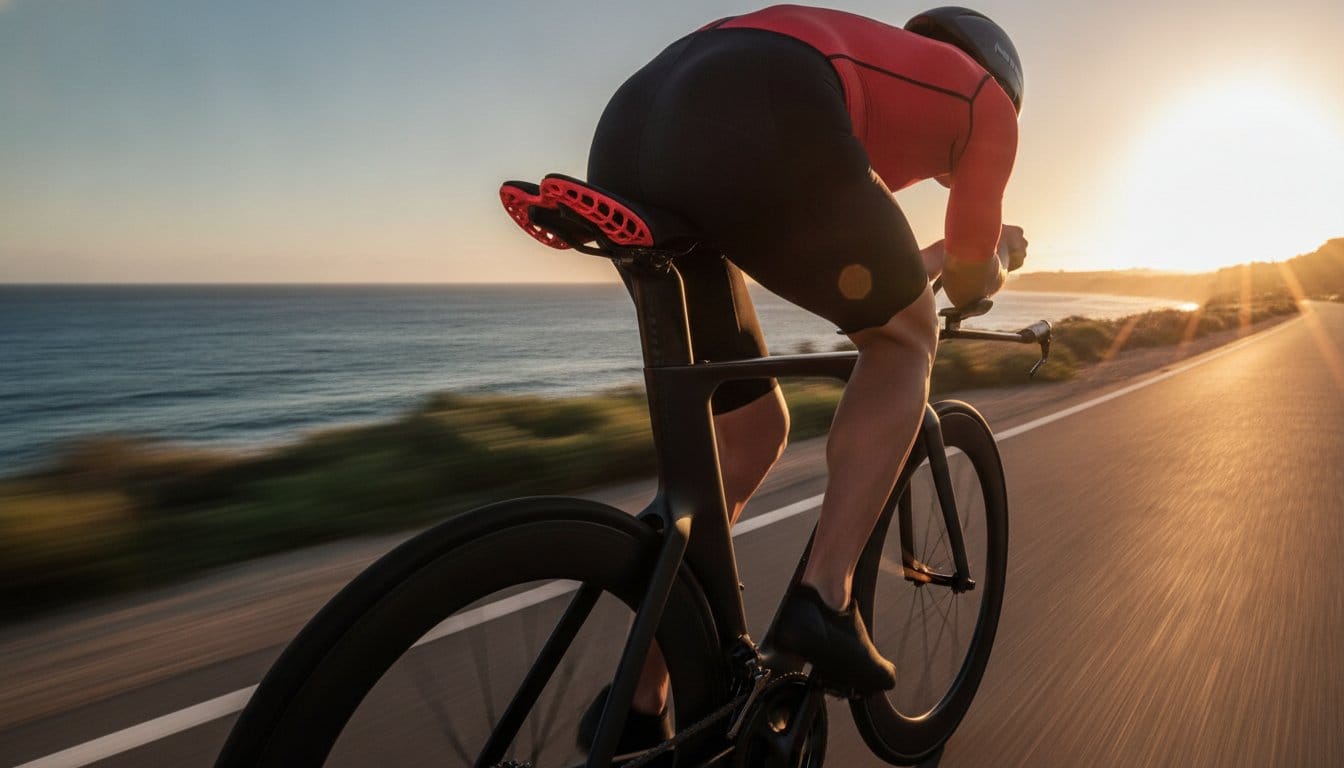
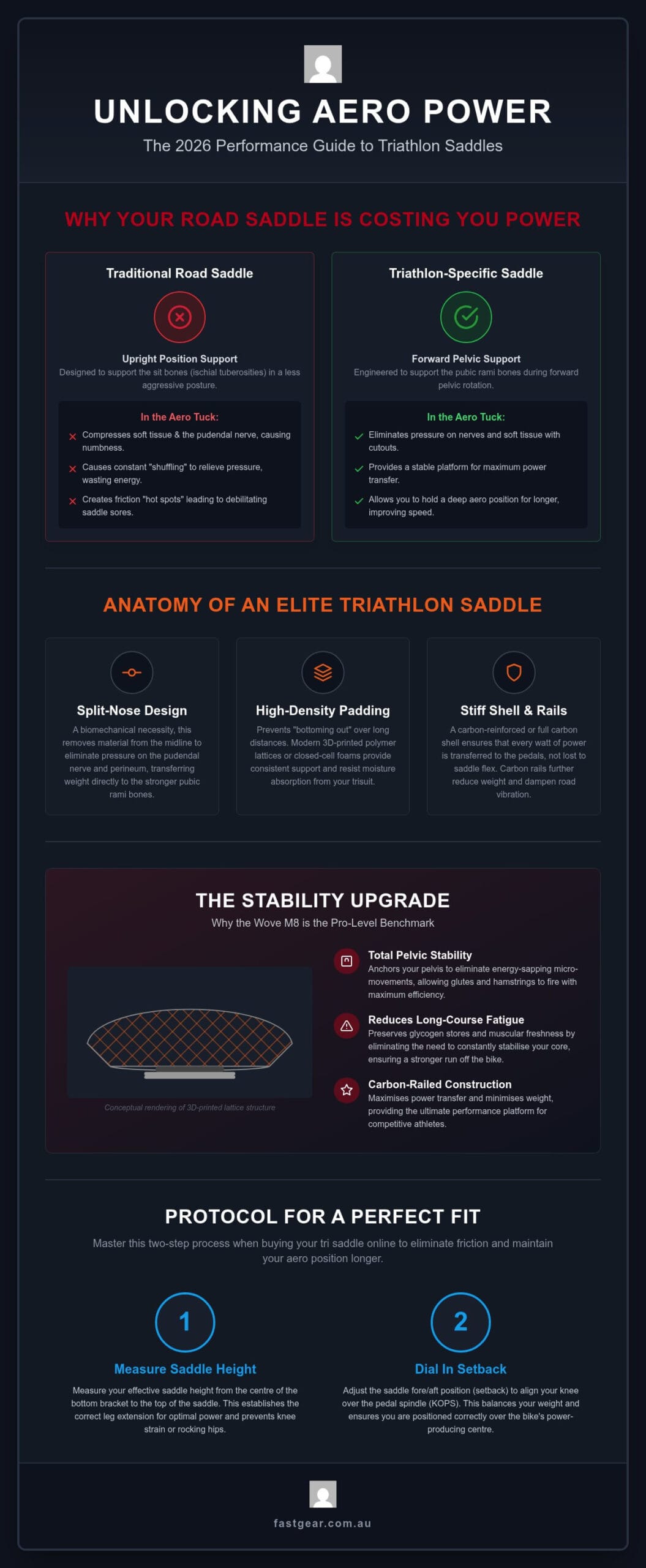
Aerodynamics dictate speed, but biomechanics dictate endurance. When you transition from an upright road position to a dedicated aero tuck, your pelvic orientation undergoes a radical shift. On a standard road bike, your weight is primarily supported by the ischial tuberosities, or sit bones. However, dropping into the aerobars forces a forward pelvic rotation. This move shifts your weight onto the pubic rami and the delicate soft tissue of the perineum. If you are riding a traditional rounded road saddle, you are essentially trying to balance a high-performance engine on a platform designed for a different sport altogether.
This mismatch creates the “shuffling” effect. Because the saddle shape doesn’t support this rotated position, you subconsciously shift back and forth to find relief from pressure. Every micro-adjustment is a leak in your power delivery. Instead of a stable base for high-torque pedalling, you have a moving target. Securing the best tri saddle buy online is about more than comfort; it’s about anchoring your pelvis so every watt you generate reaches the rear wheel. A triathlon-specific saddle is engineered to support the pubic bone structure, allowing you to stay locked into your aero bars for hours without the need to sit up and reset.
Pelvic Rotation and Nerve Compression
The primary enemy of the long-course triathlete is the compression of the pudendal nerve. When this nerve is pinched against a narrow saddle nose, it leads to the dreaded numbness that can ruin a race. Beyond the immediate pain, a poorly supported pelvis forces you to arch your lower back, which restricts diaphragm function and limits your oxygen intake. Perineal pressure is the mechanical compression of soft tissue and blood vessels against the saddle surface that compromises nerve health and skin integrity during rides exceeding four hours. Modern Bicycle saddle design has pivoted to address this by using wider, flatter noses and deep relief channels that preserve blood flow even under heavy pelvic tilt.
Stability as a Marginal Gain
Stability is the foundation of torque. When your pelvis is rock-solid, your glutes and hamstrings can fire with maximum efficiency during the downstroke. In the intense Australian heat, friction becomes a critical variable. A saddle that allows for even slight sliding creates “hot spots” that quickly turn into debilitating saddle sores. By choosing a high-stability platform like the Wove M8, you eliminate the energy-sapping micro-movements used to stabilise your core. This preserves your glycogen stores and muscular freshness, ensuring you have the legs to execute a strong run off the bike. Finding the best tri saddle buy online ensures you aren’t fighting your equipment while you’re fighting the clock.
The Anatomy of an Elite Triathlon Saddle: Beyond the Short-Nose Trend
While the saddle is a critical contact point, the bike’s overall geometry is equally vital. To see examples of how professional-grade setups are configured, you can learn more about Chain Driven Cycles and their selection of performance road bikes. Elite performance requires more than just a shortened saddle nose. While the industry has moved toward compact designs, the internal architecture of the saddle determines whether you finish the 180km leg ready to run or crippled by numbness. When evaluating the best tri saddle buy online, you must look at the specific engineering of the nose, the shell composition, and the rail material. These components work in unison to manage the unique stresses of a rotated pelvis and sustained aero positioning.
The Split-Nose Revolution
The split-nose or “noseless” design is no longer a niche preference; it is a biomechanical necessity. By removing the material from the midline, these saddles eliminate pressure on the pudendal nerve and transfer your weight directly to the pubic rami. This design allows for a more aggressive aero drop without compromising blood flow. Additionally, elite models often feature a pronounced rear “hook” or transition tab. This allows you to rack your bike quickly by the saddle in T1 and T2, saving precious seconds when your heart rate is redlining.
Padding density is another area where many athletes make mistakes. For Ironman-distance events, a softer saddle is rarely better. Excessive padding often leads to “bottoming out,” where the foam compresses completely and leaves you sitting on the hard shell. High-density, closed-cell foam or modern 3D-printed polymer lattices provide consistent support over several hours. These materials also resist moisture absorption from your trisuit after the swim, preventing the saddle from becoming a heavy, friction-filled sponge.
Shell Stiffness and Power Transfer
A carbon-reinforced nylon or full carbon shell is essential to prevent “saddle sag.” Over time, cheaper plastic shells can deform, causing the sides to flare out and lead to painful inner-thigh chafing. A stiff shell ensures that your power transfer remains efficient during high-torque climbing or headwind sections. When you are looking for the best tri saddle buy online, prioritising a carbon shell ensures the platform remains stable throughout its lifespan.
For those dealing with the coarse bitumen common on Australian roads, carbon fibre rails offer superior vibration dampening compared to titanium or alloy alternatives. This reduction in “road buzz” translates directly to lower muscular fatigue in your lower back and glutes. You can optimise your cockpit with our range of high-performance saddles to ensure your equipment matches your athletic ambitions. A rigid, well-dampened saddle is a marginal gain that pays dividends in the final hour of the bike leg.
Top-Tier Performance: Comparing the Best Tri Saddles Available Online
Selecting the best tri saddle buy online requires moving beyond the generalist road options found in most local shops. In 2026, the market has bifurcated into mass-market giants like Fizik and Specialized, and high-performance boutique brands that prioritise specific biomechanical outcomes. While the Fizik Transiro Aeris and Specialized Sitero offer reliable short-nose geometry, serious competitors are increasingly looking toward precision tools like the Wove M8. These boutique offerings focus on the marginal gains that mass-produced saddles often overlook, particularly regarding pelvic rotation and long-course stability.
Weight is a critical factor for the weight-conscious triathlete, even on a heavy aero rig. Saving 100 to 150 grams on a saddle is significant because that weight is positioned high on the bike, directly affecting your centre of gravity during technical cornering or out-of-the-saddle efforts. Transition ease is another differentiator. Modern designs now integrate rear hydration mounts and high-friction “grip zones” on the nose to ensure you stay anchored during high-intensity intervals. These features transform the saddle from a simple seat into a functional piece of cockpit hardware.
Long-Distance Comfort vs. Short-Course Speed
The requirements for a 15-kilometre Sprint leg differ vastly from a 180-kilometre Ironman haul. Sprint and Olympic distance athletes can often tolerate firmer, lighter platforms because the duration of soft-tissue compression is limited. However, for 70.3 and full-distance events, “Adaptive” 3D-printed padding has changed the game. This technology allows for differentiated cushioning zones, providing firmer support at the rear and softer pressure relief at the nose. The Wove M8 outperforms mass-market alternatives by combining this pressure-mapping logic with a full carbon shell that doesn’t “bottom out” after four hours of racing.
The Stability Factor
Power leakage occurs when you slide forward on the saddle, forcing your triceps and core to work harder to maintain your position. The best tri saddle buy online will feature a cover material designed to “lock” you into the sweet spot. Width remains a personal variable; you should generally choose a saddle roughly 20mm wider than your measured sit-bone width to ensure proper support. While carbon rails represent a higher initial investment, the vibration dampening they provide on coarse Australian bitumen is essential for reducing lower back fatigue. Investing in a pro-level platform like the Wove M8 ensures your equipment is an asset, not a distraction, during the final hour of the bike leg.
Buying Your Tri Saddle Online: A Protocol for Perfect Fit and Setup
Purchasing high-end hardware without a physical fitter requires a disciplined, data-driven approach. When you seek the best tri saddle buy online, you aren’t just buying a component; you’re investing in a specific biomechanical outcome. Success depends on a precise installation protocol that accounts for the radical shift in pelvic geometry. Most athletes fail because they attempt to mirror their road bike measurements exactly, ignoring that triathlon-specific saddles often have different stack heights and rail offsets. Follow this five-step protocol to ensure your new platform delivers immediate performance gains.
- Step 1: Baseline Measurements. Record your current effective saddle height (centre of bottom bracket to top of saddle) and setback (horizontal distance from the BB centre to the saddle nose).
- Step 2: Map Your Pressure. Identify where you currently experience “hot spots.” Frontal pressure usually dictates a need for a wider central cutout or a split-nose design like the Wove M8.
- Step 3: The Triathlon Shift. Because you’ll be rotated forward, start with the saddle 5mm lower than your road height. This accounts for the increased thickness of many tri-specific shells and prevents hip rocking.
- Step 4: The 15-Minute Trainer Test. Perform 5 minutes of easy spinning followed by 10 minutes at 85% of your Functional Threshold Power (FTP). If you feel the need to sit up or shift your weight more than twice, your setback or tilt requires adjustment.
- Step 5: Fine-Tune the Tilt. Use a digital level to set a 1 to 2-degree downward decline. This single degree of difference is what preserves blood flow during a 180-kilometre bike leg.
The DIY Sit-Bone Measurement
You don’t need a specialist’s office to determine your width requirements. Use the “cardboard method” by sitting on a piece of corrugated cardboard placed on a hard, flat surface. Measure the distance between the centres of the two deepest indentations in millimetres. Generally, you should add 20mm to this figure to find your ideal saddle width. For more technical insights on refining your setup, consult our guide on High Performance Triathlon Equipment. Translating these raw numbers into a functional TT setup is the first step toward a faster run off the bike.
Troubleshooting the New Saddle
High-performance carbon saddles like the Wove M8 don’t “break in” like traditional leather options. The carbon shell is designed to remain rigid to ensure maximum power transfer. If you experience discomfort, it’s usually a sign that the tilt or fore-aft position is incorrect rather than a fault of the material. Always use a high-quality chamois cream during the testing phase to eliminate friction as a variable. If pain persists after three or four 20-minute sessions, adjust the tilt by 0.5 degrees before considering a different model. You can secure your Wove M8 upgrade today and begin the process of perfecting your aero position.
The Fastgear Verdict: Why the Wove M8 is the Ultimate Stability Upgrade
The Wove M8 Road / Tri Saddle represents the pinnacle of contact point engineering for the modern endurance athlete. While legacy brands often iterate on decades-old designs, Wove has built a platform specifically for the extreme pelvic rotation required in a contemporary aero tuck. It is the definitive choice for those seeking the best tri saddle buy online, offering a level of stability that mass-market alternatives cannot replicate. By prioritising a rock-solid base, the M8 ensures that every watt you generate is directed into the drivetrain rather than being lost to micro-adjustments and postural corrections.
Long-course fatigue is often the result of cumulative vibration trauma. The M8 utilizes oversized carbon rail technology to provide superior dampening against the coarse bitumen found on Australian roads. This reduction in road buzz preserves your lower back and glutes for the marathon ahead. Furthermore, the saddle features a unique, aggressive taper. This specific geometry prevents the inner-thigh chafing that often plagues athletes using wider, traditional split-nose designs. When integrated with high-performance, low-friction tri-suits, the M8 becomes an invisible partner in your pursuit of a personal best.
Engineered for Stability
Stability is the foundation of a record-breaking bike split. The Wove M8 is designed to lock the rider into the “sweet spot” of the aerobars, preventing the forward “shuffling” that compromises aerodynamics and breathing. Its weight-to-stiffness ratio is industry-leading, providing a rigid carbon shell that resists sagging even after years of high-torque training. Serious Australian athletes are switching to Wove because it addresses the fundamental requirement of long-distance racing: a predictable, high-traction interface that remains comfortable from the first kilometre to the last.
The Complete Performance Package
Optimising your bike split requires a holistic approach to equipment and physiology. A stable platform allows for more efficient breathing and digestion, creating a perfect synergy with your fueling strategy. We recommend pairing your new saddle with elite nutrition like Maurten Gel Australia to ensure your energy levels match your mechanical efficiency. When you choose the best tri saddle buy online through Fastgear, you gain access to national shipping and expert technical support from a team that understands the demands of the sport.
Don’t let a sub-optimal saddle dictate your race results. Secure your competitive advantage and Buy the Wove M8 Road / Tri Saddle online at Fastgear today. Experience the difference that professional-grade stability makes to your power output and post-bike run freshness.
Secure Your Competitive Edge for the 2026 Season
Your bike split shouldn’t be a battle against physical discomfort. By shifting to a dedicated triathlon platform, you move beyond the biomechanical limitations of standard road geometry. You’ve learned how pelvic rotation dictates saddle choice and why stability is the ultimate marginal gain for long-course racing. Securing the best tri saddle buy online is a strategic investment in your performance, allowing you to hold an aggressive aero position without the distraction of soft-tissue pressure or power-sapping micro-adjustments.
The Wove M8 is already the preferred tool for elite endurance athletes who refuse to compromise on power delivery. At Fastgear Australia, we provide the high-performance technical gear and reliable national shipping you need to prepare for race day with total confidence. This authoritative guide has detailed the path to marginal gains; now it’s up to you to execute the upgrade. Don’t let a sub-optimal setup hold you back when the solution is within reach. It’s time to lock in your position and focus entirely on the road ahead.
Optimise your aero tuck with the Wove M8 saddle at Fastgear Australia. Your next personal best is waiting.
Frequently Asked Questions
How do I know if a triathlon saddle is too wide for me?
If you experience inner thigh chafing or feel your legs rubbing against the saddle’s edges during the downstroke, it’s likely too wide. A correctly fitted triathlon saddle should allow for a vertical leg path without obstruction. You should feel supported on your pubic rami without the material flaring out. If you’re constantly sliding forward to find a narrower section, the rear or mid-section of the platform is likely mismatched to your anatomy.
Can I use a triathlon saddle on my standard road bike?
Yes, you can install a triathlon saddle on a road bike, particularly if you frequently use clip-on aerobars. These saddles are designed for forward pelvic rotation, which occurs when you drop into a lower position. However, if you primarily ride upright on the hoods or tops, a tri-specific design might feel too firm or narrow at the rear. It’s about matching the saddle to your most frequent riding posture rather than just the bike frame.
Why do triathlon saddles have a hole or cutout in the middle?
Central cutouts are engineered to eliminate pressure on the pudendal nerve and soft tissues when you’re in an aggressive aero tuck. By removing material from the midline, these designs ensure sustained blood flow and prevent the numbness that often ruins long-course efforts. This is a critical feature when looking for the best tri saddle buy online, as it allows you to maintain a stable, rotated pelvis without the mechanical compression associated with traditional rounded road saddles.
How much tilt should a triathlon saddle have for an aero position?
Most triathletes find success with a slight nose-down tilt of between 1 and 3 degrees. This decline helps to alleviate pressure on the perineum while you’re rotated forward on the aerobars. Excessive tilt can cause you to slide forward, forcing your arms to work harder to hold your body in place. Use a digital level to find your baseline, then make micro-adjustments of 0.5 degrees until you achieve a perfect balance of pressure relief and stability.
Do I need a different saddle for an Ironman compared to a Sprint tri?
While the fundamental biomechanics remain the same, the requirements for padding density and vibration dampening increase with distance. A firmer saddle might be tolerable for a 20-kilometre Sprint leg, but an Ironman requires a platform like the Wove M8 that manages long-term soft tissue health. For 180-kilometre rides, you need a high-performance shell that won’t sag or bottom out over several hours of sustained output. Consistent support is more important than soft, squishy padding for long-course success.
Is a carbon-railed saddle worth the extra cost for triathlon?
Carbon rails are a significant performance upgrade due to their superior vibration-dampening properties. On coarse Australian bitumen, the reduction in road buzz helps to lower muscular fatigue in your lower back and glutes. Additionally, the weight savings improve the bike’s handling and centre of gravity. For serious athletes, the combination of increased comfort and reduced fatigue makes carbon-railed options like the Wove M8 a justified investment in race-day efficiency and run-off-the-bike freshness.
What is the best way to prevent saddle sores during long training rides?
Prevention starts with a stable saddle that eliminates friction-inducing micro-movements. Ensure your kit is clean and apply a high-quality chamois cream before every ride. If you’re still experiencing issues, check your saddle height; a seat that’s too high causes the hips to rock, which creates excessive friction. Integrating technical gear like a Mugiro neck protector and a well-fitted Wove saddle will minimise the skin irritation that often derails high-volume training blocks. Beyond equipment, maintaining skin health with athlete-specific products from Daily Miles Beard & Soap Co is essential for long-term comfort.
Most high-performance saddles should be replaced every two to three seasons, or approximately every 10,000 to 15,000 kilometres. Over time, the internal shell can lose its structural integrity and begin to sag, which alters your fit and increases pressure on soft tissues. If you notice any visible deformation, persistent creaking, or a sudden onset of discomfort on a previously comfortable setup, it’s time to find the best tri saddle buy online to maintain your performance standards.
