
Uncategorized
Maltodextrin and Fructose Endurance Drink Mix in Australia: A 2026 Buying Guide

Oct
The highest-carbohydrate drink mix isn’t automatically the best choice for race day. The right option depends on how its carbohydrate blend and concentration fit your fuelling plan, event demands and gut tolerance. This maltodextrin fructose endurance drink mix australia buying guide shows you what to compare and how to put the details into practice.
Product labels list ingredients and serving information, but those details can be hard to compare across different mixes. A dual-source blend may fit your plan, but ingredient names alone won’t tell you whether it will suit you during exercise. Check the preparation directions and test your intended intake in training.
This guide explains how maltodextrin and fructose contribute to a drink mix, what to look for on the label and how concentration affects each sip. It also covers how to compare options such as Maurten 160 powder, Maurten 320 powder and Tailwind powder with your race strategy, without relying on marketing claims. Use the steps below to narrow your options, then trial your preferred mix before race day.
Key Takeaways
- Compare carbohydrate per serving separately from the prepared drink’s concentration, and follow the product’s serving directions.
- Ingredient names alone don’t reveal a mix’s ratio or whether it suits your fuelling needs. Check the label before deciding.
- Use this maltodextrin fructose endurance drink mix australia guide to compare drink mixes with gels and chews against your event logistics and access to fluids.
- Choose an option based on your event duration, planned intake, carrying capacity and taste preference, then trial it in training.
- Compare Maurten 160 powder, Maurten 320 powder and Tailwind powder using their current labels and preparation directions.
What is a maltodextrin-fructose endurance drink mix?
A maltodextrin-fructose endurance drink mix is a powdered drink that provides carbohydrate from both maltodextrin and fructose. It is mixed with water and consumed during exercise. The ingredient names alone don’t show the blend’s ratio, the concentration of the prepared drink or whether it fits your fuelling plan and gut tolerance. Check the product label and preparation directions before comparing options.
Maltodextrin is made from starch and is used as a carbohydrate ingredient in sports drinks. For a plain-language overview of its origins and properties, see What is Maltodextrin? Fructose is another carbohydrate source. A product containing both won’t necessarily state the amount of each in a way that reveals their ratio, so read the nutrition panel and ingredient list rather than guessing from the names.
Carbohydrate fuelling and hydration are related, but they are not the same thing. Water used to prepare a powder contributes fluid, and some drink mixes may also provide electrolytes. Others may be formulated primarily as a carbohydrate source. Read the label to understand what the product provides, then plan your fluid and electrolyte needs separately as part of your overall race strategy.
What do maltodextrin and fructose contribute?
Both provide carbohydrate, but the body processes them through different steps and uses different intestinal transport pathways. Maltodextrin is broken down into glucose, which can be transported across the intestinal lining through a pathway called SGLT1. Fructose uses a separate transporter, GLUT5. In plain English, these transport proteins help move glucose and fructose from the gut into the body. This explains the rationale for combining carbohydrate sources, but it doesn’t guarantee a particular outcome for every athlete or product.
Why do endurance athletes consider a dual-source mix?
During prolonged exercise, athletes may plan to take in carbohydrate over time. Combining sources that use different transport pathways is one way to structure that intake. A dual-source blend isn’t essential for every event or athlete, however. Tolerance can vary with the product, its concentration, your intake plan and your individual gut response. Practise your chosen approach in training before relying on it in competition.
For the wider fuelling picture, including how drink mixes fit alongside other endurance nutrition, read our endurance sports nutrition guide. When comparing a maltodextrin fructose endurance drink mix australia option, start with its label and preparation directions. Then consider how it fits your event demands and the fuelling plan you have tested.
How the carbohydrate blend, concentration, and serving size work together
Three label details help you decide how a drink mix fits your fuelling plan: carbohydrate per serving, the amount of water used to prepare it and the resulting concentration. These details are connected, but they are not interchangeable.
Drink concentration is the amount of carbohydrate dissolved in a given volume of prepared drink; it affects how much carbohydrate you take in with each sip. Adding more water lowers the concentration, but it doesn’t change the total carbohydrate in the powder serving. Keeping those figures separate helps you plan carbohydrate intake and the amount of fluid you’ll carry or access on course.
How should athletes read a drink-mix label?
Start with the nutrition information panel and preparation directions. Note the carbohydrate quantity per serving, serving size, ingredient list and recommended volume of water. Compare products on the same basis, such as carbohydrate per prepared serving, rather than comparing a full serving of one product with a partial serving of another.
If the label lists maltodextrin and fructose, don’t assume their proportions from the ingredient order. Two products with similar carbohydrate per serving may also make drinks of different concentrations if their recommended water volumes differ. Formulas and directions can change, so use the current Australian label when planning your intake. Fastgear’s range includes Maurten 160 powder, Maurten 320 powder and Tailwind powder. Compare their current labels and preparation directions rather than inferring specifications from the product names.
For a simple illustration, imagine a hypothetical serving containing 60 g of carbohydrate. Mixed with 500 mL of water, it provides 12 g per 100 mL; mixed with 750 mL, it provides 8 g per 100 mL. The serving still contains 60 g. These figures demonstrate the calculation only, not the specifications or directions for any product.
How does drink mix fit into a fuelling plan?
A drink can contribute carbohydrate alongside gels or chews. Count all the sources you plan to use across the session, not just the powder in your bottle. For example, add the carbohydrate from each drink serving to the amounts in the gels or chews you intend to take, using their labels and your planned quantities. Practise the full combination in training, noting fluid access, timing and gut tolerance.
Cyclists can explore the cycling nutrition guide for event-specific fuelling context. To compare drink-mix options against your label and preparation criteria, browse endurance drink mixes at Fastgear Australia.
Maltodextrin-fructose drink mix compared with other endurance fuelling options
A dual-source carbohydrate blend is one fuelling option, not a universal upgrade. Compare formats by how they fit your event, access to fluids, carrying setup and personal tolerance. A maltodextrin-fructose mix may suit your plan, but the ingredient combination alone doesn’t make it the right choice for every athlete.
| Format | How you carry it | Intake flexibility |
|---|---|---|
| Drink mix | Prepared in a bottle or soft flask, or carried as powder to mix later. | Can be sipped over time; the amount consumed depends on your drinking pattern and the prepared drink. |
| Gels | Compact portions carried in a pocket, belt or race vest. | Useful for planned individual servings; coordinate with fluid access and your intake schedule. |
| Chews | Portable pieces carried in a packet. | Can be portioned across an effort, though eating them may be less convenient at some race intensities. |
No format removes the need to plan. Consider where you can refill or access water, how much you want to carry and whether aid-station timing affects your intake. The most practical choice is one you can use consistently and tolerate during exercise.
When can drink mix suit a training or race plan?
A prepared bottle can work well for sessions where you can carry it comfortably and take regular sips. It also lets you combine fluid intake with carbohydrate, according to the product’s directions and your tested plan. The trade-off is logistics: you need access to the bottle, must prepare the mix as directed and may need another fuel source if the drink alone doesn’t match your planned intake. For longer sessions, account for every source so you can keep track of what you have taken.
When might gels or chews be more practical?
Gels and chews are portable and let you carry separate portions, which can be useful when a bottle is awkward or you want to vary your intake. They still need to fit your overall plan, and gels or chews may require planned fluid intake. Test the format at a race-like effort rather than assuming it will suit you based on convenience alone.
For a closer look at gels as a fuelling format, read the Maurten gel guide. Compare drinks, gels and chews against your course logistics, then browse Fastgear’s endurance nutrition to explore options for your plan.
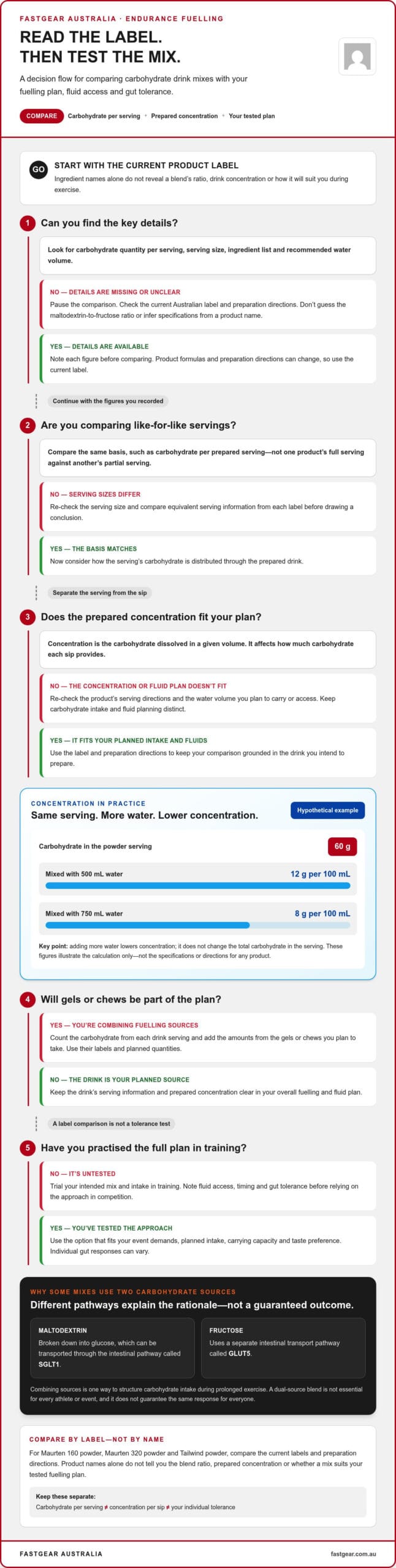
How to choose and test a drink mix before race day
Choose a mix based on your event and routine, then rehearse your plan. Use these five steps to narrow down a maltodextrin-fructose drink mix and assess how it works for you in training.
- Start with event duration and discipline. Consider how long you’ll be exercising and what the course allows. A long ride with bottle access creates different fuelling logistics from a trail run where you carry everything.
- Map your intake plan. Account for carbohydrate from drinks, gels, chews and any other planned fuel. Think about when you can drink or take fuel, and don’t count a drink mix as your only source unless that’s what your tested plan allows.
- Choose a practical format. Assess fluid access, bottle capacity, carrying space, taste preference and how easily you can prepare or use the product during your event.
- Read the current label. Compare serving size, carbohydrate quantity, ingredients and preparation directions. Don’t infer a blend ratio from ingredient order, and follow the product’s instructions when preparing it.
- Trial it in training. Rehearse preparation and planned intake during a representative session before race day. Record what you consumed, when you took it and how it felt, including flavour and gut tolerance.
What should you match to your event and routine?
Use a practical checklist: event duration, discipline, aid-station access, bottle or flask capacity, opportunities to refuel and the other products you plan to carry. Consider the likely conditions for your specific event as well. Australian weather varies by location and season, so don’t assume every race will be hot or humid.
Plan fluid and electrolytes separately from carbohydrate. A drink’s carbohydrate content doesn’t, by itself, tell you whether your fluid or electrolyte strategy is appropriate. This gives you a practical way to assess a maltodextrin fructose endurance drink mix australia option without relying on a one-size-fits-all intake target.
How can you trial a drink mix safely in training?
Follow the preparation directions and test the flavour and intended intake during a session that resembles your event. Change one variable at a time, such as the mix or timing, so your notes are easier to interpret. If you need an individual fuelling strategy or have concerns about tolerance, seek advice from a qualified sports dietitian.
Once you’ve set your criteria, browse endurance drink mixes at Fastgear Australia and compare each option’s label and directions with your training notes.
Choose an endurance drink mix from Fastgear Australia
The best choice is the one that fits your fuelling plan in practice, not simply the one with the most appealing marketing or a familiar ingredient name. Before choosing a maltodextrin fructose endurance drink mix australia option, bring together five checks: the current product label, serving directions, prepared concentration, event context and your own tolerance.
Fastgear Australia’s endurance drink-mix range includes Maurten 160 powder, Maurten 320 powder and Tailwind powder. Compare each option with your needs. Product names alone don’t establish carbohydrate quantity, ingredient ratio, preparation method or suitability, so use the information on the current pack or product label rather than assuming the products are interchangeable.
How should you compare the drink-mix options?
Work through the same checklist for each product. First, note the serving size and carbohydrate information shown on the label. Next, read the preparation instructions and consider how much water the prepared serving requires. This lets you assess concentration alongside the amount of carbohydrate in a serving, rather than treating those details as the same thing.
Then match the label details to your event. Will the bottle or flask fit your carrying setup? Can you access water or prepare another serving during the session? How does the mix fit alongside any gels, chews or other fuel in your plan? Finally, use your training notes. A flavour and intake pattern you’ve rehearsed may be more practical for you than an unfamiliar option on race day.
For a clear comparison, record the label details, mixing directions, bottle setup and your response during training. This keeps the decision grounded in your actual plan, rather than assuming one drink mix suits every athlete or event.
What is the next step before race day?
Choose the option that best aligns with your event logistics, intended intake and preferred fuelling format. Prepare it according to the directions, then practise using it during training. Note how much you consume, when you take it, how manageable it is to carry and how your gut responds. If something doesn’t feel right, adjust your plan in training rather than waiting until competition day.
Ready to compare your options? Explore endurance drink mixes and fuelling options at Fastgear Australia, then put your selection through a training trial before race day.
Make your fuelling plan race-ready
Choose a drink mix by looking beyond its ingredient list. Compare the current label and serving directions, account for the prepared drink’s concentration, then match the option to your event, bottle setup and training-tested tolerance. Remember that carbohydrate intake and hydration are connected but distinct parts of your plan.
This maltodextrin fructose endurance drink mix australia buying guide is a starting point for comparing formats and making a practical choice. Fastgear Australia stocks Maurten 160 powder, Maurten 320 powder and Tailwind powder, alongside endurance gels and chews for complementary fuelling. Use each product’s current information rather than assuming its name tells you the ingredients, ratios or preparation details.
Before race day, rehearse your chosen mix and the rest of your fuelling plan in training. Note what you prepare, how much you take and how it feels during exercise. Those notes give you a sound basis for refining your setup.
Explore endurance drink mixes and fuelling options at Fastgear Australia, and take your tested plan into your next event with confidence.
Frequently Asked Questions
Is a maltodextrin-fructose drink mix better than maltodextrin alone?
Not automatically. A dual-source mix combines carbohydrate sources that use different intestinal transport pathways, which is one reason athletes may consider a blend during prolonged exercise. That doesn’t make it the best choice for every event or athlete. Your intake plan, product concentration and individual gut tolerance matter too. Compare labels, then test your preferred option in training before relying on it during competition.
How do I choose an endurance drink mix in Australia?
When comparing a maltodextrin fructose endurance drink mix australia option, check the current Australian label, serving size, carbohydrate quantity and preparation directions. Consider how the prepared concentration fits your plan, how you’ll carry the drink and where you can access fluids during your event. Check how the mix fits alongside any gels, chews or other fuel you intend to use. Trial your choice in training and record your response.
Can I use a drink mix with energy gels or chews?
Yes. A drink mix can be part of a plan that also includes gels or chews. Use each product’s label and your planned quantities to account for the carbohydrate from every source. Consider timing, fluid access and how practical each format is during your event. Fastgear Australia stocks endurance drink mixes, gels and chews. Practise the combination in training to assess taste and tolerance.
How much carbohydrate should an endurance drink mix provide?
There isn’t one serving amount that suits every athlete or event. Start with your overall fuelling plan, then check how much carbohydrate the product provides per serving and how it fits with any gels, chews or other fuel you’ll take. Follow the preparation directions and test your planned intake during training. If you need help setting an individual target, a qualified sports dietitian can provide tailored advice.
What happens if an endurance drink mix upsets my stomach?
Don’t push through repeated or severe discomfort. Stop or adjust your intake as appropriate, and note what you consumed, how it was prepared and when symptoms started. In training, review the serving size, concentration and how the mix fits with your other fuel. Change one factor at a time when trialling adjustments, and don’t test a new approach for the first time on race day. Seek advice from a qualified sports dietitian or health professional if symptoms persist or concern you.
Do I still need electrolytes when using a carbohydrate drink mix?
Possibly. A carbohydrate drink mix doesn’t necessarily provide electrolytes, so check the product’s current label rather than assuming. Carbohydrate fuelling, fluid intake and electrolyte needs are related parts of an endurance plan, but they aren’t interchangeable. Consider your event conditions and fluid access, and plan each requirement deliberately. If you’re unsure how to meet your individual needs, consult a qualified sports dietitian or health professional.
