
Uncategorized
Marathon Hydration Storage Belt Australia: How to Choose the Right Race-Day Setup
Oct
More storage can make a marathon belt less useful. If a loaded setup bounces, rides up or chafes, it can distract you throughout the race. This marathon hydration storage belt Australia guide starts with what you’ll actually carry, not the biggest capacity you can find. Think about your fluids, nutrition, phone and other essentials, then check how the belt fits when it’s loaded.
The right setup keeps essentials secure and accessible without adding unnecessary bulk. A belt may suit a compact kit, while a handheld bottle or running vest may better match different carrying preferences. If you’re considering the Compressport Free Belt Pro, compare it with your planned race-day load and check its current specifications before deciding what it can carry.
This guide compares belt styles, storage access and fit, as well as the trade-offs between belts, handheld bottles and vests. You’ll also find a practical way to test your complete setup in training, spot bounce or chafing before race day, and align your storage with your nutrition plan.
Key Takeaways
- Start with your race-day kit: list nutrition, phone, keys and personal essentials before choosing storage.
- For a marathon hydration storage belt australia search, compare the space your planned kit needs with secure fit and easy access.
- Check separately whether a belt is designed to carry fluids. Storage capacity alone doesn’t confirm it can hold a bottle or flask.
- Compare a belt, handheld bottle and running vest based on your preferred carrying format, access needs and comfort.
- Test your loaded setup in training, then assess the Compressport Free Belt Pro against its verified details and your packing list.
Marathon hydration storage belts: what should you carry on race day?
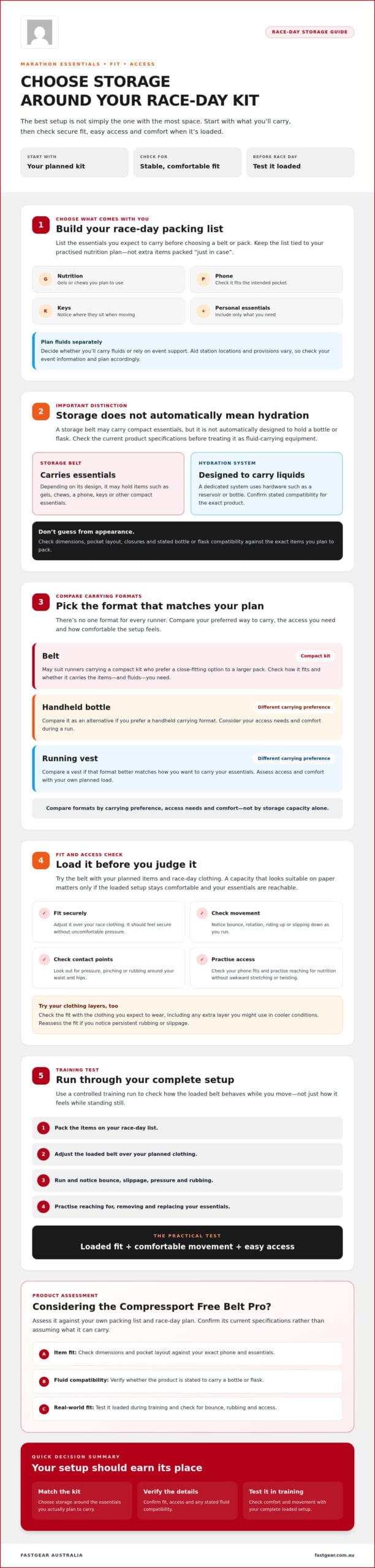
Choose your race-day kit before you choose a belt. List the essentials you expect to carry, such as nutrition, your phone, keys and any personal items you need. Then decide whether you want to carry fluids yourself or rely on event support. Aid station locations and provisions vary, so check your event information and plan accordingly.
A marathon storage belt is wearable gear for carrying essentials; it isn’t automatically a fluid-carrying system. A belt may provide storage without being designed to hold a bottle or flask. A dedicated hydration system is intended to carry liquids, using hardware such as a reservoir or bottle. Check the product’s current specifications before treating a storage belt as hydration equipment.
What does a marathon hydration storage belt actually carry?
Depending on its design, a belt may carry items such as gels, chews, a phone, keys or other compact essentials. Don’t assume every belt will fit your phone or accommodate fluid containers. Check the dimensions, pocket layout and any stated bottle or flask compatibility against the exact items you plan to pack.
Placement and access matter during a long run. Items that shift, press against your body or are difficult to reach can become a distraction. Consider what you’ll need while moving and how securely each item stays in place when the belt is loaded.
When might a belt suit your marathon setup?
A belt may suit runners carrying a compact kit who prefer a close-fitting option to a larger pack. It can also work alongside event aid stations if you want to keep selected essentials with you. That doesn’t mean a belt will suit every fluid plan: your needs depend on you, race conditions, event arrangements and your individual strategy.
Organise what you’ll carry around a nutrition plan you’ve practised, rather than packing extra items just in case. Fastgear’s Australian endurance sports nutrition guide can help you explore the role of race-day nutrition. For a marathon hydration storage belt australia search, use your planned kit as the reference point, then confirm the belt’s fit and compatibility before race day.
How to choose a marathon storage belt for fit, access and comfort
Capacity only matters if the belt stays comfortable and your essentials are easy to reach. Assess it with the items you plan to carry, rather than trying it on empty. Put it on over your race-day clothing, adjust it while standing, then run in it to see how it behaves as your stride and body position change.
How should a running belt fit over marathon distance?
A belt should feel secure without creating uncomfortable pressure. As you run, notice whether it bounces, rotates, rides up or slips down. Pay attention to contact points around your waist and hips. Pressure or rubbing that seems minor at first can become distracting over a longer effort.
Check whether the fit changes with different clothing layers, such as a lightweight top or an extra layer you might wear in cooler conditions. If the belt has adjustment options, see whether you can achieve a stable fit with each setup. Reassess it if you notice pinching, persistent rubbing or slippage. Guidance on choosing the best running belt can offer another perspective on comparing designs, but your own loaded run is the practical test.
Which storage features matter for marathon essentials?
Match the pocket arrangement to your actual kit. Check whether your phone fits, where your keys sit and whether gels or chews are easy to reach without awkward stretching or twisting. If you’ll carry nutrition to use during the race, practise taking it out and putting it back during a controlled run. Items should stay secure as you move rather than shifting into an uncomfortable position.
Read the current product specifications for dimensions, closures and stated compatibility. Don’t infer weather resistance, fluid-container compatibility or capacity from appearance alone. For a marathon hydration storage belt australia search, prioritise verified details and a comfortable fit with your planned load over capacity in isolation.
Fit check: Load the belt as planned, adjust it over your race clothing, then run. Check for bounce, slippage, pressure, rubbing and easy access to each essential.
Once you know what your setup needs to carry, explore endurance gear and nutrition at Fastgear Australia and compare the available options against your checklist.
Storage belt vs handheld bottle vs running vest: which suits your plan?
The best format depends on what you need to carry and how you prefer to access fluids and essentials. A storage belt may keep compact items close to your body, but that doesn’t mean it can carry a bottle. A handheld bottle gives you direct access to fluid, while a running vest may suit a plan that calls for more storage. Compare each format with your tested race-day kit, not capacity claims alone.
| Format | Carrying format and access | Storage and fit considerations |
|---|---|---|
| Storage belt | Worn around the waist; access to pockets varies by design. Fluid carriage must be confirmed in the specifications. | Often considered for compact essentials such as nutrition, a phone and keys. Check loaded stability, pocket access and contact points. |
| Handheld bottle | Carried in one hand, keeping the bottle directly accessible. | Consider how holding it feels over your planned distance and where your gels or personal items will go. |
| Running vest | Worn over the torso; access depends on the vest’s pocket and fluid-carrying design. | May suit a setup requiring greater carrying capacity or several accessible items. Check fit, movement and how the loaded vest feels. |
When is a belt more practical than a handheld bottle?
If you want your hands free and mainly need to carry compact essentials, a belt may be worth considering. A handheld bottle offers direct access to fluid, but you’ll need to be comfortable carrying it as you run. Decide how you prefer to carry and drink fluids first, then check whether the belt you’re considering is designed to hold a compatible bottle or flask. Storage space for gels is not proof of fluid compatibility.
When should you consider a running vest instead?
A vest may be a better fit if your plan involves carrying more items or keeping several supplies within reach. Its extra storage and torso coverage can feel different from a compact belt, so assess the loaded fit and movement before choosing it. No format is universally best. If fluid needs are a key part of your decision, read this athlete hydration and electrolytes guide alongside your event information and individual plan.
For a marathon hydration storage belt australia search, compare verified product details with your intended load. Fastgear lists the Compressport Free Belt Pro. Check its current specifications rather than assuming it carries fluid or suits a particular packing setup.
How to test a marathon hydration storage belt before race day
A belt can feel stable while you’re standing still and behave differently once you start running. Test it loaded, in the clothing you intend to wear, and with the same items you plan to carry. A short, structured check gives you time to spot movement, awkward access or rubbing and make adjustments before race day.
Run a practical loaded-belt test
- Load it: Pack only your planned race-day contents, such as nutrition, phone, keys and personal essentials. If your fluid plan includes carrying a container, first confirm the belt is designed to hold it.
- Wear your race kit: Put the belt over or under the exact clothing combination you expect to use. Adjust it so it feels secure without uncomfortable pressure.
- Run at your usual training effort: Start moving and notice whether the belt bounces, rotates, rides up or slips down. Don’t rely on a static fit check.
- Practise access: While moving, reach for each item you may need. Check whether you can retrieve and replace nutrition without awkward twisting or disrupting your rhythm.
- Review and revise: After the run, check for item movement, rubbing, pressure points or repeated adjustments. Change one thing, such as belt position or pocket placement, then test again.
How can you spot fit problems before race day?
Take note of small irritations as well as obvious instability. A phone shifting against your hip, a key pressing into your side or a waistband that needs frequent readjustment can become distracting over a longer run. If you notice chafing or persistent discomfort, reassess the fit and packing arrangement instead of hoping it will settle on race day.
Keep each test aligned with your established fuelling and hydration strategy. Don’t use a belt trial to introduce unfamiliar gear or a new intake plan. Follow your usual approach and seek relevant professional guidance for individual needs. If you’re comparing a marathon hydration storage belt australia option, check its current specifications, then test the exact setup you intend to use.
Fastgear lists the Compressport Free Belt Pro as an offering, but check its current details before deciding how it fits your kit. Explore race-day gear and nutrition at Fastgear Australia as you organise your setup.
Choosing a marathon storage belt in Australia: assess the Compressport Free Belt Pro
Fastgear lists the Compressport Free Belt Pro as an option to consider when comparing race-day storage. Rather than assume it suits your marathon, check its current product details against the kit you’ve already tested. Confirm what it’s designed to carry, how sizing and fit are described, and whether its storage arrangement matches your essentials.
Does the Compressport Free Belt Pro match your marathon checklist?
Compare the manufacturer’s current specifications with your loaded test setup. Check sizing and fit guidance, stated storage uses and any confirmed fluid-container compatibility. Then match those details against the exact contents you plan to carry, such as nutrition and personal essentials. If you intend to carry fluids, verify that capability specifically rather than inferring it from the word “belt” or the available storage.
A belt may suit runners whose tested kit is compact and who prefer carrying essentials around the waist. If your plan depends on carrying more fluid or using a different arrangement, another solution may be a better fit. Comfort and race-day requirements vary, so judge the belt by your own loaded test rather than assuming one option suits every runner or marathon.
What should you confirm before ordering a race-day belt?
Before purchasing, review the current listing and product information. Confirm the available sizing guidance, intended storage uses, care instructions and current availability. If any detail is unclear, don’t guess. Seek confirmation from the retailer or manufacturer before relying on it for race day.
Most importantly, choose only after the belt has felt comfortable and secure with your planned clothing and contents during a run. Product details can help you check compatibility, but they can’t replace testing your own setup in motion. For a marathon hydration storage belt australia search, let verified specifications and a successful loaded test guide your decision, not maximum capacity alone.
Final check: Confirm the fit, storage, fluid compatibility and care details, then match them to your tested race-day kit.
Explore the Compressport Free Belt Pro at Fastgear and review its current product details before deciding whether it suits your setup.
Lock in a setup you’ve tested
The right marathon setup carries your planned essentials securely without interrupting your stride. Compare a belt, handheld bottle and running vest based on what you need to carry and how you prefer to access it. Check fluid compatibility separately, and don’t choose on capacity alone.
Fit is proven in motion. Load the belt with your race-day contents, wear your planned clothing and test the setup during training. Watch for bounce, slippage, pressure or rubbing, and make adjustments before race day. For a marathon hydration storage belt australia search, let your tested packing list and the product’s verified specifications guide your choice.
Fastgear lists the Compressport Free Belt Pro and stocks GU Energy Gel, SIS GO Isotonic Gels and Clif BLOKS for runners organising their race-day nutrition. Explore the options and check current product details at Explore race-day storage options at Fastgear. Choose a setup that matches your tested kit, then practise with it before race day.
Frequently Asked Questions
Can a marathon storage belt carry water?
It depends on the belt’s design. Some running belts accommodate fluid containers, while others are intended mainly for small essentials or nutrition. Check the current product specifications rather than assuming every belt carries water. If your race plan requires a particular fluid volume or access method, choose equipment that supports it and test the complete setup during training. Confirm compatibility before relying on a belt to carry fluids.
How do I stop a hydration belt bouncing while running?
Start by checking the fit and adjusting the belt according to its instructions. Pack only what you need and secure each item in its intended storage area. Then test the loaded setup on a training run. If it continues to bounce, try a different position or reassess the fit and packing. Don’t wait until race day to discover the belt needs adjustment or isn’t comfortable in motion.
Is a running belt better than a hydration vest for a marathon?
Neither is best for every runner. A belt may suit a compact set of essentials, while a vest may better match a plan requiring more storage or a different fluid-carrying arrangement. Compare your planned kit, comfort and access needs, then test your preferred option on a training run. For a marathon hydration storage belt australia search, base your decision on tested fit and verified product details, not format alone.
What should I carry in a marathon running belt?
Carry only the items your race plan requires and that fit securely in the belt. Depending on your needs and event arrangements, this could include planned nutrition, a phone, keys or other personal essentials. Check that you can access items while running and that they don’t shift around under the load. Avoid adding extras just because there’s room; unnecessary contents can affect comfort and stability.
How much water should I carry for a marathon?
There isn’t one amount that suits every runner. Hydration needs vary with individual factors, conditions, effort and access to event aid stations. Follow a plan suited to you, and seek qualified guidance if you’re unsure. Choose a carrying setup that supports that plan, checking fluid capacity and access against current product specifications. Practise with the complete setup in training rather than making changes on race day.
Can I carry energy gels in a marathon storage belt?
A belt may carry gels if its design and verified specifications accommodate them securely. Check the pocket layout and access, then test the belt with the exact products you plan to use. Fastgear stocks endurance nutrition, including GU Energy Gel, SIS GO Isotonic Gels and Clif BLOKS. Whether these fit comfortably depends on the belt and your kit, so practise retrieving and replacing them while moving.
Is the Compressport Free Belt Pro suitable for a marathon?
It may suit your setup if a belt format works for your tested race-day kit, but check the current product specifications before deciding. Compare its fit guidance and storage details with your planned contents, and confirm any fluid-carrying capability rather than assuming it. Test the loaded belt during training and assess movement and comfort. Fastgear lists the Compressport Free Belt Pro, but suitability depends on your individual needs and setup.
