
Uncategorized
Triathlon Nutrition Mistakes: Debunking the Myths That Ruin Race Day
Aug
What if the very fuel you’re relying on to power your performance is actually the reason you’re doubling over with stomach cramps at the halfway mark? It’s a brutal reality for many, but common triathlon nutrition mistakes often stem from following outdated myths rather than high-performance science. You’ve put in the hard yards and nailed the taper, only to have your race derailed by a sudden energy crash or a gut bomb that makes the run leg feel like an impossible slog.
It’s frustrating to feel your engine fail when your legs still have plenty to give. You deserve a strategy that matches your physical preparation. This guide will help you master your race-day fuelling by identifying and fixing the blunders that cause athletes to bonk or suffer debilitating GI distress. We’ll break down the technical side of carb ratios, explain why specific hydrogel technologies solve stomach issues, and help you build a gut-proof plan that keeps your energy levels stable from the swim start to the finish line.
Key Takeaways
- Understand the physiology of ‘the bonk’ and why elite physical conditioning cannot replace a rigorous, technical glycogen replenishment strategy.
- Avoid common triathlon nutrition mistakes by utilising dual-pathway absorption to reach high-carb intake targets without gastric distress.
- Learn how to execute a six-to-ten week gut-training block to ensure your digestive system is conditioned for race-day intensity.
- Evaluate the metabolic cost of ‘real food’ versus technical fuels to choose the most efficient energy source for your specific race distance.
- Master the timing of caffeine and electrolytes to maintain peak power and mental clarity through the final ten kilometres of the run.
The “Fourth Discipline” Myth: Why Your Training Is Not Enough
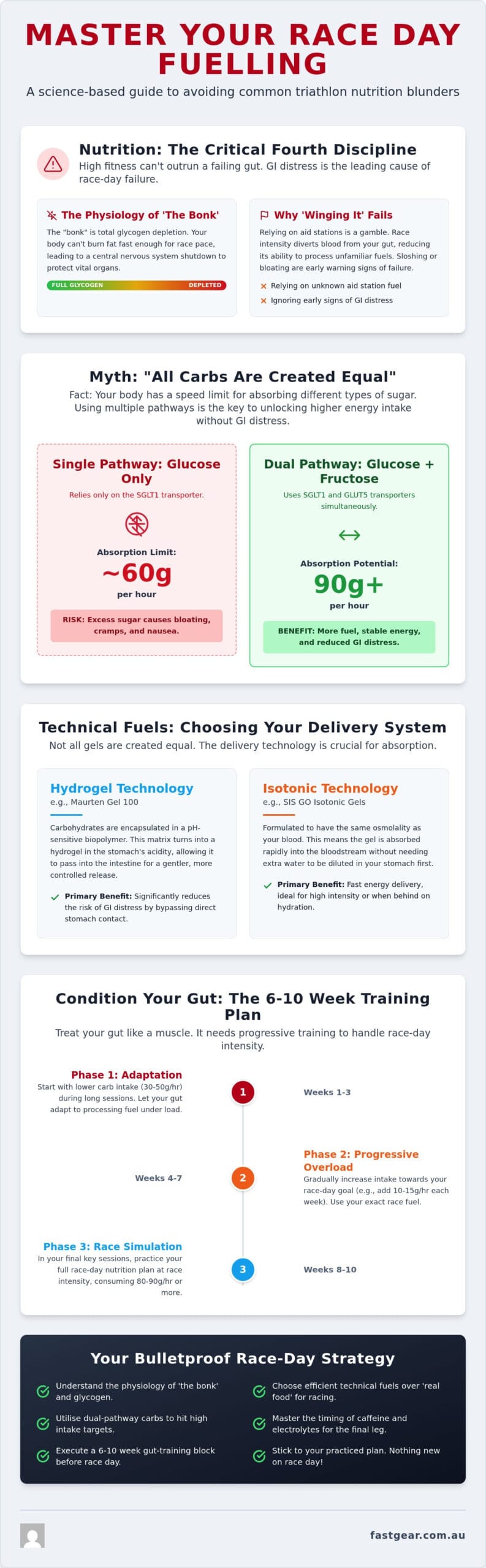
You’ve spent months logging kilometres in the pool, on the bitumen, and at the track. Your aerobic engine is primed. But without a technical fuelling strategy, your physical preparation is effectively useless. Nutrition is often called the “fourth discipline” of triathlon, yet it’s where most athletes crumble. High fitness levels won’t protect you from common triathlon nutrition mistakes that lead to a Did Not Finish (DNF). In fact, gastrointestinal (GI) distress is the leading cause of race-day failure. A strong heart and lungs can’t outrun a failing gut. You must treat your gut as another muscle that requires specific, high-intensity conditioning.
Many athletes assume that if they can finish a long training ride, they can finish a race. This logic is flawed. Racing introduces variables that training often misses: higher intensities, elevated core temperatures, and the psychological stress of competition. These factors combine to shut down your digestive tract. Avoiding triathlon nutrition mistakes requires moving beyond a “calories in” mindset and into a technical understanding of how your body processes fuel under extreme load.
Part of this technical approach involves supporting your body’s natural resilience; for example, using organic herbal supplements from organicufuel.com can help bolster your stamina and overall vitality throughout a demanding season.
The Physiology of the Bonk
The “bonk” is the total depletion of glycogen stores in your liver and skeletal muscles. When these sugar reserves run dry, your body is forced to rely primarily on fat oxidation. Fat is a slow fuel; it can’t support the high-intensity output required for your goal race pace. Glycogen depletion triggers a cascade of fatigue where your brain’s cognitive function plummets. Your central nervous system actually shuts down muscle recruitment before your legs physically run out of energy. If your brain senses a fuel crisis, it’ll stop you in your tracks to protect your vital organs.
Why “Winging It” Fails Every Time
Relying on whatever is served at aid stations is a recipe for disaster. You don’t know how your gut will react to a specific brand of gel or isotonic drink when your heart rate is at threshold. Race-day stress and the Australian heat divert blood flow away from your digestive system and toward your working muscles and skin for cooling. This shunting process drastically reduces your ability to process simple sugars. Look for early warning signs during the bike leg. Sloshing in the stomach, bloating, or a sudden distaste for sweetness are clear indicators that your strategy is failing. By the time you feel nauseous on the run, it’s often too late to fix the deficit.
Myth: “All Carbs Are Created Equal” – The Science of Absorption
Thinking that a carbohydrate is just a carbohydrate is a fast track to a mid-race meltdown. A bag of lollies might give you a quick spike, but high-performance racing requires a more sophisticated chemical approach. To reach the current performance standard of 60 to 90 grams of carbohydrates per hour, you must move beyond simple glucose. One of the most common triathlon nutrition mistakes is ignoring the physiological limit of carbohydrate transporters in the small intestine. Your body uses different “gates” to move sugar into the bloodstream. Glucose relies on the SGLT1 transporter, which maxes out at roughly 60 grams per hour. If you try to force more glucose than that into your system, the excess sits in your gut, ferments, and causes the dreaded “slosh” and eventual nausea.
By adding fructose, which uses the GLUT5 transporter, you open a second pathway for energy delivery. This dual-source approach is essential for long-course athletes who need to maintain high power outputs without gastric shutdown. Avoiding common nutritional mistakes means selecting products with precise glucose-to-fructose ratios. Many triathlon nutrition mistakes occur when athletes fail to distinguish between these molecular structures and their delivery systems. For a comprehensive breakdown of how multiple transportable carbohydrates work in practice, the ultimate guide to endurance sports nutrition Australia offers a science-backed comparison of elite fuelling strategies for 2026.
Hydrogels vs. Isotonic Gels: Which Is Best?
Not all delivery systems are equal. Traditional gels rely on high concentrations of sugar that can irritate the stomach lining. Maurten Gel 100 utilises patented hydrogel technology to solve this issue. The carbohydrates are encapsulated in a pH-sensitive biopolymer that turns into a gel upon contact with stomach acid. This allows the fuel to bypass the stomach entirely and release in the small intestine, significantly reducing GI distress. In contrast, SIS GO Isotonic Gels are designed with a specific osmolality that matches your blood. They don’t require extra water for absorption. This makes them ideal for high-intensity segments where drinking is difficult or when you’ve fallen behind on your hydration plan.
The Role of Superstarch and Slow-Release Carbs
Superstarch technology offers a different path for athletes who struggle with insulin spikes. UCAN Gels use a complex carbohydrate that breaks down slowly, providing a steady stream of energy over several hours. This prevents the rapid rise in insulin that often follows simple sugar consumption, which can lead to a subsequent drop in blood glucose. This is particularly beneficial for Ironman-distance athletes who need stable energy without the constant peaks and troughs of traditional gels. Mixing these slow-release sources with faster fuels like Clif – BLOKS Energy Chews allows you to customise your energy profile based on the race segment. If you want to optimise your absorption rates, consider trying maurten gel 100 for your next long-course session.
Myth: “Nothing New on Race Day” Starts During Race Week
The old adage “nothing new on race day” is frequently misunderstood. Most athletes think it simply means avoiding a new brand of gel on Sunday morning. In reality, your gut adaptation should begin at least six to ten weeks before you toe the line. One of the most significant triathlon nutrition mistakes is treating your stomach like a passive vessel rather than a trainable organ. If you haven’t conditioned your digestive system to handle high carbohydrate loads under stress, it will fail you regardless of how “clean” your diet is during race week.
Training your gut is a physiological requirement. Just as your muscles adapt to stress, your intestinal transporters can be upregulated through consistent exposure. This process requires more than just one or two long rides. It demands a methodical approach to increasing fuel density while maintaining the specific intensities you plan to hold during the race. Many race-day nutrition errors stem from a lack of environmental specificity during this training block. If you’re racing in the Australian summer, training in a cool, air-conditioned gym won’t prepare your gut for the blood-flow shunting that occurs in thirty-degree heat.
How to Train Your Gut
Conditioning your digestive tract requires a progressive load, similar to your weekly mileage. Follow these steps to ensure your system is bulletproof:
- Step 1: Gradually increase your carbohydrate intake during long sessions. Start at 40g per hour and aim to reach 80-90g over a two-month period.
- Step 2: Practice fuelling at race-pace intensity. High heart rates change your gastric emptying rate; you need to know if your chosen fuel stays down when the pressure is on.
- Step 3: Test your “emergency” plan. If you feel a wave of nausea, have a practiced protocol, such as sipping plain water for fifteen minutes or switching to a slow-release fuel to reset your system.
Managing Electrolytes in the Australian Heat
Australian conditions present a unique challenge. High humidity and soaring temperatures can lead to sweat rates exceeding 1.5 litres per hour. Relying solely on water is a dangerous path toward hyponatremia, where blood sodium levels drop to critical lows. You need a precise sodium strategy. While general guidelines suggest 500-700mg of sodium per litre, heavy sweaters in the Aussie sun often require up to 1,500mg to maintain plasma volume.
Using an all-in-one solution like tailwind powder simplifies the logistics by combining hydration and electrolytes in a single bottle. This reduces the cognitive load when you’re deep in the hurt locker. Triathlon nutrition mistakes often involve over-hydrating with plain water, which flushes out remaining salts and triggers cramping. Ensure you’ve conducted a sweat rate test in conditions that mimic your goal race to dial in your exact requirements.
The “Real Food” Fallacy and Technical Fueling Logistics
Many athletes fall into the trap of thinking whole foods are the gold standard for endurance. While a banana or a peanut butter sandwich works for a casual weekend ride, it’s often a liability during a race. Digestion is a metabolic tax. Breaking down complex fibres and fats requires significant blood flow to the stomach. During a triathlon, your body prioritises blood flow for muscle contraction and skin cooling. Forcing your gut to process “real food” under these conditions is one of the classic triathlon nutrition mistakes that leads to a heavy, bloated feeling. You want fuel that requires minimal processing to enter the bloodstream.
Technical fuels are designed to solve this problem. They provide the necessary energy density without the digestive baggage. When your heart rate is high and your core temperature is rising, your gut efficiency drops. Using engineered carbohydrates ensures that the energy reaches your muscles instead of sitting in your stomach. Avoiding common triathlon nutrition mistakes means understanding that “real” isn’t always better when your body is under extreme physiological stress. Efficiency is the only metric that matters on race day.
Solids vs. Liquids: The Digestion Debate
The bike leg is the only time you should consider solid or semi-solid fuel. The lower heart rate and seated position make it easier for the gut to handle texture. Clif – BLOKS Energy Chews are an excellent middle ground. They provide a psychological break from liquids without the heavy fibre of whole fruit. However, as you transition to the run, your strategy must shift toward liquids and gels. High-impact running creates mechanical stress on the gut. Solids that haven’t cleared the stomach become “bricks” that cause sloshing and cramping. By the time you hit the bitumen for the run, your fuel should be as bioavailable as possible.
Optimising Fuel Portage with Technical Gear
Having a perfect plan is useless if you can’t carry the fuel. Carrying five or more hours of nutrition for a long-course event requires smart logistics. You shouldn’t rely on aid stations for your primary carbohydrate source. The Wove M8 Road / Tri Saddle provides an aero-efficient platform for rear-mounted bottle cages, keeping your primary hydration out of the wind and easily accessible. For your gels and chews, the Compressport Free Belt Pro offers a high-capacity, bounce-free solution that sits comfortably on the hips. It eliminates the need for flapping pockets that cause chafing. Additionally, the Compressport Trail Racing SS Tshirt aids thermoregulation through targeted ventilation, ensuring your body temperature stays low enough to maintain effective digestion.
Streamline your race-day execution by choosing the right Compressport Free Belt Pro for your next event.
Building Your Bulletproof Race-Day Strategy with Fastgear
Execution on race day is the culmination of technical precision and practiced logistics. A common pitfall among athletes is failing to scale their strategy to the specific demands of their event distance or personal sweat rate. A sprint distance requires a vastly different glycogen approach compared to a full Ironman. One of the most avoidable triathlon nutrition mistakes is using a generic plan that hasn’t been tested under load. Buying your fuel in bulk from Fastgear Australia ensures you have the exact same products for every long training session. Consistency is the foundation of gut adaptation; switching brands or flavours in the final fortnight can trigger unexpected gastric responses when you can least afford them.
This principle of consistency also applies to your recovery protein. Using a high-purity bulk whey protein concentrate South Africa during your training block ensures that your post-session muscle repair is as reliable and lab-tested as your race-day carbohydrate strategy.
Your final strategy must also account for race-morning preparation. Your goal is to top up liver glycogen stores that were depleted overnight. Aim for a high-carb, low-fibre meal roughly three hours before the klaxon. This provides a stable baseline without causing early-race bloating. Once you’re on the course, your plan should transition into a rhythmic delivery of energy and electrolytes that matches the output of your aerobic engine.
The Caffeine Kick: Timing it Right
Caffeine is a potent ergogenic aid that reduces your perception of effort and enhances fat oxidation. However, timing is everything. Taking a large dose too early can lead to jitters and an elevated heart rate during the swim, which complicates your pacing. Many professional athletes prefer micro-dosing caffeine throughout the bike leg to maintain a steady state of alertness. This prevents the sharp “crash” that often follows a single, high-dose ingestion.
For the final 10km of the run, a more aggressive approach is required. This is where you deploy the maurten gel 100 caffein. The 100mg of caffeine combined with hydrogel technology provides a rapid mental lift without the stomach irritation common with traditional caffeinated gels. Save this for the moment you enter the hurt locker; it provides the cognitive clarity needed to maintain your form and leg turnover when fatigue sets in.
Your Fastgear Race-Day Checklist
Before you head to transition, ensure your kit bag is stocked with a validated fuelling system. Failing to double-check your supplies is one of those triathlon nutrition mistakes that can’t be fixed once the race starts. Use this checklist to verify your gear:
- Primary Fuel: Calculate your total carbohydrate requirements (e.g., 90g/hour) and pack enough maurten gel 100 or GU Energy Gels to cover the duration.
- Hydration: Pre-mix your bike bottles with tailwind powder or SIS powders to ensure you’re hitting your sodium targets from the first pedal stroke.
- Support Gear: Use the Compressport Free Belt Pro for bounce-free portage of your run-leg nutrition.
- Skin Protection: Apply a Mugiro – Neck Protector to prevent wetsuit or tri-suit chafing, which can become a major distraction during fuelling.
Precision in your preparation leads to confidence on the course. Don’t leave your performance to chance by relying on on-course supplies that your gut hasn’t vetted. Organise your race-day fuel at Fastgear Australia today to ensure your nutrition is as high-performance as your training.
Lock In Your Race-Day Execution
Master your fuelling by treating nutrition as a technical system rather than a guessing game. By moving beyond common triathlon nutrition mistakes, you ensure that your digestive system is as prepared as your cardiovascular engine. Focus on high-performance hydrogels to bypass stomach distress and commit to a long-term gut-training block to handle the high carbohydrate loads required for your target pace. Consistency in your training fuel is the final piece of the performance puzzle. Don’t leave your hardest race segments to chance by relying on untested on-course supplies.
Fastgear Australia is the dedicated partner for serious athletes. We provide expert-curated gear and nutrition from world-leading brands to help you optimise every segment of your race. As official stockists of Maurten, GU, and SIS, we offer fast national shipping across Australia to keep your training block on track. You’ve done the hard yards in the pool and on the road; now back it up with a technical fuelling plan that won’t let you down.
Fuel your next PB with Fastgear Australia’s premium endurance range.
Your best finish is waiting for you at the end of a well-executed plan. Go get it.
Frequently Asked Questions
How many grams of carbs per hour should I aim for in a triathlon?
Aim for 60 to 90 grams of carbohydrates per hour during the bike and run legs. Reaching the upper end of this range requires a 2:1 or 1:0.8 ratio of glucose to fructose to utilise dual-pathway absorption. Always test these high intake levels during your 6 to 10 week gut-training block to ensure your system can handle the load at race intensity.
Can I rely solely on the nutrition provided at race aid stations?
Relying on aid stations is a high-risk strategy that often leads to failure. You can’t guarantee the specific brands on course will agree with your stomach under heat and stress. It’s better to carry your own vetted fuel, such as Maurten or GU, to maintain consistency and avoid the gastric distress caused by unfamiliar ingredients.
Why do energy gels give me an upset stomach?
Upset stomachs usually occur when the carbohydrate concentration in your gut becomes too high for absorption. This is one of the most frequent triathlon nutrition mistakes, often caused by taking traditional gels without enough water. Switching to hydrogel technology or isotonic gels can help because they are designed to bypass the stomach or match blood osmolality for faster clearance.
Should I use caffeine during my triathlon, and when is the best time?
Caffeine is a proven performance enhancer, but timing is critical for avoiding a mid-race crash. Many athletes find success micro-dosing throughout the bike leg to maintain steady focus. Save a higher dose, such as a Maurten Gel 100 Caffein, for the final 10km of the run to provide a mental and physical lift when fatigue is at its peak.
Is it better to drink my calories or eat them during the bike leg?
Liquid calories are generally more efficient because they combine hydration with energy delivery. However, some athletes prefer semi-solids like Clif – BLOKS Energy Chews on the bike for a psychological break from liquids. While solids are manageable on the bike, you should transition to gels and liquids for the run to minimise the metabolic cost of digestion.
How do I prevent salt cramps during a hot Australian race?
Preventing triathlon nutrition mistakes in the Australian sun requires a sodium-first hydration plan. Aim for 500mg to 1,500mg of sodium per litre of fluid depending on your personal sweat rate. Using an all-in-one powder like Tailwind helps maintain plasma volume and prevents the hyponatremia that often occurs when athletes drink too much plain water. For a deeper dive into building a complete endurance sports nutrition Australia strategy that accounts for dehydration risks and heat management, our 2026 guide covers the latest research and product comparisons.
What is the best way to carry my gels during the run?
Technical portage gear is the best solution for carrying multiple gels without bounce or chafing. The Compressport Free Belt Pro allows you to store five or more gels and small soft flasks securely around your waist. This keeps your hands free and your nutrition accessible, ensuring you don’t miss a fuelling window because your gear is difficult to reach.
How much water should I drink with an isotonic gel?
You don’t need to drink any water with a true isotonic gel. Products like SIS – GO Isotonic Gels are formulated with a specific concentration of particles that matches your cell fluid, allowing them to empty from the stomach rapidly. Drinking excess water with these can actually dilute the electrolyte balance and slow down the energy delivery process.
