
Uncategorized
Energy Gels vs Chews: Which Fuel Wins for Endurance in 2026?
Aug
The most expensive nutrition in the world is the one you can’t swallow at kilometre 30. While gels are the default for many, the “gag reflex” and mid-race stomach cramps are clear signs your fuelling strategy needs a tactical overhaul. You’ve likely felt that hit of flavour fatigue or struggled with a sticky packet while cycling at speed. It’s a common frustration that can derail months of dedicated training.
This guide settles the energy gel vs chews endurance debate for 2026. You’ll discover whether high-speed gels or portionable chews provide the superior performance edge for your next marathon, triathlon, or ultra-endurance event. We’ll help you build a gut-friendly plan that keeps your energy levels steady without the “bonk” or the dreaded gut rot.
We are breaking down the latest absorption science and the AIS carbohydrate guidelines of 30 to 90 grams per hour. We’ll also look at practical gear solutions like the Compressport Free Belt Pro to manage your nutrition on the move. From the rapid delivery of SIS Isotonic Gels to the tactical pacing of Clif BLOKS, here is how to optimise your intake for peak results.
Key Takeaways
- Master the science of dual-source carbohydrates to reach the optimal 60-90g per hour intake for sustained peak performance.
- Evaluate the logistical trade-offs of energy gel vs chews endurance formats to solve packaging issues and enable precise mid-race micro-dosing.
- Identify the specific osmolality factors that cause gut rot and learn how to prevent flavour fatigue before it impacts your finishing pace.
- Discover the best-in-class Australian fuelling options, from advanced hydrogels for gut comfort to isotonic gels for rapid absorption during high-intensity efforts.
- Develop a personalised race-day strategy that maps specific fuel types to your intensity levels and terrain requirements for a bonk-proof finish.
Carbohydrate Delivery: The Science of Gels vs Chews
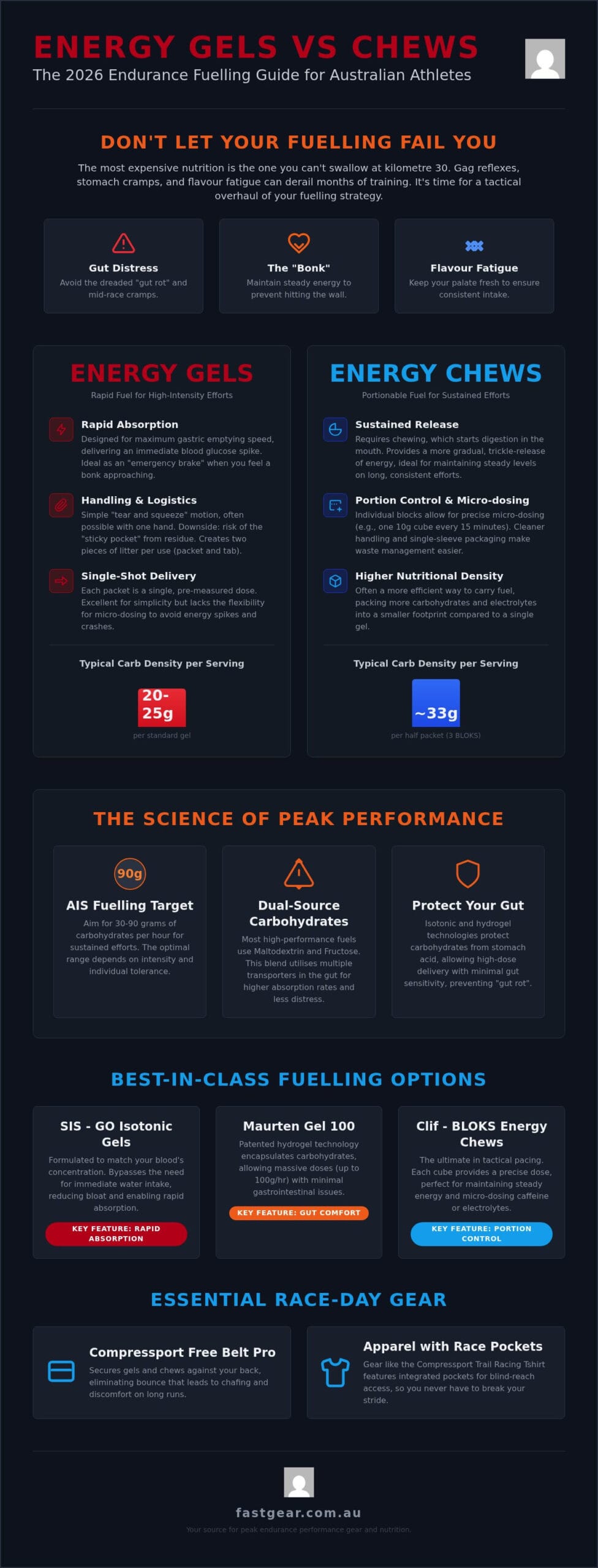
Peak endurance depends on precise fuel delivery. Whether you choose a gel or a chew, the objective remains hitting the AIS guidelines of 30 to 90 grams of carbohydrates per hour for long-duration efforts. Most high-performance options rely on a dual-source blend of maltodextrin and fructose. This combination uses multiple transporters in the gut, allowing for higher absorption rates without causing distress. To understand what are energy gels and how they compare to solids, you need to look at how your body processes them under physiological stress.
The primary difference in the energy gel vs chews endurance debate lies in the first stage of digestion. Gels are designed for maximum gastric emptying speed. They move through the stomach rapidly to provide an immediate blood glucose spike. Chews, however, require mastication. This chewing action initiates salivary amylase, meaning digestion starts in the mouth. For athletes who prefer a more tactile experience, this can feel more substantial than swallowing a viscous liquid while at threshold.
Absorption Rates and Glycaemic Response
Gels act as the “emergency brake” during a race. If you feel a bonk approaching, a gel delivers glucose to the bloodstream faster than any solid format. Products like SIS – GO Isotonic Gels are specifically formulated to be isotonic, meaning they have the same concentration as your blood. This allows them to bypass the need for immediate water intake, reducing the risk of bloating. Conversely, Maurten Gel 100 uses patented hydrogel technology to encapsulate carbohydrates, protecting them from stomach acid and allowing for high-dose delivery with minimal sensitivity issues. Chews provide a sustained, trickle release of energy, making them ideal for steady-state efforts where you want to maintain a constant level of fuel without sharp spikes.
Nutritional Density Comparison
When comparing nutritional density, the numbers vary significantly between formats. A standard GU Energy Gel – Single typically provides 20 to 25 grams of carbohydrates. In contrast, half a packet of Clif – BLOKS Energy Chews delivers approximately 33 grams. This makes chews a highly efficient way to carry more fuel in a smaller footprint. For the harsh Australian sun, sodium content is critical. Chews often carry a higher electrolyte load per serving to help manage hydration and cramp risk. Caffeine integration also differs; Maurten Gel 100 Caffeine offers a concentrated 100mg hit for late-race focus, while caffeinated chews allow you to micro-dose your stimulant intake over several kilometres to avoid the jitters.
Practical Race-Day Logistics: Handling and Portability
Execution is everything. You can have the perfect physiological plan, but if you can’t access your fuel while redlining, your performance will suffer. The energy gel vs chews endurance choice often settles on how you handle the packaging under pressure. Gels are the traditional go-to for speed. They require a simple “tear and squeeze” motion, often achievable with one hand and your teeth. However, the “Sticky Pocket” syndrome is a real threat. A half-finished gel or a torn tab can coat your jersey, bike frame, and hands in a sugary film that attracts dust and grit.
Chews offer a different tactical advantage: portion control. While a gel is a single-shot delivery of 20 to 30 grams of carbs, Clif – BLOKS Energy Chews allow you to micro-dose. You can take a single 10g cube every 15 minutes to maintain a steady blood glucose line. This prevents the “spike and crash” sensation some athletes experience with high-load gels. For waste management, chews are often easier to handle in a single sleeve, whereas gels create two pieces of litter per use. In Australian trail races, where “leave no trace” is strictly enforced, managing those tiny plastic tabs is a genuine logistical hurdle.
Carrying Your Fuel: The Gear Advantage
Your choice of apparel dictates your fuelling efficiency. The Compressport Trail Racing SS Tshirt is designed with specific rear pockets that allow for blind-reach access to your nutrition. This is vital when you don’t want to break your stride or aero tuck. For those carrying a full day’s worth of fuel, the Compressport Free Belt Pro is a superior solution. It secures your gels and chews against the small of your back, eliminating the annoying bounce that leads to chafing. On the bike, storing loose chews in a top-tube “bento” box allows for rapid, frequent intake without fumbling with wrappers at 40km/h.
Weather and Temperature Considerations
The Australian climate dictates the physical state of your fuel. In high humidity or extreme heat, some chew brands reach a “melting point,” becoming a single, fused mass inside the packet. Gels, conversely, become less viscous in the heat. This actually makes them easier to swallow, though it increases the risk of a messy leak if the packaging is compromised. You must also consider the science of fueling with carbohydrates regarding hydration. Chews are more concentrated and have lower water content than SIS – GO Isotonic Gels. This means they demand more discipline with your water bottle to ensure the carbs actually move from your stomach to your muscles.
Managing Gut Health and Avoiding the Dreaded “Bonk”
Success at kilometre 30 isn’t just about what you eat; it’s about what you can actually absorb. “Gut rot” is the athlete’s term for gastrointestinal distress caused by high-osmolality nutrition. When you consume highly concentrated gels without enough water, your body pulls fluid into the gut to dilute the sugar. This leads to bloating, cramps, and an inevitable drop in power. Understanding the energy gel vs chews endurance balance is crucial for avoiding these mid-race disasters. While chews are inherently concentrated, gels now come in varying formulations that can either cause or cure GI issues depending on your hydration status.
Isotonic vs Concentrated Solutions
Modern sports science has solved many historical gut issues through clever engineering. SIS – GO Isotonic Gels are designed with a specific osmolality that matches your blood concentration. This allows them to empty from the stomach rapidly without requiring extra water intake. This is a massive advantage during high-intensity efforts where drinking large volumes is difficult. Alternatively, Maurten Gel 100 is the gold standard for high-carb, low-irritation fuelling. It uses hydrogel technology to encapsulate carbohydrates, allowing them to bypass the stomach acid and release fuel directly in the small intestine. Chews, such as Clif – BLOKS, offer a firm block texture that requires saliva to break down. This natural process can slow the absorption rate just enough to keep the gut stable during steady-state efforts.
The “Gag Reflex” and Palatability
Sensory fatigue is a legitimate performance killer. After three hours of consuming sweet, viscous liquids, the thought of another gel can trigger a physical gag reflex. Chews provide a vital “mental break” by offering a different mouthfeel and a more substantial texture. The act of chewing can be psychologically grounding during the later stages of an ultra-endurance event. To cut through the sweetness fatigue, look for options with high salt or sour profiles. Many elite athletes find success by alternating formats. You might use chews for the first half of a marathon to keep the stomach settled, then switch to high-performance gels for the final 10 kilometres when your heart rate is high and chewing becomes a chore.
You must train your gut. Just as you train your legs, your digestive system needs 6 to 10 weeks to adapt to high carbohydrate loads. Use your long training sessions to test your energy gel vs chews endurance strategy under race-simulation conditions. Don’t wait until the start line to discover your stomach rejects a specific texture or flavour. Practice with your chosen format to ensure your fuelling plan is as robust as your fitness.
Top Performance Fueling Options for Australian Athletes
Selecting the right tool for the job is a tactical decision. The energy gel vs chews endurance landscape is dominated by a few key players that deliver results in the harshest Australian conditions. Whether you are racing a coastal marathon in high humidity or a dusty ultra in the outback, your nutrition must withstand the heat without losing its efficacy or palatability. Each brand offers a specific physiological advantage that can be mapped to your race-day requirements.
Brand Deep-Dive: Maurten and SIS
Maurten gel 100 is the technical benchmark for elite performance. It delivers 25 grams of carbohydrates through a biopolymer matrix. This hydrogel technology is why world-record holders choose it for high-density fuelling. Because it is unflavoured and contains no added preservatives, it doesn’t develop a sickly, chemical aftertaste when sitting in a hot jersey pocket for four hours. For those needing a mental lift during the final stages of a race, maurten gel 100 caffein provides a controlled 100mg stimulant hit without the bitterness of traditional caffeinated products.
SIS – GO Isotonic Gels offer a different advantage. They are the ultimate “grab and go” solution. Because they are pre-diluted, they are essential for triathletes who might miss a water cup at a chaotic aid station. You get 22 grams of carbs without the need for immediate hydration, keeping your pace high and your stomach settled. This isotonic formulation is particularly useful during high-intensity intervals where your ability to swallow thick liquids is compromised.
The Best of Chews: Clif and GU
Clif – BLOKS Energy Chews are the top choice for customisable pacing. The signature cube shape is a design win; it’s easy to handle with sweaty hands and won’t roll away if you drop it on the tarmac. Half a packet provides 33 grams of carbohydrates, allowing you to micro-load your fuel throughout a long climb. Their flavours, like Margarita with extra sodium, are specifically formulated to cut through the sweetness fatigue common in long-distance racing. They maintain their structural integrity even in the Australian sun, avoiding the “melted mass” issue found in lower-quality alternatives.
GU Energy Gel – Single remains the reliable classic for a reason. With a massive variety of flavours and a consistent 22-gram carb count, it’s a versatile workhorse. GU also incorporates branched-chain amino acids (BCAAs) to help reduce muscle fatigue during high-volume sessions. Their chewable counterparts follow the same philosophy, combining electrolytes and amino acids in a portable format. To find the perfect mix of textures and flavours for your next event, you can shop the full endurance range at Fastgear Australia.
Designing Your Personalised Endurance Nutrition Strategy
Precision is the difference between a PB and a DNF. To build a robust plan, start with the math. Most athletes should target 60 to 90 grams of carbohydrates per hour. If you’re pushing into ultra-endurance territory, you might even test higher limits. The energy gel vs chews endurance decision isn’t about choosing one over the other; it’s about mapping the right format to the specific intensity and terrain of your race.
Step one is calculating your total requirement based on your expected finish time. Once you have your total carb count, step two involves mapping your formats to the course profile. Gels are your high-intensity fuel. Use them for steep climbs, technical descents, or the final 10 kilometres when your heart rate is redlining and chewing is impossible. Chews are perfect for flat, steady-state sections where you have the breath to masticate properly. Step three is the hydration link. If you use chews or concentrated gels like GU, you must carry enough water to assist absorption. Isotonic options like SIS allow for more flexibility if aid station timing is unpredictable.
The Hybrid Approach: Mixing Gels and Chews
A 50/50 hybrid strategy is often the most sustainable for long events. This prevents the flavour fatigue that derails many athletes and keeps the gut from becoming overwhelmed by a single texture. Try using Clif BLOKS for the first half of your event. They provide a sense of “real food” and keep you psychologically grounded during the early kilometres. As you enter the “pain cave” in the final third, transition to Maurten Gel 100. This shift ensures you maintain high carbohydrate density when your digestive system is under the most stress. Managing this transition requires practice to ensure your stomach handles the change in osmolality without protest.
Final Preparation and Kit Check
Your strategy is only as good as your access. Step four is testing everything in training under race-pace conditions. This includes your carrying solution. Step five is finalising your kit. The Compressport Free Belt Pro is the ideal tool for this. It allows you to organise your gels on one side and your chews on the other, ensuring you never grab the wrong fuel in a hurry. Pair this with the Compressport Trail Racing SS Tshirt to utilise the integrated rear pockets for empty wrappers. The golden rule remains: nothing new on race day. Every gel, chew, and bottle must be vetted during your peak training block to ensure total gut comfort.
Ready to build your ultimate race-day kit? Shop the full range of endurance nutrition at Fastgear Australia and secure the fuel you need for a bonk-proof performance.
Maximise Your Performance Potential
Success on race day is the result of physical training and nutritional precision. The energy gel vs chews endurance choice effectively comes down to your personal physiological tolerance and the specific demands of your event course. Gels offer the rapid absorption required for high-intensity efforts, while chews provide the tactical pacing and sensory variety needed to stave off mid-race flavour fatigue. A hybrid strategy, balanced with technical carrying solutions, ensures you maintain a steady 60 to 90 grams of carbohydrates per hour without the risk of gut rot.
As an authorised Maurten and SIS retailer, Fastgear Australia stocks the exact formulations used by world-record holders. We are specialised technical gear experts, providing the high-performance belts and shirts required to manage your fuel on the move. With fast national shipping across Australia, you can start training your gut with the world’s best nutrition today. Optimise your race-day fuel with Fastgear Australia and ensure your next finish line is your strongest yet.
Frequently Asked Questions
Are energy chews as effective as gels for endurance?
Energy chews are just as effective as gels for maintaining blood glucose levels during long-duration efforts. Both formats typically use a blend of maltodextrin and fructose to deliver the required carbohydrate load to your muscles. The choice between energy gel vs chews endurance formats comes down to delivery speed and mouthfeel. Gels enter the bloodstream slightly faster, while chews provide a sustained release and a different sensory experience for the athlete.
Do I need to drink water with energy chews?
You should always consume water with energy chews to assist with gastric emptying and absorption. Unlike SIS GO Isotonic Gels, which are pre-diluted for immediate use, chews are highly concentrated. Without adequate fluid, the high sugar concentration can sit in your stomach, leading to bloating or mid-race cramps. Aim for a few sips of water with every individual chew to ensure the carbohydrates move efficiently into your system.
How many energy chews equal one gel?
Typically, three individual cubes of Clif BLOKS or GU Chews equal the carbohydrate content of one standard gel sachet. A single gel usually provides 20 to 25 grams of carbs, while a single chew cube offers approximately 8 to 10 grams. Always check the nutritional panel on your specific packet to be sure. This portioning allows for precise micro-dosing of your 60 to 90 gram hourly carbohydrate target during a race.
Can I mix different brands of gels and chews in one race?
Mixing different brands of gels and chews is perfectly safe, provided you have tested the specific combination during your training blocks. Many athletes use a multi-brand strategy to combat flavour fatigue and manage gut sensitivity over long hours. For example, you might use Maurten Gel 100 for its neutral taste alongside Clif BLOKS for their electrolyte profile. Ensure the total carbohydrate and sodium counts align with your personalised plan.
What is the best way to carry energy chews while running?
The most efficient way to carry chews while running is using a technical solution like the Compressport Free Belt Pro. This belt secures the packets against your waist to eliminate bounce and friction. Alternatively, you can decant loose chews into the rear pockets of a Compressport Trail Racing SS Tshirt for rapid access. Avoid keeping them in your hands for long periods, as body heat can make certain brands sticky and difficult to handle.
Why do energy gels sometimes cause stomach issues?
Gels often cause stomach issues due to high osmolality, which happens when concentrated sugar pulls water into the intestines. This process causes the gut rot or cramping often associated with the energy gel vs chews endurance debate. To prevent this, switch to isotonic formulations like SIS or hydrogel options like Maurten. These advanced technologies allow high carbohydrate loads to bypass the stomach with minimal irritation and no need for extra water.
Are there caffeinated versions of both gels and chews?
Caffeinated versions are widely available in both gel and chew formats to help with late-race focus. Products like Maurten Gel 100 Caffeine provide a concentrated 100mg hit, while certain Clif BLOKS flavours offer smaller 25mg or 50mg doses per serving. Using caffeinated chews allows you to trickle-feed the stimulant throughout a race. This helps maintain focus and reduces perceived exertion during the final stages of an ultra-endurance event without the risk of jitters.
How often should I take a gel or chew during a marathon?
You should consume fuel every 20 to 45 minutes to meet the AIS recommendation of 30 to 60 grams of carbohydrate per hour. If you are using gels, this typically means one sachet every 30 to 40 minutes. If you prefer chews, taking one or two cubes every 15 to 20 minutes provides a more consistent energy stream. Always set a timer on your sports watch to ensure you don’t miss a fuelling window during the race.
