
Uncategorized
Choosing a Triathlon Saddle: 2026 High-Performance Guide
Aug
A triathlon saddle is not a seat; it’s a precision tool designed to support rotated pelvic geometry while protecting your most sensitive soft tissue. If you’ve spent the last 40 kilometres of a race shifting positions to escape that familiar, agonising numbness, you already know that a standard road saddle won’t cut it in the aero bars. It’s the silent performance killer that prevents you from holding your tuck and ruins your power transfer. Most athletes accept this discomfort as part of the sport, but elite performance demands a better solution.
Finding the right fit is about more than just padding. This guide breaks down exactly how to choose a triathlon saddle by mastering the technical nuances of pelvic rotation and pressure relief. You’ll learn how to eliminate saddle sores and maintain a deeper aero position for longer. We’ll examine the latest 2026 UCI equipment regulations, the rise of short-nose designs, and why the Wove M8 is currently the gold standard for athletes chasing a new personal best on Australian roads.
Key Takeaways
- Understand why rotating the pelvis onto the pubic rami requires a specialised saddle design to maintain blood flow and comfort in aero.
- Master how to choose a triathlon saddle by matching your specific pelvic angle to the geometry of split-nose or short-nose models.
- Optimise your setup for Australian chip-seal roads with carbon rails that offer superior vibration dampening and stable power transfer.
- Use a high-intensity indoor trainer protocol to validate your fit and stack height before committing to a long-distance race block.
- Discover why the Wove M8’s narrow, long-nose design is the professional choice for eliminating inner thigh rub during aggressive efforts.
Understanding Pelvic Rotation: Why Triathlon Saddles Are Different
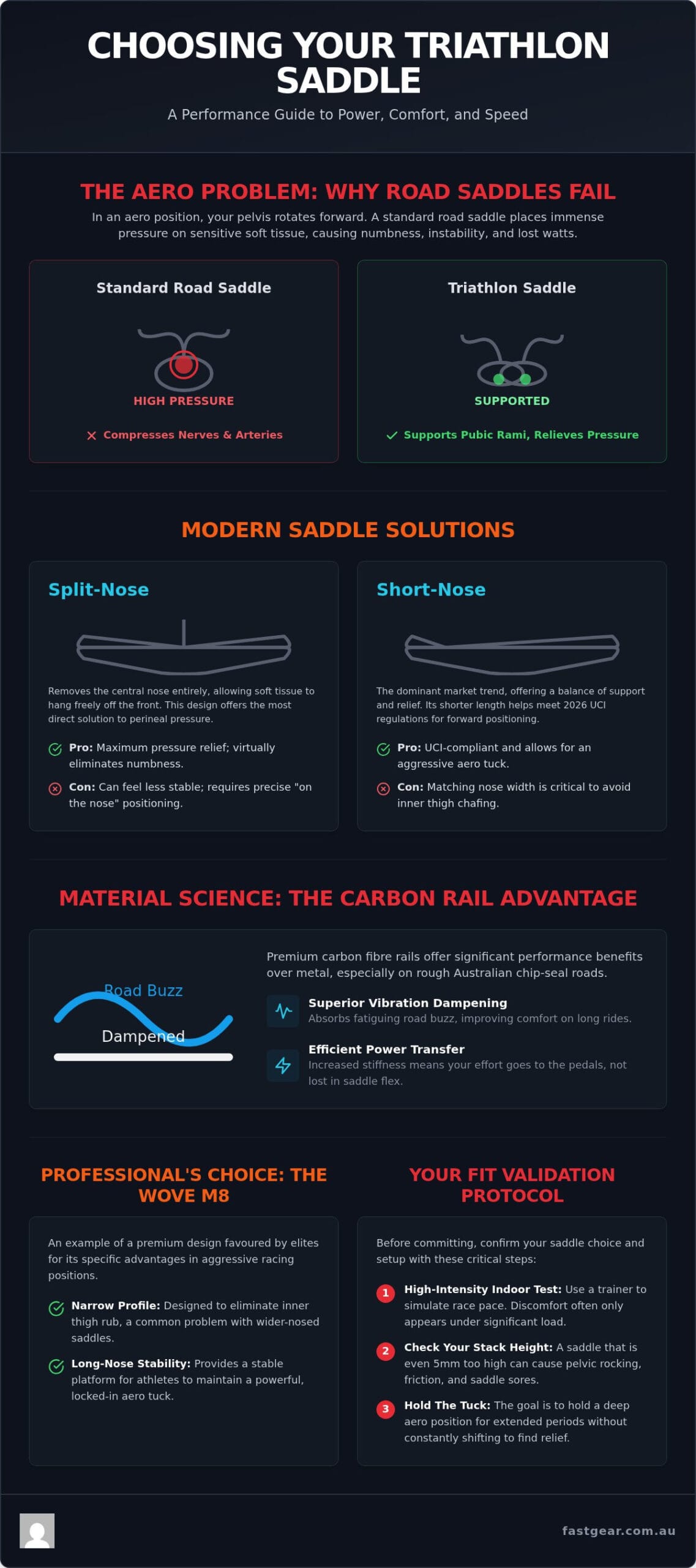
Most athletes approach their bike setup from a road cycling perspective, but triathlon demands a fundamental shift in skeletal support. On a road bike, you sit relatively upright with your weight supported by the ischial tuberosities, commonly known as your sit bones. When you drop into the aero bars, your entire pelvis pivots forward. This “Aero Shift” moves the primary contact point from the wide sit bones at the rear to the narrow pubic rami at the front. Understanding this transition is the first step in learning how to choose a triathlon saddle that doesn’t compromise your performance.
Pelvic rotation is the forward tilting of the pelvis around the hip joint to accommodate a lower torso angle in the aerodynamic position. Traditional road saddles are designed with a wide rear and a narrow, often hard nose. When you rotate forward on a standard seat, you place immense pressure on soft tissue and nerves that aren’t meant to bear weight. This results in the “saddle shuffle,” where you constantly move to find relief, breaking your rhythm and wasting watts. High-performance tri-saddles solve this by shifting the load-bearing surface forward and often incorporating a central cutout.
The Biomechanics of the Aero Position
Achieving a flat, aerodynamic profile requires a significant forward pelvic tilt. Without a technical saddle, this rotation compresses the perineum, leading to numbness and restricted blood flow. While standard bicycle saddle components are built for vertical stability, tri-specific designs focus on supporting the pubic bones while allowing the legs to move freely. Saddle height also plays a critical role here. If your saddle is even five millimetres too high, your pelvis will rock to reach the bottom of the pedal stroke, causing friction and instability that no amount of padding can fix.
Performance Benefits of a Tri-Specific Fit
The goal is to hold your aero tuck for the entire bike leg without breaking position. Every time you sit up to relieve pressure, you increase your frontal area and lose speed. A correctly fitted saddle allows for a more aggressive, lower cockpit setup while keeping the hips open. This open hip angle is vital for the run leg. By reducing strain on the hip flexors during the ride, you’ll find it easier to transition into a natural running gait once you hit T2. Mastering how to choose a triathlon saddle isn’t just about comfort; it’s about protecting your capacity to run a fast marathon after 180 kilometres in the saddle. Stable support ensures consistent power output and eliminates the micro-movements that lead to premature fatigue.
Key Design Features: Split-Nose, Short-Nose, and Cutouts
Once you understand pelvic rotation, the next step in learning how to choose a triathlon saddle is identifying the specific geometry that supports your anatomy. Modern designs have moved away from the traditional “pear” shape to solve the problem of soft tissue compression. Split-nose saddles, famously pioneered by brands like ISM, remove the central nose entirely. This allows your soft tissue to hang off the front of the saddle, effectively eliminating pressure on the perineum. However, these require a specific setup; you don’t sit “in” a split-nose saddle, you sit on the very end of the prongs.
Short-nose saddles have become the dominant market trend in 2026. These models, such as the Wove M8, typically measure around 295mm or less. This shorter length is a strategic response to UCI equipment regulations. As of January 1, 2026, the UCI stipulates that a saddle must be positioned between 0 and 50mm behind the bottom bracket for a “forwards” position. A shorter saddle allows you to move the seat further forward to achieve an aggressive aero tuck without violating these technical rules. Central cutouts further enhance this by providing essential airflow, which is critical for moisture management during a hot race in challenging conditions.
Split-Nose vs. Traditional Long-Nose
The primary advantage of a split-nose design is the total relief of the central channel. It’s the most effective way to prevent numbness. The trade-off is often a perceived loss of lateral stability. Some athletes feel they are “swimming” or sliding on the seat. This usually stems from a common mistake: sitting too far back. Your body position on the saddle should be right at the front edge. If you find yourself constantly pushing back, the saddle might be too wide or your reach to the aero bars might be too long.
Anatomy and Saddle Width
Width is the most misunderstood factor in tri-saddle selection. While road cyclists focus on sit bone width, triathletes must consider the width of the saddle nose. If the nose is too wide, you’ll experience inner thigh chafing. If it’s too narrow, you won’t have enough surface area to support your pubic rami, leading to sharp pressure points. Finding the “sweet spot” requires matching the taper of the saddle to your natural leg path. If you’re hunting for the peak of engineering in this category, you can explore the Wove M8 Road / Tri Saddle at Fastgear Australia to see how professional-grade width optimisation feels. A stable base is the only way to maintain a consistent power output over 180 kilometres.
Material Science: Carbon Rails, Padding Density, and Grip
The technical architecture of your saddle extends far beyond its silhouette. Once you’ve identified the correct geometry, the materials used in the rails and cover determine your fatigue levels over a five-hour bike leg. High-performance construction isn’t just about shaving grams; it’s about managing the brutal vibrations of the road. When learning how to choose a triathlon saddle, you must look past the aesthetics and evaluate the science of the interface.
The Case for Carbon Rails
Carbon fibre rails are often marketed as a weight-saving luxury, but their real value lies in vibration dampening. Australian chip-seal roads are notoriously harsh, sending high-frequency “road buzz” through the frame and directly into your pelvis. Carbon rails act as a micro-suspension system, absorbing these shocks before they reach your soft tissue. This reduces muscle fatigue and keeps you fresher for the run. If you’re chasing a PB on a hilly course, the weight savings are a secondary bonus that improves bike handling. Just ensure your seat post clamp is compatible with the oval shape of carbon rails, as they differ from standard 7mm round metal rails. The Wove M8 Road / Tri Saddle utilizes premium carbon rails to provide this exact balance of stiffness and comfort.
Padding Density and Long-Course Comfort
Don’t fall for the “squish” test in the shop. Many athletes mistakenly believe that a softer saddle equals more comfort. In reality, soft foam collapses under your weight during a long ride. This allows your sit bones or pubic rami to sink through the padding and hit the hard base plate, causing sharp pain. High-density, closed-cell foam is the superior choice for long-course racing. It provides a stable platform that supports your skeleton without bottoming out. This material also resists water and sweat absorption, which is vital in the Australian heat where moisture can lead to rapid skin breakdown and saddle sores.
The future of this technology is 3D-printed padding. This allows manufacturers to create “zones” of different densities within a single saddle. You can have a softer nose for pressure relief and a firmer rear for stability. Combined with a non-slip cover material, these features prevent the “forward slide” that often happens during high-intensity efforts. A grippy surface keeps you locked into your aero tuck, ensuring every watt goes into the pedals rather than into micro-adjustments of your seating position. Mastering how to choose a triathlon saddle means selecting the density that keeps you stable, not just comfortable for the first ten minutes.
The Practical Test: How to Trial Your New Saddle
Buying a technical saddle is only the first step. To truly master how to choose a triathlon saddle, you must follow a rigorous validation protocol. Don’t assume a direct swap will work. Many high-performance models have unique stack heights. If your new seat is five millimetres taller than your previous one, your leg extension will be compromised. Always measure from the centre of the bottom bracket to the top of the saddle before and after the swap to maintain your optimal fit.
The indoor trainer is your laboratory. It eliminates variables like wind, traffic, and road surface. Perform a 20-minute sustained effort in your aero bars at race pace. Since there is no coasting on a trainer, you’ll identify pressure points much faster than on the road. Try the “no-hands” test: if you can’t stay stable in the aero position without gripping the extensions for dear life, your saddle height or tilt is likely incorrect. A stable base is essential for power transfer.
Setting Up Your Test Environment
Precision matters when setting your baseline. Use a spirit level to ensure the saddle is truly flat before you start making adjustments. While some athletes prefer a slight nose-down tilt to relieve pressure, the 2026 UCI regulations limit this to a maximum of nine degrees. Start at zero and move in tiny increments. Always test in your race kit. A thin triathlon chamois provides significantly less padding than standard road bibs. What feels comfortable in thick shorts might be agonising in a tri-suit during a long-course event.
Common Adjustment Pitfalls
Avoid the “nose-down” trap. Angling the nose too far down doesn’t actually solve pressure issues; it just causes you to slide forward. This puts excessive weight on your arms and ruins your aerodynamic profile. If you feel like you’re constantly pushing yourself back, the saddle is either too high or the tilt is too aggressive. Ensure your fore/aft position allows for a relaxed reach to the bars while keeping your weight centred over the bottom bracket. You should trial the saddle for at least three long rides before deciding if it’s the right fit for your anatomy. Small adjustments of just two millimetres can be the difference between a PB and a DNF.
Ready to dial in your performance? You can order the Wove M8 Road / Tri Saddle from Fastgear and begin your structured testing programme today.
Premium Solutions: Why the Wove M8 is the Pro Choice
Technical evolution in the saddle market has moved beyond the “one-size-fits-all” approach. While legacy brands dominate local bike shops, elite triathletes are increasingly turning to boutique engineering for a competitive edge. The Wove M8 represents this new standard. It’s designed for the most aggressive aero positions, providing a stable base that doesn’t compromise on soft tissue relief. When you’re learning how to choose a triathlon saddle, identifying a model that supports your specific pelvic tilt while offering a superior weight-to-strength ratio is the ultimate goal.
Engineering Excellence in the Wove M8
The standout feature of the Wove M8 is its narrow, long nose. Traditional split-nose designs can be too wide for some athletes, leading to inner thigh rub and friction that ruins a race. The M8 eliminates this by tapering the support structure while maintaining a central relief channel. Its carbon shell is engineered to balance flex and rigidity, absorbing road buzz while providing a firm platform for maximum power transfer. Pro triathletes are switching to Wove because it offers a robust, race-winning tool without the bulk of traditional padding. You can check out the Wove M8 at Fastgear Australia to see the technical specifications in detail.
This saddle is also highly versatile. While engineered for the triathlon tuck, its design allows for a comfortable transition to the hoods, making it ideal for road setups that see high-intensity training miles. In May 2026, USA Triathlon cemented Wove’s status by making them their official partner, further validating the performance claims of this carbon-railed masterpiece. For Australian athletes, getting your hands on this elite gear is now straightforward through specialised retailers.
Final Verdict: Making Your Choice
Mastering how to choose a triathlon saddle requires a commitment to technical detail. You must account for your specific pelvic rotation, the width of your pubic rami, and the material density that supports your weight over 180 kilometres. Don’t settle for a saddle that causes numbness or forces you out of your aero tuck. Investing in your primary contact point is the most effective way to improve your bike split and protect your legs for the run. Fastgear provides national Australian shipping for this elite gear, ensuring you don’t have to settle for whatever is left on the shelf at a local shop. It’s time to organise your cockpit with the best tri gear at Fastgear and start chasing your next PB with confidence.
Dial In Your Setup for Race Day
Your saddle choice is the most influential technical decision in your cockpit setup. Understanding how to choose a triathlon saddle requires balancing forward pelvic rotation with high-density support that protects soft tissue. We’ve explored how short-nose geometries enable aggressive, UCI-legal positions while carbon rails dampen harsh Australian road buzz. Finding the perfect fit isn’t just about comfort; it’s about maintaining your aero tuck for the entire 180 kilometres to ensure you hit T2 with fresh legs.
As an authorised Wove retailer, Fastgear Australia specialises in endurance gear built for local conditions. Every watt matters when you’re chasing a personal best. Don’t let saddle discomfort dictate your race outcome. Upgrade your ride with the Wove M8 at Fastgear Australia and take advantage of free shipping on premium orders. Your next PB starts with a stable base. Get after it.
Just as you invest in a precision saddle for the road, many athletes choose to buy office supplies online Australia to ensure their home office is ergonomically sound, supporting their recovery and long-term health between training sessions.
Frequently Asked Questions
How do I know if my triathlon saddle is too wide?
You’ll experience excessive friction or chafing on your inner thighs during the pedal stroke if the nose is too broad. If you find yourself sliding forward to the very tip of the seat to find relief, the mid-section is likely too wide for your pelvic structure. This often happens with standard road seats that aren’t tapered for a rotated aero position.
Is a split-nose saddle better for long-distance Ironman racing?
Split-nose designs are highly effective for Ironman distances because they remove all central pressure from sensitive soft tissue. By allowing your weight to rest on the pubic rami rather than the perineum, you maintain blood flow for hours. It’s a popular choice for athletes who struggle with persistent numbness while tucked in the aero bars.
Why do I get numbness in my aero bars but not on the hoods?
Moving to the aero bars rotates your pelvis forward, shifting weight from your sit bones to soft tissue and nerves. On the hoods, you are more upright and supported by skeletal structures. In the aero tuck, a standard saddle compresses blood vessels. This biomechanical shift is why learning how to choose a triathlon saddle is essential for long-course comfort.
Can I use a road bike saddle for a triathlon?
You can, but it’s rarely optimal for maintaining an aerodynamic position for extended periods. Road saddles are designed for an upright posture and skeletal support at the rear. Using one in a tri-tuck usually leads to significant soft tissue compression and “saddle shuffle.” You’ll likely sit up frequently to relieve pressure, which increases your frontal area and kills your speed.
How much should I tilt my triathlon saddle downwards?
Start with a level saddle and only tilt the nose down in small, two-millimetre increments if you feel excessive pressure. While a slight tilt helps some athletes, the 2026 UCI regulations limit the maximum angle to nine degrees. Too much tilt causes you to slide forward, putting extra strain on your shoulders and triceps while ruining your pelvic stability.
What is the best saddle for preventing chafing in humidity?
Look for a saddle with a non-slip, closed-cell foam cover that doesn’t absorb moisture. In high Australian humidity, sweat can saturate traditional padding and increase friction against your skin. Technical models like the Wove M8 use materials that stay dry and stable. This prevents the skin breakdown that leads to painful saddle sores during a hot race block.
How long does it take to get used to a new triathlon saddle?
Most athletes require three to five long rides to fully adapt to a new technical saddle. Your soft tissue needs time to adjust to the new pressure distribution and support points. Always perform your initial testing on an indoor trainer to identify hotspots quickly. If you still feel sharp pain after 200 kilometres of riding, the fit or model likely isn’t right for you.
Do carbon rails really make a difference in comfort?
Yes, carbon rails provide superior vibration dampening on harsh Australian chip-seal roads. Beyond saving weight, carbon absorbs high-frequency road buzz that metal rails transmit directly to your pelvis. This reduces muscle fatigue over long distances. When deciding how to choose a triathlon saddle, consider carbon rails a performance investment that keeps you fresher for the run leg.
