
Uncategorized
2026 Road Bike Saddle Guide for Australian Triathletes
Jul
What if the reason you’re dropping out of the aero tuck isn’t your fitness, but a five-millimetre difference in pelvic tilt? You’ve likely felt the familiar sting of soft tissue numbness or the sharp rub of a wide saddle nose during a high-cadence effort. It’s a common frustration for Aussie athletes trying to optimise a standard setup for long-course speed. Fighting your equipment is a waste of precious watts that should be saved for the run.
We agree that your gear should support your performance, not hinder it. Selecting a specific road bike saddle for tri is the most effective way to rotate your pelvis forward without the agonising pressure that leads to mid-race shifting. You deserve a setup that feels as stable at kilometre 90 as it did at the mount line.
Discover how to transform your road bike into a comfortable aero machine that eliminates chafing and lower back pain. This guide previews 2026 performance tech like the carbon monocoque Wove M8, explains the latest AusTriathlon saddle setback regulations, and provides the technical blueprint to help you maintain your most aggressive position for the entire race.
Key Takeaways
- Identify the link between pelvic rotation and soft tissue pressure to stop fighting your equipment during high-intensity efforts.
- Evaluate the technical differences between split-nose and short-nose designs to choose the best road bike saddle for tri.
- Master the setup process by adjusting stack height and fore/aft positioning to simulate a steeper, race-ready seat tube angle.
- Discover how the Wove M8 carbon monocoque construction eliminates friction and chafing for a superior race-day experience.
Why your standard road saddle fails in a triathlon position
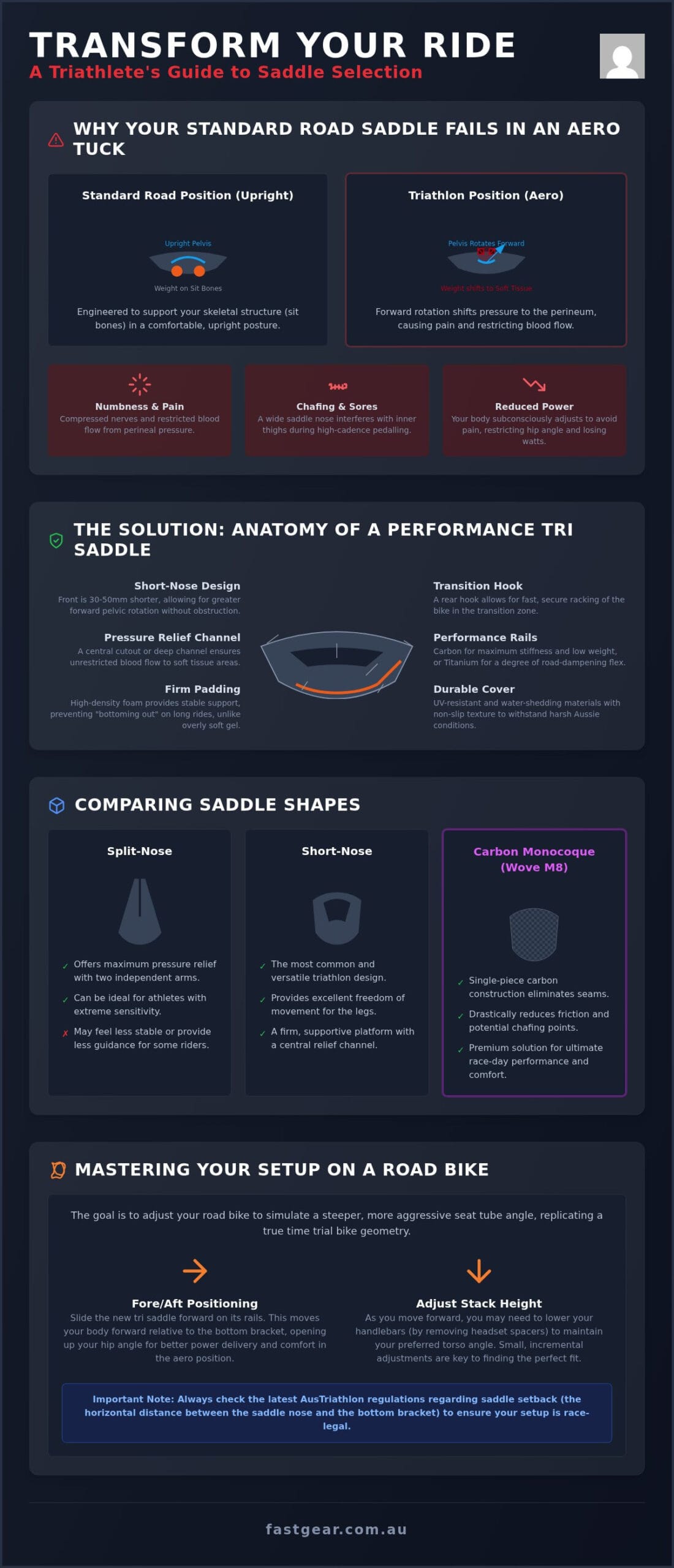
Standard road saddles are engineered for a specific purpose: supporting your sit bones while you ride in a relatively upright posture. This design works perfectly for bunch rides or tackling challenging climbs. However, the moment you clip into aero bars, that geometry fails. Selecting a dedicated road bike saddle for tri becomes essential because your pelvis rotates forward to reach the extensions, shifting your entire weight from the skeletal structure to the soft tissue. This transition creates what fitters call the hammock effect. Traditional saddles often have a slight curve or dip in the centre. When you slide forward to find speed, the raised nose of the saddle presses directly into your perineum, causing immediate discomfort and long-term issues.
Numbness is a critical warning sign that you shouldn’t ignore. It indicates compressed nerves and restricted blood flow, often leading to a forced change in posture that ruins your aerodynamics. When you’re constantly shifting to find a “soft spot” that doesn’t exist, you’re burning energy and losing time. A standard bicycle saddle simply isn’t shaped to handle the unique pressure distribution of a sustained aero tuck.
The biomechanics of the aero tuck
Pelvic rotation is the defining factor of your performance on the bike. As your torso drops to reduce drag, your contact points on the saddle change entirely. A standard road nose is typically too wide for this aggressive position. It occupies the space where your inner thighs need to move during high-cadence efforts, leading to aggressive chafing and skin irritation. More importantly, a poorly matched road bike saddle for tri can restrict your hip angle. If you’re subconsciously tilting your pelvis back to avoid pain, you’re closing off your hips and reducing your power output. Your body prioritises self-preservation over speed, which means you’ll never hit your peak wattage while uncomfortable.
Identifying ‘the burn’: saddle sores vs. nerve pressure
It’s vital to distinguish between a surface-level saddle sore and deep nerve pressure. Saddle sores are skin-level abrasions caused by friction, heat, and moisture. Nerve pressure is far more serious. Numbness isn’t a badge of honour; it’s a signal that you’re compressing the pudendal nerve and restricting oxygenated blood flow to vital areas. Many Aussie athletes mistakenly reach for “softer” saddles with thick gel padding to fix this. This often backfires. Excessive padding allows your soft tissue to sink in, actually increasing the total surface area under pressure. Perineal pressure is the sustained compression of the soft tissue between the ischial tuberosities, and managing it requires a firm, supportive platform rather than extra fluff.
Anatomy of a high-performance triathlon saddle
High-performance saddles aren’t just about weight. They’re about sustaining a position that would be impossible on a standard perch. A short-nose design is the hallmark of a quality road bike saddle for tri. By removing the front 30 to 50 millimetres of the nose, manufacturers allow you to rotate your pelvis further forward without the saddle shell obstructing your hamstrings or compressing soft tissue. This geometry is what separates the best triathlon saddles from generic road options. It enables a steeper effective seat tube angle, which is the key to preserving your run legs.
Central cutouts and pressure relief channels are scientific necessities. They ensure blood flow remains unrestricted during the 180km bike leg of an Ironman. Rail materials also dictate performance. Carbon rails offer maximum stiffness and weight savings, while titanium provides a degree of natural flex that can be more forgiving on chip-seal Australian roads. Don’t overlook the transition hook at the rear of the saddle. It’s a small detail that saves seconds in T1 by allowing you to rack your bike securely by the seat without fumbling.
Materials that survive the Australian sun
Australian conditions are brutal on gear. UV-resistant covers are non-negotiable for saddles that spend hours under the intense Queensland or WA sun. Without this protection, covers crack and internal foam degrades within a single season. You also need a saddle that sheds water instantly. Whether it’s sweat or ‘wetsuit drip’ from the T1 swim exit, moisture shouldn’t pool on the surface. Look for non-slip textures that keep you planted. Staying locked in your aero bars during a high-power interval is much harder if you’re constantly sliding forward on a slick, wet surface.
Padding density: the ‘Goldilocks’ zone for Ironman distances
Soft saddles are a trap for endurance athletes. Excessive squish leads to ‘bottoming out’, where your sit bones eventually hit the hard plastic or carbon shell. Firm, high-density padding is superior because it maintains its shape over six hours of riding. This firmness works in tandem with high-quality chamois cream to prevent friction. Modern carbon monocoque designs, like those found in the Wove range, take this further by using the shell’s layup to provide vibration dampening. This reduces the micro-trauma caused by road buzz, leaving your legs fresher for the marathon. If you’re ready to upgrade your setup, you can explore high-performance saddles at Fastgear to find your perfect fit.
Comparing saddle shapes: Split-nose vs. short-nose vs. monocoque
Choosing a road bike saddle for tri requires matching the component’s geometry to your specific aerodynamic profile. If you’re a “set and forget” rider who stays tucked in the extensions for 180 kilometres, your needs differ significantly from a short-course athlete who frequently moves between the hoods and the bars. The market is currently split into three primary design philosophies: the aggressive split-nose, the versatile short-nose, and the high-performance carbon monocoque. Each shape dictates how your pelvis interacts with the bike and how much power you can sustain without discomfort.
Split-nose designs, pioneered by brands like ISM, are built on the principle of removing the nose entirely. By splitting the front of the saddle into two independent arms, these models eliminate all pressure on the pubic bone and soft tissue. This is a game-changer for athletes who experience chronic numbness. However, this shape isn’t for everyone. Some riders find the independent arms feel too wide, leading to inner-thigh rubbing if the saddle isn’t positioned with surgical precision. It’s a specialist tool for a specialist position.
Short-nose saddles serve as the ultimate hybrid. They maintain a traditional silhouette but truncate the front, allowing for a more aggressive pelvic tilt than a standard road seat. This is often the preferred road bike saddle for tri for athletes who use their road bike for both weekend bunch rides and occasional racing. It offers a stable platform for climbing while providing enough relief for sustained aero efforts.
Split-nose designs: pros and cons
The primary benefit of a split-nose saddle is the total elimination of frontal pressure. Because there is no central nose, your weight is supported entirely by your sit bones (ischial tuberosities). This allows for an extremely aggressive forward rotation of the pelvis. The trade-off is the setup complexity. You cannot simply swap your old saddle for a split-nose and keep the same measurements. Because the nose is “missing,” these saddles must sit further back on the rails, often 3 to 5 centimetres further than a traditional seat, to maintain the same effective reach.
The monocoque advantage for competitive triathletes
For the weight-conscious athlete, carbon monocoque designs like the Wove M8 represent the pinnacle of saddle technology. Traditional saddles use a plastic base, foam padding, and a cover held in place by staples or glue. Over time, these seams become friction points that cause chafing. A monocoque build eliminates these layers entirely. The result is a smooth, seamless surface that significantly reduces the risk of saddle sores during high-cadence efforts.
Weight is the other major factor. Shaving 100g to 150g off your saddle might seem minor, but because the saddle sits at the highest point of the bike, reducing its mass improves the bike’s handling and responsiveness when out of the saddle. The Wove M8 approach uses a long, narrow relief channel that provides the soft-tissue protection of a split-nose while maintaining the structural stability of a traditional shape. This design supports the sit bones effectively without the “wide” feeling that some find uncomfortable on split-nose models.
Setting up your road bike for a tri saddle
Converting a road bike for triathlon is a precise exercise in geometry. You aren’t just swapping parts; you’re re-engineering your centre of gravity. To successfully integrate a road bike saddle for tri, you must account for the fundamental differences between a standard road setup and a dedicated aerodynamic position. Follow these steps to ensure your hardware actually translates into speed.
- Step 1: Adjust saddle height. Measure your existing height from the centre of the bottom bracket to the top of the seat. High-performance saddles often have lower profiles than stock options. If your new saddle has a shorter stack height, raise your seat post to prevent knee strain and maintain power.
- Step 2: Fore and aft positioning. This is where most athletes fail. Standard road bikes have a seat tube angle around 73 degrees, while tri bikes sit at 78 to 80 degrees. Slide your saddle forward on the rails to simulate this steeper angle. This opens your hip flexors and allows for a more powerful pedal stroke in the aero tuck.
- Step 3: Set your tilt. Start with a neutral level, then angle the nose down by 1 to 3 degrees. This small adjustment shifts pressure away from soft tissue and onto your skeletal structure, allowing you to stay in the bars for longer.
- Step 4: Integrate hydration. Use the rear rails to mount bottle cages. This reduces aerodynamic drag compared to frame-mounted bottles and keeps your cockpit clear for easier handling in crosswinds.
Compensating for road bike geometry
If you’ve reached the limit of your saddle rails, consider a forward-offset seat post. This allows you to achieve a true triathlon position on a road frame. Be mindful of your reach. Moving the saddle forward effectively shortens the cockpit. You may need a longer stem to ensure your elbows sit comfortably on the aero pads. Check your clearance carefully. Your knees shouldn’t strike the armrests or extensions when you’re climbing out of the saddle or cornering.
The ‘settling in’ period: how to test a new saddle
Don’t judge a saddle on the first ride. Follow the 3-ride rule. The first 20 minutes often feel different rather than bad. It takes time for your body to adapt to new contact points and pressure distribution. Always use a calibrated torque wrench when installing components with carbon rails, such as the Wove M8. Over-tightening can crush the carbon fibres and lead to catastrophic failure mid-race. A professional bike fit is the only way to ensure your specific anatomy is perfectly aligned with your equipment. If you’re ready to start your transformation, you can buy the Wove M8 Road / Tri Saddle and get race-ready with national delivery across Australia.
The Wove M8: Australia’s premium road and tri solution
The Wove M8 represents a significant shift in component design, often called the ‘holy grail’ for Australian road/tri hybrids. Unlike traditional options, this road bike saddle for tri uses a carbon monocoque construction. This means there are no seams, no staples, and no synthetic covers to fail under pressure. Every surface is smooth and integrated, effectively eliminating the friction points that cause mid-race chafing. It’s a high-performance tool built for athletes who refuse to compromise on speed or comfort.
The unique ‘M’ profile is the technical heart of the M8. It provides a wide, stable platform to support the pelvis while maintaining a deep central relief channel to protect the perineum. This geometry allows you to maintain an aggressive aero tuck without the circulatory restriction common in lesser designs. Fastgear Australia stocks the Wove M8 for national delivery, ensuring every Aussie triathlete has access to world-class gear that survives the rigours of long-course racing.
Performance stats: weight and durability
- Minimalist weight: The M8 is significantly lighter than traditional padded tri saddles, reducing the bike’s centre of gravity and improving handling.
- Structural integrity: The carbon shell won’t sag or “bottom out” over years of heavy training, maintaining its ergonomic shape indefinitely.
- Maximum adjustment: Long carbon rails provide an extensive range of fore/aft positioning, making it easier to find your ideal fit on a standard road frame.
Why Fastgear recommends the Wove M8
We’ve tested the M8 in the toughest Australian conditions. It handles everything from the tropical humidity of Cairns to the dry, blistering heat of the WA coast. The non-porous carbon surface won’t absorb sweat or salt, preventing the degradation that ruins standard saddles. It’s the perfect partner for your Maurten fueling strategy, allowing you to focus entirely on your power output and nutrition rather than managing saddle pain. Your equipment should be as disciplined as your training plan. Don’t let a standard road seat hold back your split times in 2026.
Upgrade to the Wove M8 and find your aero comfort today.
Optimise your race position for 2026
Winning the bike leg starts with a stable foundation. You’ve learned that standard road geometry often leads to soft tissue compression, but the right technical setup solves this by allowing for natural pelvic rotation. By selecting a purpose-built road bike saddle for tri and following a methodical setup process, you eliminate the numbness and chafing that sabotage your run legs. Precision in your gear choice is just as vital as your interval training.
Fastgear Australia is an authorised Wove retailer, offering gear that is expertly curated for the demands of Australian endurance athletes. We provide fast national shipping on all premium equipment to ensure you’re race-ready without the wait. Don’t settle for “good enough” when peak efficiency is within reach.
Shop the Wove M8 Road/Tri Saddle at Fastgear Australia
Take control of your comfort and hold that aero tuck with confidence. Your fastest split is waiting.
Frequently Asked Questions
Can I use a triathlon saddle for regular road racing and group rides?
Yes, you can use a triathlon saddle for road racing, though short-nose models like the Wove M8 are more versatile than split-nose designs. Short-nose saddles provide a stable platform for climbing on the hoods while allowing for aggressive rotation during solo breaks. Split-nose models might feel unusual during high-cadence group rides because they lack a traditional nose for thigh steering. Test your setup during training to ensure it handles well in bunch scenarios.
How do I know if my saddle is too wide for my triathlon position?
You’ll know a saddle is too wide if you experience persistent inner-thigh chafing or find yourself sliding forward to avoid the nose. A wide nose obstructs your hamstrings and prevents a smooth pedal stroke when tucked low. If your sit bones feel unsupported or you can’t rotate your pelvis without rubbing against the shell, the geometry is likely wrong. A narrower road bike saddle for tri allows for better clearance and higher power output.
Do I need a special seat post to fit a tri saddle to my road bike?
You don’t always need a special seat post, but a forward-facing post is often necessary to achieve a true triathlon geometry on a road frame. Standard road bikes have slack seat tube angles that place the saddle too far back. Moving the saddle forward on its rails is a start, but a dedicated post helps simulate the 78 to 80 degree angle found on TT bikes. This change is vital for opening your hip angle and preserving your legs for the run.
Why do triathlon saddles often have a ‘split’ or ‘stubby’ nose?
Split or stubby noses are designed to eliminate pressure on the perineum when you tilt your pelvis forward into an aero position. By removing the front portion of the shell, manufacturers shift your weight onto your sit bones rather than soft tissue. This design prevents numbness and restricted blood flow during long efforts. It’s a scientific solution to the hammock effect caused by traditional long-nose saddles that press into sensitive nerves when you’re in the extensions.
How much weight can I save by switching to a carbon monocoque saddle like the Wove M8?
Switching to a carbon monocoque saddle like the Wove M8 can save you between 100g and 150g compared to traditional foam-padded models. Because the saddle is the highest point on your bike, this weight reduction significantly improves handling and responsiveness when climbing or cornering. Beyond weight, the monocoque construction eliminates the staples and seams that cause friction. It’s an investment in both mechanical efficiency and physical comfort for race day in the Australian heat.
Should I tilt my tri saddle down or keep it level?
Most athletes find the best results by tilting the nose down between 1 and 3 degrees. While a level saddle is the starting point, a slight downward tilt provides additional relief for the soft tissue when you’re deep in the aero extensions. Avoid extreme angles, as this can cause you to slide forward and place excessive strain on your arms and shoulders. Small, incremental adjustments are the key to finding your personal comfort zone for long-course racing.
Is a triathlon saddle worth it for a 70.3 or Ironman distance?
A dedicated road bike saddle for tri is absolutely worth the investment for 70.3 and Ironman distances. Sustaining an aero tuck for 90km or 180km is impossible if you’re battling numbness or lower back pain. A triathlon-specific saddle ensures you stay comfortable, which preserves your energy and muscle function for the marathon. Comfort isn’t just about feeling good; it’s a performance metric that directly impacts your overall finish time and recovery.
How do I mount water bottle cages to the back of a triathlon saddle?
Most triathlon saddles use rail-mounted brackets to secure one or two water bottle cages behind the rider. This position is highly aerodynamic as the bottles sit in the dead air behind your torso. The Wove M8 features long carbon rails that provide ample space for mounting these systems while still allowing for significant fore/aft adjustment. Ensure your mounting bracket is tightened to the correct torque to prevent bottles from launching on rough Australian road surfaces.
