
Uncategorized
Pressure relief cycling saddles for triathletes in Australia
Oct
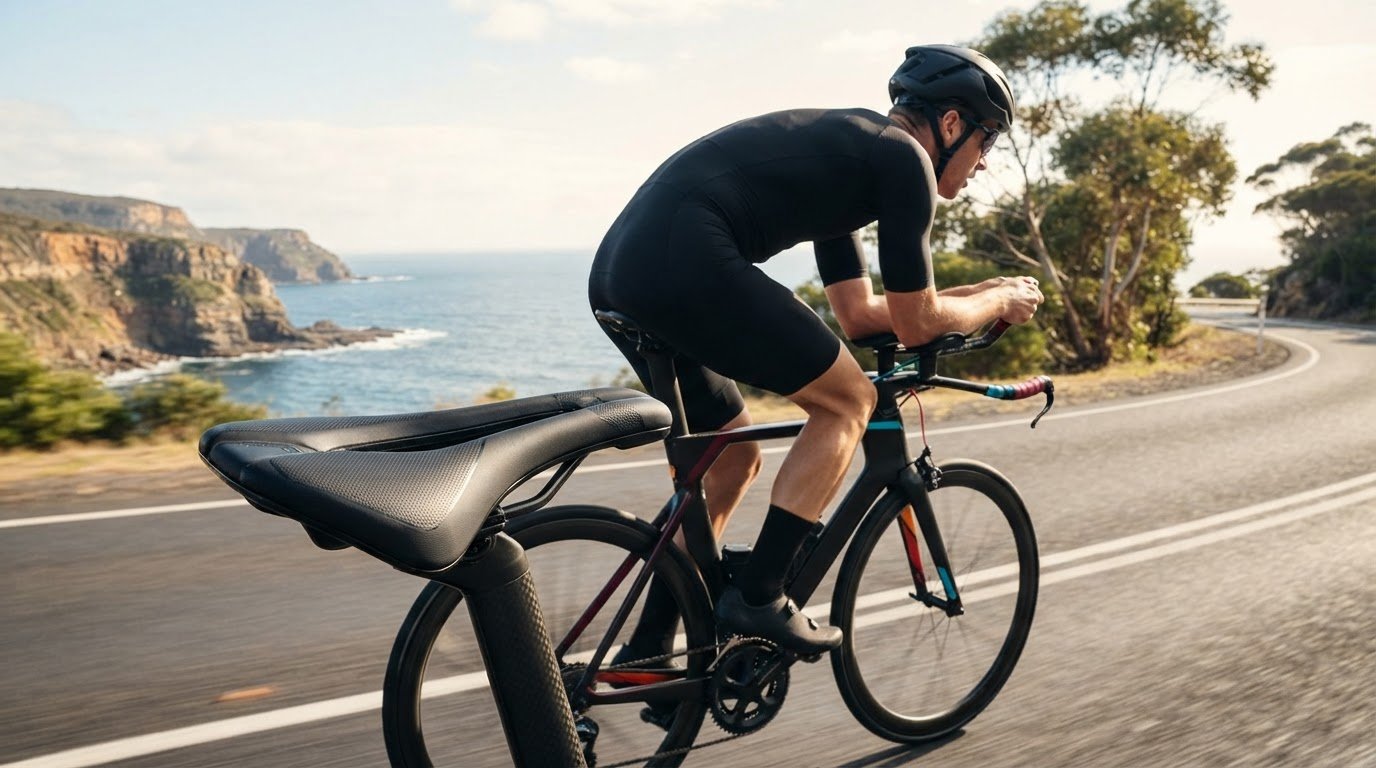
A stable, correctly shaped pressure-relief cycling saddle for triathletes in Australia matters more than simply adding soft padding. In an aggressive aero position, the pelvis rotates forward by 30-45 degrees compared with a traditional road position, shifting more load onto the pubic rami. That support needs to stay comfortable and steady across long sessions, including an Ironman bike leg that can involve 5+ hours on the bike.
If you’ve felt pressure, rubbing or numbness in the aero position, it’s worth looking beyond padding alone. Saddle shape, firmness, width, cutout design and your movement all affect fit and comfort. This guide explains how these factors work together, what to assess when choosing a saddle for long-distance triathlon riding, and why bike position matters too. You’ll have a clearer way to find support that suits your riding position and feels right over the miles.
Key Takeaways
- A forward aero position shifts load towards the pubic rami, so prioritise stable support where your body contacts the saddle.
- Assess saddle shape alongside your bike position, including saddle height, tilt and fore-aft placement.
- Give a new saddle shape 3-5 rides before judging its comfort, and pay attention to pressure and movement during each ride.
- Use sit-bone width to guide saddle width, and look for support that stays firm rather than simply feeling soft at first.
- Compare padding, cutout and surface design as a system; the right combination should suit your position and reduce unwanted movement.
1. What makes a good triathlon saddle?
A good triathlon saddle supports your forward position without concentrating pressure on sensitive soft tissue. As your pelvis rotates forwards, the pubic rami bear more load than in an upright road position. Because the contact points change, a saddle designed for upright riding may feel uncomfortable in aero. Shape matters: look for stable support where your rotated pelvis meets the saddle, rather than a design that leaves you perched on its nose.
Pressure can build over time. Traditional saddles can reduce blood flow in the perineal region by up to 82% in aggressive cycling positions. That figure underlines why comfort is more than padding density or initial softness. A stable platform, suitable relief channel and position-specific shape can help distribute contact. A noseless or split-nose profile may change where support sits, but no shape automatically suits every rider. Your pelvis, flexibility and aero posture affect how each design feels.
Australian event and World Triathlon rules can affect whether a noseless or split-nose saddle is permitted. There’s no single yes-or-no answer for every event: the applicable technical rules determine whether a particular design is allowed. Check compliance separately from comfort when selecting a saddle.
Bike fit is part of saddle comfort, not a separate fix. Start with saddle height, tilt and fore-aft position, then assess your handlebar reach in your actual aero position. Bars that sit too far away can make you stretch forward, rotate your pelvis further or shift weight towards the saddle nose. A saddle set too high can cause pelvic rocking, increasing movement and friction. Make one fit adjustment at a time, then reassess stability and pressure on a familiar ride.
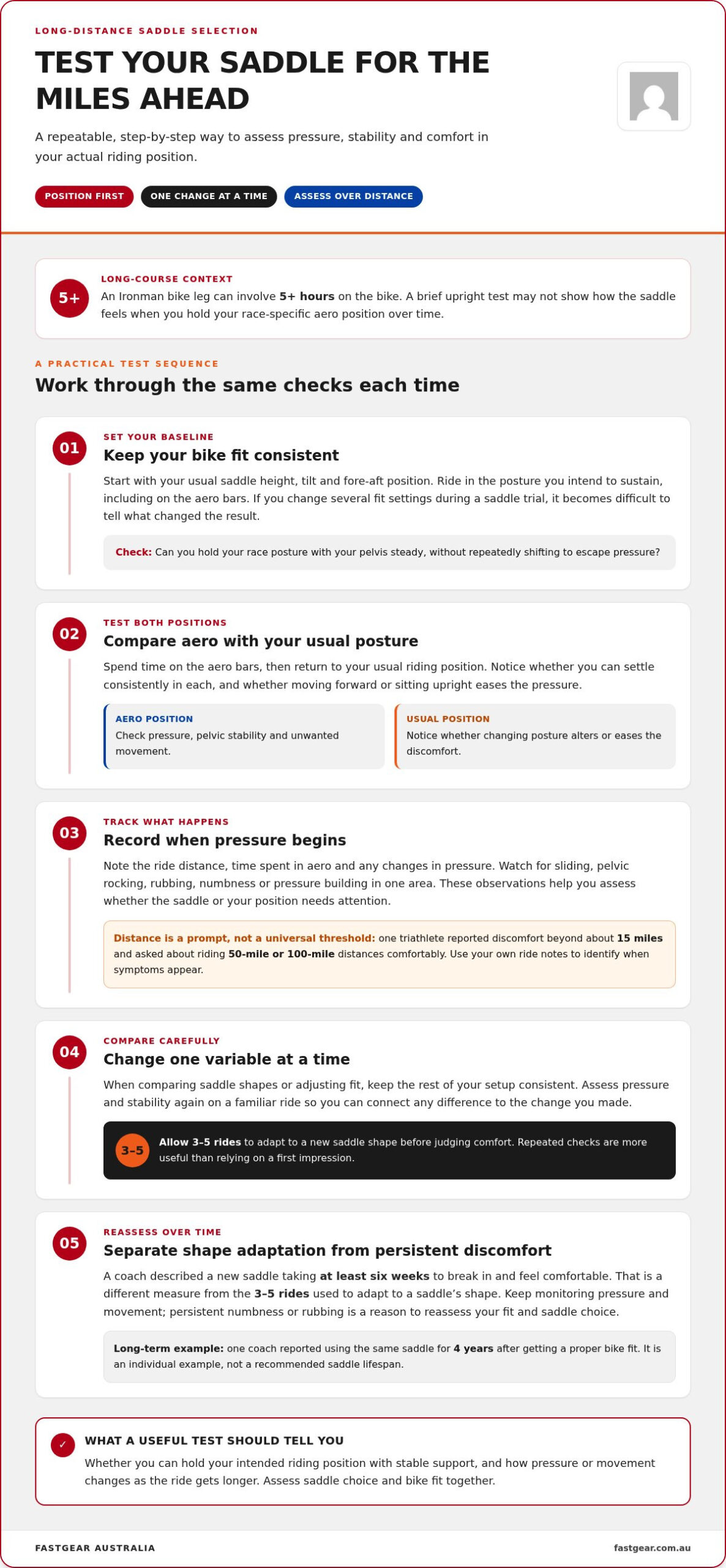
Use a repeatable position test. Ride on the aero bars, hold your race posture and notice whether you can keep your pelvis steady. Check for sliding, rocking and pressure that builds in one area. If numbness starts after 10 miles, don’t treat extra padding as the only answer. Review saddle support and bike fit together. An estimate attributes about 80% of saddle discomfort to poor bike position rather than the saddle itself, reinforcing the value of checking reach, height and tilt.
For a long course, assess comfort in the position you’ll actually race, not only while sitting upright. An Ironman bike leg can involve 5+ hours on the bike, so a saddle that feels fine during a brief test may behave differently over time. Evaluate pressure, stability and movement across longer rides. The right combination lets you hold an aerodynamic position without repeatedly shifting to escape discomfort.
2. Choosing a saddle for long-distance riding
A saddle that feels fine on a short spin may become uncomfortable as distance builds. One triathlete reported discomfort beyond about 15 miles and asked how to ride 50-mile or 100-mile distances comfortably. Use those milestones as prompts to assess your own saddle during training, not as universal comfort thresholds. Track when pressure begins, whether it changes with riding position, and if moving forward or sitting upright eases it. Those details help distinguish a saddle issue from a position that becomes difficult to hold over time.
Choose for the position you can sustain, not just for a shape that looks aerodynamic. A specialised triathlon saddle can support a forward posture, but it still needs to suit your pelvic contact points and movement. On a test ride, spend time on the aero bars, then return to your usual position. Notice whether you can settle consistently or keep shifting to relieve pressure. Repeat the check on a longer ride, because posture, fatigue and time in aero can change how the saddle feels.
Use a controlled process when comparing saddle shapes. Keep your bike fit consistent, changing one variable at a time. Allow 3-5 rides to adapt to a new saddle shape before judging its comfort. That gives you repeated opportunities to assess pressure and stability, rather than relying on a first impression. If you change saddle height, tilt or fore-aft position during the same trial, you won’t know which adjustment changed the result.
Adaptation takes time, but discomfort deserves attention. One coach said a new saddle takes at least six weeks to break in and feel comfortable. That’s a different measure from allowing 3-5 rides to adapt to its shape. Use both ideas carefully: note early pressure and movement, then assess whether comfort develops across your training. Persistent numbness or rubbing is a reason to reassess fit and saddle choice, not simply to keep riding through the same symptoms.
Consistency can pay off after a suitable setup is established. One coach reported using the same saddle for 4 years after getting a proper bike fit. That doesn’t mean every rider should keep one saddle for the same duration. It illustrates the value of matching saddle choice with fit, then avoiding unnecessary changes when the setup works across your usual rides and target distance.
Before an Ironman, test your intended saddle in training and in your race-specific riding position. Record the ride distance, time spent in aero and any pressure changes. If you’re comparing a road-and-triathlon option, the Wove M8 Road / Tri Saddle is one saddle category to consider alongside those fit checks. Choose based on sustained comfort and stable support, not on a brief test or the promise of extra padding.
3. Padding types, including 3D-printed lattices
Padding affects how a saddle deforms under load, but more cushioning doesn’t automatically mean less pressure. Foam compresses beneath you, and its thickness and density affect how firmly the saddle supports your pelvis. Very soft padding may feel comfortable at first but lose support on longer rides. In aero, where contact shifts forwards, thick padding that compresses unevenly can also make your position feel less stable.
Compare padding by how it supports you, not by touch alone. On a conventional saddle, your sit bones should carry support; in a triathlon position, more contact shifts towards the front. Check whether the padding remains supportive in your race posture. A quick hand press shows softness, but a riding test reveals compression, movement and pressure under your weight. Record the saddle position and ride conditions to make comparisons useful.
3D-printed lattice padding uses a network of connected structures rather than one uniform slab. Designers can vary the lattice’s density across different zones, creating areas with different levels of cushioning and support. For example, a firmer section beneath a support area and a more compliant section elsewhere can give the saddle a deliberate feel across its surface. The material and lattice geometry both affect how it compresses, so “3D-printed” alone doesn’t tell you how it will feel.
Variable cushioning is designed to match different saddle zones to different loading needs. It can help balance support and relief, but it doesn’t replace the right saddle shape or bike fit. A cutout changes the contact surface rather than simply adding softness. Road-bike saddles with cutouts can encourage normal blood flow and help prevent pain and numbness. In aero, check whether the relief area lines up with your contact points instead of assuming a larger opening is better.
Custom 3D-printed saddles use rider-specific information to shape the support or cushioning pattern. Measurements and pressure mapping can inform where the design is firmer or more compliant. The value lies in matching the saddle’s zones to the rider, not in customisation as a label. A 144mm sit-bone width, for instance, is one measurement that can inform saddle width, while riding position determines where front support is needed.
Use a simple comparison process: keep your bike fit consistent, test one padding design at a time, and record where pressure builds. Compare uniform foam with a variable-density lattice in the same riding position. Then assess stability, comfort and pressure on longer rides. A pressure-relief design suits your setup only when its shape, padding and contact zones match how you ride.
4. Saddle firmness, width, cutout, texture and movement
Firmness affects how the saddle supports your pelvis as your load shifts during a ride. Very soft padding may feel pleasant at first, then compress and provide less support over longer distances. A firmer surface may feel unfamiliar initially, but what matters is whether it supports you steadily in your riding position. Compare how your sit bones and front contact points feel rather than judging by hand pressure alone.
Width should correspond with your support points, not simply your body size or an upright riding posture. A 144mm sit-bone width is an example of a measurement that can inform saddle width. Measure your sit-bone spacing, then assess whether the saddle supports those points without creating pressure at the inner thighs. In a forward triathlon position, the pelvis rotates and contact shifts, so a width that feels suitable upright may feel different on the aero bars.
Split-nose saddles retain two forward support sections, while noseless designs remove the conventional nose. In a time-trial position, compare how each shape supports your forward-rotated pelvis, then assess stability, pressure and freedom of movement while riding.
A cutout changes the saddle’s contact area, while surface texture can affect how easily you slide or stay in place. A smooth cover may make repositioning easier; a grippier surface may limit unwanted movement. Neither is automatically better. Test each design in your usual aero position and note whether friction, pressure or repeated shifting increases. For road, gravel and mountain riding, the saddle should primarily support your sit bones.
Assess pressure by noting where discomfort develops and whether it changes with posture. On a familiar ride, hold your race position, check for concentrated pressure or numbness, and record the saddle setting alongside your observations. Pressure mapping can show how load is distributed across the saddle, while your riding feedback reveals whether those contact points feel stable and comfortable. Use both to compare designs.
Choose through a controlled comparison. Keep saddle height, tilt and handlebar position consistent, then change one saddle feature at a time. Compare width, firmness, cutout and surface texture in the same riding position. Changing several variables together makes it harder to tell what affected pressure or movement. A suitable saddle lets you maintain a stable pelvis without constant shifting, whether you ride upright or in an aerodynamic position.
5. Triathlon saddles designed to relieve soft-tissue pressure
A pressure-relief saddle changes how support meets you in an aerodynamic position. Its shape, nose profile, channel or cutout can redistribute contact and reduce concentrated loading on sensitive soft tissue. The aim is stable support suited to your race posture, not softness alone. For triathletes in Australia, judge a pressure-relief cycling saddle by how it feels during sustained riding in the position you’ll race in.
There isn’t one best model for every rider. Compare designs by front support, overall shape, width and how they feel when you hold the aero bars. The Wove M8 Road / Tri Saddle is one road-and-triathlon option available through Fastgear Australia. A pressure-relief cycling saddle for Australian triathletes should be assessed against your fit and comfort needs, rather than chosen on a model name or marketing claim alone.
These saddles work by changing the contact area and how your weight is supported. Cutouts, split noses and differently shaped front sections each affect contact and movement. Saddle design alone may not address an unsuitable bike fit. Test the saddle in your triathlon position and consider whether pressure, stability and movement remain manageable as the ride continues.
Australian riders can browse online product listings or compare saddles in retail settings. Testing, fitting services and return policies depend on the retailer and its arrangements. A display can help you inspect shape and firmness, while a ride in your aero position provides more relevant feedback about pressure and stability. Compare current Australian pricing in A$ before purchasing, as costs vary with construction and design.
A pressure-relief design may redistribute contact, but it can’t guarantee freedom from numbness, genital discomfort or other cycling-related health risks. Treat recurring numbness or discomfort as a reason to reassess saddle setup, riding posture and fit. Saddle design is one part of that assessment, not a substitute for addressing ongoing symptoms.
Switching models close to race day can introduce unfamiliar pressure points, friction or instability. Allow 3-5 rides to adapt to a new saddle shape before judging its comfort, and avoid an untested change immediately before an event. Use training rides to assess it in your race position, noting pressure, movement and comfort as the ride progresses.
Make the comparison systematic: record your current setup, change one feature at a time and test each option in the same riding position. This makes it easier to identify whether a model’s shape and pressure-relief features suit your body and long-course riding.
Fastgear Australia: Compressport Trail Racing SS Tshirt
Once your saddle and fit are sorted, Fastgear Australia is a natural next stop for race-day kit and fuelling essentials. The Compressport Trail Racing SS Tshirt adds an apparel option, while GU Energy Gel – Single and Clif – BLOKS Energy Chews are portable options to consider for race nutrition. The Compressport Free Belt Pro is another listed accessory for carrying essentials. These products complement your equipment planning; they don’t replace saddle testing or a suitable bike fit.
Build your race setup around what you’ve practised in training. Keep your saddle and riding position familiar, then organise your apparel and nutrition choices before event day.
Explore Fastgear Australia’s endurance gear and nutrition range online.
Make your next ride a better test
Choose an upcoming training ride as an equipment check. Settle into your intended race position, then note how the saddle feels as the ride progresses. This personal feedback can guide your next adjustment. Choosing a pressure-relief cycling saddle for triathletes in Australia isn’t about chasing a trend; it’s about finding a setup that lets you focus on your effort.
Build the rest of your race preparation around gear you can practise with. Fastgear Australia offers the Compressport Trail Racing SS Tshirt, GU Energy Gel – Single and Compressport Free Belt Pro as part of its endurance range. Explore these options alongside the Wove M8 Road / Tri Saddle as you plan your setup.
Explore Fastgear Australia’s endurance gear and saddle range, then take your next step with a clear plan and confidence in your preparation.
Frequently Asked Questions
What makes a good triathlon saddle?
A good triathlon saddle supports your race posture without forcing constant repositioning. It should feel stable on the aero bars and let you shift naturally when changing effort or returning upright. Check that its shape suits your contact points in your actual riding kit, not just during a brief sit. On a test ride, note where pressure develops and whether it changes as you move between positions.
Why Do Cyclists Get Saddle Pain?
Saddle pain can develop when pressure, friction or repeated movement irritates the contact area. A saddle that doesn’t suit your position may concentrate load; poorly fitting shorts or fabric folds can also rub. Notice whether discomfort appears in a particular posture, after repositioning or in one specific area. That pattern can help you decide whether to review saddle fit, riding position, clothing or more than one factor.
Which pressure relief saddles are best for triathlon riding and Australian conditions?
No single model suits every triathlete or every Australian ride. Look for a shape designed around your riding position, then assess its support and stability on the routes and training conditions you regularly face. The Wove M8 Road / Tri Saddle is one road-and-triathlon option available through Fastgear Australia. Compare saddle designs against your own fit and comfort needs rather than choosing by marketing claims alone.
What saddle width and shape suit different sit-bone measurements and riding positions?
Use your sit-bone measurement as a starting point, then check how the saddle supports you in your intended position. A simple home measurement can show the spacing between your sit bones, but saddle shape also affects how its width feels. For example, a rider who rotates forwards on aero bars may need a different contact profile from someone who rides mostly upright. Assess both positions if you use one bike for varied riding.
How do you set up and adjust a pressure relief saddle for a triathlon bike?
Record your current saddle height, tilt and fore-aft position before making changes. Fit the new saddle securely, then test it on a familiar ride in your race posture. Change one setting at a time and note how each adjustment affects stability, pressure and your ability to hold the aero position. Avoid changing several things together, so you can identify which adjustment helped or worsened comfort.
