
Uncategorized
Pre-Race Carb Drink Mix in Australia: How to Choose
Oct
A higher-carbohydrate drink isn’t automatically the better pre-race choice. If you’re comparing a pre race carbohydrate drink mix australia athletes can use, focus on when you’ll drink it, how it fits your fuelling plan and what you’ve tolerated in training. It’s easy to confuse a carbohydrate mix with an electrolyte drink, or to judge a product by its serve size without checking how that serve fits your race-morning routine.
You need a clear comparison, not another guess before the start line. This guide explains how pre-race carbohydrate mixes differ from hydration-focused drinks and what to check on the label, including carbohydrate per serve, ingredients and preparation directions. It also covers flavour, timing and personal tolerance, so you can compare options against your event and schedule.
We’ll look at the Maurten 160 and 320 powders and Tailwind powder available from Fastgear Australia, alongside practical checks for choosing between them. You’ll also learn how to trial a mix in training and build a simple routine you can repeat on race day. Practise first, then arrive ready to follow your fuelling plan.
Key Takeaways
- Distinguish carbohydrate-fuelling mixes from hydration-focused drinks by checking their stated purpose and serving details.
- Compare carbohydrate per serve, ingredients and preparation instructions on the current packaging.
- Match your pre-race drink to your event timing and routine, not just its carbohydrate content.
- Trial your pre race carbohydrate drink mix australia option in training, changing one variable at a time to assess how it fits.
- Use the final checklist to compare Maurten 160 powder, Maurten 320 powder and Tailwind powder against your race-day needs.
Why use a pre-race carbohydrate drink mix before an event?
Race morning involves several decisions: what you’ve eaten, how long you have before the start and what your stomach handles comfortably. A carbohydrate drink mix can be one part of your routine, but it isn’t automatically necessary or a substitute for a suitable meal. When choosing a pre race carbohydrate drink mix australia athletes can use, start by separating fuelling from hydration. The product’s purpose, serving directions and fit with your routine matter more than a bold claim on the pack.
Think of a drink mix as one option within a wider plan. It may be convenient when an early start, travel or race logistics make your usual pre-event food routine harder to follow. For longer endurance events, it may also fit within a broader carbohydrate-loading approach. Carbohydrate Loading Explained outlines the concept of building glycogen stores before endurance exercise. A drink mix alone, however, doesn’t determine whether your overall fuelling plan meets your needs.
What is a pre-race carbohydrate drink mix?
It’s a powder mixed with fluid to provide carbohydrate in a drinkable format. Plain water contributes fluid but no carbohydrate. An electrolyte-only product is intended to provide electrolytes rather than act as a substantial carbohydrate source. Some products combine these functions, so read the label instead of relying on the category name.
Formulations aren’t interchangeable. Carbohydrate per serve, ingredients, the amount of water required and preparation directions can vary. Check the current packaging to see what a serving provides and how to mix it. A more concentrated drink may not suit everyone, and changing the powder or water amount can alter the prepared drink from the manufacturer’s directions.
Who might consider one before racing?
A mix may suit an athlete who already uses drinkable carbohydrate in training, prefers sipping to eating close to the start, or wants a portable option when travelling to an event. Event duration and start logistics can also shape the choice. A short event with a familiar breakfast may call for a different routine from a long race with an early start and limited time to eat.
Your previous meal matters, too. Consider when and what you’ve eaten, how much time remains before the start and whether you’ll need separate fuelling during the event. A pre-race drink isn’t a universal replacement for food, fluids or an in-race fuelling plan. It’s an option to fit around them.
Use these questions to judge whether the format suits your race morning:
- Will you have enough time to prepare and drink it as directed?
- Does its carbohydrate contribution complement your usual pre-race meal?
- Have you tried the flavour, concentration and ingredients during training?
- Does it provide carbohydrate, hydration support, or both according to the label?
There’s no single answer for every athlete. Choose based on your event, start time, previous meal and personal tolerance, then practise the routine before race day. Familiarity helps; last-minute experimentation does not.
Comparing Pre-Race Carb Drink Mixes: Labels and Purpose
Compare products by what a correctly prepared serve provides, not by a front-of-pack claim or scoop size alone. For a pre race carbohydrate drink mix australia athletes are considering, check carbohydrate per serve, ingredients, preparation directions and the product’s stated purpose. Use the current packaging or product label before race day, as formulations and directions can change.
Which label details matter before race day?
Start with carbohydrate per prepared serve, then check the specified water volume. The same amount of powder mixed into a different volume changes the drink’s concentration. Review the full ingredient list, including carbohydrate sources, and note whether caffeine is listed. If it is, consider whether you’ve assessed its suitability in training before using it for a race.
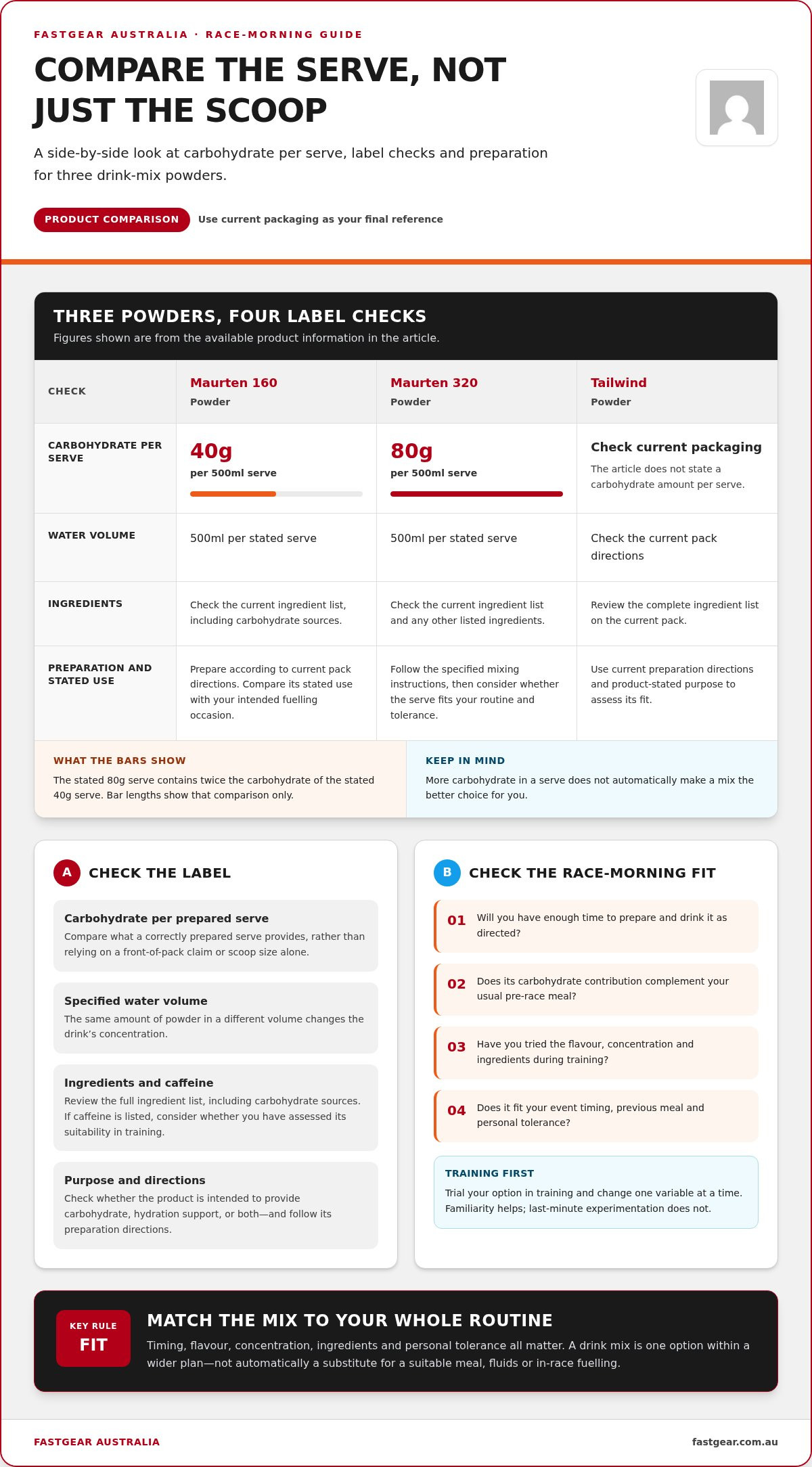
Fastgear stocks these drink-mix powders. The figures below are based on the available product information. Use the current pack directions and label as your final reference.
| Mix | Carbohydrate per serve | Ingredients to review | Preparation and stated use |
|---|---|---|---|
| Maurten 160 powder | 40g per 500ml serve | Check the current ingredient list, including carbohydrate sources. | Prepare according to the current pack directions. Compare its stated use with your intended fuelling occasion. |
| Maurten 320 powder | 80g per 500ml serve | Check the current ingredient list and any other listed ingredients. | Follow the specified mixing instructions, then consider whether the serve fits your routine and tolerance. |
| Tailwind powder | Check current packaging | Review the complete ingredient list on the current pack. | Use the current preparation directions and product-stated purpose to assess its fit. |
More carbohydrate in a serve doesn’t automatically make a mix a better choice for you. Concentration, flavour, ingredients, timing and personal tolerance all affect whether it fits your routine. A serve that looks convenient on paper may not work for your race morning if you haven’t practised it.
Carbohydrate delivery and electrolyte provision are separate functions, even when one drink mix offers both.
How do drink mixes differ from gels and hydration products?
A drink mix delivers carbohydrate in fluid, which some athletes may find convenient to sip as part of their routine. A gel provides carbohydrate in a more compact format and may suit situations where carrying or drinking from a prepared bottle isn’t practical. Hydration products may prioritise electrolytes rather than substantial carbohydrate, so check the label to see what the product provides. For more fuelling options, explore Fastgear’s endurance sports nutrition range.
Use the label as a comparison tool, not a prediction of performance. Match the serve and preparation to your plan, then test the product in training before relying on it at the start line.
Pre-Race Drink Mixes: Matching Your Race Routine
The best fit is a powder you can prepare correctly and use comfortably within your race-morning schedule. Consider where you’ll mix it, how you’ll carry it and whether you’ll have access to fluid at the start area. A sachet or measured serving may be practical for travel, while a larger container may suit a familiar home routine. These are logistical considerations, not performance guarantees.
When might a powder format suit your pre-race plan?
Powder gives you a drinkable option to work into your schedule, but it takes preparation. Check whether you’ll have water, a bottle and enough time to mix it according to the directions. If you’re travelling or moving between a car park and the start, include those steps in your plan. Practise the same preparation in training so race morning isn’t your first test.
Fastgear’s range includes Maurten 160 powder, Maurten 320 powder and Tailwind powder. Use the comparison below to organise your options around the current pack information, rather than treating the products as a ranking.
| Mix or product type | What to compare | Race-routine consideration |
|---|---|---|
| Maurten 160 powder | Available product information states 40g carbohydrate per 500ml serve. Check current ingredients and directions. | Consider whether the stated serve and preparation fit your planned timing and fluid intake. |
| Maurten 320 powder | Available product information states 80g carbohydrate per 500ml serve. Confirm the current label and mixing instructions. | Assess the specified serve against your established routine and personal tolerance. |
| Tailwind powder | Check current packaging for carbohydrate per serve, ingredients and preparation details. | Use the label’s stated purpose to decide how it fits your race-morning plan. |
| Hydration-led drink | Check whether the label focuses on electrolytes and what carbohydrate, if any, it provides. | Decide whether you need hydration support, carbohydrate delivery or both from your drink. |
How should athletes compare carbohydrate-focused and hydration-led mixes?
Start with the stated purpose, then check carbohydrate and electrolyte information on the current label. Assess a carbohydrate-focused mix for its carbohydrate contribution; a hydration-led product may prioritise electrolytes instead. Some drinks combine these functions, so don’t assume what a product provides from its name alone. Compare the actual contents and serving directions.
Keep the jobs distinct. A drink that contributes carbohydrate doesn’t automatically cover your hydration needs, and an electrolyte product may not provide the carbohydrate you’re planning for. If you’re mapping fluid intake around training or racing, use a hydration guide alongside your fuelling decisions.
When choosing a pre race carbohydrate drink mix australia athletes can use as part of a routine, compare the label, preparation and practical race-day fit together. Choose an option you’ve tested, and use the same mixing method when you practise again.
Testing Your Pre-Race Carb Drink Mix Before Race Day
A product that looks suitable on its label still needs to fit your routine in practice. Trial your chosen pre race carbohydrate drink mix australia option during training, not for the first time on race morning. A structured test helps you assess the taste, how easy it is to prepare and whether it fits alongside your usual food and fluid routine.
Build a repeatable practice routine
Choose a relevant training session and recreate the conditions you can control, such as your planned timing, mixing method and access to water. Follow the product’s current preparation directions. Keep a short record after each trial so you can compare experiences instead of relying on memory.
- Read the current directions. Note the specified powder quantity, fluid volume and any preparation instructions. Use the same measures each time, and don’t change the mix concentration unless the product directions allow it.
- Choose a realistic training test. Use a session that reflects your event routine. If you’ll drink the mix before an early start, practise at a similar point in your pre-session schedule, alongside your usual meal or snack.
- Record the details. Write down when you prepared and drank it, how it tasted, whether mixing was straightforward and whether you had suitable access to fluid. Note your comfort during and after the session, without treating one trial as a universal verdict.
- Review before changing anything. If you want to adjust your approach, change one variable at a time, such as timing or the product itself. Keep preparation consistent with the label so you can make a clearer comparison.
Adjust the plan without last-minute surprises
Use your notes to decide whether the drink suits your schedule and personal tolerance. If it’s awkward to prepare, difficult to carry or unpleasant to drink, those practical details matter. Repeat a trial after one deliberate adjustment rather than changing the product, timing, concentration and meal all at once. That gives you more useful feedback.
Don’t introduce an unfamiliar serving or preparation method on race morning. Keep to the routine you’ve practised, including how you’ll carry the drink and where you’ll get any additional fluid. For broader planning, consider the drink alongside your overall endurance fuelling strategy, including food before the start and fuelling during the event.
Individual needs vary. If you have a medical condition, dietary restriction or concern about an ingredient, seek advice from a qualified health professional before using a new sports nutrition product.
Ready to compare options for a routine you can practise? Explore endurance nutrition options and assess each mix against its current label and your training notes.
Choose a pre-race carbohydrate drink mix from Fastgear Australia
The right choice is the one that fits your event and race-morning routine, and that you’ve practised. Before settling on a pre race carbohydrate drink mix australia athletes might use, check its stated purpose, current serving information and preparation directions. Then consider when you’ll drink it, what you’ve eaten beforehand and whether its format works with your start-area logistics. No powder suits every athlete or event.
Which Fastgear powders can you compare?
Fastgear stocks Maurten 160 powder, Maurten 320 powder and Tailwind powder. Available product information lists 40g of carbohydrate per 500ml serve for Maurten 160 and 80g per 500ml serve for Maurten 320. Check current packaging for carbohydrate quantities, ingredients and preparation instructions, including Tailwind’s product details, before comparing serves. Follow the pack directions rather than assuming similar formats are prepared the same way.
If you’re planning a broader Maurten fuelling approach, consider how a drink fits alongside other formats, such as gels, across your event plan. Base the comparison on your own routine rather than assuming products are interchangeable or that one mix suits every race-day plan.
What should you do before selecting your race-morning mix?
Run through this final checklist before you commit:
- Event context: Consider the event, start time and how the drink fits around your usual pre-race meal and wider fuelling plan.
- Label: Compare carbohydrate per serve, ingredients and the product’s stated purpose using current packaging.
- Preparation: Check the specified powder amount and fluid volume, then make sure you can prepare it as directed in your race-morning setting.
- Tolerance: Use your training experience to judge whether the taste, ingredients and drink format work for you.
- Practice: Repeat the routine you intend to use, including when you’ll prepare and drink the mix.
Keep the distinction between fuelling and hydration clear as you make your final choice. A mix’s carbohydrate contribution and electrolyte content are separate label details; assess both against your plan instead of assuming one covers the other. To compare powder options, work through the checklist with Maurten 160 powder, Maurten 320 powder and Tailwind powder, using the current label for each.
Make your selection before race week, then stick with the preparation and timing you’ve rehearsed. Explore Fastgear’s endurance nutrition range to compare these powders alongside other fuelling formats. A considered choice, practised in training, gives you a routine you can follow when the start approaches.
Turn your choice into a race-ready routine
Your next step is straightforward: choose a mix to trial, then make its preparation part of a repeatable training routine. Use each session to refine your timing and see how the product fits alongside your usual pre-race food and fluid. That practical experience makes your race-morning decision more individual than any front-of-pack claim.
Fastgear focuses on endurance sports nutrition and race-day equipment, with Maurten 160 powder, Maurten 320 powder and Tailwind powder among the options to compare. Use current product labels to guide your choice, and keep personal tolerance at the centre of your plan. A pre race carbohydrate drink mix australia athletes choose should work for their event and routine, not just look convincing on a shelf.
Explore Fastgear’s endurance nutrition range and choose a powder to assess against your training plan. Practise before competition, make deliberate adjustments and arrive ready to follow a routine you trust.
Frequently Asked Questions
Does a pre-race carbohydrate drink replace breakfast?
Usually, it shouldn’t replace breakfast unless that’s part of a plan that already works for you. A drink can contribute carbohydrate, but it may not provide the range of foods or amount of energy you’d normally get from a meal. For an early start, consider what you can comfortably eat and drink, and practise the combination in training. If solid food feels difficult, don’t assume a drink alone meets your needs.
How far before a race should I drink a carbohydrate mix?
There’s no single timing that suits every athlete or product. Follow the mix’s current directions, then test your preferred timing during training in conditions similar to race morning. For example, an athlete with a long wait between breakfast and the start may plan differently from someone who eats closer to the event. Record how the timing feels and avoid trying an unfamiliar schedule on race day.
Can I use a carbohydrate drink mix before a short race?
Yes, you can consider one, but a short event doesn’t automatically mean you need extra carbohydrate immediately beforehand. Your usual meal, the start time and your established habits all matter. If you’re comfortable with your normal pre-race routine, there may be no reason to add a new product. The right pre race carbohydrate drink mix australia athletes choose depends on their plan, not event distance alone.
Should I use the same carbohydrate drink mix before every event?
Not necessarily. Consistency can make race preparation simpler, but different start times, travel demands and event plans may call for different routines. Keep a familiar option for situations where it works, and assess any alternative before using it at an event. For instance, a mix that suits your home routine may be less convenient when you need to carry it to a remote start area. Practise each routine you plan to use.
Can I prepare a carbohydrate drink mix the night before?
Only prepare it ahead if the product’s current directions allow it and explain how to store it. Otherwise, mix it closer to when you plan to drink it. If you prepare it in advance according to the label, use a clean, sealed bottle and follow any storage instructions precisely. Build preparation into your race-morning checklist so you’re not relying on guesswork when time is tight.
Can I combine a pre-race drink mix with coffee?
Possibly, but consider the ingredients and your usual caffeine routine before combining them. Check whether the drink mix lists caffeine, and account for any other caffeinated products you plan to use. Coffee can also affect how your stomach feels, so trial the same combination in training rather than combining unfamiliar products on race morning. If caffeine doesn’t suit you or you’re unsure, leave it out and seek individual advice where needed.
Is a carbohydrate drink mix suitable for athletes with diabetes?
It may be suitable for some athletes, but carbohydrate intake can affect blood glucose, and individual circumstances differ. Check the product’s carbohydrate and ingredient information, and discuss its use with your diabetes care team or an accredited practising dietitian familiar with your needs and exercise routine. Don’t use a generic race-day recommendation in place of your personalised diabetes management plan, and avoid trialling a new mix at an event.
