
Uncategorized
Mugiro Neck Protector: The Ultimate Guide to Ending Wetsuit Chafing
Aug
Petroleum-based lubricants are a performance liability for serious endurance athletes. You’ve felt that searing sting of saltwater hitting a raw neck rash at the 1,500-metre mark. It’s a distraction that breaks your rhythm. Most athletes rely on messy creams that wash off during the swim leg, leaving behind stained collars and degraded neoprene. The Mugiro neck protector changes this dynamic. It replaces temporary lubrication with a permanent, high-performance mechanical barrier that stays in place from the first stroke to the final transition.
Peak output requires equipment that works as hard as you do. This guide details how this specialised silicone tool provides reliable protection against high-rotation friction in harsh Australian conditions. You’ll discover the technical advantages of a reusable solution that lasts multiple seasons without damaging your gear. We’ll break down the sizing, application, and the specific engineering that makes it a critical marginal gain for any dedicated competitor. It is time to eliminate the discomfort and focus entirely on your split times.
Key Takeaways
- Understand why the Mugiro neck protector provides a superior mechanical barrier compared to traditional anti-chafe creams that often fail in Australian saltwater.
- Learn how high-grade elastic silicone technology eliminates friction by moving with your body rather than against it during high-rotation swimming.
- Master the correct sizing and fitting techniques to ensure your protector stays secure and comfortable throughout long-distance swim legs.
- Discover how preventing neck burns acts as a critical marginal gain by maintaining focus and performance during endurance events.
- Protect your gear investment by using a reusable solution that prevents petroleum-based stains and stops neoprene degradation on your wetsuit collar.
The Science of Wetsuit Burn: Why Your Neck Suffers
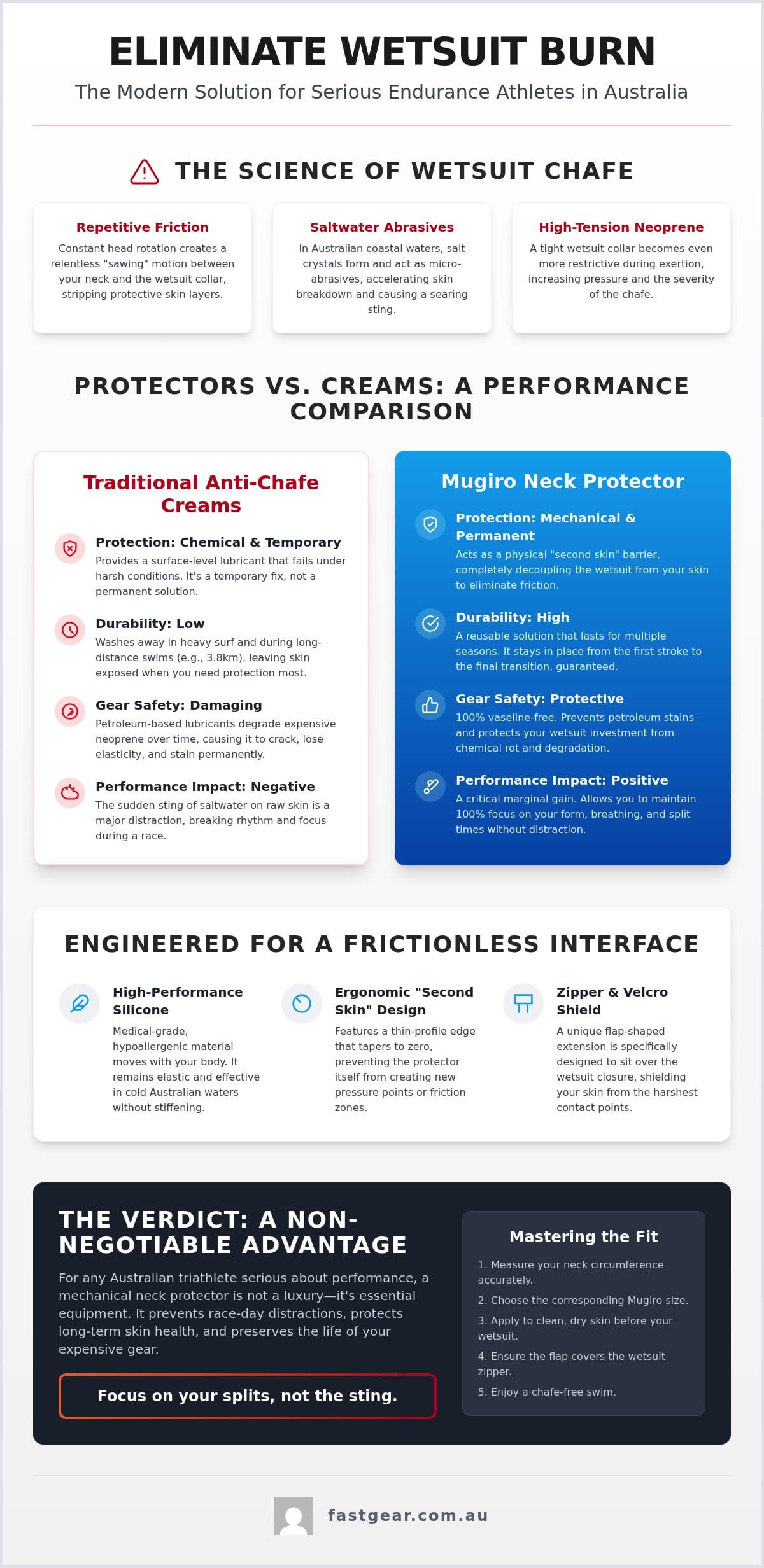
Wetsuit burn is a performance killer. It is not merely a surface-level rash; it is a complex physiological event caused by the intersection of high-tension neoprene, salt-water crystals, and repetitive friction. For the competitive swimmer, this combination creates a micro-abrasive environment that strips the skin’s protective layers within minutes of entering the surf. Understanding the science of wetsuit burn is essential for any athlete aiming for a podium finish. Left unmanaged, these abrasions often lead to secondary bacterial infections, forcing you out of the water for weeks of recovery. The Mugiro neck protector was engineered specifically to interrupt this cycle of damage.
The Biomechanics of Swimming Friction
Efficient swimming requires constant body rotation and precision head movement. When you rotate to breathe, your neck moves against the rigid, often salt-encrusted collar of your wetsuit. This creates a relentless “sawing” motion. During high-intensity exertion, your neck girth fluctuates as blood flow increases to the secondary respiratory muscles. This expansion makes a tight wetsuit collar even more restrictive. Over an Ironman-distance swim, this contact is an absolute certainty. The Mugiro neck protector addresses this by decoupling the skin from the neoprene. It provides a dedicated interface that allows the suit to glide over the protector rather than grinding into your tissue.
Saltwater vs. Fresh Water: The Abrasion Factor
Australian coastal waters present a unique challenge due to high salinity and mineral density. As water is trapped between your skin and the suit, salt crystals begin to form through evaporation and friction. These crystals act as micro-abrasives, accelerating the breakdown of the epidermis. While many athletes rely on chemical lubricants, these solutions have a fundamental flaw: they are temporary. In heavy Australian surf or during a 3.8km swim leg, lubricants eventually wash away. Once the barrier is gone, the salt crystals begin their work on your exposed skin. This often results in permanent scarring, which makes the area more prone to future injury. A mechanical barrier is the only way to ensure protection remains consistent from the first stroke to the final transition. It eliminates the “wash-off” variable and keeps you focused on your split times rather than the sting of the salt.
Mugiro Neck Protector Tech: Engineering a Frictionless Interface
Top-tier performance gear should function as a seamless extension of the athlete. The Mugiro neck protector embodies this “second skin” philosophy by providing a technical interface between your body and your equipment. Unlike messy lubricants that sit on the surface, this protector is an engineered tool designed to move in total synchronicity with your neck’s natural rotation. It effectively decouples the mechanical movement of the wetsuit from the skin, ensuring that friction is absorbed by the silicone rather than your tissue. This shift from chemical to mechanical protection represents a significant upgrade for serious multisport competitors.
High-Performance Silicone Composition
The foundation of the Mugiro’s effectiveness is its medical-grade, hypoallergenic silicone construction. This material was selected for its unique elastic properties, which remain consistent even in the low temperatures of a cold Australian ocean or a deep-water lake start. It doesn’t stiffen or lose its “grip” when the mercury drops. One critical advantage for gear longevity is that this silicone is entirely “vaseline-free.” Petroleum-based lubricants are notorious for degrading neoprene over time, causing it to lose elasticity and crack. By switching to the Mugiro neck protector, you protect your expensive wetsuit investment from chemical rot while enjoying a barrier that won’t wash away in heavy surf. The material density is lower than water, meaning it floats and won’t negatively impact your buoyancy or body position.
Design and Ergonomics
Every millimetre of the Mugiro is contoured to match human anatomy. The design features a thin-profile edge that tapers to almost zero, ensuring the protector itself doesn’t create new pressure points or friction zones. It integrates perfectly with various wetsuit collar heights, sitting low enough to stay secure but high enough to cover the sensitive areas prone to “wetsuit burn.” A standout feature is the flap-shaped extension. This specific component is designed to sit over the wetsuit zipper and Velcro closure, providing a total shield against the harshest contact points of the suit. Integrating this level of technical protection into your kit ensures you’re race-ready. You can secure your Mugiro neck protector to experience this precision engineering first-hand.
Choosing a reusable solution is also a matter of efficiency. One protector can last multiple seasons with basic care, replacing the need for dozens of single-use lubricant sachets that clutter your transition bag and end up as environmental waste. It’s a cleaner, more reliable, and ultimately more professional approach to injury prevention. The Mugiro isn’t just a safety item; it’s a durable piece of performance hardware that delivers consistent results every time you hit the water.
Protectors vs. Creams: The Performance Comparison
Efficiency is the hallmark of an elite athlete. While many swimmers rely on chemical lubricants, these solutions are transient and unreliable in high-rotation sports. Products like BodyGlide or Vaseline provide temporary relief, but they fail the “Wash-Off” test. After 60 minutes in heavy Australian surf, water turbulence and skin-to-neoprene friction emulsify these creams. This process strips the barrier and leaves your neck exposed to the salt. The Mugiro neck protector offers a permanent mechanical alternative that doesn’t thin out or disappear. It delivers the same level of protection at the 4km mark as it does at the start line.
From a financial perspective, the investment is logical. A single protector replaces dozens of premium anti-chafe sticks or sachets over its lifespan. When you calculate the cumulative cost of high-end lubricants over a two-year racing cycle, the Mugiro pays for itself within months. It’s a one-time purchase for a multi-season solution that removes a recurring expense from your race-day budget.
Reliability in Endurance Events
For athletes tackling 70.3 or Full Ironman distances, consistency is everything. The Mugiro neck protector is a “set and forget” tool. You fit it once in the morning and don’t think about it again until you’re stripping your suit in T1. This eliminates a significant stressor during race day. Crucially, using a mechanical barrier means you avoid the “greasy hand” syndrome. Lubricant residue on your palms can compromise your grip on the handlebars and brake levers during the bike leg. A clean transition is a fast transition. It ensures you maintain total control over your bike from the moment you leave the mount line.
Neoprene Longevity and Care
Petroleum-based products are the primary enemy of high-end wetsuits. These chemicals eventually rot the glue and stitching, causing the seams to fail prematurely. Your suit loses its structural integrity and thermal efficiency. Switching to a silicone barrier preserves the neoprene and keeps your gear in race-ready condition. Maintenance is effortless. A simple fresh-water rinse after your swim is all that’s required to keep the protector functional. The total cost of ownership for anti-chafe solutions in 2026 is significantly lower when you opt for a durable mechanical interface over recurring chemical applications.
Sizing and Fitting: Getting Your Mugiro Right
Precision fitting is non-negotiable for high-performance gear. A Mugiro neck protector only delivers its full mechanical advantage when the interface with your skin is secure. To find your size, use a flexible tape measure around the midpoint of your neck. Keep your neck neutral; do not flex your traps or tilt your head. This measurement determines your baseline for a frictionless swim. An accurate fit ensures the material stays in place during high-cadence strokes.
The 2026 Sizing Matrix
The 2026 range is engineered to accommodate a broad spectrum of athlete physiologies. The current sizing standards are:
- XS: 25-30cm
- S: 30-35cm
- L: 35-40cm
For athletes with highly developed traps or muscular necks, choosing the correct size is a balance of compression and comfort. If you sit on the exact border between sizes, a tighter fit is generally preferred for high-surf conditions. This prevents water ingress from shifting the silicone during heavy sets. A loose protector is a liability that can create new friction points. Ensure your selection matches your current neck circumference for maximum stability.
Fitting Technique for Race Day
Speed in transition starts with how you layer your kit. Apply the protector to dry skin before you step into your wetsuit. Ensure the flap extension is centred at the back of your neck. Pull your wetsuit collar up so it sits entirely over the protector’s base. The goal is to have the suit’s internal seams resting against the silicone, not your skin. A professional pro-tip: apply a small amount of water-based lubricant to the outside of the protector. This helps the wetsuit collar slide into position without snagging the silicone. Avoid petroleum-based products to protect your suit. Check for any skin folds trapped under the edges. Even a minor fold will become a painful hot spot after 2,000 metres. Once fitted, rotate your head 360 degrees to confirm total range of motion. You can shop the Mugiro neck protector range to find your specific fit today.
Maintenance is straightforward but vital for longevity. Rinse the silicone in fresh water after every session to remove salt and body oils. Do not use harsh detergents; these can compromise the material’s elasticity. Store it in the provided container to prevent the edges from curling or picking up debris. If the protector shifts during a swim, check your wetsuit collar tension. A well-maintained Mugiro remains a reliable partner for multiple seasons of racing.
The Fastgear Verdict: Why Every Aussie Triathlete Needs One
Eliminating friction is a fundamental part of a successful race strategy. The Mugiro neck protector is a critical marginal gain that prevents race-ending discomfort. While many generic alternatives exist, Fastgear Australia curates this specific brand because it meets the rigorous demands of the local multisport community. It is not just a safety accessory; it’s a professional-grade component that ensures your focus remains on your power output and stroke rate. We choose gear that solves specific athlete pains with technical precision. Every second saved by avoiding the sting of saltwater on a raw neck is a second you can apply to your transition speed.
A Vital Part of Your Race-Day Kit
Injury prevention is as important as your taper. Integrating the Mugiro into your setup allows you to train and race without the distraction of skin abrasions. It works best when paired with other high performance triathlon equipment that prioritises efficiency and speed. The Mugiro neck protector is the gold standard for Australian open-water swimmers because it provides a permanent mechanical barrier that thrives in high-salinity coastal environments. It completes a comprehensive protection strategy for the 2026 season, ensuring that your equipment never becomes your limitation.
Athletes who focus on marginal gains understand that small details lead to podium finishes. A neck protector that stays in place during a 3.8km swim is as vital as a well-tuned drivetrain. By removing the variable of “wash-off” lubricants, you create a more predictable and controlled race environment. This level of preparation is what separates the disciplined competitor from the casual participant.
Fastgear Support and Expertise
We don’t stock gear based on trends. Our team tests every product in real-world Australian conditions to ensure it delivers on its performance promises. This disciplined approach means you receive tools that are proven to work in the surf and the heat. For maximum efficiency, you can order your protector alongside your Maurten gel Australia supplies. Centralising your race-day essentials saves time and ensures your nutrition and equipment are ready for the mount line. We provide expert advice and reliable national shipping to keep you moving toward your next milestone.
Success in triathlon is built on preparation and the right tools. Don’t let a predictable injury like wetsuit burn compromise your performance in 2026. Take control of your comfort and your results. Secure your Mugiro Neck Protector at Fastgear Australia today and experience the difference of a frictionless swim.
Optimise Your Swim Performance for 2026
Winning is about eliminating variables. You’ve seen how the Mugiro neck protector provides a superior mechanical barrier that outperforms temporary lubricants in the surf. By switching to this reusable silicone design, you protect your skin from salt-crystal abrasion and your wetsuit from petroleum-based degradation. It’s a technical upgrade trusted by Australian Ironman finishers who demand equipment that lasts. The shift from messy creams to a precision-engineered interface is a critical marginal gain for any dedicated athlete.
A pain-free swim leg sets the tone for your entire race. Ensure your kit is ready for the 2026 season by choosing a solution that doesn’t wash off or fail when the intensity increases. You can order your Mugiro neck protector today for chafe-free racing. This wetsuit-safe material is a durable investment in your athletic longevity. Stay focused on your split times and keep your momentum high through every transition.
Frequently Asked Questions
Will the Mugiro neck protector make me feel like I am choking?
The Mugiro neck protector shouldn’t cause a choking sensation when sized correctly. The elastic silicone is engineered to expand with your secondary respiratory muscles during high-intensity efforts. It sits flat against the skin to provide a barrier without excessive compression. Proper measurement of your neck circumference ensures the fit remains secure but non-restrictive. If you feel pressure, check your sizing against the matrix or adjust the position relative to your wetsuit collar for optimal comfort.
Can I use the Mugiro neck protector for surfing or scuba diving?
This protector is highly effective for surfing and scuba diving. These sports involve repetitive head movements and neck rotation that often lead to collar rash from neoprene. The mechanical barrier works identically in these disciplines by decoupling the suit from the skin. It is particularly useful for surfers who spend long periods paddling and divers who experience friction from heavy gear or high-collar drysuits in saltwater conditions. It provides a permanent solution for all water-based friction.
How long does a Mugiro neck protector typically last?
This device typically lasts for multiple seasons depending on the frequency of use and maintenance. Because it is made from high-grade medical silicone rather than a degradable chemical, it maintains its structural integrity over time. Most athletes find that one protector covers them for two to three years of regular racing and training. Ensuring you store it in the provided plastic container prevents the edges from curling and protects the material from debris during transport between sessions.
Is the Mugiro neck protector legal in Ironman and ITU sanctioned races?
The Mugiro is legal in Ironman and ITU sanctioned events. It is classified as an accessory rather than a flotation device or a performance-enhancing suit component. Since the material density is lower than water, it doesn’t provide illegal buoyancy. Always check specific race briefings for any local rule variations, but the protector is a standard piece of kit for competitive triathletes globally. It helps you stay focused on the race instead of managing painful skin injuries.
Do I still need to use anti-chafe cream with the neck protector?
You don’t need to use anti-chafe cream with the Mugiro neck protector. The silicone material is engineered to provide a frictionless interface on its own. Using petroleum-based products can actually cause the protector to shift during your swim. If you find removal difficult in transition, a small amount of water-based lubricant on the outside is acceptable. For most athletes, the mechanical barrier alone is sufficient for total protection during long-distance swims.
How do I clean and store my Mugiro protector after a saltwater swim?
Clean your protector by rinsing it thoroughly in fresh water after every saltwater swim. This removes salt crystals, body oils, and sand that can act as abrasives. Avoid using harsh chemical detergents or soaps that might degrade the silicone’s elasticity. Once dry, place the protector back in its original plastic storage container. This keeps the shape intact and prevents the thin-profile edges from becoming damaged or picking up lint in your transition bag between sessions.
What happens if I am between sizes on the Mugiro size chart?
If your measurement falls between sizes on the chart, we recommend choosing the smaller size. A tighter fit ensures the silicone remains stable against your skin during high-cadence strokes and heavy surf. A loose protector is more likely to shift or allow water ingress, which can create new friction points. The high-grade elasticity of the material allows it to stretch comfortably over muscular necks without causing restriction or discomfort during your race.
Will the protector slide down if I have a very low-cut wetsuit?
The protector is designed to stay secure even with varying wetsuit collar heights. Its “second skin” grip relies on the interface between the silicone and your skin rather than the suit’s tension. For low-cut suits, ensure the protector is positioned so the base is covered by the neoprene. This prevents water from catching the edge. The flap extension at the back provides additional stability by sitting under the zipper closure, keeping the device locked in place throughout.
