
Uncategorized
Marathon Fuel Belt Australia: Choose Race-Day Carrying Gear That Works
Oct
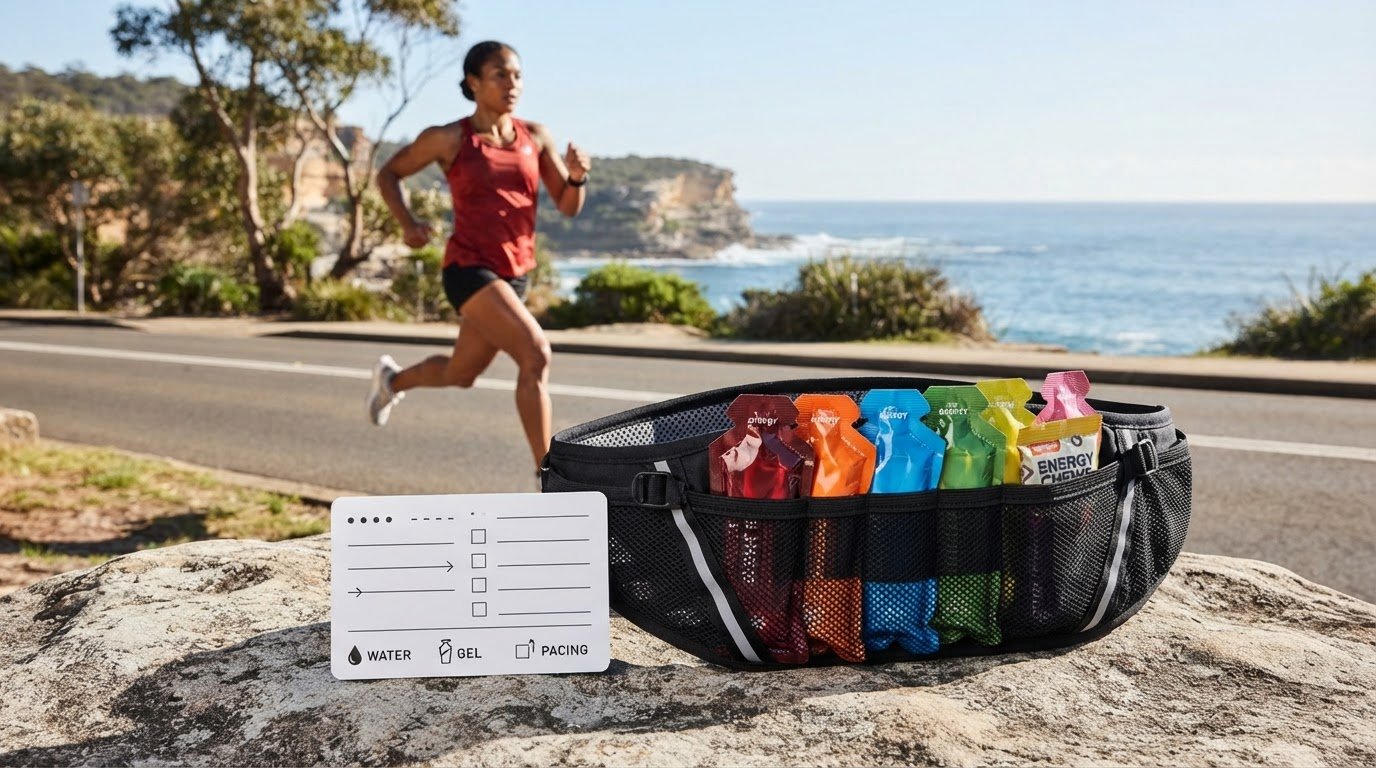
A marathon fuel belt should carry your plan, not rewrite it. Searching “marathon fuel belt australia” is really about one thing: keeping your planned fuel comfortable to carry and easy to reach when the race gets hard.
It’s understandable to focus on capacity, bounce and access. But the best setup isn’t automatically the one that holds the most. Start with the fuel you’ve practised using, then decide whether a belt, your clothing pockets or a combination suits your race-day routine. A belt that shifts or makes fuel awkward to reach can disrupt a plan you’ve already tested.
This guide will help you match carrying capacity to your marathon fuelling plan, assess fit and practise reaching for fuel on training runs. You’ll also find Australian shopping options, including Fastgear Australia’s Compressport Free Belt Pro and nutrition products such as GU Energy Gel – Single, Clif – BLOKS Energy Chews and SIS – GO Isotonic Gels. The aim is a simple, rehearsed setup that’s ready to go on race day.
Key Takeaways
- Match carrying capacity to the fuel in your tested marathon plan, rather than carrying extra “just in case”.
- Compare a belt, clothing pockets and aid-station reliance against your planned load and how you’ll access fuel.
- Assess fit while moving: check whether the loaded belt stays in place without distracting you.
- Use a representative training run to rehearse your race-day setup with the marathon fuel belt australia option you’re considering.
- Explore Fastgear Australia’s Compressport Free Belt Pro alongside its listed marathon fuelling products.
What does a marathon fuel belt need to carry on race day?
Race day already demands focus. Your carrying setup should keep planned fuel within reach without adding unnecessary movement, weight or distraction. A marathon fuel belt is one way to carry selected essentials close to your body. It isn’t a requirement, and it doesn’t need to hold everything you might possibly use.
Carry needs depend on your rehearsed race plan, not a standard checklist or a universal number of gels. Marathon fuelling and hydration are individual considerations, shaped by your plan and the race conditions. For background on the demands involved, see this overview of marathon physiology and hydration.
Start with a simple inventory:
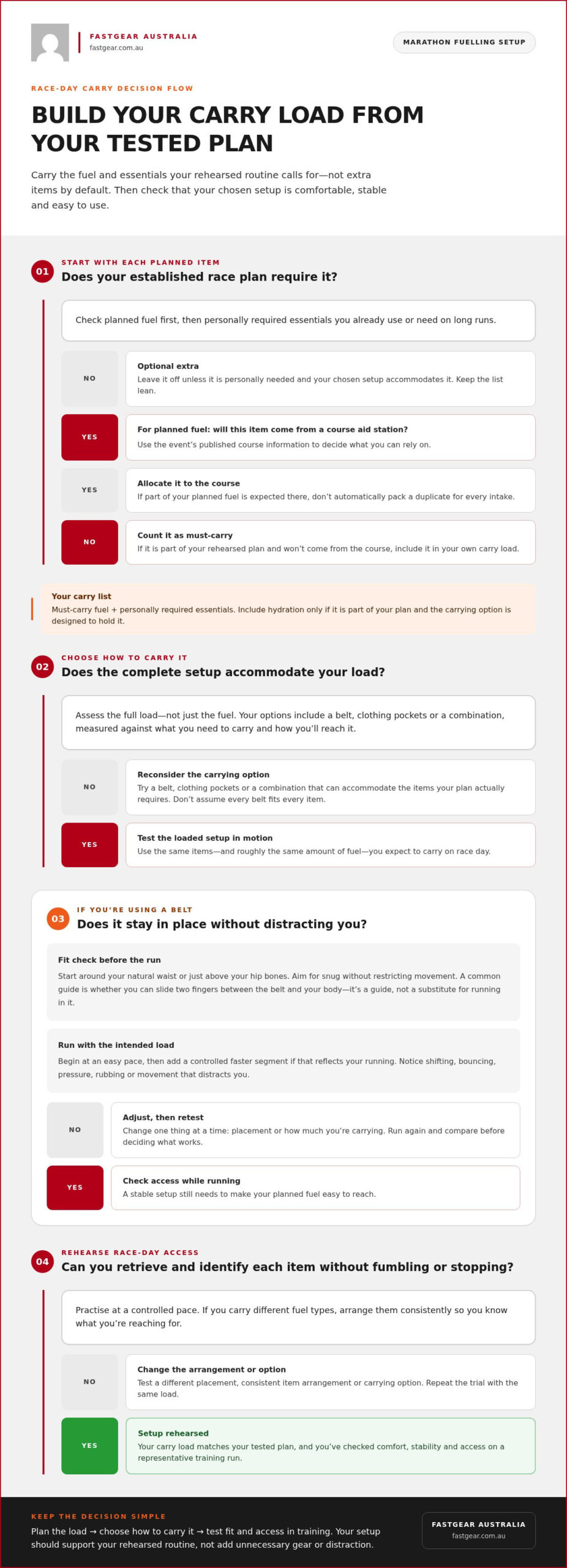
- Planned fuel: the products you intend to take, minus any you expect to collect at course aid stations.
- Personally required essentials: items you already use or need during long runs, if your chosen carry setup accommodates them.
- Hydration, if needed: include it only if it’s part of your plan and the carrying option is designed to hold it.
This turns “How much can the belt hold?” into a more useful question: “What must I carry myself, and what will be available on course?”
Start with your planned fuelling schedule
Use your established intake plan to count the fuel you’ll need between opportunities to collect supplies. Mark each planned intake, then note whether that item will start with you or come from an aid station. Follow the event’s published course information when deciding what you can rely on. This gives you a personal carry total without assuming every runner follows the same timing or needs the same number of items.
For example, if part of your planned fuel is intended to come from the course, don’t automatically pack a duplicate for every intake. If you’re carrying a particular product because it’s part of your rehearsed plan, count it as a must-carry item. The aim is a clear allocation, not extra gear by default.
Separate must-carry items from optional extras
Each addition increases the load and can change how your setup feels in motion. Keep the list lean. Don’t assume all belts fit every item, or that a belt is the right place for hydration. If your plan depends on carrying a bottle or another larger item, assess the complete carrying option rather than judging capacity by the fuel alone.
For a marathon fuel belt australia search, use this inventory as your filter: choose the carrying approach around the items your race plan actually requires, then assess fit and access with that load.
How belt fit, load and access affect marathon fuelling
A belt can look secure while you’re standing still and behave differently once your stride settles in. Fit, load and access need to work together. A belt that shifts may distract you, while a stable setup is only useful if you can reach the fuel you planned to take. Treat each point as something to test on your own body and at your own pace, not a guaranteed feature of a product category.
A practical starting position is around your natural waist or just above your hip bones. The belt should feel snug without restricting movement. A common fit check is whether you can slide two fingers between it and your body. That’s a guide, not a substitute for running in it. Clothing layers and how a belt feels under movement can affect your preferred placement.
Check stability with the intended race load
Load the belt with the same items, and roughly the same amount of fuel, you expect to carry on race day. Begin at an easy pace, then include a controlled faster segment if that reflects your running. Notice whether the belt shifts, bounces, presses uncomfortably or changes position as your stride and effort change.
Make one adjustment at a time during training. You might alter placement or reconsider how much you’re carrying, then run again and compare. Don’t leave your first proper fit test until race morning.
Make planned fuel easy to reach
Race-day access means retrieving planned fuel without breaking rhythm. Practise reaching for each item while running at a controlled pace, then check whether you can identify the right fuel without fumbling or stopping. If you carry different types, arrange them consistently so you know what you’re reaching for.
Storage details vary between products. Don’t assume a belt has a particular pocket layout, capacity or opening style unless its product information states that. Instead, test whether the exact item you plan to carry is secure and accessible in your chosen setup. That’s especially useful if your plan includes different fuel formats or personal essentials.
During a training run, review the setup using these prompts:
- Position: Does the belt stay where you placed it as your pace changes?
- Comfort: Do you notice rubbing, pressure or movement that distracts you?
- Access: Can you retrieve and identify each planned item while maintaining a controlled rhythm?
- Load: Does the full setup feel manageable, or could you leave an optional item behind?
If the belt shifts, first review fit and placement. If fuel is awkward to reach, test a different arrangement or carrying option. Repeat the trial with the same load before deciding what works. The aim isn’t to eliminate every sensation of carrying gear. It’s to find a setup that stays manageable across the running you’ve practised.
If you’re comparing options for marathon fuel belt australia, use your training observations to guide the choice. You can explore marathon carrying gear, including the Compressport Free Belt Pro, alongside the fuel you plan to rehearse with.
Compare marathon fuel-carrying options against your race plan
The right setup depends on how much fuel you’ll carry yourself, how you prefer to access it and what the event provides. A running belt, clothing pockets or greater reliance on aid stations can each work for different plans. Compare the trade-offs against your actual race-day routine, rather than choosing by category alone.
Running belt
Planned load: Useful to assess if you want a separate place for fuel you’re carrying. Access: Practise reaching for items while running. Course hydration: Consider whether your plan needs you to carry fluid as well as fuel.
Clothing pockets
Planned load: May suit a smaller load if your race clothing can hold it comfortably. Access: Test whether items stay secure and are easy to retrieve. Course hydration: Your decision to carry fluid still depends on your plan and the event’s support.
Aid-station reliance
Planned load: May reduce what you start with if course supplies match your plan. Access: Depends on where and what the event provides. Course hydration: Relies more heavily on published aid-station arrangements.
When a belt may suit your marathon setup
A belt may be worth considering if you want to keep personally planned fuel with you, particularly when you prefer to manage intake using products you’ve already practised with. It can also provide an alternative to relying entirely on clothing pockets. The deciding factor is whether your own kit feels comfortable and makes your fuel straightforward to reach while running.
Try the intended load with the clothing and pace you expect to use. A belt isn’t automatically more stable or accessible for every runner, and carrying one doesn’t guarantee a performance benefit. Its value comes down to whether it supports your rehearsed routine without creating a new distraction. Much like track and field athletes sourcing competition-ready equipment through FiberSport USA, distance runners benefit most when every piece of gear is selected and tested for their exact discipline.
When pockets or course support may change the decision
Existing pockets may be enough if they hold your planned items comfortably and keep them accessible throughout a run. Test them loaded, not just by checking whether an item fits while you’re standing still. If fuel shifts, presses against you or takes too much effort to retrieve, that setup may not suit your race plan.
Course support can also change how much you carry. Review the event’s published information for aid-station locations and the supplies provided, then decide which planned items you’ll take from the course and which you’ll carry yourself. Don’t assume course offerings match your preferred fuel or hydration approach.
Some runners may combine options, carrying selected fuel in a belt or pockets while using course aid stations for other needs. Decide in advance what comes from where and rehearse that arrangement. For anyone comparing options through a marathon fuel belt australia search, use planned load, access and dependence on course hydration as the decision points. Choose the setup that fits your plan, then test it in training.
How to test your marathon fuel belt before race day
A belt that feels comfortable at home still needs to prove itself in motion. Rehearse your complete race-day setup on a representative training run, using the clothing, fuel and carrying arrangement you intend to use at the event. That gives you time to spot friction, shifting or awkward access and make measured adjustments before race morning.
Keep the test focused. You’re checking how the setup works for you, not following a new training plan or changing a fuelling approach you’ve already established. Use this four-step sequence:
- Load: Pack only the fuel and personal essentials you plan to carry on race day. Use the same items and a similar load.
- Fit: Position the belt with your event clothing. Check that it feels secure without restricting your movement.
- Run: Use a representative training run. Include varied paces that suit the session, and practise reaching for each planned item.
- Review: Note movement, comfort and access issues afterwards, while there’s time to address them.
Rehearse your full carry setup
Test the whole system, not the belt in isolation. Clothing layers can affect how it sits, while the contents can change how the load feels. During the run, check for shifting or pressure and practise retrieving fuel at the points you’ve planned. Notice whether you can identify the right item without disrupting your rhythm. Keep brief notes so you can distinguish a one-off annoyance from a problem that repeats.
If part of your plan relies on course supplies, rehearse the items you’ll personally carry and keep your race-day allocation clear. Don’t add spare products or optional gear just to fill space. The trial should reflect the intended setup as closely as practical.
Refine the setup using training feedback
Make adjustments one at a time. If the belt moves, try changing its placement. If access feels awkward, reorganise the load or reconsider which items you’re carrying. Remove anything that doesn’t serve the plan, then repeat the check with the revised setup. Changing several things at once makes it harder to tell what improved the fit or access.
Use the same review criteria after each trial: does the belt stay manageable as your pace changes, can you reach the planned fuel, and does anything distract you? If an issue persists, keep refining the arrangement in training rather than assuming it will resolve itself on race day.
For broader fuelling context, Fastgear’s endurance sports nutrition guide can help you connect the items you carry with your wider approach. Once you know what you want to test, explore Fastgear running and fuelling gear for carrying gear and sports nutrition options.
For a marathon fuel belt australia search, make rehearsal part of the decision. The right choice is the setup you’ve loaded, fitted, run in and reviewed before the event.
Find marathon fuel belt options at Fastgear Australia
Your training rehearsal gives you a practical filter for choosing race-day gear. You know what you intend to carry, how the setup feels in motion and whether you can reach each item. Use those observations to assess options, rather than expecting a product description to decide what belongs in your marathon setup.
Match Fastgear gear to the setup you have tested
Fastgear Australia offers the Compressport Free Belt Pro as a carrying option, alongside sports nutrition for endurance athletes. Consider it against your own checklist: the fuel you plan to take, any personal essentials and how you’ll access each item while running. Then assess the belt with your intended load and clothing during training. Your own test is what tells you whether the arrangement works for your routine.
Fastgear’s listed fuelling products include GU Energy Gel – Single, SIS – GO Isotonic Gels and Clif – BLOKS Energy Chews. Consider these as options within your established plan. They aren’t a promise of belt compatibility: test how the specific items fit your chosen setup rather than assuming every belt holds every format in the same way.
Keep the decision grounded in three questions:
- Load: Does your planned fuel and required essentials form a manageable carry?
- Fit: Have you tested the belt with your race clothing and intended contents?
- Access: Can you identify and retrieve the fuel you’ve planned while maintaining your running rhythm?
If hydration is part of your carrying plan, consider how it relates to the event’s course support and your own rehearsed approach. Fastgear’s Electrolytes for Athletes guide offers broader context for thinking about hydration. Keep that decision separate from assumptions about what a particular belt can carry.
Make the next step simple
Use your notes from training to browse carrying gear and nutrition online. If the Compressport Free Belt Pro is on your shortlist, assess it against the same load, clothing and access checks you used for your current setup. If you’re reviewing fuel choices, compare the listed gels and chews with the products you already know how to use. Don’t add a new item to your race-day plan simply because it’s available; rehearse any change before relying on it.
That’s the point of a race-ready setup: each item has a clear role, and you’ve tested how it works as part of the whole. Your marathon fuel belt australia search can lead to a more confident choice when it’s guided by evidence from your own training, not capacity claims alone.
Browse Fastgear Australia for carrying gear and fuelling options, then take your chosen setup back to training and put it through its paces.
Take your tested setup into race week
Make your next step practical: keep a short race-week checklist of the gear and nutrition you’ve settled on, so you’re not making last-minute changes under pressure. If you’re still comparing options, use the setup that worked in training as your reference point. A marathon fuel belt australia search is most useful when it leads to gear you can assess against your own race-day routine.
Fastgear Australia lists the Compressport Free Belt Pro alongside fuelling options including GU Energy Gel, SIS GO Isotonic Gels and Clif BLOKS Energy Chews. Choose products that fit the plan you’ve rehearsed, and keep testing any new combination before race day. Free shipping applies to orders over $100.
Browse marathon carrying gear and sports nutrition at Fastgear Australia, then lock in your setup and head towards the start line ready to run your race.
Frequently Asked Questions
Is a fuel belt worth wearing for a marathon?
It can be useful if it suits the fuel you’ve planned and helps keep it accessible, but not every runner needs one. Your marathon may offer course support, and your running clothing may already have suitable pockets. Think about what you want to carry yourself, then choose the arrangement that feels least distracting. Try it in training with your race clothing before deciding it belongs in your race-day kit.
Can I wear a fuel belt in every marathon?
Don’t assume equipment rules are the same across all events. Check your marathon’s official race information for guidance on carried items and course support, especially if you’re considering more than a belt. Event rules and personal comfort are separate checks: approval doesn’t mean the belt will feel right for you. Once you’ve checked the event information, practise running with the belt so you can assess your own fit and access.
How many gels should I carry in a marathon belt?
There’s no single gel count that suits every runner. Base your quantity on the fuelling schedule you’ve practised, the duration you expect to be on course and the supplies available at the event. For example, if your plan includes collecting some fuel on course, account for those items rather than automatically carrying duplicates. Check that your chosen setup can accommodate the fuel you intend to take with you.
Can a marathon fuel belt carry a phone and gels?
That depends on the specific belt’s storage design and the size of the items. Don’t infer capacity from the product category or assume every model has the same pockets. Check the product information, then try loading your phone and the exact fuel you plan to carry. A stationary fit check won’t show how the combination feels while running, so assess movement and access during a training session.
What should I do if my fuel belt bounces while running?
Review the setup in training before race day. Check the belt’s position and whether you’ve added items that aren’t essential to your plan. Change one thing at a time, then see whether the movement remains distracting during a run. If it still doesn’t feel manageable, compare it with clothing pockets or another carrying approach. Don’t assume a quick adjustment on race morning will solve a problem you haven’t tested.
Do I need a hydration belt as well as a marathon fuel belt?
Not necessarily. Your hydration approach depends on what you plan to drink, what the event provides and whether carrying fluid fits your race routine. A separate hydration setup adds another consideration, so weigh its purpose against the extra load. Check the event’s published aid-station details, then rehearse your chosen arrangement. For anyone searching marathon fuel belt australia, the useful question is whether carrying fluid supports your own plan, not whether it’s standard gear.
