
Uncategorized
Guide to the Best Running Belts for Australian Athletes
Aug
Your running belt isn’t just a simple pocket. It’s a specialised piece of load-management gear that must be perfectly synchronised with your endurance nutrition strategy. If your equipment fails, your performance follows. Every bounce and every centimetre of movement wastes energy that should be driving you toward the finish line.
You likely know the frustration of a belt that rides up your waist or the constant distraction of a phone bouncing against your hip. Chafing from poor-quality materials and sweat-damaged electronics shouldn’t be part of your training. Serious athletes require gear that disappears during high-intensity efforts while providing instant access to critical fuel like Maurten or SIS gels. It’s about finding that balance between carrying what you need and maintaining a streamlined profile.
Discover how to select a zero-bounce running belt that organises your nutrition and essentials for peak race-day performance. This guide explores technical specifications for Australian conditions, comparing elite options like the Compressport Free Belt Pro against leading industry standards. We examine storage capacity, material durability, and how to achieve a minimalist look with maximum utility for your next marathon or trail event.
Key Takeaways
- Identify why a technical running belt is vital for superior load distribution and eliminating performance-sapping bounce.
- Distinguish between tubular and buckle designs to select the most stable configuration for your specific race terrain.
- Apply a precise selection framework to measure your true running waist and audit your essential race-day gear.
- Implement the “First-In, Last-Out” rule to organise your nutrition for rapid access during peak physical efforts.
- Explore why elite athletes choose the Compressport Free Belt Pro for its streamlined, single-compartment technical design.
Beyond the Pocket: Why a Technical Running Belt is Essential Kit
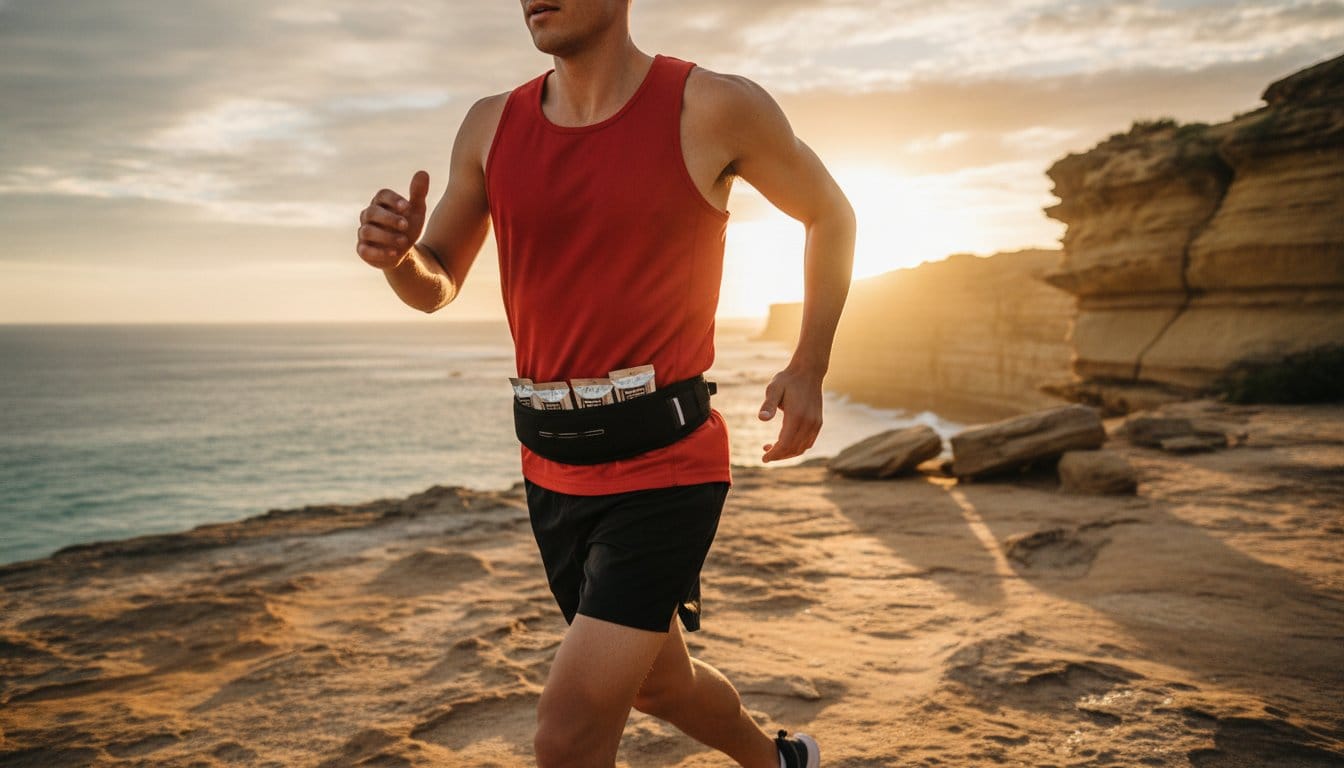
A technical running belt is not a simple accessory. It is a precision-engineered tool designed for ergonomic load distribution. For elite athletes, gear must function as a seamless extension of the body. A high-performance belt secures your smartphone, keys, and technical nutrition like Maurten gels without compromising your biomechanics. This allows you to maintain total focus on your split times and power output rather than adjusting shifting gear.
The “Zero-Bounce” principle is the absolute baseline for quality kit. Traditional storage methods fail because they allow mass to move independently of the athlete’s stride. In the intense Australian heat, carrying hydration and electrolyte salts is a safety requirement rather than an option. A technical belt keeps these heavy essentials flush against your centre of gravity. This hands-free configuration ensures your arm swing remains natural and efficient, preserving your gait through the final stages of a race.
The Problem with Standard Pockets
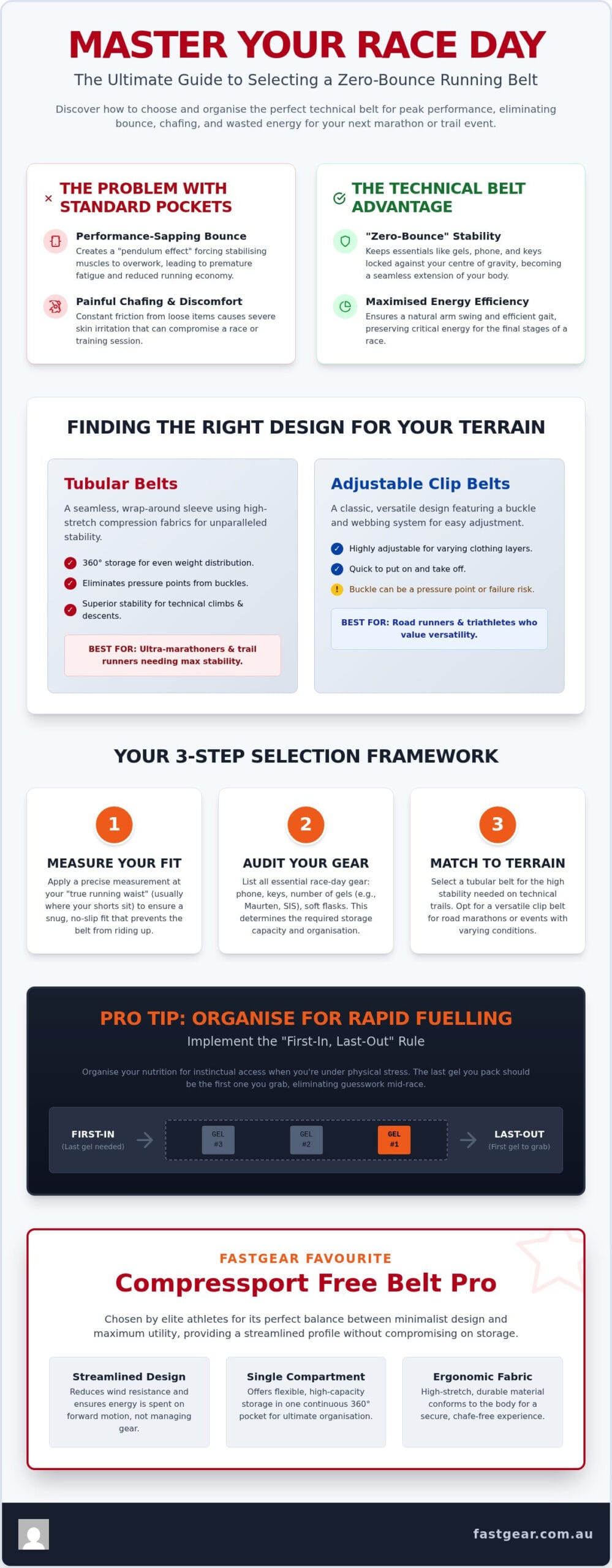
Standard shorts pockets are built for casual wear, not the rigours of endurance running. Placing a heavy phone or multiple gels in a loose pocket creates a destructive pendulum effect. This swinging weight forces your stabilising muscles to work harder to compensate for the uneven pull, leading to premature fatigue and muscular imbalance. Loose items also generate constant friction against the skin. This rubbing leads to severe chafing that can compromise your performance or force a premature exit from the course. Load-sway is the uncontrolled movement of carried items that disrupts your rhythm and significantly reduces your running economy.
Performance Benefits for Marathoners and Triathletes
Efficiency determines your results on race day. For triathletes, a technical running belt streamlines the transition from the bike to the run leg. You can pre-load your belt with SIS gels and simply slide it on as you exit the transition area. There is a massive psychological edge in knowing your fuel is locked down. You won’t waste mental energy checking for dropped items or adjusting a sliding waist pack. Investigating the ergonomic benefits of weighted gear shows that the placement of mass is critical for maintaining speed. By keeping a minimalist profile, you reduce wind resistance and ensure your energy is spent on forward motion, not managing your gear.
Types of Running Belts: Finding the Right Design for Your Terrain
Selecting the right running belt depends entirely on your event distance and gear volume. Mechanical design dictates how the weight sits against your pelvis. A mismatch between belt type and terrain leads to the performance-sapping bounce issues that plague many athletes. We categorise these tools by their closure systems and storage architecture to help you identify the most efficient solution for your specific discipline.
The Rise of the Tubular Belt
Tubular designs have revolutionised the endurance market by offering a seamless, wrap-around sleeve. These belts use a 360-degree pocket system to distribute weight evenly around the waist. Because they rely on high-stretch compression fabrics rather than a single plastic buckle, they provide superior stability during vertical climbs and technical descents. This design eliminates the pressure points often caused by traditional fasteners. It is the primary choice for ultra-marathoners who need to carry a smartphone, soft flasks, and multiple Maurten gels simultaneously without the kit shifting.
Adjustable Clip Belts for Versatility
Buckle-based belts offer a classic approach to load management. These systems are highly adjustable, making them ideal for athletes who vary their layering between cold morning starts and hot afternoon finishes. While they are easy to put on and remove, plastic buckles can be a point of failure during high-intensity efforts. In the harsh Australian climate, salt-heavy sweat can lead to grit buildup in the mechanism or cause the webbing to slip. For serious training, ensure the buckle is low-profile to prevent it from digging into your skin during deep breathing or core engagement.
For short-course triathlons or local events, a race number belt provides a minimalist solution. These are simple elastic strips designed to hold your bib and perhaps two GU energy gels. Conversely, hydration-specific belts feature reinforced holsters for rigid bottles. These are essential for self-supported long runs in remote areas where water stations are non-existent. When evaluating these designs, consult expert running belt reviews to see how specific models perform under extreme endurance conditions. Finding the right fit ensures you stay focused on the path ahead. You can view our range of technical storage solutions to find a model that matches your current training volume.
The Selection Framework: What to Look for Before You Buy
Purchasing a running belt based on aesthetics alone is a mistake that leads to gear failure at the twenty-kilometre mark. Professional athletes use a systematic framework to evaluate technical specifications against their specific race-day requirements. Follow these five steps to ensure your equipment supports, rather than hinders, your physical output.
- Step 1: Measure your true running waist. Your natural waist is the narrowest point of your torso, but a performance belt should sit lower. Measure the circumference across the top of your hip bones or the iliac crest where the load naturally settles.
- Step 2: Audit your essential gear. Lay out your smartphone, car key, and exact gel count. If you plan to carry six Maurten gels for a marathon, ensure the internal volume can accommodate them without overstretching the fabric.
- Step 3: Evaluate material technicality. Check for high-stretch polyester/elastane blends that provide compression. Avoid heavy nylons that retain water and become heavy when saturated with sweat.
- Step 4: Verify safety features. Look for 360-degree reflective detailing. Visibility is a non-negotiable requirement for dawn or dusk training sessions on public roads.
- Step 5: Test one-handed accessibility. You must be able to retrieve nutrition during high-intensity intervals without breaking your stride or looking down.
Sizing and Fit: Avoiding the Bounce
A precision fit is the only way to eliminate vertical oscillation. The belt must be snug enough to lock against your hips, yet it cannot restrict deep diaphragmatic breathing. If you feel pressure against your lower ribs during heavy exertion, the size is too small. Conversely, if the belt shifts when you jump in place, it will bounce on the road. Look for internal silicone grippers or textured bands on the underside of the fabric. these provide the necessary friction to keep the kit locked over your apparel during high-cadence strides.
Material Science: Breathability and Chafing
Technical polyester/elastane blends are superior to standard nylons because they offer multi-directional stretch and rapid moisture transfer. Seamless construction is essential to prevent “belt rash” during long-range efforts where repetitive movement amplifies friction. Moisture-wicking properties are especially critical for the protection of your electronics. Wicking is critical for protecting electronics because it transports corrosive, salt-heavy sweat away from the device casing, preventing moisture ingress into sensitive charging ports and internal circuitry.
Organising Your Gear: Packing for Marathons and Trail Races
Logistics can make or break your performance. A running belt is more than a storage pouch; it is a mobile command centre for your race-day requirements. Proper organisation ensures your centre of gravity remains stable while providing immediate access to critical fuel. Poorly distributed weight causes the belt to shift, leading to the biomechanical issues discussed previously. You must treat packing as a technical exercise in load management.
The “First-In, Last-Out” rule is the standard for elite organisation. Place the nutrition you will need at the end of the race in the least accessible parts of the belt. Keep your immediate fuel, such as your first two SIS or Maurten gels, in the primary access zones. Secure valuables like car keys or emergency ID using internal clips to prevent them from scratching your phone or falling out during a gel retrieval. For longer, self-supported sessions, integrate soft flasks into the wrap-around compartments. This provides hydration without the bulk and heat-retention of a full racing vest.
The Marathon Setup
For a standard marathon, you should aim to carry 4 to 6 energy gels, such as Maurten Gel 100, to support your fueling strategy at 30-minute intervals. Position these evenly around your waist to maintain balance. Tuck your mobile phone into the small of your back. This area has the least amount of movement and provides the most protection against sweat-induced screen damage. To refine your approach, learn How to Build a Personalised Endurance Fueling Strategy before your next major event.
Trail and Ultra-Running Essentials
Trail running introduces complex gear requirements. Technical belts often feature integrated silicone loops designed specifically for carrying collapsible poles. This allows you to stow your poles quickly during flat sections without stopping. You must also pack mandatory safety gear, including emergency foil blankets and whistles, for official gear checks. Balancing these items requires a high-performance base. Pairing your belt with a lightweight, breathable garment like the Compressport Trail Racing SS Tshirt ensures maximum stability. This combination prevents the belt from sliding against your skin while managing moisture in the humid Australian bush. To ensure your body keeps pace with your gear, follow a precision trail running nutrition strategy tailored for Australian conditions so your fuel supply matches the demands of the terrain. You can optimise your race-day kit by selecting gear designed for technical efficiency.
Fastgear Favourites: Why the Compressport Free Belt Pro Leads the Pack
The Compressport Free Belt Pro stands as the gold standard for trail and triathlon run legs. Unlike standard options, this running belt features a single-compartment wrap design that offers total flexibility. Elite trail runners prefer this architecture because it allows for rapid, intuitive gear placement. You can slide a 500ml soft flask into the rear and distribute your Maurten or SIS gels across the front and sides without fumbling with restrictive zippers or small pockets.
Durability is a critical factor for endurance athletes. This belt maintains its structural integrity and compressive stretch even after hundreds of kilometres of technical use. The high-performance fibres don’t sag when fully loaded with nutrition and electronics. It provides a reliable, locked-down feel that remains consistent from the first kilometre to the finish line. Pairing this belt with Fastgear’s range of high-carb strategies, like Maurten 320 powder or GU Energy Gels, ensures you have the fuel capacity required for peak performance. For a complete breakdown of what to eat and when during your event, consult the ultimate Australian trail running nutrition guide to dial in your hourly carbohydrate targets.
The Compressport Advantage
Ergonomics are at the heart of the Compressport design. The belt is cut to follow the specific anatomy of a runner in motion, sitting securely on the hips without migrating toward the waist. Its ultra-lightweight mesh construction is a standout feature for performance. This material doesn’t hold water or sweat, ensuring the kit remains light even during torrential rain or heavy exertion. To understand the full technical benefits, read Why the Compressport Free Belt Pro Beats Running Packs for your next event.
Expert Recommendation for Australian Conditions
This belt excels in the intense Australian heat and humidity. The ventilated mesh allows for maximum airflow against the skin, reducing the risk of heat rash and overheating. Before you commit to your next piece of gear, run through this final checklist. Ensure the size provides a snug fit without restricting your breathing. Verify that the material is high-stretch polyester/elastane. Test that you can reach your SIS gels with one hand. When you’re ready to upgrade, organise your race-day kit with the Compressport Free Belt Pro at Fastgear to ensure you’re prepared for the rigours of competition.
Dominate Your Next Race with Precision Gear
Transitioning from training to race day requires absolute confidence in your kit. You now understand that a technical running belt is a fundamental load-management tool rather than a simple accessory. By measuring your true running waist and implementing a “First-In, Last-Out” nutrition strategy, you eliminate the distractions of load-sway and gear migration. High-performance materials like those found in the Compressport Free Belt Pro ensure your essentials remain secure through every technical climb and high-cadence sprint.
Success on the course depends on the small details of your preparation. As an authorised Compressport retailer, Fastgear Australia provides technical gear selected by endurance experts to help you reach your physical peak. We offer fast national shipping across Australia to get you ready for your next event without delay. Our team understands the rigours of the Australian climate and stocks only the most reliable equipment for serious athletes.
Optimise your run with our professional range of belts at Fastgear Australia. Your next personal best starts with gear that works as hard as you do. Stay focused and keep pushing.
Frequently Asked Questions
Will a running belt fit my large smartphone?
Yes, most high-performance tubular belts are engineered with elasticated mesh that expands to accommodate large smartphones like the iPhone Max or Samsung Ultra. The 360-degree compartment allows you to position the device in the small of your back for maximum stability. This prevents the phone from shifting during high-cadence efforts while keeping it accessible for performance tracking or emergency calls.
How do I stop my running belt from bouncing during a sprint?
To stop a running belt from bouncing, you must ensure it is sized correctly and positioned over the iliac crest, which is the top of your hip bones. Wearing the belt too high on the soft tissue of your natural waist causes it to migrate and oscillate. A snug, compressive fit locks the load against your skeleton and effectively eliminates vertical movement during high-intensity intervals.
Can I wear a running belt over a compression shirt or directly on my skin?
You can wear a technical belt either directly against your skin or over a performance garment like a compression shirt. Technical fabrics, such as those used in Compressport gear, are designed with seamless edges to prevent irritation. If you have sensitive skin or are running in extreme Australian humidity, wearing it over a lightweight base layer provides an extra barrier against friction.
How many energy gels can I realistically fit in a tubular running belt?
A high-capacity tubular belt can realistically hold between 6 and 10 energy gels, such as Maurten Gel 100 or SIS GO Isotonic Gels. The wrap-around design allows you to distribute the weight evenly around your circumference rather than stacking it in one pocket. This capacity is typically sufficient for a full marathon or a self-supported trail run lasting several hours without requiring a backpack.
Are running belts better than hydration vests for a half-marathon?
A running belt is generally superior to a hydration vest for half-marathons because it offers better thermoregulation and weighs significantly less. Unless you require more than one litre of fluid or mandatory trail safety gear, a belt provides enough storage for your phone and nutrition. This minimalist approach reduces heat retention across your back and chest, which is critical in hot Australian conditions.
How should I wash my running belt to ensure the elastic doesn’t perish?
Hand wash your belt in cold water using a mild detergent to preserve the integrity of the elasticated fibres. Avoid fabric softeners and high-heat dryers, as these break down the elastane and cause the belt to lose its compressive properties. Air dry the gear in a shaded area. Direct Australian sunlight can also damage technical mesh and weaken the structural stretch over time.
Do running belts cause chafing on long-distance trail runs?
Technical belts with seamless construction and moisture-wicking properties rarely cause chafing, even on long-distance trail runs. Irritation usually occurs when a belt is sized too large, allowing it to rub against the skin, or when salt crystals from dried sweat create friction. Choosing a high-quality mesh belt ensures that moisture is transported away from the body, keeping the contact area dry and comfortable.
Can I use a running belt for the run leg of a triathlon?
Yes, a tubular belt is an exceptional choice for the run leg of a triathlon. It allows for a rapid transition because you can pre-load it with GU Energy Gels and slide it on in seconds as you exit T2. The streamlined profile fits perfectly over a tri-suit and won’t interfere with your running mechanics or arm swing as you chase a personal best on the road.
