
Uncategorized
Triathlon Nutrition Australia: The 2026 High-Performance Fuelling Guide
Aug
Gastrointestinal distress is the leading cause of DNF results in Australian Ironman events, often ending a season’s hard work before the final 10 kilometres. You’ve likely felt that familiar dread as stomach cramps set in or your energy bottoms out just as you exit T2. Mastering triathlon nutrition Australia isn’t about guessing; it’s about applying precision science to the unique demands of our high-humidity racing environments.
We know the frustration of hitting the wall at the 30km mark despite a perfect training block. You deserve a fuelling strategy that matches your physical output. This guide provides a comprehensive roadmap to building a bulletproof gut and maintaining consistent power from the swim start to the finish line. We’ll leverage the latest 2026 data on high-carbohydrate intake and hydrogel technology to ensure your engine never runs dry.
You’ll learn how to navigate the 90 to 120 gram per hour carbohydrate threshold using elite-level tools like Maurten, SIS, and Tailwind. We’ll also break down precision electrolyte protocols to combat Australian heat and clarify exactly how to transition from carb-loading to race-day execution without the debilitating bloat.
Key Takeaways
- Establish a baseline of 60-90 grams of carbohydrates per hour to maintain peak power and prevent the physiological collapse known as “the bonk”.
- Discover how hydrogel technology in Maurten products bypasses the stomach to provide high-density energy while significantly reducing the risk of gastrointestinal distress.
- Optimise your triathlon nutrition Australia plan by balancing sodium levels with fluid intake to ensure efficient hydration in high-humidity racing conditions.
- Utilise the bike leg as your primary fuelling window to maximise calorie absorption and preserve glycogen stores for the final run.
- Identify the specific performance benefits of isotonic gels versus superstarch solutions to curate a “bulletproof” gut strategy tailored to your individual physiology.
Fuelling the Australian Triathlon: Why Nutrition is Your Fourth Discipline
Elite performance requires more than just a high power-to-weight ratio or an efficient swim stroke. Success on race day depends on your ability to apply the foundational principles of sports nutrition to a dynamic, high-stress environment. In the context of triathlon nutrition Australia, we define this fourth discipline as the strategic, proactive management of glycogen, electrolytes, and fluid. Without a structured plan, even the most disciplined training block can be undone by physiological collapse.
The “Bonk” is not merely a feeling of fatigue; it’s a total metabolic shutdown. When your liver and muscle glycogen stores hit zero, your brain reduces neurological drive to the muscles to preserve remaining glucose for vital organ function. This results in a sudden, catastrophic drop in power output. “Winging it” with on-course nutrition is a high-risk strategy for serious PB seekers. On-course supplies are often inconsistent, and your gut may not tolerate the specific carb ratios provided at aid stations under high intensity.
The Australian climate acts as a metabolic accelerator. High ambient temperatures increase the rate of carbohydrate oxidation, meaning you burn through fuel faster than you would in cooler European or North American conditions. This makes precision fuelling a non-negotiable requirement for racing on home soil.
The Science of Glycogen Depletion
Most athletes carry roughly 2,000 calories of stored glycogen, which typically provides a 90-minute window of high-intensity effort. Triathlon intensity levels, specifically those in Zone 3 and 4, accelerate this burn rate significantly. As you push toward the red line, your body shifts its primary fuel source from fat to carbohydrates. Glycogen depletion is the primary limiter of endurance performance.
Heat Stress and Sweat Rates in Australia
Thermoregulation and digestion are competing physiological processes. When racing in the heat, your body prioritises cooling by shifting blood flow from the gastrointestinal tract toward the skin. This shift reduces the gut’s ability to process fuel, leading to slower gastric emptying and potential nausea. To counter this, you must understand your specific physiology. Testing your sweat rate in local conditions before race day is essential. This data allows you to calibrate your fluid and sodium intake, ensuring your triathlon nutrition Australia strategy remains effective even as the mercury rises.
The Three Pillars of Endurance Fuelling: Carbs, Sodium, and Hydration
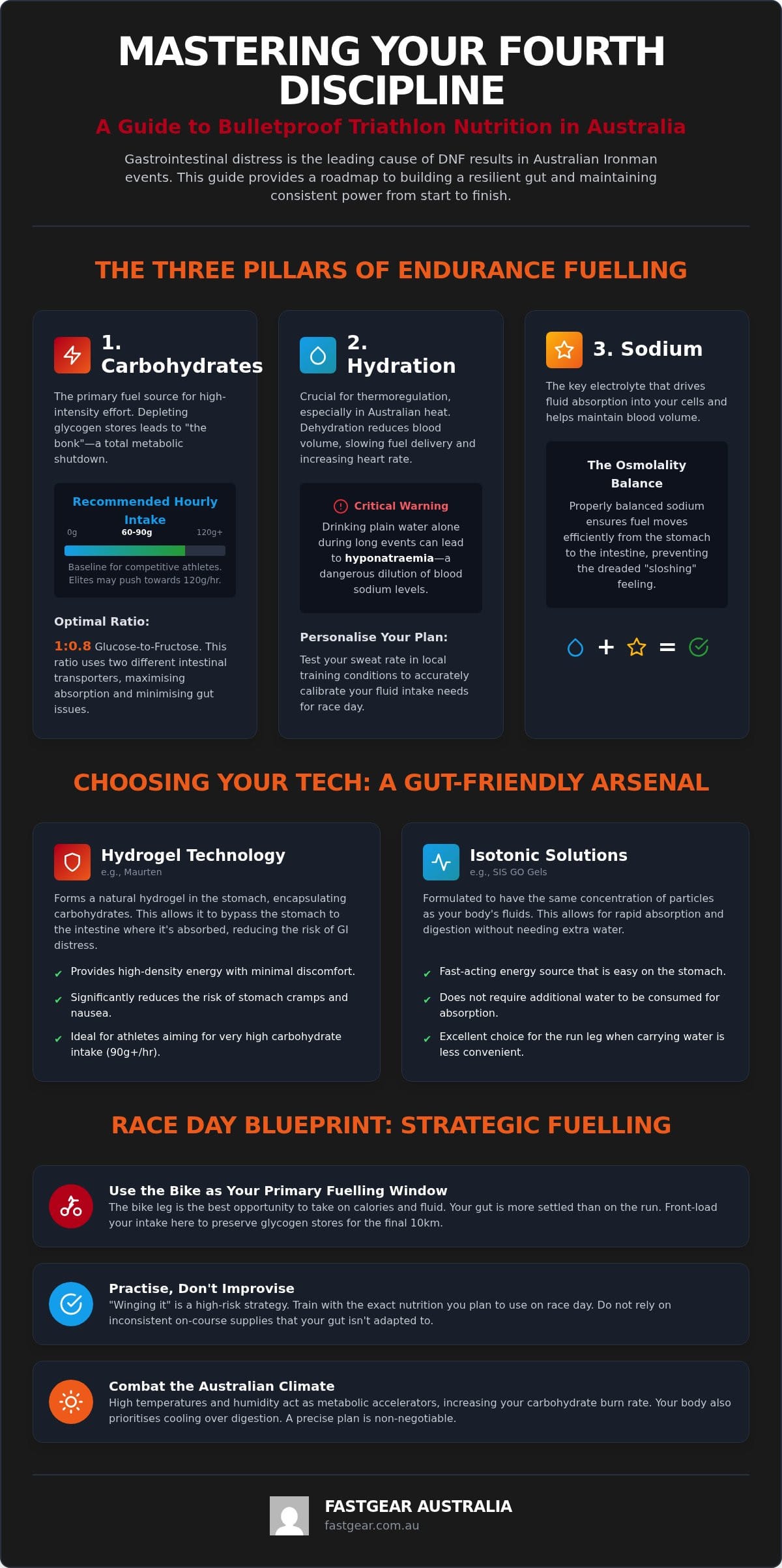
High-performance fuelling relies on three non-negotiable variables: carbohydrates, sodium, and fluid. Getting these right determines whether you finish strong or fade. The 60-90g carbohydrate per hour benchmark is the gold standard for endurance events lasting over two hours. While some elite performers push toward 120g, the 90g target remains the baseline for competitive triathlon nutrition Australia strategies. This density provides enough fuel to spare glycogen without overwhelming the gut.
Sodium is the misunderstood driver of fluid absorption. It maintains blood volume and creates the osmotic pressure required to pull water into your cells. Drinking plain water during long-distance racing is a significant risk. It can lead to hyponatraemia, where blood sodium levels become dangerously diluted, causing confusion and performance collapse. Balancing osmolality, the ratio of solids to liquids, ensures your fuel moves efficiently from the stomach to the small intestine without causing “sloshing” or distress.
Carbohydrate Densities: Gels, Chews, and Powders
Texture and delivery method matter during long-course events. Energy chews, such as Clif Bloks, provide a necessary textural break during the bike leg. Fast-acting options like SIS GO Isotonic Gels are superior for the run, as they don’t require additional water for absorption. Liquid calories from Maurten 320 powder or tailwind powder offer high-density energy for the bike, allowing you to front-load your intake. To maximise uptake, modern triathlon nutrition Australia protocols suggest a 1:0.8 glucose-to-fructose ratio. This combination uses two different intestinal transporters, allowing athletes to process up to 120 grams of carbs per hour.
Electrolyte Management Beyond Just Salt
Electrolyte balance extends beyond simple salt intake. Magnesium and potassium are essential for preventing late-race cramping and maintaining neuromuscular function. Every athlete has a unique sweat-sodium concentration, meaning a generic “one size fits all” tablet rarely works. Precision hydration requires understanding your specific losses under the Australian sun. You can deep-dive into these mechanics in our Electrolytes for Athletes: Performance Hydration Guide. As noted by Sports Dietitians Australia, individualised plans are the only way to ensure safety and speed in extreme conditions. You can optimise your race kit by selecting the specific ratios your physiology demands.
Hydrogels vs Isotonics: Choosing the Right Tech for Your Gut
Achieving a high carbohydrate intake is only half the battle. The delivery mechanism determines whether those calories reach your muscles or sit heavy in your stomach. In the landscape of triathlon nutrition Australia, athletes must choose between three distinct technologies: hydrogels, isotonics, and superstarch solutions. Each serves a specific physiological purpose, and the “best” option depends entirely on your gut tolerance and race intensity.
The primary challenge during long-course racing is gastric emptying. When intensity rises, your digestive system slows down. If you consume traditional high-concentration gels without enough water, your body pulls fluid from the bloodstream into the gut to dilute the mixture. This leads to bloating, “sloshing,” and eventually, the dreaded DNF. Modern fuelling tech is designed to bypass this bottleneck.
Maurten and the Hydrogel Revolution
Maurten changed the game by introducing a pH-sensitive biopolymer. When the hydrogel hits the low pH environment of the stomach, it encapsulates the carbohydrates in a protective structure. This allows the fuel to pass through the stomach unnoticed and move directly into the small intestine for absorption. It’s the most efficient way to hit 90-120g of carbs per hour without GI distress. For a deep dive into this technology, read our Maurten Gel Australia: The High-Performance Guide to Hydrogel Fuelling (2026). We recommend using Maurten 320 powder for the bike leg and maurten gel 100 for the run to maintain a steady, high-density fuel flow.
SIS GO and Isotonic Efficiency
SIS – GO Isotonic Gels are engineered to be “thin” and easily digestible. Isotonicity means the gel has the same osmotic pressure as the fluid in your cells. You don’t need to drink water immediately after consuming one for it to be absorbed. This is a massive advantage during the run leg when heavy breathing makes swallowing large amounts of fluid difficult. SIS variety also helps combat flavour fatigue, a common issue in the final hours of an Ironman when your palate begins to reject sweet, syrupy textures.
UCAN: Steady Energy Without the Crash
ucan gels utilise LIVSTEADY, a complex superstarch that provides a slow-burn energy release. Unlike simple sugars that cause a rapid insulin spike followed by a crash, UCAN maintains stable blood glucose levels for up to several hours. This makes it the ideal choice for “fat-adapted” triathletes or those prone to metabolic swings. Use UCAN in the 30-45 minute window before the swim start or during the early stages of the bike leg to establish a consistent energy baseline before switching to faster-acting fuels.
The Race-Day Blueprint: Fuelling from T1 to the Finish Line
Precision execution starts three hours before the klaxon. Your pre-race meal should be familiar, high in carbohydrates, and low in fibre. When refining your triathlon nutrition Australia plan, aim for 1 to 4 grams of carbs per kilogram of body mass. A “top-up” 15 to 30 minutes before the swim start, using a fast-acting gel like Maurten Gel 100, ensures blood glucose is elevated as you enter the water. This prevents an early energy dip during the swim, where fuelling is impossible.
The race doesn’t end at the finish line. The 30-minute post-race window is critical for glycogen replenishment and muscle repair. Aim for a 3:1 or 4:1 ratio of carbohydrates to protein. This initiates the recovery process immediately, allowing you to return to training without the prolonged fatigue of a poorly fuelled effort.
The Bike Leg: Your Moving Buffet
The bike is your primary opportunity for high-density fuelling. Your heart rate is typically lower and more stable than on the run, allowing the gut to process more complex loads. Target 80 to 100 grams of carbohydrates per hour. Front-loading your nutrition in the first two-thirds of the ride is a critical tactic. It ensures you have a surplus of energy before the run leg begins, where gastric emptying becomes significantly more difficult. For detailed bike-specific strategies, consult our Cycling Nutrition Australia: The 2026 High-Performance Fuelling Guide. Utilising high-calorie powders like Maurten 320 or tailwind powder in your aero-bottles keeps your cockpit clean and your energy levels consistent.
The Run: High-Intensity Gut Management
Running introduces vertical oscillation, a mechanical stress that physically jostles the stomach. This increases the risk of GI distress, making triathlon nutrition Australia protocols even more vital. Shift to a high-frequency, low-volume approach. Sip small amounts of fluid and take gels in increments rather than gulping at aid stations. Caffeine strategy is a proven performance enhancer for the final 10km. Introducing Maurten Gel 100 CAF late in the race provides a neurological boost, reducing perceived exertion when fatigue is at its peak. You can shop our curated range of elite race-day fuel to build your custom blueprint.
Building Your High-Performance Nutrition Arsenal with Fastgear
Elite execution is the result of synergy between your physiology, your gear, and your fuel. At Fastgear Australia, we curate only the most effective triathlon nutrition Australia options because we know that second-best leads to a DNF. Building your arsenal requires a strategic selection of brands like Maurten, SIS, and Tailwind, each chosen for their specific role in your race-day timeline. Nutrition is only as good as its delivery system; if you can’t access your fuel at 40km/h or during a high-intensity run, the science behind it becomes irrelevant.
A core tenet of our performance philosophy is the “trial in training” mandate. Australian conditions are unforgiving. You cannot afford to discover a gut intolerance at the 15km mark of a marathon. Use your long sessions to stress-test your intake levels, ensuring your body is adapted to the 90g or 120g carbohydrate loads discussed in previous sections. High-performance gear and nutrition must work in tandem to eliminate friction and maximise efficiency.
Integrating Nutrition with Technical Gear
Technical gear should facilitate, not hinder, your fuelling. The Compressport Free Belt Pro is a vital tool for the run leg. It provides a bounce-free, 360-degree storage solution for your Maurten Gel 100 or SIS – GO Isotonic Gels, keeping your hands free and your focus on your pace. On the bike, aerodynamic efficiency is paramount. The Wove M8 Road / Tri Saddle allows for streamlined nutrition storage that doesn’t compromise your aero profile or comfort. For a deeper look at optimising your setup, view our High Performance Triathlon Equipment: The 2026 Marginal Gains Guide.
Customising Your Race-Day Bundle
Optimal results often come from a hybrid approach. Many athletes prefer the simplicity of Tailwind powder for the bike leg to manage hydration and calories simultaneously, then switch to the precision of Maurten hydrogels for the run. When carrying a high volume of gels, physical comfort is a factor. Use the Mugiro – Neck Protector to prevent irritation from increased movement and salt crystallisation on the skin. Your final “bonk-proof” checklist should include:
- Verify your 1:0.8 glucose-to-fructose ratios for high-intensity segments.
- Ensure your Compressport Free Belt Pro is packed with enough Maurten Gel 100 Caffein for the final 10km.
- Pre-mix your Tailwind powder or Maurten 320 powder into aero-bottles.
- Confirm your electrolyte concentrations match your pre-tested sweat rate for the expected temperature.
- Keep your transition bags and nutrition bottles clearly marked to prevent any mix-ups during the race; check out DymoOnline for durable labelling solutions.
By treating your triathlon nutrition Australia strategy as a technical component of your kit, you turn a potential point of failure into a competitive advantage. Just as you tune your metabolic engine, ensure your support vehicle is equally prepared by choosing to visit Veloce Tuning for expert log book servicing and fleet management.
Dominate the Fourth Discipline
Success on race day isn’t just about the kilometres you’ve logged in the pool or on the road. It’s about the precision of your metabolic engine. You now have the blueprint to master triathlon nutrition Australia, from the 90-gram carbohydrate benchmark to the tactical application of hydrogel technology. By selecting the right fuel for your specific physiology, you eliminate the risk of the “bonk” and ensure your power output remains consistent until you cross the finish line.
Fastgear acts as your performance partner, providing an expert-curated endurance range that refuses to compromise on quality. As specialist stockists of Maurten, SIS, and UCAN, we ensure your nutrition strategy integrates seamlessly with your technical gear. Whether you’re using a Compressport belt for run-leg accessibility or an aero-efficient Wove saddle, every choice must serve your final result. Don’t leave your fuelling to chance. Optimise your race-day fuelling with Fastgear’s premium nutrition range and execute your plan with absolute confidence. Your next milestone is within reach.
Frequently Asked Questions
How many grams of carbs per hour should I aim for in a triathlon?
Aim for 60 to 90 grams of carbohydrates per hour as your baseline for events exceeding 90 minutes. Elite athletes often push toward 120 grams per hour using a 1:0.8 glucose to fructose ratio to maximise intestinal transport. Achieving these high densities requires technical products like Maurten 320 powder or SIS – GO Isotonic Gels. Consistent intake prevents glycogen depletion and maintains neurological drive during the final stages of your race.
What is the best nutrition for a 70.3 vs. a Full Ironman?
For a 70.3, focus on high-intensity, fast-acting fuels like SIS – GO Isotonic Gels. The shorter duration allows for a more aggressive carbohydrate strategy. A Full Ironman requires varied textures to combat flavour fatigue. Incorporate Clif – BLOKS Energy Chews on the bike for a solid break, alongside liquid calories from Tailwind powder. Your triathlon nutrition Australia plan must account for the increased duration and total caloric deficit of the full distance.
Can I use Maurten gels with other hydration powders?
You can combine Maurten gels with other hydration powders, but you must be cautious of total carbohydrate concentration in the stomach. Maurten’s hydrogel technology relies on a specific pH-sensitive biopolymer. Consuming high-osmolality drinks simultaneously may interfere with the encapsulation process. For optimal results, use Maurten 160 powder for hydration and save the gels for the run leg where gastric emptying is more challenging.
How do I prevent stomach cramps during the triathlon run?
Prevent stomach cramps by switching to hydrogel-based fuels like Maurten Gel 100 which bypass the stomach entirely. Gastrointestinal distress is often caused by high-concentration solutions pulling water into the gut. Ensure you are meeting sodium targets of 230 to 575 mg per hour to maintain fluid balance. Training your gut during long sessions is essential to adapt your digestive system to the high carbohydrate loads required on race day.
Is caffeine beneficial for triathlon performance?
Caffeine is a potent performance aid when used at dosages of 3 to 6 mg per kilogram of body mass. It reduces perceived exertion and enhances mental focus during the latter stages of the run. Use Maurten Gel 100 Caffeine strategically for the final 10 kilometres to provide a late-race neurological boost. Avoid over-consumption early in the race to prevent heart rate spikes or potential gastrointestinal issues.
What should I eat the morning of a triathlon?
Consume 1 to 4 grams of carbohydrates per kilogram of body weight at least three hours before the klaxon. Stick to low-fibre, familiar foods like white toast or porridge to ensure rapid gastric emptying. A final top-up of 25 to 30 grams of carbs 15 minutes before the swim start, using a single GU Energy Gel, keeps blood glucose levels elevated. This ensures your triathlon nutrition Australia strategy begins with a full tank.
How do I carry my nutrition on the bike without losing aerodynamics?
Maximise aerodynamics by using integrated storage solutions like the Wove M8 Road / Tri Saddle, which allows for streamlined bottle placement. Avoid taping gels to your top tube as this creates significant drag. Instead, use a Compressport Free Belt Pro for the run leg to carry your gels bounce-free. Consolidating your liquid calories into a single aero-bottle on the bike frame keeps your cockpit clean and your drag coefficient low.
What is the difference between an isotonic gel and a hydrogel?
An isotonic gel, such as SIS – GO Isotonic Gels, has the same osmotic pressure as your blood. This allows it to be absorbed without requiring additional water. A hydrogel, like Maurten, uses biopolymers to encapsulate carbohydrates. This allows the fuel to pass through the stomach unnoticed and reach the small intestine for absorption. Hydrogels are typically superior for athletes who suffer from severe GI distress under high-intensity loads.
