
Uncategorized
Compare road bike saddle types for comfortable endurance rides
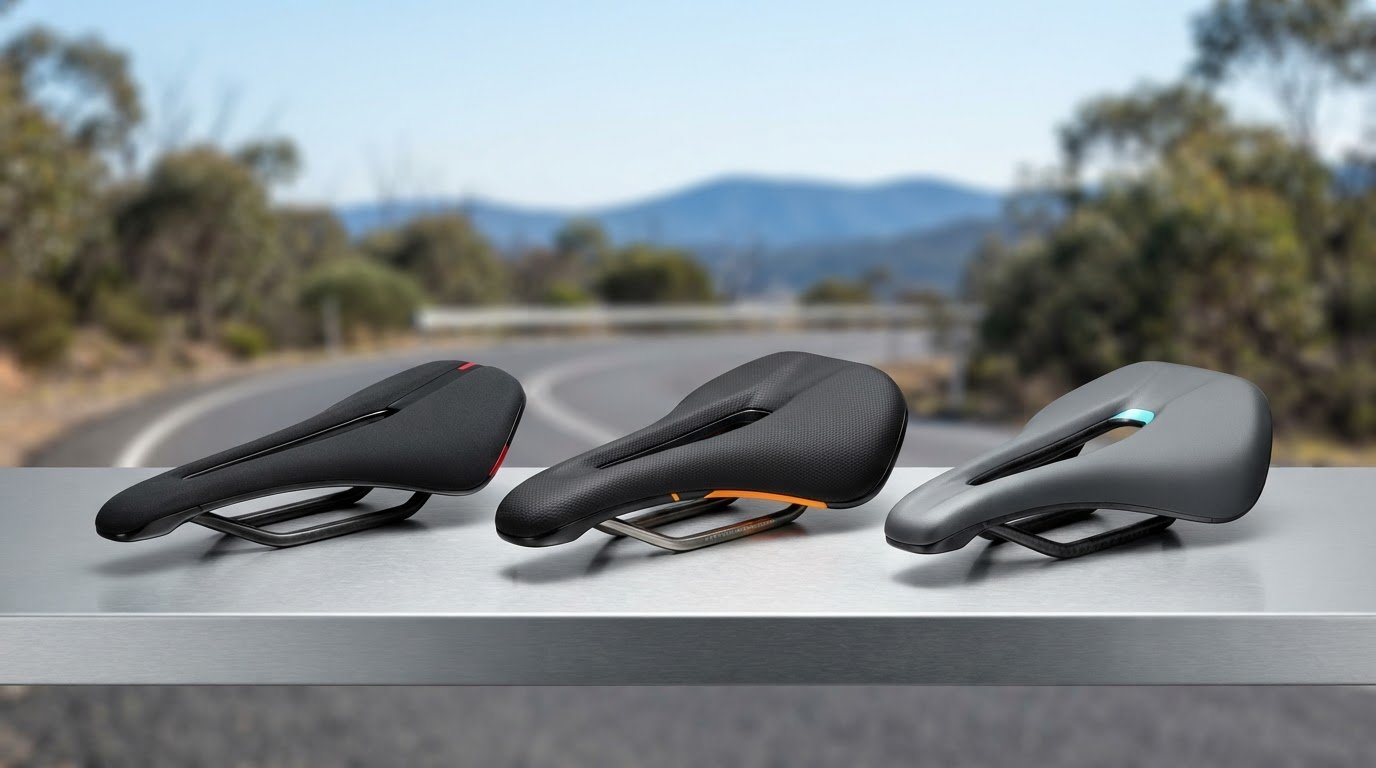
Oct
More padding doesn’t automatically mean more comfort on a long ride. Choosing a comfortable road-bike saddle for endurance cycling in Australia depends on your sit-bone width, riding position and how long you stay in one position. Performance saddles tend to have a lightweight, low-profile feel, while comfort-oriented designs are usually wider and more supportive.
That trade-off matters when pressure, numbness or discomfort distracts you from riding. To find a comfortable road-bike saddle for endurance cycling in Australia, compare saddle types and how padding, width, flat or curved profiles, short-nose designs and pressure-relief features affect comfort over distance. Match the saddle to your riding style, rather than choosing by cushioning alone.
Key Takeaways
- Match saddle type to your riding position and typical ride duration, not just the amount of cushioning.
- More padding isn’t always more comfortable; supportive foam and a suitable saddle shape matter on long rides.
- Use sit-bone width as a guide: a general rule is to choose a saddle 2 cm wider than your sit-bone measurement.
- Compare short-nose designs, cut-outs and relief channels to find features that suit your posture and pressure points.
- Assess performance saddles for long-duration comfort, weight and durable construction, then fine-tune saddle position for your ride.
Padding, foam and vibration absorption
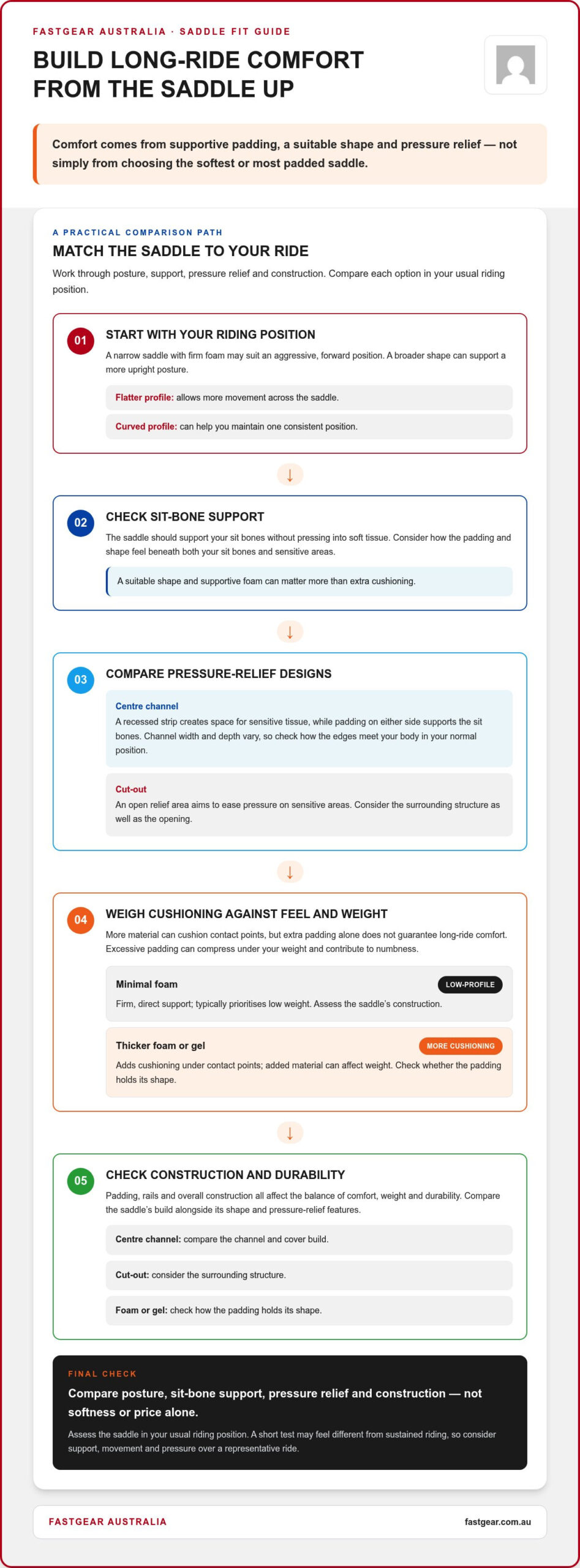
Endurance comfort comes from supportive padding, a suitable shape and pressure relief, not maximum cushioning. On long rides, consider how foam density, gel, channels and cut-outs feel beneath your sit bones and soft tissue.
Endurance saddles differ in long-ride comfort, weight and durability. Thicker foam or gel can add cushioning, while lighter, minimally padded designs prioritise low weight. Construction and rail material also affect the balance, so compare them alongside the padding.
Endurance Padding and Cut-Outs
Endurance saddles often have slightly thicker padding than racing saddles, and some add gel or a pressure-relief cut-out. These features aim to cushion contact points while easing pressure on sensitive areas. Compared with a minimal racing profile, they provide more material beneath the rider, but extra padding alone doesn’t guarantee comfort.
Excessive padding can compress under your weight and contribute to numbness. If you feel pressure during a long seated effort, a supportive shape or relief feature may help more than simply choosing a softer saddle.
Centre-Channel Padding Designs
A centre-channel saddle has a recessed strip through its middle instead of a fully padded surface. The channel creates space for sensitive tissue, while padding on either side supports the sit bones. Unlike a closed profile, this design targets pressure relief without relying on more foam across the saddle.
Channels vary in width and depth, so assess how their edges meet your body in your normal riding position. A narrow channel may feel different from a broad recess; the right option depends on where pressure builds during sustained pedalling.
Saddle Padding and Shape
Saddle shape determines where padding supports you. A flatter profile allows more movement across the saddle, while a curved shape can help you maintain a consistent position. Matching the profile to your posture can reduce discomfort without adding unnecessary bulk, unlike choosing by foam thickness alone.
A narrow saddle with firm foam may suit an aggressive position, while a broader shape can support a more upright posture. Expensive materials don’t automatically make a saddle comfortable; fit, support and pressure distribution matter most.
| Padding option | Long-ride comfort | Weight | Durability consideration |
|---|---|---|---|
| Minimal foam | Firm, direct support | Typically prioritises low weight | Assess the saddle’s construction |
| Thicker foam or gel | More cushioning under contact points | Added material can affect weight | Check how the padding holds its shape |
| Centre channel | Relieves central pressure | Depends on overall construction | Compare the channel and cover build |
| Cut-out | Creates an open relief area | Depends on saddle design | Consider the surrounding structure |
To compare options, start with your riding posture, then assess sit-bone support, pressure relief and construction. Don’t choose by softness or price alone.
What Are Road Bike Saddles Types?
Road saddle types range from minimal racing profiles to wider comfort designs, with flat and curved shapes in between. Choose according to your riding style, position and ride duration, then assess how each saddle supports your posture.
Endurance and Mixed-Terrain Saddles
Endurance saddles balance support and pedalling efficiency for longer road rides. Compared with minimal racing saddles, they may have more padding or pressure-relief features; touring models often prioritise sustained comfort. For gravel and mixed-terrain riding, a durable, rounded profile can accommodate movement as the surface and your position change. Match the shape to your usual route and how often you shift on the saddle.
In Australia in 2026, the best endurance option is the type that suits your sit-bone width, flexibility, riding position and typical ride duration. Compare supportive endurance designs with lightweight performance saddles rather than relying on a single universal “best” model.
Road and Other Riding Versatility
For mixed road and gravel riding, consider how stable the rear platform feels when you sit back and how easily you can move forward. Replace a saddle if its rails or shell are damaged, its cover exposes worn material, or it no longer supports you after fit adjustments.
Saddles for Different Riding Positions
Flat saddles suit flexible riders who move frequently or adopt an aggressive position. Curved saddles have a central dip and raised rear, supporting riders who prefer one consistent position. Wider comfort saddles can suit a more upright posture, while narrow performance designs accommodate a forward reach. For UCI-regulated racing, the minimum saddle length is 240 mm.
Set saddle height so your hips stay stable through the pedal stroke. Excessive height can cause hip rocking and knee pain, while a low setting can reduce pedalling efficiency and strain your knees. Start with the saddle level, then make small tilt changes. Adjust the fore-aft position to support your posture without forcing you forward.
On long rides, make one adjustment at a time and assess comfort in your usual position. A saddle that feels suitable during a short test may feel different after sustained riding, so compare support, movement and pressure over a representative ride.
Saddle widths and sit-bone measurement
Saddle width should support your sit bones without pressing into soft tissue. Measure your sit-bone distance, then use the 2 cm wider rule as a starting point for comparing sizes.
Saddle Sizing and Width
Saddle sizing begins with the distance between your sit bones, not your clothing size or the width of your current bike seat. A general rule is to choose a saddle 2 cm wider than your sit-bone measurement. That extra width helps place the sit bones on the supporting area instead of loading soft tissue.
To estimate your sit-bone distance, sit on firm corrugated cardboard on a hard, flat surface. Keep your posture similar to your usual riding position, then stand and measure between the centres of the two visible indentations. Repeat if the marks are unclear. Use the result to compare saddle widths, rather than assuming a wider model will always fit better.
Width changes how body weight meets the saddle. A model that’s too narrow can leave the sit bones without enough support, while excess width may rub the inner thighs during each pedal stroke. For example, if a rider’s measurement is 12 cm, the general rule points to a saddle about 14 cm wide. Treat that as a starting guide, then assess pressure and movement while riding.
Check the fit in your normal position, since an upright posture and a forward racing position load the saddle differently. If pressure falls on soft tissue or the saddle edges interfere with leg movement, compare another width. Sit-bone support should remain stable as you pedal, without making your hips rock or changing how your knees track.
Saddle Width and Length
Width describes the saddle’s support across your body; length describes its front-to-back profile. The two dimensions work together, but one doesn’t determine the other. A short-nose saddle can still have a broad rear platform, while a longer saddle can taper to a narrow nose. Compare both measurements with your posture and movement.
For example, a rider who rotates forward during racing may need rear space for sit-bone support and clearance at the nose. A rider who stays upright may prefer a shape that supports a consistent seated position. Don’t select a saddle by length alone: check where its widest support sits relative to your sit bones.
Use a simple comparison sequence: measure sit-bone distance, shortlist widths around the 2 cm guide, then compare each saddle’s length and profile. During a ride, note whether support stays under the sit bones and whether the nose causes rubbing. This process helps distinguish a width problem from a shape or position mismatch.
Short-nose saddles and pressure relief
Short-nose saddles and pressure-relief features target pressure in a forward road-cycling position. Compare saddle length, rear support and channel shape with how you sit and pedal.
Are cut-out or 3D-printed saddles more comfortable for long-distance cycling? Neither design is automatically more comfortable. Cut-outs and channels can reduce pressure, while fit and support still determine how a saddle feels over distance.
How can you test a saddle and assess its comfort before buying? Use a saddle demo programme or fitting service to compare options in your normal riding position. Assess pressure, stability and rubbing during a sustained ride, not just while sitting still.
Pressure-Relief Channels and Cut-Outs
A relief channel is a recessed track through the saddle’s centre; a cut-out is an open section. Both aim to reduce pressure on sensitive areas and may improve blood flow on long rides. A channel retains material across the saddle, while a cut-out removes it. Their shapes and edges feel different beneath the rider.
Compare each feature’s position with your pressure points. For example, a channel that’s too narrow or misaligned may not relieve the area causing discomfort. Check the feature in your usual forward position, then reassess after sustained pedalling.
Saddles with Pressure-Relief Cut-Outs
A cut-out saddle has an opening through its centre, unlike a closed profile or recessed channel. It may suit riders who feel concentrated pressure in that area, particularly when riding forward. The opening’s position and surrounding support matter: your sit bones still need stable contact while the saddle relieves pressure.
Short-nose saddles measure less than 260 mm; long-nosed designs measure more than 260 mm. A shorter nose and wider rear platform can reduce pressure in an aerodynamic posture. That differs from a mountain bike saddle, whose rounded profile supports movement over rough terrain.
Tested comfort depends on the interaction between the rider and the whole saddle, not one feature. A 3D-printed surface describes construction, but doesn’t by itself show whether the shape, width or pressure relief suits you. Compare it with a channel or cut-out model using the same riding position and similar effort.
During a demo, check whether you stay stable when reaching forward, then note any pressure or rubbing as you pedal. A relief feature should address your pressure points without creating discomfort at its edges. Repeat the assessment on a longer ride, since a brief test may not reveal pressure that builds over time.
Choose the design that relieves your specific pressure point while keeping support consistent. A cut-out, centre channel or shorter nose is a feature to assess, not a substitute for a suitable fit.
Performance saddles for road cycling
Performance saddles prioritise pedalling efficiency and low weight over soft cushioning. For endurance rides, the right design still needs stable support, suitable pressure relief and a profile that works with your riding position.
A racing saddle is usually narrow and minimally padded, reducing bulk during intense efforts. That profile can suit riders who hold an aggressive, forward posture. It may feel firm over longer rides, so assess sit-bone support and pressure rather than assuming less padding always means discomfort.
Your posture changes how the saddle contacts your body. Rotating forward can increase pressure around soft tissue, while a more upright position shifts support towards the rear. Choose a profile that lets you move naturally without sliding forward or feeling the saddle’s edges against your thighs.
Rail material affects the balance between affordability, weight and vibration damping. Steel, titanium and carbon rails offer different combinations of these characteristics. Carbon can prioritise low weight, while steel can suit riders focused on affordability. Compare rail material with the saddle’s shell, shape and construction, rather than treating it as a stand-alone measure of comfort.
Performance doesn’t mean choosing the lightest option at any cost. A well-matched saddle supports your body and distributes your weight as you ride. If its profile concentrates pressure or makes you shift repeatedly, it can disrupt a steady effort. A quality chamois can also improve comfort on a minimally padded road saddle.
Set up the saddle carefully before judging its performance. Start with it level, then make small tilt adjustments. Excessive nose-down tilt can make you slide forward and fatigue your hands. Check saddle height and fore-aft position, too: a high saddle can cause hip rocking and knee pain, while a low one can strain your knees and reduce pedalling efficiency.
Compare performance using consistent criteria. Reviews assign 30% weighting each to comfort and performance, and 20% to versatility when calculating overall saddle scores. For your own assessment, also consider long-duration comfort, weight, construction and durability. A road saddle designed for a single aggressive position may feel different from one used across road and mixed-terrain rides.
The takeaway is direct: prioritise fit and support, then weigh material, weight and profile against your riding demands. Compare road saddle options to explore a performance-focused design for road cycling.
Fastgear Australia: Compressport Trail Racing SS Tshirt
Fastgear Australia offers the Compressport Trail Racing SS Tshirt for athletes building their endurance-racing kit. Saddle fit is a separate decision: use your riding position, sit-bone support and pressure points to guide your choice. Apparel and fuelling products can complement your preparation without changing what the saddle needs to do.
For event-day essentials, Fastgear Australia also stocks GU Energy Gel – Single, Clif – BLOKS Energy Chews and Compressport Free Belt Pro. Consider these gels, chews and belt alongside your apparel and equipment plans.
Choose your saddle around fit and comfort, then explore Fastgear Australia’s endurance gear for your wider race setup. Contact Fastgear Australia to discuss its range.
Make your next ride a useful test
Turn a familiar route into a practical saddle check. Notice when discomfort begins, whether you shift position and how the saddle feels after the ride. Keeping a brief record across several rides can help distinguish a fit issue from a one-off response to effort, terrain or posture. Change one setup factor at a time so you can judge what makes a difference.
Choosing a comfortable road bike saddle for endurance cycling in Australia is a personal equipment decision, not a contest for the softest or lightest design. If you’re considering a road saddle, Fastgear Australia offers the Wove M8 Road / Tri Saddle as an option to explore alongside the needs you’ve identified.
Contact Fastgear Australia for saddle help and take your next step with a clearer idea of what you need. Keep testing thoughtfully, stay focused on your riding, and build towards more comfortable kilometres.
Frequently Asked Questions
What’s the Best Value?
Best value means choosing a saddle that fits your riding needs and provides suitable support, not simply picking the cheapest option. Compare construction, rail material and durability alongside fit. For example, a rider planning long road outings may prioritise stable support over a racing saddle’s minimal weight. A saddle that suits your posture and typical rides is more useful than extra features that don’t address your discomfort.
Why Saddle Choice Matters?
Saddle choice affects how steadily you can ride and where your body weight is supported. A mismatch can contribute to discomfort, numbness, saddle sores, lower back discomfort or knee pain. Repeatedly shifting to escape pressure, for example, can interrupt a consistent pedalling position. Treat the saddle as part of your complete bike setup: riding posture, clothing and saddle position all influence how the contact points feel.
How do you choose the right road bike saddle width and shape?
Start with your sit-bone measurement, then compare saddles that support those points without interfering with leg movement. A comfortable road bike saddle for endurance cycling in Australia should also suit your usual posture, not just your measurement. For example, compare a flatter profile if you move around frequently, or a curved profile if you stay in one position. Assess the shape in your regular riding kit and position.
What do road bike saddles cost in Australia, and where can you buy them?
Road saddle prices vary with materials, rails and construction, so compare the features and fit rather than relying on one price as a value guide. Fastgear Australia sells the Wove M8 Road / Tri Saddle through its online store. You can view the current product listing there for the price and product details. Before choosing, consider whether its road and triathlon focus matches your riding position and intended use.
What causes saddle pain or numbness on long road rides, and how can it be prevented?
Pressure from a poorly matched saddle or setup can contribute to pain and numbness on long rides. Track when discomfort begins and whether it changes with posture, pedalling or saddle position. Keep your riding clothing consistent while assessing the setup, so you can identify patterns. Make one adjustment at a time, then compare how the next ride feels. This gives you clearer feedback than changing several parts at once.
What are the best endurance road bike saddles available in Australia in 2026?
The best option is an endurance saddle that matches your sit-bone width, flexibility, riding position and typical ride duration. Compare supportive designs with lightweight performance saddles, and assess pressure relief rather than choosing by cushioning alone.
How do popular endurance saddles compare for comfort, weight, and durability?
Endurance saddles vary in long-ride comfort, weight and durability. Thicker foam or gel adds cushioning, while lighter, minimally padded designs prioritise low weight. Compare construction and rail material, and check whether the padding holds its shape.
