
Uncategorized
Carbon Rail Triathlon Saddle Australia: How to Choose the Right Fit
Sep
A carbon rail triathlon saddle can look like an easy upgrade, but the material alone won’t tell you whether it suits your riding position or your bike. If you’re searching for a carbon rail triathlon saddle in Australia, check the clamp’s compatibility with the rail shape as carefully as the saddle’s weight and construction.
It’s reasonable to expect a premium component to feel better or help you ride faster. Carbon rails may reduce weight, but they don’t guarantee greater comfort or performance. Saddle shape, width, pressure support and your forward position all affect fit, while the rail dimensions determine whether your seatpost clamp is suitable.
This guide gives you a practical way to compare those factors before you buy. You’ll learn what carbon rails may offer, what they can’t promise, and which saddle-fit and compatibility details to check against your bike’s specifications. Fastgear Australia lists the Wove M8 Road / Tri Saddle as an option to investigate. Confirm its current rail material and technical details before treating it as a carbon-rail model.
Key Takeaways
- Compare rail material separately from saddle-shell construction.
- Assess saddle shape, adjustment range and riding position together, rather than choosing by material alone.
- Before buying a carbon rail triathlon saddle in Australia, confirm its rail dimensions match your exact seatpost clamp.
- Follow the saddle and seatpost manufacturers’ installation instructions, including their torque guidance.
- Explore Fastgear Australia’s Wove M8 Road / Tri Saddle, and verify its current specifications before assuming it has carbon rails.
Carbon rail triathlon saddles: what the material means for your ride
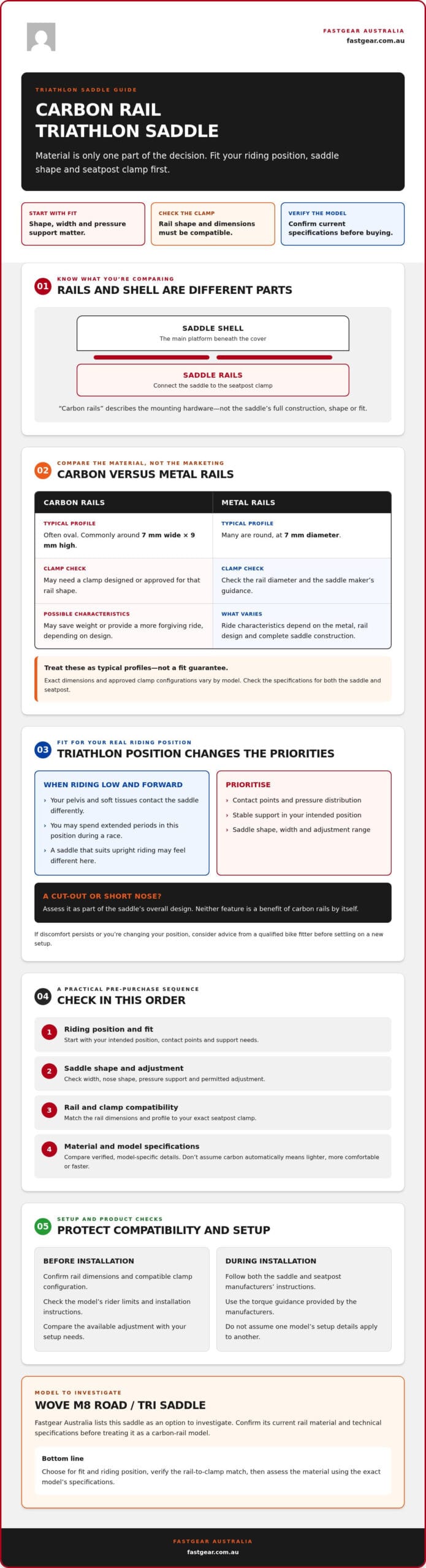
Rails connect a saddle to the seatpost clamp. They’re separate from the saddle shell, which forms the main platform beneath the cover. The Bicycle saddle overview describes these as distinct parts of a saddle assembly. That distinction matters: carbon rails describe the mounting hardware, not the saddle’s full construction or fit.
When comparing a carbon rail triathlon saddle Australia option, start with your riding position and the saddle shape that supports it. Then confirm that the rail profile works with your seatpost clamp. Fit and compatibility come before material preference.
What carbon rails change, and what they don’t
Rails secure the saddle in the seatpost clamp and allow position adjustments within the limits set by the saddle and seatpost. Carbon can offer a weight-saving alternative to metal rails, and some designs may provide a more forgiving ride. Neither result is guaranteed by the word “carbon”. The effect depends on the rail design and the complete saddle construction.
Carbon rails don’t determine saddle width, nose shape or pressure relief. The material alone also can’t tell you how durable a particular saddle is, whether it will feel comfortable or whether it will make you faster. Check the exact model’s specifications, including rail dimensions, compatible clamps, rider limits and installation instructions. Don’t assume details from one carbon-rail saddle apply to another.
Why triathlon position changes saddle priorities
A forward-rotated aero position changes how your pelvis and soft tissues contact the saddle. You may also spend extended periods in that position during a race. A saddle that feels suitable when you’re upright may provide different support when you’re riding low and forward. Prioritise contact points, pressure distribution and stable support in your intended triathlon position.
These are questions of fit and shape, not rail material. Assess a cut-out or short nose as part of the saddle’s overall design rather than assuming it’s a benefit of carbon rails. If discomfort persists or you’re changing your position, consider advice from a qualified bike fitter before settling on a new setup.
Fastgear Australia lists the Wove M8 Road / Tri Saddle, but confirm its current rail material and technical specifications before treating it as a carbon-rail model. For a confident carbon rail triathlon saddle Australia shortlist, verify the product details and compare them with your position, fit needs and seatpost.
Carbon versus metal saddle rails: compare the details before buying
Carbon and metal rails are worth comparing, but neither material tells you whether a saddle suits your body or your bike. Start with published specifications: the rail profile, compatible clamp, saddle shape and manufacturer’s setup guidance. For a broader overview of saddle rail materials explained, consider how design and construction vary between models.
| Comparison point | Carbon rails | Metal rails |
|---|---|---|
| Typical profile | Often oval, but check the specific model’s dimensions. | Often round, though dimensions and profiles vary by model. |
| Clamp compatibility | May require a clamp designed or approved for that rail shape. | Check that the clamp suits the rail diameter and the saddle maker’s guidance. |
| Weight and ride feel | May offer weight savings or a more forgiving ride, depending on design. | Characteristics vary with the metal, rail design and complete saddle construction. |
| Saddle shape and adjustment | Not determined by rail material. Check the saddle’s shape and permitted adjustment. | Also determined by the specific saddle and its instructions, not simply by material. |
These are general design tendencies, not specifications for every product. Carbon rails are commonly oval, around 7 mm wide by 9 mm high, while many metal rails are round at 7 mm diameter. Treat these as typical profiles, not a fit guarantee. Confirm the exact dimensions and approved clamp configuration for the saddle and seatpost you plan to use.
Which rail material suits your priorities?
For a carbon rail triathlon saddle Australia shortlist, prioritise your established fit and intended riding position before choosing a material. A lighter rail may matter if reducing component weight is a goal, but compare verified, model-specific figures rather than assuming every carbon option is lighter or faster. Your seatpost, clamp and available adjustment can quickly narrow the options.
What to check in a carbon rail comparison
- Rails: Find the manufacturer-listed profile and dimensions.
- Clamp: Confirm that your exact seatpost model and clamp configuration are approved.
- Fit: Compare the published saddle shape and intended riding position with your setup.
- Adjustment: Check the permitted saddle position and installation instructions.
- Unknowns: Treat missing details as unverified. Don’t fill gaps with assumptions based on another model.
Let saddle fit and clamp compatibility guide your material choice, not price or material prestige alone. Fastgear Australia lists the Wove M8 Road / Tri Saddle. You can explore Fastgear Australia’s triathlon saddle offering and check the current product details before adding it to a carbon-rail comparison.
Will a carbon rail triathlon saddle fit your seatpost and riding position?
A saddle can suit your triathlon position and still be incompatible with your seatpost clamp. Check both before ordering. Carbon rail designs and clamp systems vary, so don’t rely on the product category, a similar-looking bike or the clamp’s appearance as proof of fit. Confirm the requirements for the exact saddle and seatpost models you plan to use.
Check the rail clamp before ordering
Start with the saddle manufacturer’s rail specifications, then compare them with the seatpost manufacturer’s clamp requirements. Confirm that the clamp is approved for the rail’s shape, dimensions and material. Some posts use interchangeable clamp parts, but use only a configuration permitted by the manufacturer. If either set of instructions is unclear or the specifications conflict, ask the saddle or seatpost manufacturer before buying or installing the saddle.
- Identify the exact seatpost: Record its model and check the manufacturer’s documentation. Don’t assume all posts from the same brand use the same clamp.
- Match rail details: Compare the saddle’s published profile and dimensions with the clamp’s approved specifications.
- Check installation requirements: Follow the instructions for the specific saddle and post. Don’t substitute generic advice or guess a torque value.
- Confirm the setup range: Make sure the clamp arrangement allows the saddle to sit in your intended position within the manufacturers’ stated limits.
Assess fit in your actual triathlon position
Clamp compatibility tells you whether the saddle can be mounted correctly. It doesn’t tell you whether it will support your body comfortably. Assess the saddle in the position you’ll use on the bike, including your forward rotation, contact points and time in the aero position. Notice where pressure builds and whether you can maintain a stable position without shifting to escape discomfort.
Rail material doesn’t determine saddle width, nose shape or pressure distribution. A carbon upgrade can’t correct a saddle that doesn’t suit your anatomy or position. If you change saddle height, fore-aft placement or your overall position, assess each adjustment carefully. Persistent pressure or pain is a reason to seek guidance from a qualified bike fitter rather than continuing to adjust by guesswork.
For a carbon rail triathlon saddle Australia purchase, follow this order: establish your riding position, assess saddle fit, verify clamp compatibility, then check the installation instructions. Fastgear lists the Wove M8 Road / Tri Saddle. Verify its current specifications before deciding whether it matches your seatpost or belongs on a carbon-rail shortlist.
Carbon saddle rail installation and care: protect compatibility and setup
A suitable saddle can still be a poor choice if it’s installed with an incompatible clamp or incorrect setup. Treat installation as a sequence, not trial and error: confirm the components are approved for use together, follow their instructions, set your position, then recheck the assembly. This matters for any saddle, especially when the rail profile requires a specific clamp configuration.
Install using the exact manufacturer instructions
Before loosening the clamp, read the instructions for both the saddle and seatpost. Check that the post’s clamp is approved for the rail material and profile, and note any specified hardware, tools or installation steps. Don’t substitute a standard clamp part, force the rails into place or improvise a fix if the components don’t match. Incorrect clamping can damage components or leave the saddle insecure.
For safety, use the manufacturer’s torque specifications for your exact saddle and seatpost components. There’s no universal torque value for every setup. If instructions are missing, conflict or leave you unsure about the clamp assembly, pause and contact the manufacturers or ask a qualified bicycle mechanic to assess the installation.
Recheck setup after fitting or adjustment
Once installed, confirm the saddle is in your intended position and the clamp is secure, following the manufacturers’ checks. Recheck after any adjustment or refitting. Don’t assume the clamp is secure because it looks aligned. Use the specific inspection method in the product instructions.
- Inspect before riding: Look for visible damage to the rails, clamp and surrounding components.
- Stop if something looks wrong: If you suspect damage or notice movement, don’t ride until the setup has been assessed.
- Keep care product-specific: Use only cleaning products and maintenance methods recommended by the manufacturer. Avoid solvents, repair attempts or other treatments unless the instructions explicitly allow them.
For a carbon rail triathlon saddle Australia setup, preserve the saddle’s position as well as its compatibility. If you change the position, stay within the manufacturers’ stated limits, then reassess how it feels in your triathlon posture. Persistent discomfort calls for a fit review, not repeated clamp changes.
Fastgear lists the Wove M8 Road / Tri Saddle. Explore the Wove M8 Road / Tri Saddle and check its current product details before confirming compatibility with your seatpost.
Choosing a carbon rail triathlon saddle in Australia: shortlist and next steps
A useful shortlist starts with your position, not a material label. Record how you ride, what isn’t working with your current saddle and the exact seatpost model on your bike. Then remove options whose published rail or clamp specifications don’t match. Compare the remaining saddles using verified details rather than filling gaps with assumptions.
Build a practical saddle shortlist
- Define your setup: Note your intended triathlon position and any current pressure points, discomfort or stability concerns.
- Identify your seatpost: Use the exact model to check its clamp requirements and approved rail configurations.
- Filter for compatibility: Set aside options whose rail dimensions or clamp requirements don’t match, or can’t be confirmed.
- Compare fit and material: Review the published shape, intended riding position and rail material. Treat missing specifications as unverified.
- Check product support: Look for clear manufacturer installation guidance and confirm who to contact if a compatibility detail is unclear.
This sequence keeps the decision grounded: riding position first, fit next, then clamp compatibility, verified material and product support. A carbon rail triathlon saddle in Australia may suit your priorities, but carbon alone doesn’t confirm that it will fit your bike or feel right in your aero position. Keep your shortlist focused on options that work with your actual setup.
Explore Fastgear’s confirmed triathlon saddle option
Fastgear Australia lists the Wove M8 Road / Tri Saddle as part of its triathlon equipment offering. Check the current product specifications for its rail material, dimensions and other technical details. Don’t assume it’s a carbon-rail model. Verify those details before comparing it with saddles that have confirmed carbon rails.
Once you’ve recorded your riding position, fit priorities and seatpost model, you’ll have a clear basis for evaluating the Wove M8 and other suitable options. If a specification isn’t published or clamp compatibility is unclear, verify it before ordering. That final check helps align your choice with both your position and your bike.
Ready to continue your shortlist? Explore Fastgear’s saddle offering and review the current Wove M8 Road / Tri Saddle details before deciding whether it meets your requirements.
Make your next saddle choice with confidence
The right saddle choice starts with your triathlon position and how the saddle supports you there. Carbon rails may offer material-specific benefits, but they don’t guarantee comfort, speed or a better fit. Before choosing a carbon rail triathlon saddle Australia option, verify its specifications and confirm the rails and clamp are compatible with your exact seatpost.
Installation matters too. Follow the saddle and seatpost manufacturers’ instructions, including their torque guidance, and seek qualified help if compatibility or setup is unclear. These checks turn a material comparison into a decision based on fit, safe installation and your actual riding requirements.
Fastgear specialises in triathlon equipment and endurance sports gear, and lists the Wove M8 Road / Tri Saddle. Check the current product details, including rail material and technical specifications, before deciding whether it suits your setup. Explore Fastgear’s triathlon saddle range and review the Wove M8 as you narrow your options.
Frequently Asked Questions
Are carbon rail saddles suitable for triathlon?
Yes, carbon-rail saddles can be suitable for triathlon if their shape supports your riding position and their rails are compatible with your seatpost clamp. Carbon describes the rail material, not the saddle’s fit or intended use. Check the saddle’s published specifications, including its intended riding position and approved clamp configuration. A carbon model that doesn’t suit your position or fit your bike isn’t the right choice.
Are carbon saddle rails stronger than aluminium rails?
There’s no universal answer. Strength depends on the specific rail design, construction and manufacturer’s limits, so material labels alone can’t establish which saddle is stronger. Don’t assume carbon is stronger than aluminium, or that aluminium is automatically more durable. Compare the model-specific specifications and rider limits, and use only a clamp configuration approved by the saddle manufacturer. Use product documentation rather than guesswork.
Will carbon saddle rails fit my existing seatpost?
Possibly, but compatibility depends on the exact rail profile and dimensions, as well as the seatpost’s clamp design. Some carbon rails are oval, while many metal rails are round, so a clamp made for one profile may not suit another. Check the saddle specifications against the instructions for your exact seatpost model. If compatibility isn’t clearly confirmed, ask the saddle or seatpost manufacturer before ordering.
Do carbon rails make a triathlon saddle more comfortable?
Not necessarily. Carbon rails may affect weight or ride feel, depending on the design, but they don’t determine saddle width, nose shape or pressure distribution. Comfort depends on how the saddle’s shape supports you in your riding position. Assess the saddle in your triathlon posture, not just by its material. If discomfort persists or a position change causes pain, consider a qualified bike fitter.
How do I install a carbon rail triathlon saddle safely?
First confirm that the saddle rails and seatpost clamp are approved for use together. Read the instructions for both components, then use the specified tools and installation method. Follow the manufacturers’ torque specifications for your exact saddle and seatpost, as there’s no universal value. Don’t force an incompatible clamp or improvise a repair. If the instructions are unclear, have a qualified bicycle mechanic assess the setup.
Does the Wove M8 Road / Tri Saddle have carbon rails?
Fastgear Australia lists the Wove M8 Road / Tri Saddle, but its rail material, dimensions and other technical specifications should be checked against the current product details. Don’t assume it’s a carbon-rail model based on its name or triathlon use. Verify the manufacturer’s specifications before comparing it with carbon-rail saddles or checking compatibility with your seatpost.
What should I compare when buying a triathlon saddle in Australia?
Start with your riding position and fit needs, then compare saddle shape and published specifications. Check rail material, dimensions, clamp compatibility and installation guidance against your exact seatpost. A search for “carbon rail triathlon saddle australia” can help you find options, but material alone doesn’t establish comfort or suitability. Confirm current product details before buying, and seek fit advice if discomfort continues.
