
Uncategorized
Liquid Energy Drink Mix for Ultra Runners: How to Choose in 2026

Oct
The highest-carb bottle isn’t automatically the best choice. The right liquid energy drink mix for ultra runners needs to fit your gut, water access, carrying capacity and overall fuelling plan, not just promise more fuel per serve.
It’s easy to confuse an energy drink mix with an electrolyte drink, particularly when you’re also working out how much to carry and how to keep drinking over long distances. Concentration matters too: a mix that works in one bottle setup may not suit your tolerance or the gels and chews you use alongside it.
This guide compares drink mixes by fuelling role, concentration, portability and tolerance, with examples from Fastgear Australia’s range, including Tailwind powder and Maurten 160 and 320 powders. You’ll learn how to assess each option, fit drink mix around gels, chews and water, and test a practical approach in training before race day.
Key Takeaways
- Separate fuel from hydration when comparing labels, so you can see what each drink contributes to your plan.
- Assess a liquid energy drink mix for ultra runners by its fuelling role, preparation demands, portability and how it sits during training.
- Use product directions to guide mixing, then consider how the amount of powder and liquid changes the drink’s concentration.
- Map water access, carrying capacity and refill opportunities before deciding how drink mix fits with gels, chews and water.
- Compare options such as Tailwind powder and Maurten powders, then refine your choice through training rather than relying on race-day guesswork.
Why liquid energy drink mix can suit ultra runners
A liquid energy drink mix lets you carry and consume some planned fuel as a prepared drink. Instead of taking all your fuel as gels or chews, you can sip a mix from a bottle or flask when it suits your race plan. For ultra runners, that can work well when drinkable fuel fits their preferences, course logistics and tested tolerance.
An overview of ultramarathons gives a sense of the varied distances and formats involved. There’s no single fuelling setup for every course. The practical question is where a drink mix fits in your system, not whether it should replace every other format.
When drinkable fuel may fit an ultra plan
Drinkable fuel may be practical on a long training run when you already carry a flask, or on a race section with a long gap between aid stations. It may also suit runners who prefer sipping fuel instead of taking gels or chews at set intervals. Decide based on what feels manageable, what the course provides and what you’ve tested in training.
Energy, hydration and electrolytes are different jobs
Carbohydrate provides fuel; fluid is a resource for hydration. A drink mix can contribute both, but electrolyte content varies by product. Check the current label rather than assuming every mix does the same job. A fuel drink isn’t automatically a complete hydration or electrolyte plan. For more context, see our electrolytes for athletes guide.
Build your decision around four practical constraints:
- Race duration: Consider how long you’ll be moving and how drink mix could sit alongside your other planned fuel.
- Fluid access: Map aid stations, refill points and sections where you’ll need to carry your own drink.
- Personal tolerance: Use training to assess whether the mix’s taste and concentration work for you while running.
- Carrying capacity: Account for the bottles or flasks you can carry and the space your other gear and fuel need.
A mix doesn’t automatically replace plain water, separate electrolyte products or solid and semi-solid fuel. Depending on the product and your plan, you may still use water to meet fluid needs, or gels and chews to provide fuel in another format. Treat each as part of the overall setup rather than assuming one bottle covers every need.
Start with the course and your preferred way to take fuel. Then test the combination of drink, water and other formats on comparable training runs. Note how much you can carry, where you can refill and how the setup feels to use. That gives you practical feedback before race day and helps avoid a last-minute change.
How liquid energy drink mixes deliver fuel during long runs
A powdered drink mix becomes drink-based fuel when combined with liquid according to the product directions. The prepared drink lets you carry some planned fuel in a bottle or flask and consume it while moving. Its contribution depends on the product and how you prepare it, so don’t assume every mix delivers the same amount of carbohydrate or electrolytes. For a liquid energy drink mix for ultra runners, the label is the starting point for comparing options.
Drink-mix concentration is the amount of powder relative to the liquid used to prepare it. More powder in a given volume makes a more concentrated drink; more liquid makes it more diluted. That affects how much fuel each sip carries, but concentration alone doesn’t tell you how much sodium or other electrolytes the drink contains. Assess energy and electrolyte information separately.
What to check on a drink-mix label
Start with the serving size and carbohydrate information, then read the preparation instructions closely. Check whether the figures apply to a serving, a prepared drink or another basis, and note the recommended liquid volume. Review electrolyte information separately rather than inferring it from carbohydrate or energy content. Use the current Australian product label for figures, as packaging and product details can change.
For a useful comparison, record the details that affect your setup:
- Serving basis: Identify how much powder counts as a serve and what the listed nutrition information applies to.
- Carbohydrate: Note the stated amount per serving, then consider how it fits your wider fuelling plan.
- Electrolytes: Check the listed details independently. Don’t treat a carbohydrate figure as a guide to electrolyte content.
- Preparation: Follow the label’s mixing directions and note the liquid volume they specify.
Concentration, flavour and gut tolerance
Concentration changes with both powder quantity and liquid volume. A stronger-tasting drink may be less appealing to sip repeatedly, while a more diluted preparation changes how much fuel each sip carries. Your response is individual, so assess the drink you plan to use, not just its nutrition panel. Follow the product directions rather than improvising a concentrated mix for race day.
Flavour and drinkability can matter over repeated hours on course. A mix you tolerate early in a run may feel different later, especially when you’re also using gels or chews. Practise the intended preparation during training. Notice how it tastes at your planned drinking pace and how it fits alongside other fuel and water. If you adjust the preparation, change one thing at a time and repeat the test so you can judge what made a difference. This helps you assess whether a liquid energy drink mix for ultra runners fits your routine.
Compare options such as Tailwind powder and Maurten 160 or 320 powder by checking their current labels and preparation directions, not by relying on the product name alone. For a practical next step, compare endurance drink-mix options as part of your fuelling setup, then test your chosen preparation before race day.
Compare liquid energy drink mix options for ultra running
Compare formats by what you’ll carry, how you’ll consume them and what the current label says. The table is a starting point, not a universal ranking. Check the Australian pack directions and nutrition panel for the exact product you’ll use, then assess taste and preparation during training.
| Format or example | Carbohydrate information | Electrolyte information | Preparation and portability | Taste |
|---|---|---|---|---|
| Tailwind powder | Check the current label for serving size and carbohydrate content. | Review the label separately for electrolyte details. | Prepare according to pack directions; plan how to carry powder or a prepared drink. | Assess flavour and drinkability in training. |
| Maurten 160 powder | Research-verified information lists 40g carbohydrate per serving. | Research-verified information lists 400mg sodium per serving. | Follow the current Australian pack’s mixing directions and account for bottle space. | Test the prepared drink over a comparable run. |
| Maurten 320 powder | Research-verified information lists 80g carbohydrate per serving. | Research-verified information lists 200mg sodium per serving. | Check serving and preparation directions; plan how the prepared drink fits your carry setup. | Test flavour and tolerance rather than assuming it suits you. |
| Gels and chews | Use each product’s label to account for its carbohydrate contribution. | Check the label; don’t assume electrolyte content. | Carry and consume as directed, without mixing into a drink unless the product instructions say so. | Try them in training as part of your overall format mix. |
The best format depends on your plan and logistics, including what’s comfortable to carry, prepare and consume on course.
Powdered drink mix versus gels and chews
A drink mix is prepared in liquid and consumed by sipping. Gels and chews are separate delivery formats with their own serving directions. The practical differences include how you carry them, access them while moving and organise your planned intake around water and refills. Some runners use more than one format when the combination has been tested and suits the race plan. For format-specific considerations, see this energy gels versus chews comparison.
Compare listed powders without assuming they are interchangeable
Fastgear’s listed examples include Tailwind powder and Maurten 160 and 320 powders. The Maurten figures above are a comparison prompt, not a substitute for checking the current Australian label. Product numbers and brand names don’t tell you how to prepare a serving or whether its taste and concentration work for you. Compare the actual directions and nutrition panels, then test each intended preparation in training. This Maurten 160 and 320 powder comparison provides further context for assessing those options.
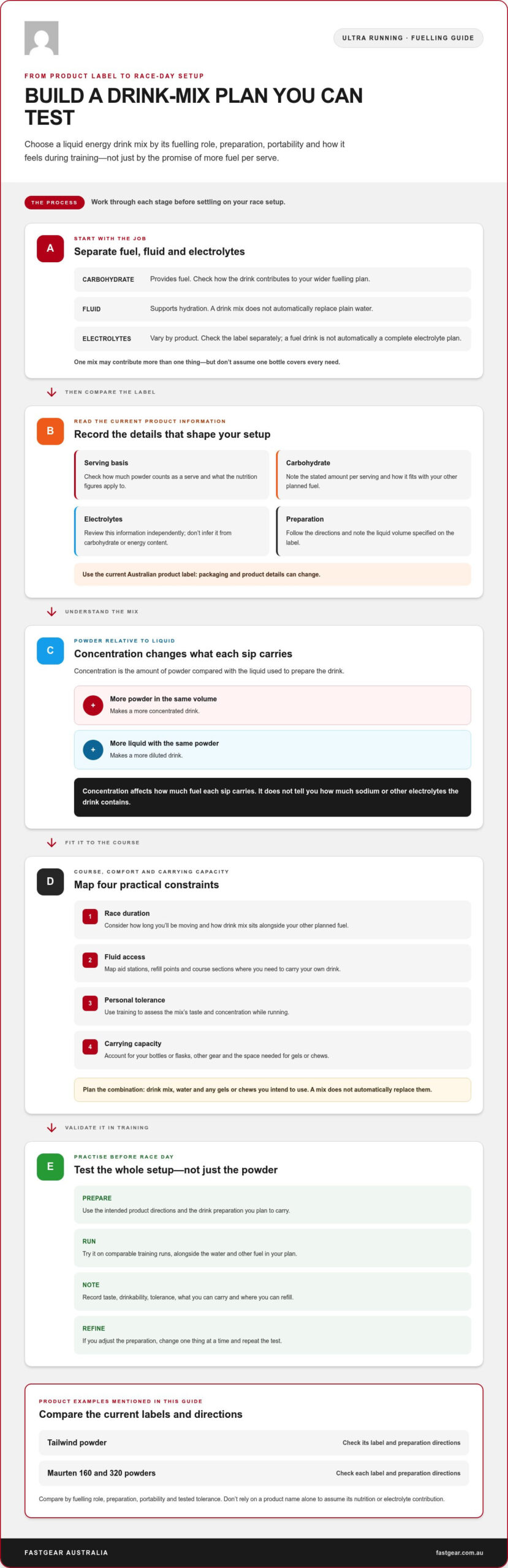
Build and test your liquid fuelling plan before race day
A drink mix belongs in your race setup only if you can prepare, carry and tolerate it under realistic conditions. Build the plan around the course, then use training runs to find practical snags before they matter. Keep the product directions in view, and treat the label as product information, not an individualised race-day prescription.
- Review the race format. Map expected aid-station gaps, refill opportunities, terrain and conditions. Note where you’ll have access to water and where you may need to carry enough fluid for a longer stretch.
- Choose a preparation method. Decide whether to start with a prepared bottle or flask, carry powder for a later refill, or use another approach permitted by the product directions. Match the method to your carrying capacity.
- Test the setup. Use the same bottle, flask or vest arrangement you expect to race with. Practise preparing and drinking the mix during a suitable long session.
- Refine the plan. Review your notes after each test. Change one thing at a time, such as preparation, timing or how the mix fits beside other fuel, so you can interpret your response more clearly.
Trial the mix in realistic training conditions
Rehearse the planned concentration and drinking pattern, not just a quick taste before a run. Use your intended gear and practise any refill routine. After each session, record the product, dilution, timing, conditions and any tolerance issues, including whether the flavour stayed appealing. Change one variable per trial where possible; otherwise, it’s harder to tell what influenced your experience.
Keep the record simple and consistent. Note what you drank, when you drank it, how much water was available and whether the carrying setup was easy to manage while moving. Mark any change to the mix or its preparation. Comparable training sessions can give you more useful information than one test where several parts of the plan changed at once.
Coordinate drink mix with the wider race plan
Map each drink opportunity against your planned gels, chews or other fuel, as well as the course’s water access. This helps you identify where formats overlap and where a refill or carrying capacity may become a constraint. Conditions can also affect logistics, so use the ultramarathon hot-weather fuelling guide when considering a plan for warmer conditions.
Keep the plan flexible enough to respond to what you’ve practised, but don’t introduce an untested preparation on race day. If medical or dietary needs affect your fuelling choices, seek advice from a suitably qualified sports nutrition professional. To compare options for your training trials, explore endurance drink mixes.
Choose your ultra drink mix from Fastgear’s endurance range
Make your final choice from evidence gathered in training, not a product name or a promise of what might work. For a liquid energy drink mix for ultra runners, compare the current label, the role you want it to play, preparation directions, how it fits your carrying setup and your tested tolerance. Those criteria turn a broad choice into a practical race decision.
Fastgear Australia’s endurance range includes Tailwind powder and Maurten 160 and 320 powders. They’re options to assess, not universal recommendations. Check each product’s current Australian label for serving and nutrition information, then follow its preparation instructions. Compare like with like: note what each serving contributes and how the instructed preparation fits your bottles or flasks. Don’t assume products are interchangeable based on brand or product number.
Match the product format to your race setup
Start with the course logistics. Consider how much prepared drink you can carry, where you can refill and whether preparing a fresh mix at an aid station is realistic for your setup. If you prefer drinkable fuel, work out how it fits alongside any gels or chews you’ve practised using. Your mix should slot into the plan without leaving you guessing about water access or carrying capacity.
Use your training notes to compare your shortlist. Look for a preparation you can reproduce, a flavour you can keep drinking and a format that fits your kit. If the powder’s directions or serving information don’t match the way you intend to carry and prepare it, revisit your setup before race day. Consider the product instructions alongside your own practice results.
Take the next step with a tested fuelling choice
Before settling on a mix, review what happened during training: which product you used, how you prepared it, when you drank it, the conditions and any tolerance issues. Compare those observations with the current product directions and your race plan. A label describes the product; it doesn’t prescribe an individual fuelling strategy. For broader context on fitting drink mix into a wider plan, explore this endurance sports nutrition guide.
Choose the option you’ve practised and keep the race setup straightforward. Fastgear Australia brings drink powders together with gels and chews, so you can compare formats as parts of your endurance fuelling toolkit. Shop endurance nutrition at Fastgear Australia and select an option to assess against your tested plan.
Turn your tested setup into race-day confidence
Use your training notes to make a clear race-day checklist: which mix you’ve practised, how you’ll prepare it, where you’ll refill and how it fits with your other planned fuel. Keep the product’s current instructions close at hand. If the course plan or conditions change, revisit the setup rather than relying on memory or improvising with an untested preparation.
The right liquid energy drink mix for ultra runners isn’t simply the one with the boldest claims. It’s the option you’ve tested and can fit into your race logistics. Make the practical decisions before the start so you have a plan you understand and can execute.
Ready to put your shortlist together? Compare endurance drink mixes at Fastgear and choose an option to assess against your training-tested setup. Take that clarity to the start line and run your plan with confidence.
Frequently Asked Questions
Can liquid energy drink mix replace gels during an ultramarathon?
It can contribute to your fuelling plan, but it doesn’t have to replace gels or chews. You might use a drink mix in a flask during one section and a gel or chew at another point, if that combination suits your tested plan. Consider product directions, fluid access and race logistics. Practise the complete setup during training rather than introducing a new combination on race day.
How do I know whether an energy drink mix is too concentrated?
Concentration depends on the amount of powder and liquid, so begin with the product’s current preparation directions. In training, notice whether the drink remains manageable to sip and how you tolerate it; these observations aren’t diagnostic tests. If you want to change the preparation, trial one adjustment at a time in a controlled training session. For persistent symptoms, stop experimenting and seek advice from a qualified health professional.
Should ultra runners use a separate electrolyte product with energy drink mix?
Not automatically. Electrolyte content varies between products, and a drink’s energy information alone can’t show whether your hydration plan suits you. Check the current label and consider the event conditions alongside your other planned drinks and fuel. There isn’t one sodium intake that applies to every runner. If you have individual health concerns or specific hydration needs, seek advice from a qualified sports dietitian or healthcare professional.
Can I prepare drink mix in advance for an ultra?
Preparation and storage guidance can differ between products, so follow the current label rather than assuming every prepared drink can be stored the same way. Practise your race-day routine in training, including when you’ll mix it, how you’ll carry it and where you’ll refill. This can reveal whether your planned process is workable before the event. Don’t rely on an untested preparation method on race day.
Is liquid energy drink mix suitable for every ultra runner?
No single format suits every athlete. Your preference, tolerance, dietary needs, course logistics and capacity to carry or refill fluids all influence whether a mix fits your plan. Trial it during training and use your observations to adjust the broader setup. For athletes tailoring their overall regimen around clean or plant-based nutrition, ranges from My Wellness offer quality supplements to complement training demands. If you have a medical condition, follow a specialised diet or experience recurring gastrointestinal issues, consult a qualified sports dietitian or healthcare professional before making changes.
Does an energy drink mix contain caffeine?
Some may, but caffeine content varies by product, so don’t assume it’s present or absent based on the category or brand. Check the current label for caffeine information and serving guidance. If caffeine is part of your plan, trial the product in training and account for other sources you use, such as caffeinated gels or drinks. For individualised advice, consult a qualified professional rather than applying a general dose.
How should I carry liquid fuel during an ultra?
Choose a setup that fits the event’s refill access, the fluid capacity you need to carry and what you can comfortably manage while running. Practise with your intended bottles or flasks to check access and handling on the move. If you plan to mix at refill points, rehearse following the product directions with the equipment you’ll use. Training can reveal practical snags before race day.
