
Uncategorized
The Ultimate GU Energy Gel Guide: Fueling Your Next Aussie PB

Jul
What if your 30km “bonk” has nothing to do with your training and everything to do with your gut’s osmolality? Most Aussie endurance athletes have faced that sickening mid-race “gut bomb” or the sudden power drain that hits when fuel simply refuses to digest. It’s a frustrating, performance-killing barrier that often stands between you and a massive PB. This GU energy gel guide provides the technical framework you need to master the science of isotonic fuelling and rapid carbohydrate absorption.
You’ll learn how to coordinate your intake to avoid nausea while ensuring your muscles receive a constant, reliable stream of dual-source carbohydrates. We’ll explore the specific roles of electrolytes, the strategic timing of caffeine, and the exact protocols for combining gels with hydration to ensure your next race is defined by speed, not stomach sloshing. It’s time to stop guessing and start fuelling for peak efficiency. This guide ensures you have the practical knowledge to turn your nutrition into a competitive advantage.
Key Takeaways
- Understand how dual-pathway carbohydrate blends maximise energy delivery while minimising the risk of GI distress during high-intensity efforts.
- Use this GU energy gel guide to master the science of tonicity and choose the right gel concentration for your specific gut sensitivity.
- Implement a strategic “little and often” fuelling timeline designed to sustain power output throughout marathons and 70.3 events in Australian conditions.
- Discover the physiological causes of the “gut bomb” and learn how to maintain efficient digestion when blood flow is diverted to working muscles.
- Identify the best technical gear, such as the Compressport Free Belt Pro, to efficiently carry and access your GU and Maurten Gel 100 supplies on race day.
Understanding GU Energy Gels: The Science of Rapid Fueling
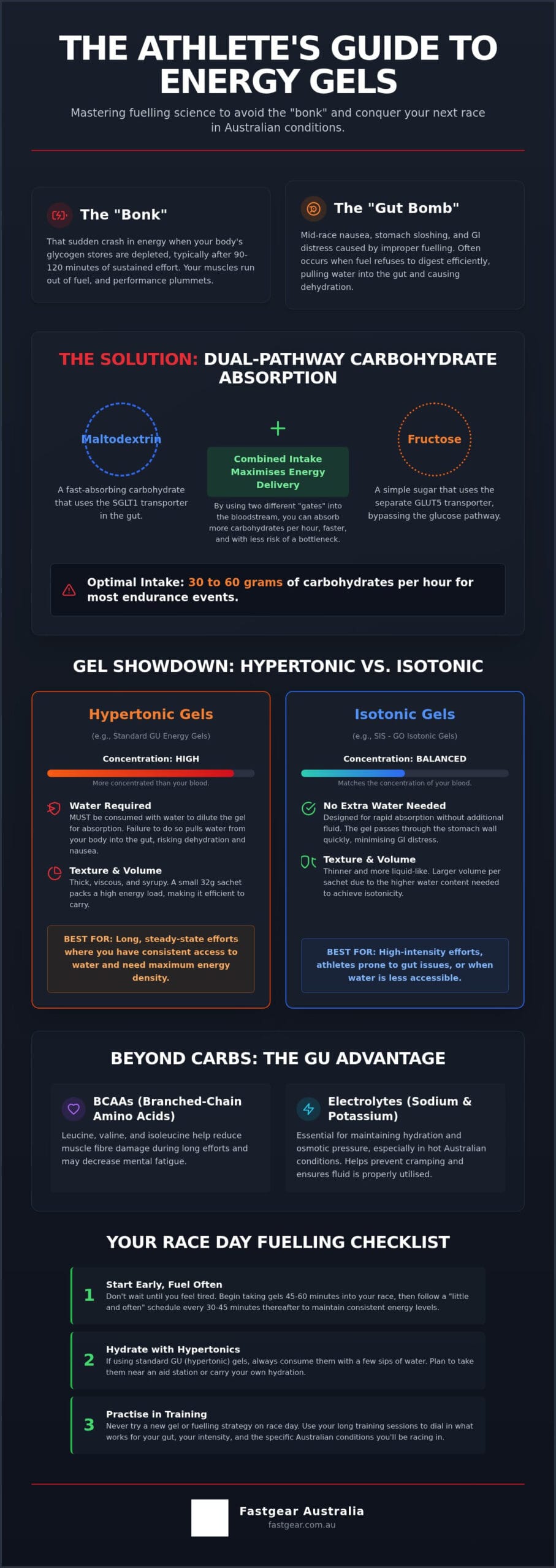
Endurance performance relies on a delicate balance of intensity and fuel delivery. What are energy gels? At their core, they are highly concentrated carbohydrate sources designed to bypass slow digestion and enter the bloodstream rapidly. This GU energy gel guide breaks down why these sachets are the gold standard for Aussie triathletes and runners. GU uses a precision-engineered dual-pathway blend of maltodextrin and fructose. This combination is critical because your body uses different transporters to absorb these sugars. By using both, you can process more fuel per hour than with glucose alone. It’s about maximising gastric emptying and avoiding the bottleneck that leads to nausea.
The distinction between standard gels and isotonic options is a matter of tonicity. GU gels are hypertonic. This means they have a higher concentration of solutes than human blood. To digest them effectively without a “gut bomb,” you must consume them with water. This process dilutes the gel in the stomach, allowing it to pass into the small intestine. Failing to drink enough water causes the body to pull fluid from the bloodstream into the gut. This leads to dehydration and that dreaded sloshing sensation mid-race.
The Role of Carbohydrates in Performance
Your body stores limited glycogen in the muscles and liver. For most athletes, these stores deplete after roughly 90 to 120 minutes of sustained effort. This depletion is what causes “the bonk” or hitting the wall. GU gels provide an immediate blood glucose spike to preserve those internal stores. Research suggests an optimal intake of 30 to 60 grams of carbohydrates per hour for most endurance events. Maintaining this intake is essential for sustaining power output during the final kilometres of a marathon or the bike leg of a 70.3. It keeps your brain focused and your muscles firing.
BCAAs and Electrolytes: More Than Just Sugar
GU formulations distinguish themselves by including branched-chain amino acids (BCAAs). These include leucine, valine, and isoleucine. They serve as a functional tool to reduce muscle fibre damage during long efforts. In the harsh Australian climate, fluid balance is equally vital. Each gel contains sodium, the primary electrolyte lost in sweat. High humidity in Queensland or the dry heat of Western Australia accelerates salt loss. This often leads to cramping and decreased plasma volume. The electrolytes in GU help maintain osmotic pressure. This ensures the water you drink actually stays in your system rather than sitting in your stomach. It’s a technical approach to fuelling that prioritises muscle protection alongside raw energy delivery.
Isotonic vs. Hypertonic: Choosing the Right Gel for Your Gut
Successful fuelling depends on understanding tonicity. This technical term describes the concentration of dissolved particles in a solution compared to your blood. In the context of this GU energy gel guide, we categorise gels into two main types: hypertonic and isotonic. Standard GU Energy Gels are hypertonic. They contain a high concentration of carbohydrates and electrolytes in a small, 32g volume. This makes them incredibly efficient for carrying high energy loads, but it also dictates how your body processes them. Because they are more concentrated than your blood, they require external fluid to move through the stomach wall.
When you swallow a thick, hypertonic gel without enough water, your body must correct the concentration imbalance. It does this through osmosis, pulling water from your bloodstream into your stomach to dilute the gel. This “water draw” is a primary cause of mid-race nausea and the dreaded “gut bomb.” It dehydrates your system while leaving a heavy, sloshing sensation in your belly. Conversely, isotonic gels like SIS – GO Isotonic Gels have a lower concentration that matches your blood’s tonicity. They pass through the stomach almost immediately without needing extra water. The texture reflects this science. Hypertonic gels are viscous and syrupy, while isotonic options are thinner and more liquid-like.
When to Reach for an Isotonic Gel
Isotonic gels are your best tactical choice for high-intensity efforts where grabbing a cup of water is difficult. If you’re redlining in the final 10km of a marathon, your digestion slows significantly as blood flow prioritises your legs. A thinner, isotonic gel reduces the mechanical strain on your gut. It’s the safest option for athletes prone to GI distress or those racing in cooler conditions where they aren’t drinking as frequently. You can explore our full range of isotonic and hypertonic options to find the best fit for your next race.
Managing Hypertonic Gels Correctly
To use hypertonic gels like GU effectively, you must follow the golden rule: always consume them with roughly 200ml to 250ml of water. This creates a DIY isotonic solution in your stomach. Hypertonic gels are superior for ultra-distance events where space is at a premium and you need maximum carb density. You can identify these types by their physical profile. They are typically smaller sachets with a thick, honey-like consistency. Mastering this balance allows you to hit 60g to 90g of carbs per hour without risking a DNF due to stomach cramps. This GU energy gel guide recommends testing these different viscosities during your long training runs to see which texture your throat handles best at race pace.
Solving the “Gut Bomb”: Preventing GI Distress on Race Day
The “gut bomb” is the single biggest fear for Aussie endurance athletes. It starts as a subtle heaviness before evolving into full-blown nausea, cramping, or the urgent need for a mid-race portaloo. This GU energy gel guide identifies the primary culprit: reduced splanchnic blood flow. When you’re pushing hard during a marathon or a technical trail run, your body diverts up to 80% of its blood volume away from the digestive system to support working muscles. This physiological shift makes your gut significantly less efficient at processing concentrated sugar. If you force-feed a hypertonic gel without enough water, the fuel simply sits in your stomach, fermenting and causing distress.
Avoiding this requires a disciplined approach to osmolality. You must train your gut during your long Sunday runs just as rigorously as you train your legs. This process involves gradually increasing your carbohydrate intake per hour to adapt your digestive enzymes. By practicing your race-day fuelling protocol during training, you teach your body to maintain gastric emptying rates even under physical stress. It’s the difference between a smooth finish and a painful DNF.
Gastric Emptying and Performance
Gastric emptying is the speed at which food leaves your stomach and enters the small intestine for absorption. High-performance gels aim to “trick” the stomach into faster clearance by maintaining a specific concentration. While the dual-pathway carbohydrate blend in GU gels (maltodextrin and fructose) is designed for maximum uptake, high-fructose loads can be problematic for some. If you experience bloating, it may be due to fructose malabsorption. In these cases, alternating with a hydrogel like Maurten Gel 100, which encapsulates carbohydrates in a pH-sensitive biopolymer, can bypass the stomach and reduce the risk of irritation. Slow digestion is a performance killer. It leads to a calorie deficit that eventually causes you to hit the wall.
Caffeine Timing and Gut Sensitivity
Caffeine is a powerful ergogenic aid, but it’s also a known gastrointestinal stimulant. It increases gut motility, which can be a double-edged sword during a long race. To manage this, many athletes find success by alternating caffeinated and non-caffeinated GU gels throughout their event. This prevents a massive accumulation of caffeine that might trigger an unwanted bathroom stop. Deploying a high-caffeine gel during the final 45 minutes of a race provides a neurological surge to mask fatigue when glycogen stores are at their lowest. This strategic “caffeine spike” should be reserved for the final leg to ensure you cross the line with maximum mental clarity without compromising your stomach earlier in the day.
Mastering Your Fueling Strategy in Australian Conditions
Executing a precision fuelling strategy requires more than just carrying a handful of sachets. It’s about maintaining a steady state of glycogen availability without overloading your digestive capacity. This GU energy gel guide advocates for a “little and often” approach rather than bulk fuelling. Consuming an entire gel in one go can cause a sudden osmotic shift in your gut, leading to the distress we’ve previously discussed. Instead, aim to consume a single sachet over the course of several minutes or strictly every 35 to 45 minutes. For a marathon or the bike leg of a 70.3, a disciplined timeline is your best defence against the 30km wall.
Australian environmental factors play a massive role in how your body processes these nutrients. High humidity in regions like Queensland or the intense dry heat of Western Australia increases your sweat rate significantly. This affects your blood volume and, consequently, your gastric emptying speed. To maintain efficiency, many athletes combine gels with tailwind powder in their hydration bottles. This creates a baseline of liquid energy and electrolytes, allowing you to use gels as supplemental “top-ups” rather than your sole fuel source. You can shop our full endurance fuelling range to build your custom race-day kit.
The 60-90g Carbohydrate Target
Modern sports science suggests a target of 60 to 90 grams of carbohydrates per hour for sustained endurance efforts. A standard GU Energy Gel provides approximately 22 grams of carbohydrates. If you only take one sachet every 45 minutes, you’re only hitting roughly 29 grams per hour. This is a significant deficit. To reach the 60g threshold, you must increase your frequency or mix brands. Many Aussie racers find success by using GU for flavour variety and BCAAs, while incorporating a maurten gel 100 to hit higher carb densities without the extra volume. Finding your personal “sweet spot” is a matter of training data. Over-fuelling is just as dangerous as under-fuelling; exceeding your gut’s absorption limit will inevitably lead to a “gut bomb.”
Fueling for Heat and Humidity
Heat alters your fuelling requirements. When your core temperature rises, blood is diverted to the skin for cooling, further reducing the blood available for digestion. In these conditions, your water intake must increase to compensate for the hypertonic nature of standard gels. If you’re racing in the tropics, consider using extra electrolytes to maintain fluid balance. A practical tip for Aussie summer races: keep your gels in a cooler bag or out of direct sunlight before the start gun. A warm, syrupy gel is far less palatable at 30 degrees Celsius and can feel significantly more “sickly” during the late stages of a run. Success in the heat is a result of technical preparation and environmental adaptation.
Selecting the Best Gels and Gear for Your Next Race
Choosing the right fuel is only half the battle. This GU energy gel guide concludes with the practical execution: selecting your specific product mix and ensuring you can actually access it at 170 beats per minute. Your choice should reflect your gut’s tolerance and your target carbohydrate intake. While GU remains the industry standard for flavour variety and muscle-protecting BCAAs, high-performance racing often requires a multi-brand approach. Mixing textures and absorption rates prevents flavour fatigue and ensures your digestive system stays active throughout the event.
Fastgear Australia stocks a technical range of endurance fuel designed for every stage of your race. GU Energy Gels are the versatile choice, offering a dual-pathway carbohydrate blend and varying caffeine levels to suit your strategy. For those hitting the 90g per hour threshold, maurten gel 100 is the premium “Hydrogel” alternative. It uses a biopolymer to encapsulate high concentrations of carbohydrates, allowing them to pass through the stomach without irritation. If you struggle with the thick texture of hypertonic gels or find it difficult to drink at aid stations, SIS – GO Isotonic Gels provide a pre-diluted, “no-water” solution. For a tactical change in texture, Clif – BLOKS Energy Chews offer a solid alternative that feels more like food during the middle miles of an ultra.
Organising Your Race-Day Kit
Efficiency in transit is just as important as the fuel itself. The Compressport Free Belt Pro is a technical essential for carrying your nutrition kit. It’s designed to hold 6+ gels, a phone, and even a soft flask without any bounce or friction. Before race morning, create a “flat lay” checklist to ensure your caffeine timing is correct. Mark your gels with the intended race time or kilometre marker using a permanent marker. This allows you to stick to your protocol without thinking. Practical tip: if you’re racing in the cold or have sweaty hands, slightly pre-tear the top of your gel sachets to make opening them effortless. Managing these small technical details ensures you stay focused on your pace rather than struggling with packaging. High-performance gear and precision fuel are the tools you need to smash your next Aussie PB.
Execute Your Race-Day Fuelling with Precision
Mastering your endurance nutrition is the final piece of the performance puzzle. You now understand that avoiding the dreaded “gut bomb” requires a technical approach to tonicity and a disciplined “little and often” intake strategy. By applying the protocols in this GU energy gel guide, you’ve moved beyond guesswork to a science-based plan that prioritises rapid absorption and muscle protection. Whether you’re navigating the humidity of a Queensland summer or the intense dry heat of a Western Australian trail, your success depends on having the right fuel and the technical gear to carry it.
Fastgear Australia is your dedicated performance partner. We are official stockists of world-leading brands including Maurten, SIS, and GU, with every product expertly selected for harsh Australian endurance conditions. Shop our curated range of performance-tested energy gels at Fastgear Australia and take advantage of free shipping on qualifying orders across the country. Don’t leave your next PB to chance. Lock in your fuelling strategy, trust your training, and prepare to smash your goals on race day.
Frequently Asked Questions
Do I really need to drink water with GU energy gels?
Yes, you must consume water with standard GU gels to facilitate absorption. Because GU is a hypertonic solution, it’s more concentrated than your blood. Drinking roughly 200ml to 250ml of water dilutes the gel in your stomach, preventing the “water draw” effect that causes GI distress. This GU energy gel guide recommends avoiding sports drinks when taking a gel, as the combined sugar concentration can overwhelm your gut.
How many GU gels should I take per hour during a marathon?
Aim for two to three gels per hour to hit a target of 45g to 66g of carbohydrates. This frequency ensures a steady supply of glucose without overloading your digestive system. Your specific needs depend on your body weight and race intensity. Always test your hourly intake during long training runs to find your personal absorption limit before race day.
What is the difference between an isotonic gel and a standard gel?
Tonicity is the primary difference. Isotonic gels have the same salt and sugar concentration as your blood, allowing them to pass through the stomach without extra water. Standard gels are hypertonic, meaning they are highly concentrated and require water for digestion. Isotonic options are thinner and easier to swallow at high heart rates, while standard gels provide more carbohydrates in a smaller sachet.
Are GU energy gels vegan and gluten-free?
Most GU Energy Gel flavours are vegan and all are gluten-free. They utilise a blend of maltodextrin and fructose rather than animal-derived sugars. While the majority of the range is plant-based, always check the specific ingredient list on the sachet for any limited-edition flavours. This makes them a reliable choice for Aussie athletes with specific dietary requirements or sensitive systems.
When should I take a caffeine gel during a race?
Deploy caffeine gels strategically during the first 15 minutes for a mental “wake up” or in the final 45 minutes to mask late-stage fatigue. Caffeine takes about 45 to 60 minutes to reach peak levels in your bloodstream. Avoid taking them back-to-back if you have a sensitive stomach, as caffeine can increase gut motility and lead to unwanted bathroom stops mid-race.
How long does it take for an energy gel to kick in?
You’ll typically feel the energy spike within 5 to 15 minutes of consumption. The simple sugars are absorbed rapidly through the small intestine and enter the bloodstream as glucose. The mental boost from the carbohydrates often hits even faster due to receptors in the mouth signalling the brain that fuel is on the way. Caffeine takes slightly longer to reach its full ergogenic effect.
Can I take too many energy gels during an Ironman?
Yes, exceeding your gut’s absorption capacity will lead to a “gut bomb” and potential DNF. Most athletes can process 60g to 90g of carbohydrates per hour. Taking more than this often results in malabsorption, where the sugar sits in your stomach and ferments. Use this GU energy gel guide to balance your intake with electrolytes and plain water to maintain gastric emptying over 10+ hours of racing.
Do energy gels expire or go bad in the heat?
GU gels have a “best by” date typically 12 to 18 months from the date of manufacture. While they don’t “go bad” in a way that makes them dangerous immediately after this date, the texture and flavour may degrade. Extreme Australian heat won’t spoil the gel instantly, but prolonged exposure to high temperatures can thin the consistency and affect the potency of certain ingredients like BCAAs.
