
Uncategorized
Swimming Goggles Australia: The 2026 High-Performance Buyer’s Guide
Aug
What if your vision is the only thing holding back your split times? In the high-stakes world of competitive swimming and triathlon, a leaking seal or a fogged lens isn’t just an annoyance; it’s a technical failure that compromises your hydrodynamics and mental focus. Finding the right swimming goggles Australia wide means moving beyond the bargain bin and into the realm of elite sports science. Whether you’re navigating the chop of an open-water race or grinding through a high-intensity pool set, your eyewear must function as a seamless extension of your performance kit.
We understand the frustration of stopping mid-set to clear a fogged lens or dealing with the stinging fatigue of sun glare during a sunrise ocean swim. You shouldn’t have to fight your gear while you’re fighting for a podium finish. This 2026 high-performance guide promises to help you master technical specifications, from ISO 18527-3:2020 lens tint categories to the latest anti-leak frame designs. We’ll break down the essential features of racing and open-water models, help you meet safety recommendations for intraocular pressure, and ensure you select the exact optics needed to optimise your performance in every lane and shoreline.
Key Takeaways
- Identify why precision-engineered optics are critical for managing extreme UV and high-glare conditions in the Australian sun.
- Select the right lens technology for your session, from mirrored lenses for outdoor pools to polarised optics for open-water sighting.
- Master the two-step pro fit guide to ensure a leak-proof seal during high-intensity sets and explosive dive starts.
- Find the best swimming goggles Australia provides for balancing long-course comfort with streamlined racing performance.
- Learn how to integrate your swim eyewear with your total endurance kit, including race-day nutrition and anti-chafe protection.
Why Technical Swimming Goggles Matter in Australia
Performance goggles aren’t just pool accessories; they’re precision-engineered optics designed for high-intensity athletic training. For athletes searching for swimming goggles Australia wide, the choice often dictates the success of a session. While recreational swimmers might tolerate a minor leak, serious competitors know that gear failure is a non-negotiable setback. Modern eyewear has evolved significantly. Looking back at the history of swimming goggles, the shift from primitive protective cups to today’s hydrodynamic polycarbonate lenses reflects a dedication to physical optimisation and technical clarity.
Australia presents a unique set of environmental challenges that demand more from your equipment. Extreme UV levels and high-glare environments are the norm, not the exception. Standard leisure goggles simply aren’t built to manage the intensity of the Australian sun or the rigours of a 5,000-metre squad set. High-performance gear acts as a technical extension of your kit, providing a psychological edge when you’re sighting a buoy in crowded open water or pushing through the final lap of a PB attempt. When your vision is clear, your focus remains on your stroke rhythm and power output.
The Cost of Poor Visibility
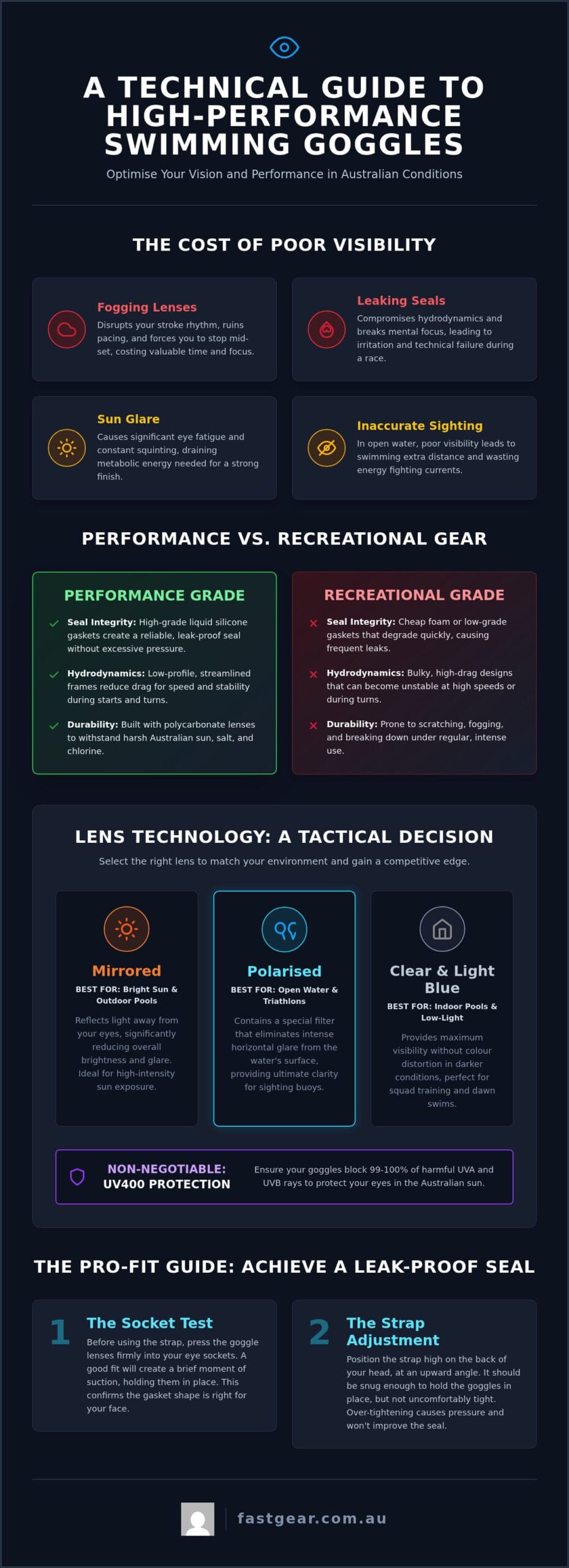
Fogging is the primary enemy of the endurance swimmer. It disrupts your stroke rhythm, forces frequent breaks, and ruins your pacing. In open water, poor visibility isn’t just a nuisance; it’s a safety risk. Inaccurate sighting leads to extra distance covered and wasted energy fighting currents. Constant squinting against surface glare causes significant eye fatigue, which can drain the metabolic energy you need for a strong finish. Technical lenses with anti-fog coatings and specific tint categories are essential for maintaining a sharp visual field throughout your race.
Performance vs. Leisure Gear
The difference between elite gear and bargain-bin alternatives lies in the materials and construction. High-performance goggles prioritise reliability and speed:
- Seal Integrity: Elite models use high-grade liquid silicone gaskets that provide a secure, leak-proof seal without excessive pressure. Cheap foam gaskets degrade quickly in salt water and chlorinated pools.
- Hydrodynamics: Low-profile frames reduce drag and remain stable during explosive dive starts and aggressive tumble turns.
- Durability: Technical gear is built to withstand harsh Australian conditions. This reliability ensures your equipment survives the transition from the pool to the surf.
Serious athletes treat their eyewear with the same respect as their nutrition strategy. Just as you’d rely on Maurten or Tailwind for fuel, or a Mugiro Neck Protector to prevent wetsuit chafing, your goggles must be a dependable component of your race-day preparation. Investing in quality optics means you spend less time adjusting your straps and more time hitting your splits.
Lens Technology: Choosing the Right Colour for Your Session
Your lens choice is a tactical decision. In the high-intensity light environment that users of swimming goggles Australia wide must manage, the wrong tint leads to squinting, eye fatigue, and missed sighting buoys. Performance optics are categorised by how they manage light transmission. Mirrored lenses are the gold standard for outdoor pool sessions. They reflect light away from the eyes, significantly reducing brightness. For indoor squad training or low-light dawn sessions, clear or light blue lenses provide maximum visibility without distorting your perception of the pool floor.
UV protection is non-negotiable. Quality goggles must offer UV400 protection to block 99% to 100% of active UV rays. Beyond sun protection, effective eyewear acts as a barrier against environmental irritants. Expert Summer Eye Safety Tips for Swimmers highlight that goggles are essential for preventing chemical irritation and bacterial infections. This protection allows you to focus entirely on your stroke mechanics rather than eye discomfort.
Polarised vs. Mirrored: The Great Debate
Understanding the technical difference between polarised and mirrored lenses is vital for race-day success. Polarised lenses contain a special filter that blocks intense reflected light, specifically horizontal waves bouncing off the water surface. This makes them the ultimate tool for open-water sighting. Mirrored lenses, while excellent at reducing overall brightness, do not filter glare in the same way. In a triathlon context, use polarised lenses for the swim leg to spot markers through the chop, and reserve mirrored lenses for high-glare pool sessions where direct overhead sun is the primary challenge.
Anti-Fog Coatings and Maintenance
Modern anti-fog technology relies on a hydrophilic coating that prevents water droplets from clustering. This layer is delicate. Never rub the inside of your lenses with your fingers or a towel; this creates micro-scratches and strips the coating. To extend the life of your gear, rinse your goggles in fresh, cold water after every session and allow them to air dry in the shade. When you notice persistent clouding that doesn’t clear with a simple rinse, it’s a sign the coating has failed and it’s time for a replacement. You can find technical gear and high-performance replacements at Fastgear to keep your vision sharp.
Matching your lens to the light conditions is a hallmark of a serious athlete. Whether you’re grinding out kilometres in a 50-metre outdoor pool or navigating a coastal swell, the right optics ensure your training remains uninterrupted by environmental factors. Invest in the right technology to keep your focus on the finish line.
Roundup: Best Goggles for Open Water, Pool, and Triathlon
Selecting the right pair of swimming goggles Australia offers depends entirely on your specific training environment. A goggle that excels in the controlled lanes of a 50-metre pool may fail you in the unpredictable chop of a coastal swim. High-performance athletes often maintain a “goggle kit” with different models for specific sessions. Whether you are chasing a PB in the squad or navigating a mass-start triathlon, your eyewear must match the technical demands of the discipline.
Triathlon-specific goggles prioritise a balance between long-course comfort and wide-angle sighting. In a race start, peripheral vision is your greatest asset. It allows you to track competitors and avoid collisions without breaking your stroke. For those who find traditional gaskets restrictive, mask-style goggles offer an increased surface area. These provide exceptional visibility and reduced pressure on the eye sockets, making them a popular choice for beginners or long-distance endurance sessions where comfort is paramount. Your goggles are just one piece of the puzzle; understanding how they fit within your broader triathlon race day essentials Australia athletes rely on can make the difference between a podium finish and a mid-pack result.
Competitive pool swimmers generally opt for racing “Swedes” or low-profile goggles. These designs are stripped of excess bulk to minimise drag. They sit closer to the eye, ensuring they stay secure during explosive dive starts and high-speed tumble turns. When you are deep into a high-intensity set, you need gear that doesn’t shift or leak under pressure.
The Open Water Specialist
Open water demands gear that can handle the elements. Look for oversized lenses and soft, high-grade silicone gaskets. These features provide the wide field of view necessary for effective sighting of buoys and landmarks. To truly optimise your open-water setup, consider pairing your goggles with a Mugiro – Neck Protector. This prevents the salt-water chafing often caused by wetsuit collars, allowing you to maintain a high head position for sighting without discomfort. Reliability in the ocean comes from gear that works together to protect your focus.
The Pool Performance Kit
Squad training is about precision and repetition. Pool-focused goggles often feature interchangeable nose bridges. This allows for a customised, narrow fit that matches the exact distance between your eyes. A perfect fit is the only way to ensure a zero-leak experience during 100-metre sprints. Maintaining focus in a crowded squad lane requires confidence in your equipment. When your goggles are locked in, you can concentrate on your catch and pull rather than clearing water from your lenses. High-performance swimming goggles Australia wide are built to endure the daily grind of chlorinated training and the pressure of race day.
The Pro Fit Guide: Ensuring a Leak-Proof Seal
A high-performance lens is useless if the seal fails during a dive start or a heavy set. Achieving a technical fit is the difference between a focused session and a frustrating one. When searching for swimming goggles Australia athletes often overlook the mechanics of the seal. Fit is highly individual; what works for your squad mate might not suit the unique contours of your face. Follow this methodical four-step process to ensure your gear remains watertight under pressure.
Step 1: The Suction Test. Before touching the strap, press the goggle lenses firmly against your eye sockets. If the gaskets provide a correct anatomical match, they should stick to your face for a second or two through suction alone. If they fall off immediately, the frame shape doesn’t match your bone structure. Step 2: Nose Bridge Adjustment. The gap between your eyes is critical. If the bridge is too wide, the seals will gap at the inner corners. If it’s too narrow, the lenses will pinch. Step 3: Strap Placement. Position the strap high on the crown of your head at a 45-degree angle. This pulls the lenses up and back into the socket rather than just squashing them against your face. Step 4: Seal Integrity. Once the strap is on, run your finger around the gasket. Check for any bunching or gaps near the temples where water is most likely to ingress during a turn.
Common Fitting Mistakes
Overtightening is the most frequent error. Athletes often crank the strap to compensate for a poor seal, which actually distorts the gasket and causes leaks. It also leads to headaches and “raccoon eyes”. Don’t ignore the nose piece; it is the foundation of the fit. Always test your goggles with your swimming cap on. A cap changes the profile of your temples and can shift the position of the straps, potentially breaking the seal mid-race. Investing in high-quality swimming goggles Australia residents can rely on means understanding that a secure fit is a technical requirement, not a luxury.
Managing Chafing and Pressure
Ultra-distance sessions and long open-water swims increase the risk of pressure sores and skin irritation. If you find your goggle fit is causing discomfort, it might be linked to your overall posture and kit setup. For triathletes, neck irritation from a wetsuit often leads to head-position changes that compromise goggle stability. Using a Mugiro – Neck Protector helps maintain a consistent head angle by eliminating collar friction. For the best results, ensure your skin is prepped with anti-chafe solutions before any session exceeding 60 minutes. You can shop the full range of performance accessories at Fastgear to refine your setup.
Optimise Your Swim with Fastgear’s Elite Range
Fastgear Australia focuses on race-day reliability. We don’t stock every item on the market; we curate a specific selection for athletes who demand peak efficiency. When you source swimming goggles Australia through our platform, you’re accessing gear tested for the rigours of high-level training. Our technical focus ensures you only invest in equipment that serves a functional purpose in your kit. We understand that for serious endurance athletes, every piece of gear must justify its place in the gear bag.
Efficiency extends beyond your eyewear. Integrating your swim sessions with a precise nutrition strategy is vital for maintaining power in the water. We support your endurance goals by providing direct access to world-leading fuel like maurten 320 powder and tailwind powder. Whether it’s a pre-dawn squad set or a coastal marathon swim, your gear and your fuel must work in tandem. Having your nutrition and equipment sorted in one place allows you to focus on the only thing that matters: the work in the lane.
Complete Your Race-Day Kit
A successful race day requires a holistic approach. Pair your technical goggles with high-performance swim caps to minimise drag and manage thermoregulation. Fueling starts before you hit the water. Using SIS – GO Isotonic Gels or GU Energy Gel ensures your glycogen levels are topped up for the opening sprint. Post-swim recovery is equally critical. Utilising hydration powders and electrolytes helps replace the fluids lost through sweat, even in the pool. This integrated approach ensures you back up every session with the same intensity.
The Fastgear Advantage
We are more than a retailer; we are a dedicated performance partner. Our team consists of athletes who understand the unique demands of the Australian terrain and climate. This expertise allows us to provide professional advice on everything from goggle lens tints to the ergonomics of the Wove M8 Road / Tri Saddle. We offer reliable national shipping across Australia, providing a streamlined shopping experience for all your triathlon essentials. You get direct access to premium brands like Compressport and Wove without the hassle of international logistics.
Stop settling for gear that fails under pressure. Take control of your performance with equipment designed for serious endurance pursuits. Experience the difference that professional-grade curation makes to your split times and comfort levels. Upgrade your swim kit at Fastgear Australia today.
Master Every Lane and Shoreline
Technical clarity is the foundation of every successful session. By mastering lens selection for high-glare environments and ensuring a precision fit through methodical testing, you eliminate the gear-related distractions that stall your progress. Elite performance isn’t about luck; it’s about the deliberate choice of equipment that matches your athletic ambition. You’ve learned how to identify the right optics and how to secure a leak-proof seal that holds up during explosive starts.
When you select the best swimming goggles Australia provides, you’re investing in race-day reliability. Fastgear provides a curated range specialised for endurance athletes, backed by expert performance advice from those who understand the rigours of the water. With fast national Australian shipping, your high-performance kit is always within reach. Trust your optics, refine your technique, and commit to the grind. We’re here to ensure your gear never holds you back from your potential.
Shop the curated swimming range at Fastgear Australia
Your next personal best starts with a clear field of vision. See you at the starting blocks.
Frequently Asked Questions
How do I stop my swimming goggles from fogging up during a session?
Maintain the integrity of the internal hydrophilic coating by never touching the inside of the lens with your fingers. This delicate layer is designed to prevent water droplets from clustering and clouding your vision. Rinse your gear in cold, fresh water after every squad session to remove chlorine or salt. If the factory coating has degraded, apply a technical anti-fog spray before your next set to restore clarity and maintain your training rhythm.
Are polarised lenses worth it for open water swimming in Australia?
Polarised lenses are essential for any serious open water athlete managing the intense glare of the Australian sun. These lenses contain a specific filter that blocks horizontal light waves reflecting off the water surface. This technology allows you to sight buoys and track competitors with precision without squinting. When choosing swimming goggles Australia athletes should prioritise polarised optics for coastal races to reduce eye fatigue and improve sighting accuracy during the swim leg.
How tight should my swimming goggles actually be?
Your goggles should be tight enough to create a waterproof seal without causing discomfort or deep skin indentations. Rely on the anatomical suction of the silicone gaskets rather than excessive strap tension. If you have to overtighten the strap to stop leaks, the frame shape is likely a poor match for your bone structure. Aim for a snug fit that remains stable during dive starts but doesn’t trigger “raccoon eyes” after a long set.
What is the difference between mirrored and tinted lenses?
Mirrored lenses feature an outer coating that reflects light away from the eyes, making them the gold standard for bright, outdoor pool sessions. Tinted lenses, such as smoke or blue, reduce overall brightness without the same level of reflection. Use mirrored lenses for high-glare midday sessions to maximise comfort. Tinted lenses are often more versatile for indoor training or overcast days where you need a balance of light reduction and natural clarity.
Can I use my pool goggles for a triathlon in the ocean?
You can use pool goggles for a triathlon, but they often lack the wide field of view necessary for effective sighting in the surf. Pool-specific racing models are designed for streamline and speed in a controlled lane. Open water goggles typically feature larger lenses and softer gaskets for better peripheral vision and comfort during a mass start. If you are serious about your split times, invest in a dedicated open water pair for race day.
How often should I replace my performance swimming goggles?
Replace your goggles every four to six months if you are training three or more times a week. Over time, chlorine and salt water degrade the silicone seals and strip the internal anti-fog coatings. Once the gaskets lose their elasticity or the lenses become permanently cloudy, your performance will suffer. Always keep a fresh pair in your kit bag for race day to ensure your vision remains crystal clear when it matters most.
How do I find the right size goggles for my face shape?
Perform the suction test by pressing the lenses against your eye sockets without using the strap. A correct fit will hold for a few seconds through suction alone. Ensure the nose bridge doesn’t pinch and the frame doesn’t sit too close to the outer corners of your eyes. For children, Glaucoma Australia recommends an internal horizontal width greater than 55mm to avoid increased eye pressure. Finding the right swimming goggles Australia wide requires testing for these specific anatomical markers.
Should I wear my goggles under or over my swimming cap?
Wear your goggles under your swimming cap for racing and over the cap for casual training sets. Placing the straps underneath the cap provides extra security during dive starts and prevents them from being knocked off in a crowded triathlon swim. For daily squad sessions, wearing them over the cap is more convenient for quick adjustments. Most elite swimmers use the “under” method during competition to ensure their gear remains perfectly streamlined and secure.
