
Uncategorized
Carbohydrate Gels: The Ultimate Cycling Fuelling Guide
Aug
The difference between a personal best and a miserable DNF often has nothing to do with your legs and everything to do with your gut. You’ve likely felt that hollow sensation in your quads when your glycogen stores bottom out, commonly known as the bonk. It’s a frustrating reality for endurance athletes who train with discipline but struggle to select the right carbohydrate gels for cycling. You already know that hitting the wall isn’t just a mental hurdle; it’s a physiological failure that occurs when your fuelling strategy fails to match your metabolic demand.
You don’t have to settle for debilitating stomach cramps or fading power in the final hour. This guide helps you master the science of on-bike nutrition to ensure you maintain peak output for rides exceeding three hours. We’ll cut through the confusing technical jargon surrounding glucose-to-fructose ratios and gastric emptying to help you build a gut-friendly plan. You’ll learn how to distinguish between advanced hydrogel technology, isotonic formulas, and steady-state energy sources. We are breaking down exactly which gel technology suits your specific intensity so you can ride with total confidence.
Key Takeaways
- Identify the 90-minute physiological limit of glycogen storage to prevent the bonk before it starts.
- Select the right carbohydrate gels for cycling by understanding the specific absorption mechanics of isotonic, hydrogel, and dual-source formulations.
- Implement a proactive fuelling schedule that adapts to your specific race duration, from high-intensity criteriums to endurance-focused gran fondos.
- Master gut management techniques to maintain nutrient absorption and performance during high-temperature Australian racing conditions.
- Optimise your power output by matching professional-grade fuel technologies to your individual digestive tolerance and intensity levels.
The Science of Carbohydrate Gels for Cycling Performance
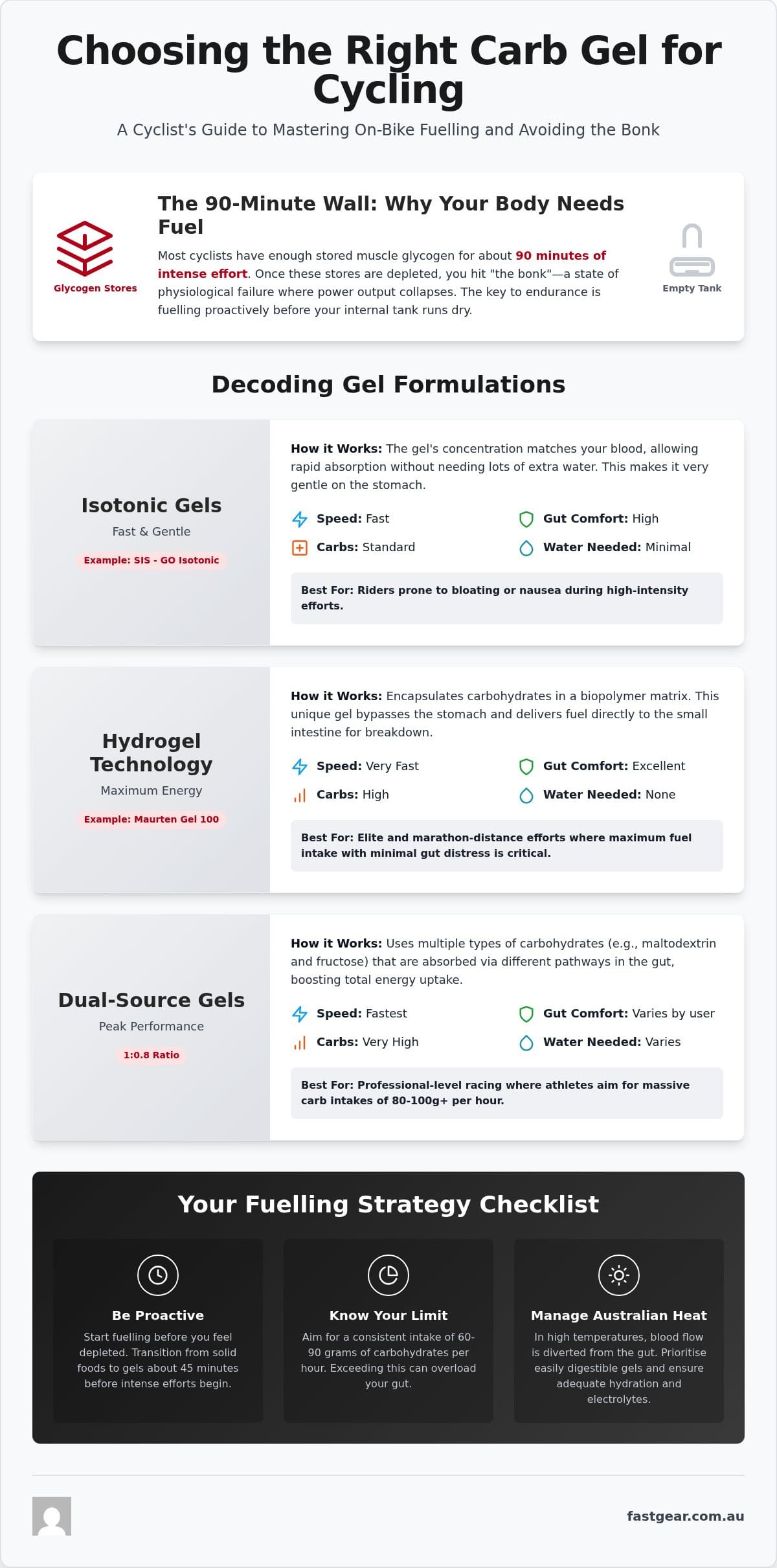
Energy is your most valuable resource on the bike. Performance drops the moment your internal tank runs dry. What are energy gels? These products are highly concentrated carbohydrate solutions engineered to bypass complex digestion. They provide a rapid influx of glucose or fructose directly into the bloodstream. This delivery mechanism is vital because your body has a hard physiological limit for glycogen storage. Most athletes carry enough fuel for roughly 90 minutes of high-intensity effort before the reservoir hits empty.
Running out of glycogen leads to the bonk, a state of clinical hypoglycaemia. Your power output collapses. Your focus wavers. Decisions that should be instinctive become difficult. To avoid this, you must utilise exogenous carbohydrate oxidation. This involves consuming fuel during the ride to spare your internal muscle glycogen. By using carbohydrate gels for cycling, you provide the muscles with a steady stream of external energy. This strategy extends your endurance far beyond your natural capacity.
Why Real Food Isn’t Always Enough
Solid food has its place on long, steady rides, but it often fails when the pace intensifies. Digestion requires significant blood flow. When you’re climbing or sprinting, your body shunts blood away from the gut and toward the working muscles. This shift makes it nearly impossible to process solids, which can lead to bloating or nausea. Gels require minimal breakdown and exit the stomach quickly. They are the superior choice for high-intensity segments. You should transition from solid snacks to gels about 45 minutes before the most demanding part of your session.
If you are searching for a bridge between whole foods and advanced sports science, you can visit Mānuka Performance to discover how they utilise natural ingredients in their performance-led nutrition.
Glycogen Depletion and the Performance Ceiling
Your gut can only process a certain amount of energy at once. Most cyclists are limited by the rate at which glucose can be transported from the intestine into the blood. Consuming excessive fuel won’t make you faster. Instead, it will sit in your stomach and cause distress. Blood sugar stability is essential for maintaining a high power output. The physiological ceiling for carbohydrate absorption typically sits between 60 and 90 grams per hour, depending on the specific sugar ratios used. Staying within this window ensures consistent energy delivery without overloading your digestive system.
Decoding Gel Formulations: Isotonic vs. Hydrogel vs. Dual-Source
Selecting the right carbohydrate gels for cycling requires looking past flavours and focusing on the delivery system. The efficacy of a gel depends largely on its osmolality, which is the concentration of particles in the solution. If the concentration is too high, water is drawn from your body into the gut, causing the dreaded “stomach slosh” and significant GI distress. To combat this, modern formulations use specific glucose-to-fructose ratios, typically 2:1 or the newer 1:0.8. These multi-transportable carbohydrates use different pathways in the intestine, allowing you to absorb more energy than glucose alone could provide. Sodium also plays a critical role here, as it actively facilitates the transport of glucose across the gut wall into your bloodstream.
Isotonic Gels: Fuelling Without Extra Water
Isotonicity refers to a solution that has the same concentration as your blood. This means the gel can be absorbed quickly without requiring you to drink large volumes of water simultaneously. SIS – GO Isotonic Gels are the benchmark in this category. They use a specific maltodextrin structure that is thin enough to swallow easily while remaining gentle on the stomach. If you’re a rider who frequently suffers from bloating or nausea during high-intensity intervals, these are your most reliable tool.
Hydrogel Technology: The Maurten Revolution
Maurten changed the landscape of endurance nutrition by introducing hydrogel technology. Standard gels release their contents immediately in the stomach, but maurten gel 100 encapsulates the carbohydrates in a biopolymer matrix. This pH-sensitive gel only breaks down once it reaches the small intestine. This bypasses the stomach entirely, reducing the risk of irritation and allowing for much higher carbohydrate concentrations. It’s the primary choice for elite professionals tackling marathon-distance efforts where every gram of fuel counts.
Dual-Source and High-Carb Gels
The latest trend in professional cycling is the move toward massive carbohydrate intakes, often reaching 80-100g per hour. Achieving this without a total gut shutdown requires dual-source technology. By shifting the ratio to 1:0.8 (maltodextrin to fructose), researchers found that carbohydrate oxidation rates increase significantly compared to the traditional 2:1 ratio. High-density options leverage this science to provide maximum energy in a single serving. You can test these advanced formulas by grabbing single servings to see how your gut responds under load.
Strategy on the Saddle: When and How to Fuel
Hunger is a lagging indicator. If you wait until your stomach rumbles or your power fades to reach for your jersey pocket, you’ve already lost the battle. Effective use of carbohydrate gels for cycling requires a disciplined, proactive approach that begins long before the first significant climb. Your body takes time to process nutrients; even the fastest-absorbing gels need a lead time to reach your bloodstream and muscles. A reactive strategy leads to a physiological deficit that is nearly impossible to recover from mid-ride. You must fuel for the work you are about to do, not the work you have already finished.
The requirements for a high-intensity 60-minute criterium differ vastly from a 160km gran fondo. For short, explosive efforts, your primary focus is on high blood-glucose levels from the gun. You might only need a single gel taken 15 minutes before the start. In contrast, endurance events demand a sustained, methodical intake to preserve glycogen stores for the final hour. Precision in your timing is the difference between a podium finish and a mid-pack struggle. By starting your fuelling plan early, you keep the metabolic machinery primed and prevent the catastrophic drop in blood sugar that leads to the bonk.
The 20-Minute Rule: A Pro-Level Schedule
Professional riders don’t eat when they’re hungry. They eat by the clock. To maintain a steady state of energy, follow this three-step protocol:
- Start early: Consume your first dose within the initial 20 to 30 minutes of your ride. This prevents your blood glucose from dipping as your body transitions into high-intensity metabolism.
- Micro-dosing: Aim for small, frequent intakes rather than one large bolus. Taking a portion of a gel every 20 minutes is often better for gut absorption and blood sugar stability than a massive intake every hour.
- Focus on grams: Stop counting “gels” and start tracking total grams of carbohydrate per hour. Most serious competitors aim for 60 to 90 grams to maintain peak power.
Intensity-Based Fuelling
Your fuelling rate must mirror your power output. During low-intensity recovery blocks or long descents, your energy demand drops. Over-fuelling during these periods can lead to gastric distress as gut motility slows down. Conversely, when your heart rate enters Zone 4 or 5, your reliance on carbohydrates skyrockets. This is when you need the most efficient delivery systems to bypass the gut quickly.
Strategic use of caffeine provides a significant cognitive and physical edge during the final stages of a race. Products like maurten gel 100 caffein are engineered for these critical moments. Caffeine reduces the perception of effort and can help mobilise fatty acids, but it takes roughly 45 to 60 minutes to reach peak levels in your system. Time your final caffeine gel to hit your system just before the decisive move or the final climb of the day.
Managing the Australian Heat: Gut Comfort and Electrolytes
Endurance racing in the Australian summer presents a brutal physiological challenge. High ambient temperatures and humidity levels accelerate fluid loss and elevate your core temperature. This combination forces your body to prioritise skin-surface cooling over digestive function. As dehydration sets in, blood volume drops and gut motility slows down. Nutrient malabsorption becomes a genuine risk when the mercury climbs. Successfully using carbohydrate gels for cycling in the heat requires a strategy that integrates fluid, salt, and sugar in perfect harmony to keep the system moving.
When your gut is under-perfused, it loses the ability to process high-density fuel. This leads to the sugar sitting in your stomach, drawing water out of your cells and causing nausea. You must stay ahead of the thirst curve. Dehydration is the primary trigger for most GI issues on the bike. By maintaining a steady intake of water alongside your fuel, you ensure that the osmolality in your stomach remains at a level the body can actually absorb. This proactive approach prevents the performance-killing bloating that often ruins long summer rides.
The Salt Factor: Preventing Cramps and Malabsorption
Sodium is the primary driver of carbohydrate absorption. The SGLT1 transporter in your small intestine requires sodium to move glucose molecules into your system. If your electrolyte levels drop, your fuelling efficiency collapses. Salty sweaters should look toward high-performance options like GU Energy Gel – Single to replace lost minerals. Integrating tailwind powder into your hydration routine further supports this process by providing a steady stream of electrolytes that facilitate gastric emptying. You must balance your gel intake with enough water to maintain a gut-friendly osmolality, preventing the dreaded “brick in the stomach” feeling.
Training Your Gut (Nutritional Periodisation)
Your gut is a highly adaptable organ. Just as you train your quads for the climb, you must train your digestive system for the load. Nutritional periodisation involves gradually exposing your gut to higher concentrations of sugar under exercise stress. Start by consuming 30 to 40 grams of carbs during your mid-week sessions. Gradually increase this by 10 grams every fortnight until you reach your target race-day intake. This physiological adaptation reduces the risk of mid-race distress and ensures your body is ready for peak output. Watch for early warning signs like upper-GI bloating or nausea. If these occur, sip plain water for 15 minutes to help clear the gut before resuming a lower dose of energy.
You can optimise your summer fuelling strategy by selecting the right combination of electrolyte-rich gels and powders from our curated range.
Professional-Grade Fuel: The Fastgear Selection
Fastgear Australia operates as a technical partner for the dedicated athlete. We don’t fill our shelves with every supplement on the market. We curate a specific range based on physiological efficacy and proven race-day results. Selecting the right carbohydrate gels for cycling is a matter of matching energy density to your metabolic threshold and gut tolerance. Your nutrition should be as performance-tuned as your drivetrain; just as you might check out Motorbull for high-tech engine protection, your body needs the right fuel technology to prevent internal wear and tear during intense efforts. We focus on providing the tools that elite competitors use to maintain power when the pace intensifies.
Maurten remains the primary choice for athletes seeking a clean, high-performance fuelling system. Its hydrogel technology provides a reliable way to ingest large amounts of energy without the typical GI distress. For those who prefer a lighter consistency, SIS – GO Isotonic Gels offer a versatile solution that doesn’t require additional water for absorption. It’s an ideal choice for beginners or those with sensitive stomachs. Meanwhile, GU Energy Gel – Single serves as a reliable staple for riders who need specific caffeine doses and a variety of flavour profiles to combat palate fatigue during endurance events.
When the pace is high and your heart rate is red-lined, you need fuel that enters the bloodstream with minimal effort. maurten gel 100 is the definitive choice for personal best attempts. It provides a concentrated carb source that feels light and digests quickly. For athletes pushing toward the 90g carb-per-hour limit, advanced dual-source gels are essential to maximise oxidation rates. If you prefer a solid texture during long-distance efforts, Clif – BLOKS Energy Chews provide a functional alternative that allows for precise, incremental fuelling without the mess of a liquid gel.
Steady-State and Gut-Friendly Options
For longer, steady-state sessions, blood sugar stability is the priority. ucan gels use specialized starch technology to provide a slow, consistent release of energy. This prevents the spikes and crashes often associated with simple sugar formulas. These are excellent for base-mile training or riders who are particularly sensitive to high-glucose products. GU Energy Gel – Single remains a versatile option for any rider due to its portability and wide compatibility with various hydration strategies. It’s a proven performer that fits easily into any jersey pocket or top-tube bag.
Organise your race-day nutrition with Fastgear’s premium gel range to ensure you have the right tools for your next milestone.
Fuel Your Next Milestone
Mastering your on-bike nutrition is a fundamental pillar of endurance performance. You now understand that avoiding the bonk requires a strategic approach to absorption and timing rather than reactive eating. By selecting the right carbohydrate gels for cycling, you bypass the physiological limits of your glycogen stores and maintain power throughout your most demanding efforts. Whether you deploy the advanced hydrogel technology of Maurten or the gut-friendly isotonic formulas from SIS, your choice must reflect your intensity and the specific demands of the Australian climate.
Fastgear Australia is an authorised retailer for world-leading brands including Maurten, SIS, and GU. Our range is expertly curated for the needs of Australian endurance athletes who face unique heat and humidity challenges. We provide fast national shipping to ensure your race-day essentials arrive before you hit the start line. Don’t leave your power output to chance by relying on suboptimal fuelling strategies.
Shop the full range of high-performance energy gels at Fastgear Australia and take control of your next ride with total confidence. Your next personal best is waiting.
Frequently Asked Questions
How many carbohydrate gels should I take per hour while cycling?
Aim for 60 to 90 grams of carbohydrates per hour for high-intensity efforts. Since most carbohydrate gels for cycling contain between 20 and 30 grams of sugar, this equates to two or three units every sixty minutes. You should monitor your total intake rather than just the number of packets. Consistent delivery ensures your blood glucose levels remain stable, preventing the performance drop associated with glycogen depletion during long-distance sessions.
Do I need to drink water with every energy gel?
You must consume water with standard concentrated gels to facilitate gastric emptying. Regular gels have high osmolality, meaning they require fluid to be drawn from your body into the gut for processing. If you don’t drink enough, you risk dehydration and stomach cramps. The exception is an isotonic formula, which is pre-mixed with the correct water ratio to allow for immediate absorption without the need for additional fluids from your bottle.
What is the difference between an isotonic gel and a regular energy gel?
The primary difference is the concentration of particles, known as osmolality. Isotonic gels, such as SIS – GO Isotonic Gels, have the same concentration as your blood, allowing them to pass through the stomach quickly without extra water. Regular energy gels are more concentrated and hypertonic, meaning they deliver more energy in a smaller volume but require external hydration to prevent GI distress. Choosing the right one depends on your gut sensitivity and hydration strategy.
Can I use running gels for cycling, or is there a difference?
You can certainly use running gels for cycling as the underlying physiology of energy absorption remains the same. The main differences are often found in the packaging and consistency. Cyclists have the advantage of jersey pockets, making it easier to carry larger, more liquid-based gels that runners might find too bulky. Both sports benefit from the same glucose-to-fructose ratios to maximise carbohydrate oxidation during sustained endurance efforts.
Why do some carbohydrate gels cause stomach cramps or nausea?
GI distress usually occurs when the rate of carbohydrate intake exceeds your gut’s ability to transport it into the bloodstream. This causes unabsorbed sugar to sit in the intestine, leading to fermentation and gas. Dehydration also slows down gut motility, making it harder to process fuel. Using advanced carbohydrate gels for cycling that feature hydrogel technology or dual-source ratios can significantly reduce these issues by utilising multiple transport pathways.
What are the best energy gels for long-distance endurance rides?
Long-distance rides require high-density fuelling that doesn’t cause palate fatigue or gut shutdown. maurten gel 100 is a top-tier choice because its hydrogel structure allows for high carb concentrations with minimal irritation. High-density powders like maurten 320 powder are also effective for pushing toward 90 grams per hour. For ultra-endurance events, mixing these with steady-state options like ucan gels helps maintain stable energy levels over six or more hours.
When should I use a caffeine gel during a race?
Strategic timing is critical because caffeine takes roughly 45 to 60 minutes to reach peak concentration in your bloodstream. You should consume a caffeine gel about an hour before the most demanding part of your race, such as a final climb or the finishing sprint. This reduces your perception of effort and provides a cognitive boost. Avoid taking caffeine too early in a long race to prevent a mid-event energy crash.
How do I “train my gut” to accept more carbohydrates during cycling?
Training your gut involves a methodical increase in carbohydrate intake during your weekly training rides. Start by consuming 30 to 40 grams per hour and increase this by 10 grams every fortnight. This process up-regulates the number of glucose transporters in your intestine, allowing you to process higher volumes of fuel on race day. Practice this strategy at race-pace intensity to ensure your digestive system is adapted to the stress of competition.
